
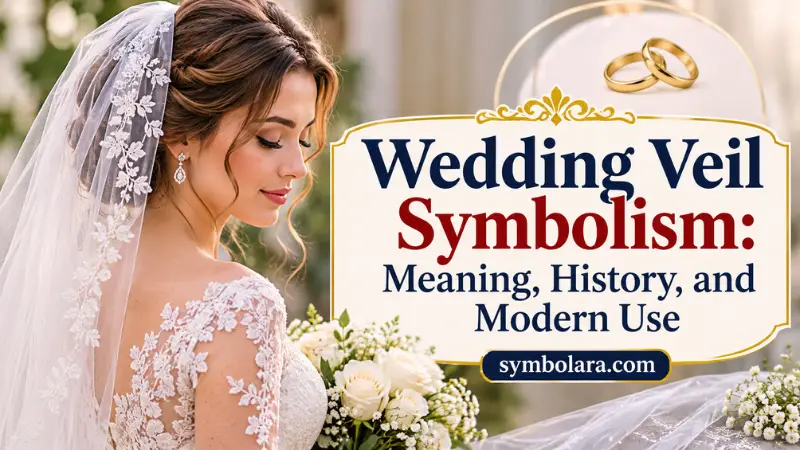
A wedding veil is a piece of fabric worn over or around the bride’s head, face, or hair. It can be a short net covering the eyes, a shoulder-length accessory, or a long train of sheer fabric flowing behind the wedding dress. Although it is often chosen to complete a bridal outfit, the veil also carries meanings connected to marriage, privacy, tradition, and personal identity.
The meaning behind this accessory is not the same for every couple. Some brides wear one because it represents modesty or a traditional approach to marriage. Others choose it for its connection to family customs, romantic style, or the visual beauty it adds to wedding photographs.
In American weddings, the veil can be a traditional bridal accessory or a personal fashion choice. Understanding its symbolism helps explain why some brides consider it an important part of their ceremony while others prefer to leave it out.
Quick Answer
Wedding veil symbolism most commonly represents purity, modesty, romantic commitment, and the transition into married life in modern American weddings. Its historical associations developed through different religious, cultural, and marriage customs, including traditions involving modesty, protection, and the ceremonial covering of the bride.
TL;DR
- Veils commonly represent modesty, purity, romance, and marriage.
- Ancient Mediterranean weddings included traditions of covering brides.
- White veils became closely associated with Western bridal fashion.
- American brides often use veils for tradition and personal expression.
- Face coverings can represent ceremony, anticipation, or family customs.
- Modern wedding styles include both traditional and unconventional veils.
What Does a Wedding Veil Look Like?
A traditional bridal veil is made from lightweight, semi-transparent fabric such as tulle, lace, silk, or fine netting. It is usually attached to a comb, headband, or decorative hairpiece and secured to the bride’s hairstyle.
The length and design can change its appearance considerably. Some veils cover only the face, while others extend several feet behind the wedding dress.
Common styles include:
- Birdcage veil: A short net covering part or all of the face, often associated with vintage bridal fashion.
- Blusher veil: A layer of fabric worn over the face and lifted during the ceremony.
- Shoulder-length veil: A simple style that adds a traditional bridal detail without extending far beyond the dress.
- Cathedral veil: A long design that trails behind the bride, often used in formal church or ballroom weddings.
- Chapel veil: A floor-length style that extends slightly beyond the wedding dress.
- Mantilla veil: A lace-edged veil that rests over the head and shoulders, traditionally associated with Spanish bridal dress.
The material matters too. Plain tulle creates a light, understated appearance, while embroidered lace can connect the accessory to family heirlooms or a particular cultural tradition.
What Does a Wedding Veil Symbolize Today?
In contemporary American weddings, the veil has several common interpretations. Its meaning often depends on the bride’s beliefs, family background, and reason for wearing it.
Purity and innocence
White bridal veils are often associated with purity and innocence. In traditional Western wedding customs, white became a familiar bridal color, and the veil developed a close visual connection with that image.
However, purity does not have to mean sexual innocence. Many modern brides understand it more broadly as sincerity, honesty, or beginning a marriage with good intentions.
Modesty and privacy
A veil partially covers the bride’s head or face. This appearance can suggest modesty, personal boundaries, and a reserved approach to the ceremony.
For some people, the fabric represents a private moment before the bride joins her partner in front of family and friends.
Romantic commitment
The soft fabric, flowing shape, and ceremonial movement of a veil contribute to its romantic associations. Brides may see it as a sign that the wedding is a special occasion rather than an ordinary gathering.
Transition into married life
A veil can also represent a change in personal circumstances. Its removal, lifting, or adjustment during the ceremony may mark the movement from the preparation of the wedding to the beginning of married life.
Not every bride attaches these meanings to her accessory. For some, the decision is simply about appearance.
Where Did the Tradition of Wearing Wedding Veils Begin?
The exact origin of bridal veiling is difficult to establish because covering the head or face appeared in different societies for different reasons.
One commonly discussed historical connection comes from ancient Greece and Rome. Brides in these societies sometimes wore coverings during wedding ceremonies, although the materials, appearance, and customs differed.
In ancient Rome, a bride could wear a distinctive orange-red veil called the flammeum. Its color and ceremonial role separated it from the white bridal veils familiar in modern American weddings.
Some historical interpretations connect these coverings with protection from harmful influences or supernatural forces. Other explanations focus on modesty, social customs, and the formal presentation of the bride.
These practices should not be treated as one continuous tradition. Ancient societies had different marriage customs, and the modern white veil developed much later.
During the medieval period, Christian European wedding customs increasingly connected bridal clothing with religious ideas about modesty and proper dress. Head coverings were also common in everyday women’s clothing, so a covered head was not necessarily unique to marriage.
By the nineteenth century, white bridal clothing and veils became increasingly visible in Western wedding fashion.
How Queen Victoria Changed the Meaning of the White Bridal Veil
Queen Victoria’s 1840 marriage to Prince Albert is an important turning point in Western bridal fashion.
Rather than wearing a royal outfit covered in expensive jewels, Victoria chose a white silk satin wedding dress decorated with Honiton lace. She also wore a lace veil that complemented the dress.
Her choice attracted attention and helped make white bridal clothing fashionable among women who wanted to follow royal and upper-class styles.
Before this period, brides did not universally wear white. Depending on their wealth, location, and personal preferences, they might choose red, blue, gold, or another available color.
Victoria did not invent the white wedding dress or the bridal veil. However, her highly publicized wedding helped establish a fashion that became increasingly popular during the nineteenth century.
Over time, the white veil became closely connected with ideas of purity, elegance, and formal bridal appearance.
This change also influenced American wedding traditions. As photographs, magazines, department stores, and wedding publications spread bridal fashion, the white dress and veil became familiar parts of the American wedding image.
What Does a Wedding Veil Represent in American Culture?
In the United States, a bridal veil often connects personal choice with family and social traditions.
Its meaning can change depending on the ceremony, the people attending, and the bride’s background.
A connection to family traditions
Some American brides wear a veil because their mothers, grandmothers, or other relatives wore one. An older veil may even be passed down through several generations.
For example, a bride might wear her grandmother’s lace veil while choosing a modern wedding dress. The accessory then becomes a reminder of family relationships as well as a bridal decoration.
A familiar wedding image
The veil is strongly associated with traditional American wedding photographs. It often appears in bridal portraits, wedding invitations, television weddings, and romantic films.
Even couples who do not follow religious customs may recognize it as a familiar sign of a wedding celebration.
A personal fashion statement
Modern brides sometimes choose veils that reflect their personality instead of following conventional styles.
A bride wearing a black wedding dress might choose a black veil to create a coordinated look. Another might select a short birdcage veil to create a vintage appearance.
A ceremonial detail
Some brides wear their veils only for the ceremony and remove them before the reception. Others keep them on throughout the celebration.
The decision can reflect comfort, personal preference, and the atmosphere of the event.
In American culture, wearing a veil is generally optional. A bride does not need one to have a traditional, meaningful, or complete wedding.
What Does Covering the Bride’s Face Mean?
A face-covering veil, particularly a blusher, has a separate meaning from a veil that rests behind the head.
In some traditional wedding ceremonies, the fabric is lowered over the bride’s face before she walks down the aisle. It may then be lifted by a parent, another family member, or the partner during the ceremony.
This practice can represent several ideas.
Anticipation: The covered face creates a moment of waiting before the bride is fully seen.
Ceremonial presentation: Lifting the fabric can mark a formal moment in the wedding, especially when it is part of a family tradition.
Modesty: Covering the face may reflect older customs in which bridal clothing emphasized reserved behavior.
A personal transition: Some brides interpret the unveiling as a visual beginning of their married life.
However, the lifting of the veil does not have one universal meaning. In some weddings, the bride lifts it herself before walking down the aisle. In others, it remains behind her head and is never used to cover her face.
Wedding Veil Meanings in Different Cultures
Bridal head coverings have appeared in several cultural and religious traditions. Their meanings are not always the same as those associated with the modern Western white veil.
Spanish bridal tradition
The Spanish mantilla is a recognizable lace covering worn over the head and shoulders. It is often associated with formal dress, Catholic traditions, and Spanish cultural identity.
Some brides use mantillas during church weddings, while others wear them as a connection to Spanish family heritage.
Christian wedding customs
In some Christian communities, bridal veiling is connected with modesty, reverence, and religious teachings about covering the head.
Practices differ widely among denominations and individual churches. Many Christian brides wear veils as a cultural wedding tradition rather than as a specific religious requirement.
Jewish wedding traditions
In traditional Jewish weddings, the groom may cover the bride’s face with a veil in a ceremony called the bedeken.
This custom is associated with the biblical story of Jacob, who was deceived into marrying Leah instead of Rachel. The practice is especially recognized in traditional Jewish wedding ceremonies, although customs vary between communities.
South Asian wedding traditions
In several South Asian wedding communities, brides wear a dupatta or another covering over their head, sometimes extending across the face.
These coverings may be connected with modesty, family customs, ceremonial dress, and regional identity. Their meanings depend on the particular community and wedding practice.
These examples show why bridal coverings should not be assigned one universal meaning. A lace mantilla, Jewish bedeken, and South Asian bridal dupatta belong to different traditions, even though all involve covering the bride.
What Does Wearing a Wedding Veil Say About the Bride Emotionally?
A veil can communicate something about how a bride wants to experience her wedding day.
For some women, it creates a feeling of anticipation. Putting on the veil may be one of the final steps in getting ready, making the moment feel like the beginning of the ceremony.
Others connect it with family memories. Wearing an accessory that belonged to a mother or grandmother can bring a sense of continuity to an otherwise new experience.
The veil can also offer a sense of privacy. A bride who feels nervous about being photographed or watched may appreciate the partial covering, particularly before the ceremony begins.
There is another side to this choice. Some women feel more comfortable without a veil because they prefer a simpler appearance or want to avoid the attention associated with traditional bridal clothing.
Neither decision reveals how committed someone is to marriage. The emotional meaning comes from the individual, not from the fabric itself.
Why Do Some Brides Lift or Remove Their Veils?
Lifting or removing the veil is one of the most recognizable moments in some wedding ceremonies.
The action can have different meanings depending on the couple’s customs.
- Before the vows: A bride may lift the blusher herself to see clearly during the ceremony.
- During the ceremony: A parent or partner may lift it as part of a family tradition.
- After the vows: Some couples include the unveiling before their first kiss.
- Before the reception: The bride may remove the veil for easier movement, dancing, and socializing.
A long cathedral veil may look beautiful during the ceremony but become difficult to manage during dinner or dancing.
For this reason, some brides choose a removable veil that can be taken off without changing their hairstyle.
The action does not automatically mean that the bride is leaving behind her old identity or becoming a different person. That interpretation is personal rather than a fixed wedding rule.
What Do Different Veil Colors Symbolize?
White is the most recognizable color in American bridal fashion, but it is not the only option.
Some brides choose ivory, champagne, blush, black, or other colors to complement their dresses and wedding themes.
| Context | Meaning in USA | Common Associations | Notes |
| White veil | Traditional bridal appearance | Purity, innocence, celebration | Closely connected with Western wedding fashion |
| Ivory veil | Soft traditional elegance | Warmth, romance, classic style | Often chosen to match ivory dresses |
| Blush veil | Individuality and modern romance | Femininity, softness, creativity | Usually a fashion preference |
| Black veil | Nontraditional bridal expression | Independence, dramatic style, individuality | Does not automatically represent mourning |
| Lace veil | Family heritage and craftsmanship | Tradition, refinement, vintage fashion | May include inherited or handmade details |
| Colorful veil | Personal and cultural identity | Celebration, creativity, heritage | Meaning depends on the color and tradition |
A black veil, for example, can be part of a gothic wedding theme or an alternative bridal outfit. It does not necessarily suggest sadness or an unhappy marriage.
Similarly, a blush veil may be selected because it complements the wedding dress rather than because the bride wants to communicate a particular emotion.
Color meanings are influenced by fashion, culture, and personal preference.
How Wedding Veils Appear in Modern Fashion and Pop Culture
Wedding veils remain popular because they can change the overall appearance of a bridal outfit without requiring a different dress.
Designers regularly experiment with length, fabric, decoration, and placement.
Some contemporary styles include:
- Minimalist veils: Plain, lightweight tulle with little or no decoration.
- Embroidered veils: Designs featuring flowers, initials, dates, or personal messages.
- Pearl veils: Small pearls attached to the fabric for a delicate decorative effect.
- Floral veils: Embroidered flowers or botanical patterns that match the wedding theme.
- Statement veils: Large bows, colored fabric, unusual shapes, or dramatic lengths.
Social media has also changed how brides select their accessories. Wedding photographs and short videos allow people to see how different veils look while walking, standing, and moving during a ceremony.
A bride may choose a veil specifically because she wants a certain photograph or because a particular design matches the atmosphere of her wedding.
In films and television, the veil often appears during scenes involving proposals, wedding preparations, or the ceremony itself. Its recognizable appearance allows filmmakers to communicate that a character is approaching a major personal event without explaining every detail.
Common Misunderstandings
Several popular beliefs about bridal veils are often presented as universal historical facts, even though the evidence is more complicated.
Myth: Every bride originally wore a veil to represent purity.
There is no single historical explanation for bridal veiling. Different societies used coverings for reasons involving clothing customs, modesty, protection, and ceremonial traditions.
Myth: Queen Victoria invented the white wedding veil.
Victoria helped popularize white bridal fashion after her 1840 wedding, but white wedding clothing and veiling existed before her marriage.
Myth: A bride must wear a veil to have a traditional wedding.
Veils are optional in modern American weddings. Many couples follow traditional ceremonies without including one.
Myth: Removing the veil always represents a change in ownership.
Some older interpretations connect the unveiling with family authority or the transfer of responsibility. However, modern brides may lift or remove their veils for practical, personal, or ceremonial reasons.
Myth: A colored veil has a fixed negative meaning.
Black and other nontraditional colors do not automatically communicate sadness, bad luck, or rejection of marriage. The bride’s design choices and cultural background matter more than assumptions about color.
Understanding these differences helps separate documented customs from modern interpretations.
How the Meaning of Wedding Veils Has Changed Across Generations
The way Americans understand bridal veils has changed alongside wedding fashion and social expectations.
Before the nineteenth century
European brides used different forms of head coverings depending on local customs, religious expectations, and available materials. White was not a universal wedding color.
During the nineteenth century
Queen Victoria’s 1840 wedding helped popularize the white bridal appearance. As printed fashion publications and commercial wedding services expanded, the veil became more closely associated with formal bridal clothing.
During the twentieth century
Hollywood films, celebrity weddings, and wedding magazines helped establish the veil as a familiar part of American bridal fashion. Long veils became especially recognizable in formal ceremonies.
During the late twentieth and early twenty-first centuries
Wedding styles became more varied. Short veils, vintage designs, minimalist accessories, and informal ceremonies gave brides more choices.
During the 2020s
Personal expression has become a visible part of bridal fashion. Some brides select traditional lace, while others choose colored tulle, embroidered messages, or no veil at all.
The accessory has not lost its traditional associations. Instead, modern couples have more freedom to decide which meanings matter to them.
Why Do Some Brides Choose Not to Wear a Veil?
Not wearing a veil is just as valid a bridal choice as wearing one.
Some brides prefer the appearance of uncovered hair, especially when they have spent time creating a hairstyle they want to show.
Others choose practical alternatives because they are having an outdoor wedding, getting married on a beach, or planning a celebration that involves a lot of movement.
There are also cultural and personal reasons. A bride may not identify with Western bridal traditions, may prefer a different type of head covering, or may simply dislike the appearance of a veil.
Common alternatives include:
- Floral crowns
- Decorative hairpins
- Pearl headbands
- Bridal hats
- Hair vines
- Traditional cultural head coverings
A bride wearing a floral crown at an outdoor California wedding, for example, can create a distinctly bridal appearance without using a veil.
The absence of a veil does not suggest a lack of respect for marriage or family traditions. It simply reflects a different approach to wedding clothing.
FAQs
Is a wedding veil considered a good or bad symbol?
A wedding veil is generally considered a positive symbol in modern American culture. It is commonly associated with marriage, celebration, romantic commitment, and traditional bridal fashion rather than bad luck.
Does a wedding veil have to be white?
No. Brides can choose ivory, champagne, blush, black, or other colors. The choice usually depends on the wedding dress, cultural background, and personal style.
Does wearing a wedding veil have to be a religious decision?
No. Many American brides wear veils for fashion, family traditions, or personal reasons without attaching a religious meaning to them. Religious interpretations depend on the specific faith community and ceremony.
What does a long wedding veil symbolize?
A long veil often represents formality, elegance, and a traditional bridal appearance. Its extended shape also creates a dramatic visual effect, particularly during the walk down the aisle.
Why do some brides wear their mother’s or grandmother’s veil?
An inherited veil can represent family connection and shared memories. It may also be a way to include a relative who cannot attend the wedding or to honor a family’s wedding traditions.
What does a black wedding veil symbolize?
A black veil can represent individuality, alternative fashion, gothic style, or a preference for a dramatic bridal appearance. Its meaning is not automatically negative and depends on the person wearing it.
Can a bride wear a veil without covering her face?
Yes. Many modern veils attach behind the head and flow down the back without covering the face. This style allows brides to enjoy the traditional appearance of a veil while keeping their faces visible throughout the ceremony.
Conclusion
Wedding veil symbolism brings together several ideas, including purity, modesty, romance, family tradition, and the beginning of married life. Its historical associations developed across different societies, while the familiar white bridal appearance became especially popular through nineteenth-century Western fashion.
In modern America, the veil has become more flexible in meaning. Some brides wear it to honor family customs, others choose it for its appearance, and many decide that their wedding feels more authentic without one.
A veil does not determine the meaning or success of a marriage. What makes it meaningful is the reason a bride chooses to wear it, the traditions she wants to honor, and the memories she hopes to carry into her new chapter.


[…] people may look for meaning in a fallen piece of jewelry after losing a wedding ring, breaking a sentimental necklace, or […]