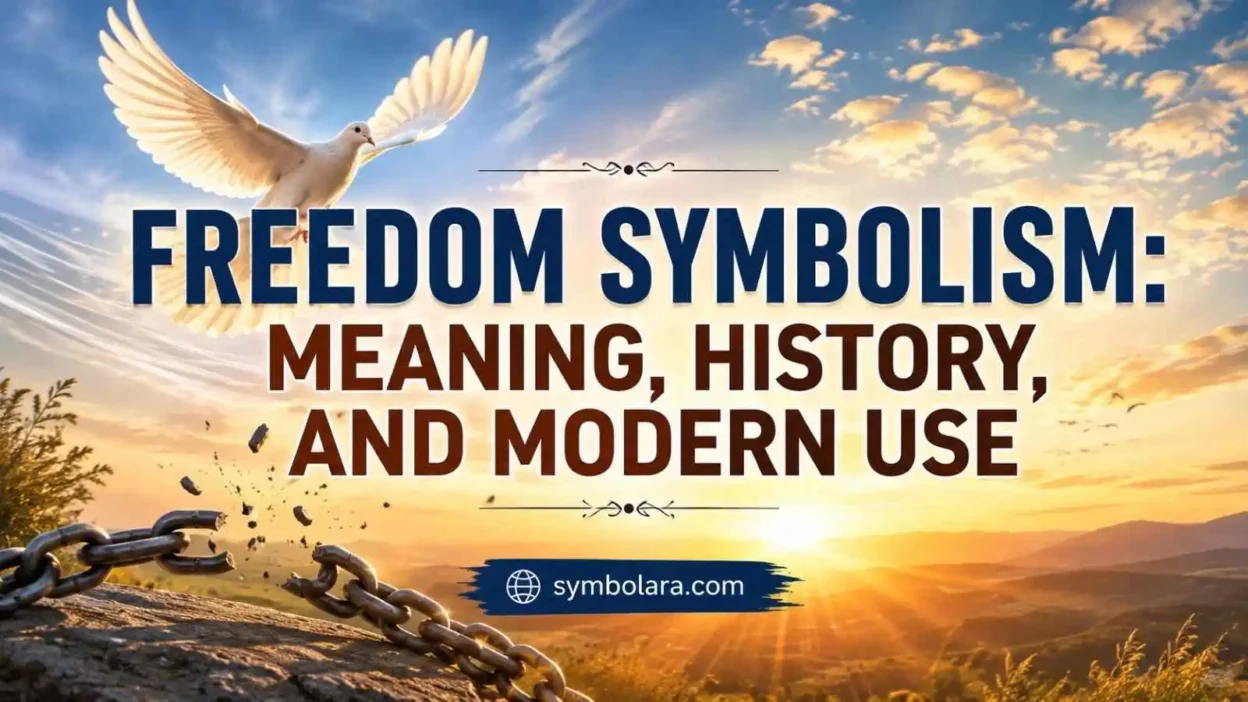
Freedom Symbolism appears everywhere in American life: flags, eagles, broken chains, open roads, raised torches, protest signs, tattoos, songs, and national holidays. These images point to the right to speak, move, worship, choose, belong, and live without unjust control.
People care about freedom because it is more than a political word. It can describe a country’s independence, a family’s new beginning, a person’s recovery, or a community’s demand for equal treatment.
In the United States, freedom carries special weight because the nation often defines itself through liberty. Still, Americans do not always agree on what freedom requires. Some see it as independence from government control. Others connect it with equality, safety, justice, and the right to participate fully in public life.
Quick Answer
Freedom Symbolism commonly represents independence, self-determination, civil rights, and life without oppression in modern American culture. Historically, it also connects with revolution, emancipation, citizenship, democracy, spiritual release, and the continuing effort to make liberty real for everyone.
TL;DR
- Freedom often means independence and self-rule.
- U.S. symbols include flags, eagles, bells, and torches.
- Broken chains represent release from oppression.
- Juneteenth connects freedom with emancipation.
- Tattoos often show personal liberation.
- Misuse happens when liberty ignores others’ rights.
What Freedom Commonly Means In The United States
In the United States, freedom usually means personal rights, national independence, and the ability to make meaningful choices. Americans connect it with speech, religion, movement, voting, privacy, protest, ownership, and self-expression.
Different communities often emphasize different parts of the idea. For immigrants, freedom may mean safety, opportunity, and the chance to begin again. For Black Americans, Indigenous communities, and other groups shaped by exclusion, freedom often means dignity, legal protection, and equal access to civic life.
This range of meanings makes freedom both inspiring and complicated. The same symbol can celebrate national pride, honor sacrifice, or challenge the country to live up to its own ideals. In American culture, freedom functions as a promise, a demand, and a measure of public honesty.
What Freedom Looks Like As A Symbol
Because freedom is abstract, people often show it through images of movement, light, release, height, and open space. A torch suggests guidance and public hope. A bird in flight suggests escape from limits. An open road suggests choice, travel, and possibility.
Broken chains give the idea a sharper meaning. They show release from force, captivity, or injustice. An open cage, unlocked door, or wide horizon can create a similar feeling, but chains point more directly to oppression and liberation.
Americans encounter these images in monuments, flags, tattoos, jewelry, home decor, political art, public murals, social media graphics, and memorials. Each image turns an idea into something people can recognize quickly.
The Most Powerful Symbols Of Freedom And Their Meanings
Freedom is an abstract idea, so people often use recognizable images to express it. Some symbols focus on escape and release, while others represent rights, courage, independence, or the hope for a better future.
Common freedom symbols include:
- Birds and wings: Represent movement, independence, and the ability to rise above limitations.
- Broken chains: Symbolize release from oppression, captivity, or restrictions.
- Open doors and gates: Suggest new opportunities, choice, and the ability to move forward.
- Torches and light: Represent knowledge, guidance, hope, and the search for a better society.
- Keys: Often symbolize access, personal control, and unlocking new possibilities.
- Roads and horizons: Reflect adventure, personal choice, and the freedom to choose one’s direction.
The meaning of each symbol depends on its cultural and personal context. A wing tattoo may represent recovery after hardship, while a national monument may represent collective freedom. These symbols become powerful because they connect large social ideas with individual experiences.
Ancient Roots Of Liberty Symbols
Many Western freedom symbols grew from older ideas about citizenship, status, and release from control. In ancient Rome, the figure Libertas represented liberty as a public virtue. Roman culture also connected certain caps with freed status, especially for people released from slavery.
Over time, artists and revolutionaries blended these older images with the Phrygian cap, a soft cap with a forward-bending top. By the eighteenth century, that cap had become a revolutionary sign in Europe and the Americas.
These older symbols shaped later American imagery. Caps suggested release. Female figures represented abstract ideals. Torches suggested enlightenment. Broken chains showed the end of bondage. Modern freedom imagery still borrows from these older visual languages, even when people no longer know their origins.
The American Revolution And The Language Of Liberty
During the American Revolution, colonists used liberty as a rallying idea. They described independence from Britain through words such as rights, self-government, tyranny, and freedom. Visual symbols helped those ideas spread.
Liberty poles, flags, eagles, caps, printed emblems, and patriotic figures gave political arguments a shared look. These images helped ordinary people see independence as both a practical goal and a moral cause.
Yet early American liberty had serious limits. Enslaved Africans, Native peoples, women, and many people without property did not receive the same rights that revolutionary language praised. That contradiction still shapes American freedom symbols today. They celebrate an ideal, but they also reveal who had to fight to be included in it.
The Statue Of Liberty And The Torch Of Welcome
The Statue of Liberty remains one of America’s clearest images of freedom. Her raised torch suggests light, guidance, and democratic hope. Her tablet connects liberty with law and national founding. The broken shackles near her feet point to release from oppression.
Many Americans also connect the statue with immigration. Because she stands in New York Harbor near Ellis Island, generations have linked her image with arrival, refuge, and a safer future. For many families, she represents the first sight of a new life.
The statue’s meaning works on two levels. Publicly, she represents national ideals. Personally, she can represent risk, migration, courage, and belonging. That combination gives the statue lasting emotional force.
The Liberty Bell And The Sound Of Public Freedom
The Liberty Bell symbolizes freedom through sound, public announcement, and civic memory. A bell gathers people. It marks important moments. It carries a message beyond one room or one speaker.
Its famous inscription calls for liberty throughout the land. In the nineteenth century, abolitionists adopted the bell as an image in the fight against slavery. Later generations connected it with civil rights, women’s suffrage, protest, and national celebration.
The bell’s crack also adds meaning. Rather than weakening the symbol, the crack makes it feel honest. It suggests that American liberty has never been perfect. The country has proclaimed freedom loudly, but people have had to repair, expand, and defend that promise.
The American Flag As A Freedom Symbol
The American flag gives freedom one of its most visible forms. People display it at schools, government buildings, military ceremonies, homes, sports events, parades, protests, and memorials.
Its stars and stripes represent the country’s union. Its colors often bring to mind courage, endurance, vigilance, justice, and sacrifice. In everyday life, the flag can express pride, grief, service, belonging, constitutional rights, or national memory.
The flag can also create disagreement. Some people use it to show patriotism. Others use it in protest to argue that the nation has failed its own principles. Both uses show how deeply Americans connect the flag with freedom. They also show that freedom remains a living argument, not only a finished achievement.
Eagles, Wings, And The Meaning Of Flight
The bald eagle strongly represents American freedom because it suggests strength, height, vision, and independence. Its wide wingspan makes it a natural image of open air and national confidence.
Birds in general work well as freedom symbols because flight breaks the limits of the ground. A bird leaving a cage, a feather moving through air, or wings spread across a tattoo can all suggest release from restriction.
The eagle adds a specifically American meaning. It points to sovereignty, courage, and national identity. In personal symbolism, however, wings may mean healing, escape, grief, recovery, or the decision to live without someone else’s control. That flexibility explains why eagle, bird, and wing imagery appears so often in tattoos, jewelry, logos, and memorial art.
Broken Chains And Emancipation
Broken chains offer one of the most direct images of freedom. They do not merely suggest independence. They show a forceful restraint ending.
In American history, this image connects strongly with slavery, abolition, emancipation, and civil rights. A chain represents control over the body. A broken chain shows that control losing its power. Because of this history, people should use the image with care and respect.
Personal uses can still carry meaning. Someone may choose broken chains to represent leaving abuse, addiction, fear, debt, shame, or a controlling relationship. In each case, the symbol keeps its central message: something once held a person down, and now that hold has broken.
Juneteenth And The Symbolism Of Delayed Freedom
Juneteenth adds an essential layer to American freedom imagery. The holiday marks June 19, 1865, when Union troops announced freedom to enslaved people in Galveston, Texas, more than two years after the Emancipation Proclamation.
This history links freedom with delayed justice. Juneteenth celebrates emancipation, but it also reminds people that legal freedom did not reach everyone at the same time. A nation can announce liberty, yet communities may still have to wait, fight, and organize to experience it.
Modern Juneteenth celebrations often include family gatherings, education, music, red foods, public ceremonies, and community storytelling. These practices turn freedom into memory, not just an abstract ideal. They also widen the American meaning of liberty beyond national independence.
Freedom In Civil Rights And Protest Culture
American protest movements have long used freedom as a public demand. Civil rights activists used the word to call for voting rights, desegregation, fair housing, equal education, and protection from racial violence.
Songs, marches, signs, sermons, speeches, and boycotts gave freedom a shared language. Phrases such as “freedom rides” and “freedom songs” show that liberty was not just a legal concept. It became a discipline, a movement, and a way for communities to keep courage alive.
Modern protest culture continues that pattern. People use freedom symbols to speak about racial justice, religious liberty, women’s rights, disability rights, LGBTQ+ rights, labor rights, and immigration. Each movement gives the symbol a specific purpose: include us in the promise.
Freedom In Holidays And Public Rituals
American holidays give freedom a public rhythm. Independence Day connects it with revolution and national founding. Memorial Day and Veterans Day connect it with service, loss, and sacrifice. Juneteenth connects it with emancipation and the long struggle for equal freedom.
Other civic rituals also reinforce the idea. Naturalization ceremonies, parades, flag displays, fireworks, public readings, school programs, and community memorials all turn freedom into a shared experience.
These rituals can inspire people, but they can also simplify history. A parade may celebrate independence without mentioning who lacked it. A stronger modern reading holds both truths together: freedom deserves celebration, and its full story requires honesty.
Religious And Spiritual Meanings Of Freedom
Religious traditions often connect freedom with release from fear, sin, bondage, exile, or spiritual darkness. In Christianity, freedom may mean redemption, deliverance, or life guided by conscience rather than domination.
Jewish tradition gives liberation a central role through the Exodus story, where escape from slavery becomes a foundation for memory, worship, and moral responsibility. Other spiritual traditions may understand freedom as inner release from craving, suffering, ego, or attachment.
These meanings differ from political freedom, but they often overlap. A broken chain, open door, lighted path, or river crossing can represent both spiritual release and real-world escape from harm.
Cross-Cultural Meanings Of Freedom
Freedom does not look the same in every culture. In France, the Phrygian cap and Marianne connect liberty with republican identity. In many Latin American countries, freedom imagery often includes independence heroes, flags, broken chains, and national personifications.
Postcolonial nations may connect freedom with liberation from empire. Indigenous communities may understand freedom through land, sovereignty, language, ceremony, and the right to maintain cultural identity.
Across cultures, the core idea usually involves release from domination. The focus changes, though. Freedom can carry many meanings. Freedom changes meaning depending on the struggle. A nation may seek independence, one person may search for spiritual release, and an oppressed community may fight for survival, dignity, and the basic right to exist without fear.
In other cases, it means personal autonomy. A careful interpretation asks which kind of freedom the symbol is expressing.
Emotional And Psychological Meaning
On a personal level, freedom often symbolizes relief, breathing room, courage, and self-trust. People may turn to freedom imagery after leaving fear, grief, family pressure, work stress, addiction, shame, or a controlling relationship.
Open-space images create this feeling especially well. A wide sky, ocean horizon, mountain road, unlocked door, or bird in flight tells the mind that movement remains possible.
Freedom imagery can also signal identity. A feather necklace, wing tattoo, open-road print, or small “liberty” charm may quietly communicate independence, resilience, restlessness, or self-ownership. The message is simple: I can move forward on my own terms.
Freedom Symbolism In Literature And Storytelling
Writers often use freedom symbols to explore human desires, struggles, and transformations. In literature, freedom rarely appears only as physical escape. It often represents identity, self-discovery, courage, or the search for dignity.
Common literary freedom symbols include:
- Birds in flight: Often represent dreams, independence, and breaking away from limits.
- Open landscapes: Suggest possibility, exploration, and a new beginning.
- Journeys and roads: Represent personal growth and the search for a chosen path.
- Prisons and cages: Show restrictions, fear, or social barriers.
- Light and sunrise: Can represent hope, awareness, and a new understanding.
Many stories use freedom symbols because they allow readers to connect with universal experiences. A character escaping a physical prison may also represent someone escaping fear, expectations, or a false identity. This makes freedom one of the most lasting themes in storytelling.
Modern Uses In Tattoos, Jewelry, Decor, And Digital Culture
Today, people use freedom symbols across personal style and visual culture. Tattoo designs often include birds, wings, feathers, broken chains, open cages, arrows, compasses, motorcycles, mountains, waves, and short words such as “free” or “liberty.”
Jewelry often uses wings, keys, birds, stars, arrows, or open circles to suggest movement and release. Home decor may show road photography, flags, maps, open landscapes, or horizon scenes. On social media, people often connect freedom with travel, solo milestones, recovery stories, entrepreneurship, and major life changes.
Pop culture relies on the same emotional pattern. Road movies, escape songs, superhero stories, frontier images, and rebellion narratives all use the desire to leave limits behind. Modern freedom imagery works because it can speak to both public ideals and private turning points.
| Context | Meaning In The USA | Common Associations | Notes |
| National symbols | Liberty, democracy, independence | Flag, eagle, Statue of Liberty | Often patriotic, sometimes contested |
| Civil rights | Equal protection and dignity | Marches, songs, protest signs | Connects freedom with justice |
| Emancipation | Release from slavery and oppression | Broken chains, Juneteenth | Requires historical care |
| Personal style | Self-expression and autonomy | Tattoos, wings, feathers, roads | Often tied to life changes |
| Spiritual life | Inner release and redemption | Open doors, light, chains | Meaning depends on tradition |
Freedom Symbolism In Art And Visual Culture
Artists have used freedom symbolism for centuries to communicate ideas that words alone cannot express. Paintings, sculptures, murals, and public monuments often turn freedom into a visible human experience.
Artists frequently use images such as:
- Flying birds: To show escape, hope, and independence.
- Raised hands: To represent resistance, voice, and collective action.
- Open skies: To suggest unlimited possibility.
- Broken barriers: To show overcoming restrictions.
- Light sources: To represent truth, awareness, and progress.
Freedom-themed art often reflects the time period in which it was created. Revolutionary artwork may focus on independence from rulers, while modern artwork may explore personal identity, equality, or social change.
Because freedom means different things to different people, artists continue to reinterpret the symbol. A single image can represent national pride, personal healing, social justice, or the desire for a different future.
Common Misunderstandings About Freedom Symbols
The biggest misunderstanding treats freedom as a simple feel-good idea. Real freedom often involves conflict, sacrifice, law, responsibility, and struggle. A bright or uplifting symbol may still carry a painful history.
Another mistake ignores context. Broken chains can represent personal recovery, but they also carry a strong connection to slavery and emancipation. The Statue of Liberty can suggest welcome, but it also raises questions about immigration, refuge, and national belonging.
People also confuse freedom with permission to ignore others. Democratic freedom usually depends on rights, duties, laws, and mutual dignity. A meaningful freedom symbol should not erase the freedom of another person.
Controversies And Misuse
Freedom symbols can become distorted when people separate liberty from responsibility. A group may claim freedom for itself while denying rights or safety to others. In that case, the symbol becomes selective instead of universal.
American history shows this tension clearly. Leaders praised liberty while slavery still existed. Public symbols celebrated freedom while many people lacked citizenship, voting rights, safety, or equal treatment. That contradiction does not erase the symbols, but it demands a more honest reading.
Modern misuse also appears in advertising, politics, and online culture. Brands may use freedom imagery to sell products. Political messages may use it to oversimplify complex issues. A careful viewer asks three questions: freedom for whom, freedom from what, and at whose cost?
How The Meaning Has Changed Over Time
The meaning of freedom has expanded across American history. In the eighteenth century, many political leaders connected it with independence, property, self-government, and resistance to monarchy. During the nineteenth century, abolition and emancipation forced the nation to confront the gap between political liberty and human freedom.
In the twentieth century, civil rights movements connected freedom with voting access, desegregation, public dignity, and equal protection under law. In the twenty-first century, Americans often discuss freedom through identity, privacy, speech, bodily autonomy, migration, technology, and economic opportunity.
The core idea remains stable: release from unjust control. What changes is who claims it, what kind of control people challenge, and how society decides whether freedom actually exists in daily life.
FAQs
What does freedom symbolize in American culture?
Freedom usually symbolizes independence, rights, opportunity, and protection from oppression. In American culture, it also connects with immigration, protest, military service, civil rights, and personal self-expression.
What is the most common symbol of freedom?
The Statue of Liberty is one of the most common American symbols of freedom. The American flag, bald eagle, Liberty Bell, broken chains, and birds in flight also carry strong freedom meanings.
What does a freedom tattoo mean?
A freedom tattoo often represents personal independence, survival, escape from control, or a new beginning. Birds, wings, feathers, broken chains, open cages, and compasses work well because they suggest movement and release.
Is freedom symbolism always positive?
Freedom usually carries a positive meaning, but the symbol can become complicated. It can turn harmful when people use it to defend their own choices while ignoring the rights or safety of others.
What do broken chains symbolize?
Broken chains symbolize release from captivity, oppression, slavery, or personal bondage. In the United States, the image has a strong connection to emancipation, so careful context matters.
How is freedom different from liberty?
Freedom usually sounds broader and more personal. Liberty often sounds more formal or legal, especially when people discuss protected rights, citizenship, or constitutional principles.
Why is freedom important in symbolism?
Freedom matters because it connects public history with personal emotion. It can represent a nation’s ideals, a community’s struggle, or an individual’s decision to live with more honesty and control over their life.
Why are broken chains used as a freedom symbol?
Broken chains symbolize the end of control, captivity, or oppression. In American history, the image is strongly connected with emancipation and the fight against slavery.
Conclusion
Freedom remains one of the most important symbols in American life because it carries pride, pressure, memory, and responsibility. It points to independence, rights, movement, dignity, and the hope of living without unjust control. Freedom Symbolism works best when it does not ignore history. The torch, bell, eagle, flag, broken chain, open road, and flying bird all mean more when people understand the struggles behind them. A strong freedom symbol does not claim that the work has ended. It reminds people why the work still matters.
Freedom usually symbolizes independence, rights, opportunity, and protection from oppression. In American culture, it also connects with immigration, protest, military service, civil rights, and personal self-expression.
The Statue of Liberty is one of the most common American symbols of freedom. The American flag, bald eagle, Liberty Bell, broken chains, and birds in flight also carry strong freedom meanings.
A freedom tattoo often represents personal independence, survival, escape from control, or a new beginning. Birds, wings, feathers, broken chains, open cages, and compasses work well because they suggest movement and release.
Freedom usually carries a positive meaning, but the symbol can become complicated. It can turn harmful when people use it to defend their own choices while ignoring the rights or safety of others.
Broken chains symbolize release from captivity, oppression, slavery, or personal bondage. In the United States, the image has a strong connection to emancipation, so careful context matters.
Freedom usually sounds broader and more personal. Liberty often sounds more formal or legal, especially when people discuss protected rights, citizenship, or constitutional principles.
Freedom matters because it connects public history with personal emotion. It can represent a nation’s ideals, a community’s struggle, or an individual’s decision to live with more honesty and control over their life.
[…] Hermetic symbols requires attention to context. A symbol does not have one permanent meaning that applies everywhere. Its meaning changes depending on the time period, culture, and purpose of […]
[…] symbols often connect to freedom and […]