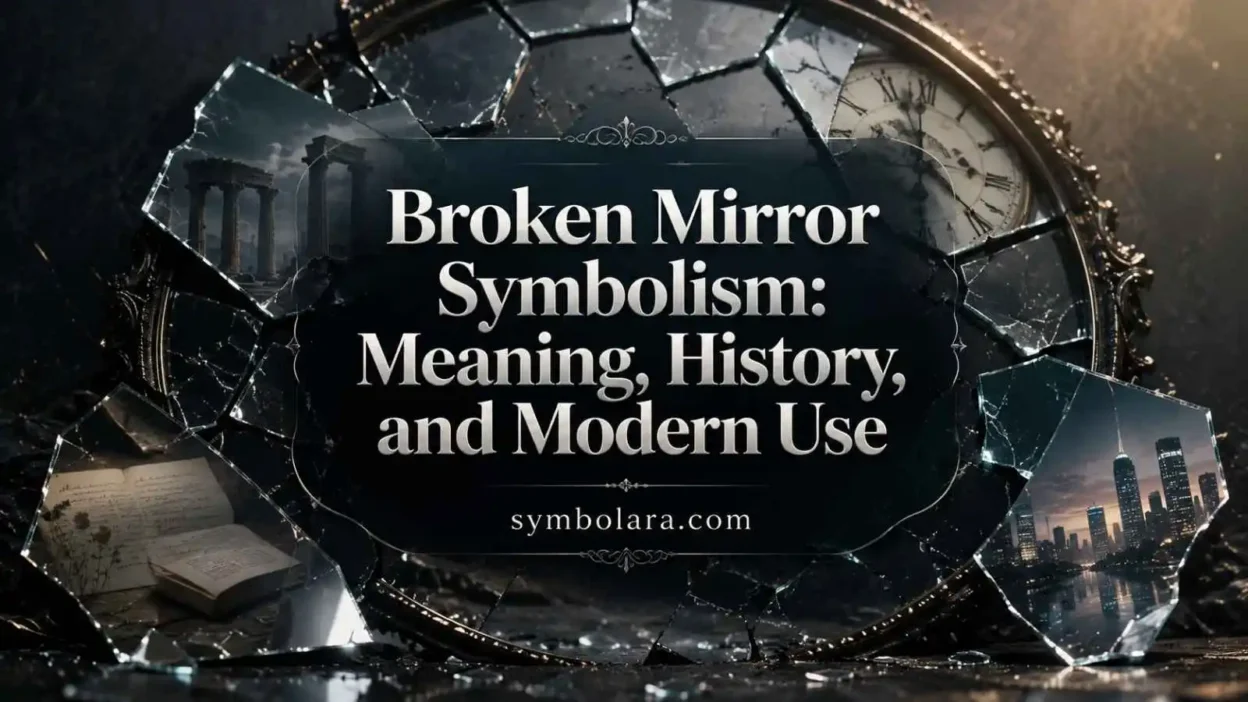
A mirror normally gives us a complete image of ourselves. Once the glass cracks, that familiar reflection becomes divided, distorted, or incomplete. Broken Mirror Symbolism grows from that visual change: something that once showed clarity now suggests disruption, uncertainty, or a damaged sense of wholeness.
For many Americans, the first association is the familiar superstition that breaking a mirror brings seven years of bad luck. Yet broken mirrors carry meanings beyond misfortune. In art, tattoos, horror, fashion, and personal imagery, they can represent fractured identity, a relationship ending, loss of innocence, distorted self-perception, or the decision to leave an old version of yourself behind.
The symbol works because people already connect mirrors with identity and self-recognition. Breaking the reflective surface changes the meaning of the mirror itself.
Quick Answer
Broken Mirror Symbolism most commonly represents bad luck, disruption, fractured identity, or a major break from the past in modern American culture. Its meanings are shaped by an old mirror-breaking superstition as well as older traditions that associated reflections with identity, the soul, hidden knowledge, and divination.
TL;DR
- Broken mirrors commonly suggest bad luck, disruption, or fractured identity.
- Seven years of bad luck remains the best-known American association.
- Mirrors historically carried spiritual, divinatory, and self-knowledge meanings.
- Cracked reflections can symbolize damaged or changing self-perception.
- Tattoos often turn the image into a symbol of survival or reinvention.
- Context determines whether the symbol feels frightening, sad, or liberating.
What a Broken Mirror Looks Like as a Symbol
The image may be as simple as a household mirror split by one long crack. More dramatic versions show a web of fractures radiating from a central impact point, missing pieces of glass, or a face divided into several disconnected reflections.
Those visual details influence interpretation.
A single crack can suggest the first break in something that appeared stable. A completely shattered mirror feels more final, suggesting collapse, separation, or destruction. When part of a person’s face remains visible in the fragments, the emphasis often shifts toward identity, memory, or self-perception.
Because every fragment can reflect a slightly different angle, shattered glass also creates the impression of multiple versions of the same person. Artists frequently use that visual effect when exploring conflicting identities or unstable perspectives.
Core Meanings at a Glance
| Context | Common Meaning in the U.S. | Typical Association | Tone |
| Folk superstition | Bad luck | Seven unlucky years | Negative |
| Art and photography | Fractured identity | Distorted self-image | Reflective |
| Tattoo imagery | Survival or reinvention | Life after hardship | Often positive |
| Relationships | Broken trust or separation | Emotional rupture | Sad or serious |
| Horror imagery | Danger and instability | Supernatural threat | Ominous |
| Personal symbolism | Leaving an old self behind | Transformation | Positive or mixed |
No single interpretation applies every time. A cracked vanity mirror in a horror movie communicates something very different from a broken-mirror tattoo chosen after a major personal change.
Why Mirrors Meant More Than Household Objects
Mirrors have not always been ordinary pieces of inexpensive glass. Ancient and medieval mirrors were often made from highly polished metal, including bronze or silver. Surviving Greek, Etruscan, and Roman examples show that reflective objects were used long before the modern glass mirror became commonplace.
Their unusual visual effect helped give mirrors symbolic importance. A person could see an image that looked like the self but existed only on the reflective surface. That relationship between person and double encouraged associations with identity, souls, truth, illusion, and unseen realities.
Mirrors also entered practices of divination. Historical traditions of mirror-gazing attempted to obtain knowledge about illness, fate, or future events through reflections. Scholars use the term catoptromancy for divination involving mirrors.
Once mirrors had acquired meanings connected with identity and fate, damaging one could easily feel more significant than breaking an ordinary household object.
Where Seven Years of Bad Luck Comes From
The most famous belief says that anyone who breaks a mirror will experience seven years of misfortune.
A common explanation connects the superstition with ancient Greek and Roman beliefs about reflections, souls, and cycles of renewal. Ancient reflective surfaces certainly carried religious and divinatory associations, and later retellings linked these traditions to the idea that damage to a reflected image could symbolically harm the person represented.
The exact historical path to the familiar seven-year rule is less certain than popular explanations sometimes suggest. Folk beliefs rarely develop from one documented event. They change through oral storytelling, family customs, local traditions, and later popular culture.
What matters symbolically is the logic behind the superstition: the mirror stands for the person, and damage to the reflected image becomes an omen of disorder in that person’s life.
How the Superstition Took Root in American Folklore
By the early twentieth century, the broken-mirror belief was clearly part of American folk culture.
A 1905 collection of Louisiana superstitions recorded the idea that breaking a mirror meant seven years of bad luck. A much larger Louisiana collection published in 1927 also documented mirror-breaking beliefs, including warnings against keeping broken mirrors inside the home.
Similar beliefs continued to appear in American folklore collections later in the century, including material collected in Texas.
That history helps explain why the image remains immediately understandable in the United States. Someone does not need to seriously believe in the superstition to recognize the joke or warning. Breaking a mirror in a television scene can still prompt someone to say, “That’s seven years of bad luck.”
In that sense, the superstition now functions as shared cultural shorthand.
What It Commonly Means in the United States
In everyday American culture, a broken mirror usually carries one of two broad meanings.
The first is misfortune. This interpretation comes directly from the superstition and works especially well in jokes, Halloween imagery, horror stories, and scenes involving ominous accidents.
The second is something broken within the self or within life. Because a mirror normally presents a unified reflection, cracks can suggest that a person’s identity, confidence, plans, relationships, or understanding of reality have been disrupted.
Modern imagery sometimes reverses that negative meaning. Smashing or abandoning a mirror can represent rejecting an old identity rather than losing one. The same image can therefore signify collapse in one context and liberation in another.
Fractured Identity and Self-Image
Mirrors are closely connected with the question, “Who am I?” A broken reflection naturally complicates that question.
In visual storytelling, a character staring at a cracked mirror may appear divided between several identities: who they were, who others expect them to be, and who they are becoming. One face divided across several pieces can also represent inner conflict or difficulty reconciling different parts of one’s life.
The symbolism becomes especially effective when the person still recognizes themselves but no longer sees a complete image.
This does not mean that broken-mirror imagery has a fixed clinical or psychological definition. Artists use it metaphorically. It may communicate insecurity, identity conflict, shame, personal change, or simply the feeling that life no longer fits together as neatly as before.
Emotional Meaning: Anxiety, Loss, and Uncertainty
A cracked mirror often produces discomfort because it turns something familiar into something unstable.
The reflection remains recognizable, yet the fractures interrupt it. That makes the image well suited to feelings that are difficult to express directly: grief after a major loss, uncertainty after a breakup, fear of change, or the sense that a previously dependable part of life has failed.
The sharpness of broken glass adds another emotional layer. Mirrors do not simply crack visually; shattered pieces can physically injure someone. As a result, the symbol combines psychological disruption with a suggestion of danger.
In darker imagery, the fragments may communicate vulnerability. In more hopeful work, they may show that a person can remain recognizable even after something has broken.
Broken Mirrors as Symbols of Change and Reinvention
Not every broken mirror represents permanent damage.
Sometimes the image means that an old version of the self can no longer be maintained. A previous identity, lifestyle, expectation, or relationship has reached its end. The break creates a clear before-and-after point.
That interpretation appears frequently in personal art because it changes the question from “What was destroyed?” to “What comes next?”
A person may choose the image after leaving an unhealthy environment, ending an important chapter, rebuilding confidence, or changing how they define themselves. The broken mirror then becomes less about bad luck and more about refusing to return to an outdated reflection.
The symbolism remains complicated, which is part of its appeal. Reinvention usually involves both loss and possibility.
Relationships, Trust, and Broken Perception
A mirror can also stand for how two people see each other.
When that reflective surface breaks, the imagery can suggest damaged trust, emotional separation, or the realization that a relationship was not what it appeared to be. In this context, the important idea is not simply heartbreak. It is changed perception.
Someone may discover a betrayal and feel that their previous understanding of the relationship has shattered. Alternatively, both people may recognize that they no longer see themselves or each other in the same way.
A broken mirror can therefore symbolize the end of an illusion as much as the end of a relationship.
That distinction allows the image to express clarity after disappointment: the reflection is damaged, but the person may finally be seeing the situation more accurately.
Spiritual and Religious Interpretations
Spiritual interpretations should be separated from established religious doctrine.
The seven-years-of-bad-luck belief belongs primarily to folklore and superstition. It should not automatically be described as a Christian teaching or universal spiritual rule.
Christian traditions have used the mirror as a metaphor for moral examination, imperfect human understanding, and spiritual reflection, but this does not create a biblical doctrine that accidentally breaking glass brings seven years of punishment. Historical mirror traditions are much broader and include philosophy, folk religion, divination, mourning customs, and magical beliefs.
In contemporary personal spirituality, some people interpret a broken mirror as a sign to reconsider identity, patterns, or direction. That is a modern personal reading rather than an objective prediction of future events.
The physical explanation remains simple: mirrors break because of impact, pressure, temperature changes, structural weakness, or accidents not because they are announcing a supernatural event.
Cross-Cultural Meanings
Mirror symbolism changes significantly across cultures, so the American “seven years of bad luck” idea should not be treated as universal.
In some Chinese symbolic traditions, a broken mirror has been associated with separation, including separation between married partners. The complete mirror can represent harmony, while its division naturally suggests two people being pulled apart.
Japanese religious history gives mirrors another set of associations. Ancient mirrors have held important ceremonial significance in Shinto, where reflective objects can carry connections with purity, sacred presence, and religious tradition.
Elsewhere, mirrors have been involved in divination, protection, funeral customs, and beliefs about spiritual doubles. These traditions demonstrate why it is misleading to reduce every mirror belief to the same European-American superstition.
The meaning of a damaged mirror therefore depends heavily on the cultural framework surrounding it.
Why Broken Mirrors Appear in Tattoos and Personal Style
Broken-mirror tattoos can communicate very different stories depending on what appears inside or around the glass.
A face reflected in several fragments may represent identity conflict. A flower growing around shattered glass can suggest beauty continuing after hardship. A mirror with no reflection may emphasize the rejection of a former self. Adding dates, names, eyes, skulls, butterflies, or other imagery changes the meaning further.
For some people, the design marks survival. The object is damaged, yet the fragments still reflect light and retain pieces of the original image.
Others deliberately use the bad-luck association, choosing the design because it feels rebellious or because it plays with superstition.
There is no universal tattoo definition. Placement, accompanying imagery, and the wearer’s personal reason matter more than any standardized interpretation.
Horror, Film, Art, and Digital Culture
Broken mirrors are especially effective in horror because mirrors already blur the boundary between a real person and an image that seems to imitate them.
When the reflection cracks, that dependable relationship becomes unreliable.
A filmmaker may use the image just before a character loses control, confronts a hidden part of themselves, or enters a dangerous situation. In psychological stories, several mirror fragments can visually divide one face into competing identities. In supernatural stories, the broken surface may suggest that an ordinary boundary has been disturbed.
Contemporary photography and digital art use the same visual language without necessarily implying anything supernatural. Cracked-mirror effects can communicate heartbreak, rebellion, identity change, beauty standards, pressure, or emotional exhaustion.
Fashion graphics and social media imagery may use the motif simply because it creates an immediate feeling of disruption. The audience recognizes that something once whole has been fractured.
Common Misunderstandings and Modern Misuse
The biggest misunderstanding is treating symbolism as prediction.
A broken mirror does not provide evidence that seven years of misfortune will follow. Superstitions can persist because people remember coincidences that seem to confirm them while overlooking the many times nothing unusual happens. Social learning also helps beliefs survive as families and communities repeat them across generations.
Another mistake is claiming that every ancient culture believed mirrors contained human souls. Historical cultures gave reflective surfaces many meanings, but those beliefs were not identical.
Modern psychological symbolism also requires care. A drawing of a shattered reflection can represent inner conflict without indicating a mental health condition. Symbolic art is not a diagnosis.
Finally, broken-mirror imagery does not have to be negative. The symbol may express the end of an illusion, release from an old identity, or the beginning of reconstruction.
FAQs
Spiritually, some people interpret a broken mirror as disruption, a shift in self-perception, or the ending of an old phase. These are symbolic interpretations rather than reliable supernatural predictions.
No evidence shows that breaking a mirror causes seven years of misfortune. The belief survives as a long-standing superstition and cultural tradition rather than a demonstrated cause-and-effect rule.
A broken-mirror tattoo may represent survival, identity change, emotional damage, rebellion, or leaving the past behind. The design’s surrounding images and the wearer’s personal story usually determine its specific meaning.
It can be either. Traditional superstition makes it negative, while modern personal symbolism can turn the same image into a sign of reinvention, honesty, freedom, or rebuilding after hardship.
It can symbolize broken trust, separation, heartbreak, or a changed understanding of another person. It may also represent discovering that an idealized version of the relationship was inaccurate.
The Bible does not teach that breaking a mirror causes seven years of bad luck. Christian mirror imagery is generally connected with reflection, self-examination, and limited human perception rather than accidental broken-glass superstition.
A mirror produces a familiar copy of the viewer, so damaging that copy immediately creates visual unease. Horror uses cracked reflections to suggest unstable identity, danger, distorted reality, or loss of control.
Conclusion
A broken mirror carries meaning because a mirror normally represents recognition, wholeness, and a dependable image of the self. Once that surface fractures, the same object can suggest bad luck, broken trust, uncertain identity, emotional disruption, or the collapse of an old way of seeing things.
In American culture, Broken Mirror Symbolism still carries the familiar seven-years-of-bad-luck association, but modern art, tattoos, fashion, and storytelling have expanded the image far beyond superstition. A shattered reflection can represent damage, yet it can also mark the moment when someone stops depending on an old image of who they were.
Whether the symbol feels threatening or hopeful depends on what the broken reflection is leaving behind and what might replace it.