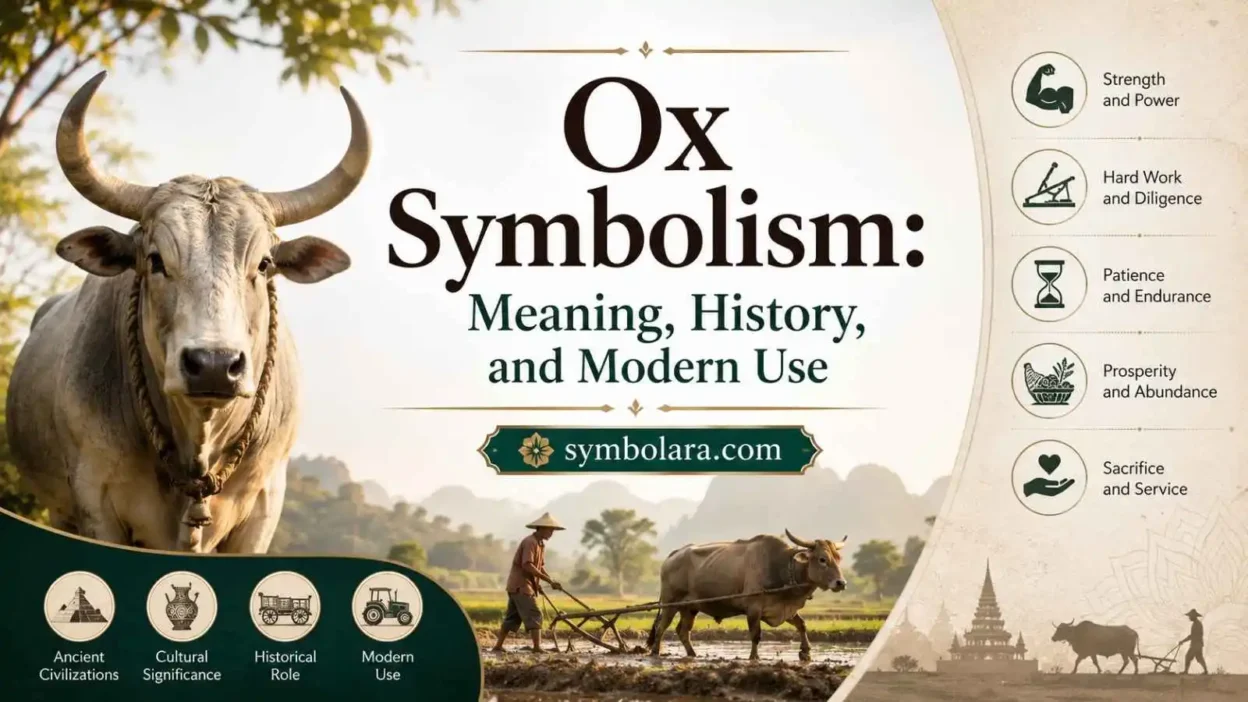
Ox Symbolism is most often connected with strength, patience, hard work, dependability, and steady progress. The ox is not usually seen as a flashy or dramatic animal. Its meaning comes from work, endurance, usefulness, and the quiet ability to carry heavy burdens without needing attention.
In the United States, the ox carries a distinctly practical image. Americans often associate it with farming, pioneer life, old barns, covered wagons, rural labor, and the kind of persistence needed to build something slowly. The animal also appears in religious art, Chinese zodiac traditions, tattoo design, rustic decor, and personal symbolism.
Understanding the ox matters because it represents a kind of strength that is easy to overlook. It is not the strength of speed, aggression, or dominance. It is the strength of showing up, pulling weight, staying grounded, and finishing difficult work.
Quick Answer
Ox Symbolism commonly represents strength, patience, hard work, reliability, and steady progress in modern American culture. Historically, the ox has also symbolized agriculture, sacrifice, fertility, service, endurance, and moral responsibility in farming societies, religious art, and Asian zodiac traditions.
TL;DR
- The ox symbolizes steady strength and patient labor.
- In America, it recalls farming and pioneer life.
- In Christianity, it can represent sacrifice and service.
- In Chinese tradition, it suggests discipline and responsibility.
- In tattoos, it often means resilience and grounded power.
- Modern misuse usually confuses ox symbolism with brute force.
What the Ox Is and Why Its Image Matters
An ox is typically a trained bovine used for draft work, especially pulling plows, carts, wagons, and heavy loads. In many cases, the word refers to a castrated adult male cow, though trained cattle of different sexes have served as oxen in various regions. The important point is not only the animal’s biology but its role: an ox is cattle trained for work.
That work-shaped identity explains much of the symbolism. The ox became meaningful because people depended on it for food production, transportation, land clearing, and survival. Before tractors and trucks, an ox team could turn hard soil, haul timber, move goods, and help a family farm become productive.
Visually, the ox is often imagined as broad-bodied, horned, slow-moving, and yoked. The yoke matters symbolically because it shows partnership, burden, discipline, and service. Unlike wild bulls, oxen are not usually symbols of uncontrolled force. They represent strength that has been trained, directed, and made useful.
What the Ox Commonly Means in the United States
In the United States, the ox most often symbolizes dependable strength. It suggests a person or community that can handle hard work without complaint. When Americans use phrases like “strong as an ox,” they usually mean physical toughness, but the deeper meaning includes stamina and usefulness.
The ox also carries associations with rural life. It can bring to mind early farms, colonial settlements, westward migration, logging roads, country fairs, and living-history museums. For many Americans, the ox belongs to the visual language of old America: wooden wagons, split-rail fences, hand tools, open fields, and practical survival.
There is also a moral quality to the symbol. The ox is admired not because it wins attention, but because it contributes. It represents the kind of character that keeps a household, farm, team, or community moving. In that sense, the ox is close to values Americans often describe as work ethic, grit, responsibility, and staying power.
The Core Meanings of the Ox
The ox carries several related meanings, but they all grow from the animal’s working role.
Strength is the most obvious meaning. An ox can pull, carry, and endure weight far beyond what a person can manage. Symbolically, it represents the ability to bear difficulty.
Patience is equally important. Oxen move steadily rather than quickly. Their meaning is not about sudden victory but about progress made through repetition, discipline, and time.
Service is another core meaning. The ox is useful because it works with people. It suggests cooperation, duty, and the willingness to support others.
Groundedness also belongs to the ox. It is close to the soil, the field, the harvest, and the practical realities of daily life. For this reason, it often represents stability rather than ambition.
Together, these meanings create a symbol of quiet resilience. The ox does not need to dominate a scene to matter. Its importance comes from what it makes possible.
Ancient Roots and Agricultural Meaning
The symbolic meaning of the ox began in agricultural societies. When human communities relied on farming, animals that helped prepare fields became part of survival itself. A strong ox was not just livestock. It was a source of food security, transportation, wealth, and continuity.
Plowing gave the ox one of its most lasting meanings. To turn soil is to prepare for future harvest. Because of that, the ox became associated with patience, fertility, productivity, and hope. It represented the beginning of a process that would not pay off immediately but could feed a family later.
In many ancient cultures, cattle also signaled wealth. A household with cattle had resources, status, and practical security. The ox, as a working animal, stood at the meeting point of strength and prosperity. It was valuable not because it was ornamental, but because it could transform effort into survival.
This is why the ox often feels older and earthier than many other animal symbols. It belongs to the world of fields, seasons, labor, and grain. Its meaning comes from human dependence on the land.
The Ox in Early American Life
The ox has a strong place in American historical imagination because oxen were essential in colonial and frontier life. They helped clear land, pull plows, haul supplies, drag logs, and move wagons. In many early American communities, they were practical partners in building farms and settlements.
Compared with horses, oxen were often valued for their steadiness, strength, and ability to work under difficult conditions. They were not fast, but speed was not always the point. On rough land, muddy roads, and heavy tasks, controlled pulling power mattered more than elegance.
This history shaped the American meaning of the ox. It became a symbol of settlement, endurance, and the hard physical work behind national expansion. That symbolism should be handled carefully, because frontier stories can overlook Indigenous displacement and the harsh realities of colonization. Still, within American cultural memory, the ox remains tied to the labor of building roads, farms, towns, and supply routes.
Today, Americans are more likely to encounter oxen at historical farms, agricultural fairs, museums, heritage festivals, and rural demonstrations than in daily farm work. Even so, the symbolic meaning remains recognizable: the ox stands for the kind of strength that helped people survive before machines took over.
The Ox in Christianity and Religious Art
In Christian symbolism, the ox is often connected with sacrifice, service, and spiritual labor. One of the best-known examples is the winged ox associated with Saint Luke the Evangelist. In traditional Christian art, Luke’s symbol is frequently shown as an ox or calf, sometimes with wings.
This association is usually explained through the sacrificial themes connected to Luke’s Gospel and its opening scenes around temple worship. The ox, as a sacrificial animal in ancient religious practice, became a visual shorthand for offering, priestly service, and devotion.
The ox also appears in biblical agricultural imagery. Ancient readers understood oxen as working animals that plowed fields and threshed grain. Because of that, references to oxen could point not only to farming but to fairness, care for laborers, and humane treatment of animals.
For modern American readers, the religious meaning of the ox is usually less familiar than the farm meaning. Still, in churches, illuminated manuscripts, stained glass, and Christian iconography, the ox can represent faithful service rather than ordinary farm work alone.
The Ox in Chinese Zodiac Tradition
In Chinese zodiac tradition, the ox is the second animal in the twelve-year cycle. People born in ox years are commonly associated with diligence, reliability, discipline, patience, honesty, and persistence. These meanings are widely recognized in American communities that celebrate Lunar New Year and in popular astrology content.
The zodiac ox does not exactly match the narrow English definition of a trained draft animal. In Chinese, the animal term can cover cattle more broadly. Even so, English-speaking audiences usually understand it as an ox because that translation emphasizes work, patience, and strength.
In the United States, the zodiac meaning has become one of the most visible modern uses of the ox symbol. Around Lunar New Year, people may see ox imagery in decorations, greeting cards, restaurant displays, classroom activities, social media posts, and cultural festivals.
The zodiac ox is not only about toughness. It is about trustworthiness. It suggests someone who may not seek the spotlight but can be counted on when responsibility matters.
Cross-Cultural Meanings Beyond America
Across cultures, the ox and related cattle symbols often connect to fertility, food, wealth, religious offering, and agricultural power. In ancient Egypt, sacred bull traditions linked cattle with fertility, kingship, regeneration, and divine presence. These examples usually involve bulls more than working oxen, but they show how cattle became symbols of life and strength.
In Hindu tradition, Nandi, the sacred bull associated with Shiva, carries meanings of devotion, fertility, strength, and reverence. Although Nandi is technically a bull rather than an ox, American readers often group cattle symbols together. The distinction matters: an ox usually emphasizes labor and patience, while a bull often emphasizes virility, force, and sacred power.
In many agrarian societies, cattle were also tied to marriage, inheritance, ritual exchange, and family wealth. The animal’s value came from milk, labor, meat, hide, offspring, and social meaning. Because of this, the ox can symbolize not only work but the larger idea of a stable household.
Cross-cultural symbolism should be treated with care. The ox does not mean the exact same thing everywhere. Its meanings shift depending on whether a culture is emphasizing work, sacrifice, fertility, wealth, divinity, or zodiac personality.
Ox Symbolism in Native American and Indigenous Perspectives
Ox symbolism is not a traditional Native American symbol in the same way that animals such as the eagle, bear, wolf, or buffalo appear in many Indigenous traditions. The ox arrived mainly through European agricultural practices and later became connected with farming and settlement history in North America.
However, cattle and working animals have influenced many communities through agriculture, trade, and changing relationships with land. In American history, the ox often represents the physical labor involved in building farms, roads, and communities.
When discussing Indigenous perspectives, it is important not to combine unrelated traditions. Native American symbolism varies greatly among nations, and animal meanings depend on specific cultural teachings and histories.
The ox is best understood in the American context as a symbol of agricultural labor, endurance, and human cooperation with domesticated animals rather than as a universal Indigenous symbol.
Emotional and Psychological Meaning
Emotionally, the ox communicates steadiness. It suggests someone who can be trusted in difficult circumstances. People may connect with the ox when they want to feel grounded, capable, and less reactive.
Psychologically, the ox often represents endurance under pressure. It can symbolize the part of a person that keeps going even when progress is slow. This makes it especially meaningful for people who value discipline, recovery, long-term goals, family duty, or quiet perseverance.
The ox can also represent emotional restraint. Unlike more dramatic animal symbols, it does not suggest speed, glamour, or rebellion. It points to calm force. For some people, that can feel reassuring. For others, it can feel heavy, as if the symbol carries too much duty.
This dual feeling is important. The ox can inspire resilience, but it can also raise questions about overwork. A person who identifies with the ox may be proud of being dependable while also needing to remember that strength does not require endless sacrifice.
Ox Symbolism Meaning in Dreams and Personal Interpretations
Dreams about an ox often connect with themes of strength, responsibility, patience, and personal effort. Because the ox has a long history as a working animal, many interpretations focus on the idea of carrying responsibilities and moving forward through difficult situations.
Seeing a calm or healthy ox in a dream may represent stability, discipline, or confidence in your ability to handle challenges. It can reflect a period when steady effort matters more than quick results.
A working ox may symbolize dedication and commitment. It can appear during times when someone is building a career, supporting family members, completing a long-term goal, or managing heavy responsibilities.
A tired or struggling ox may represent emotional exhaustion or feeling overwhelmed by duties. This interpretation does not mean failure. Instead, it can serve as a reminder to create balance and recognize personal limits.
Dream symbolism depends on personal experiences and cultural background. For some people, the ox represents strength and protection. For others, it may reflect the pressure of always being dependable.
Meaning in Tattoos and Personal Style
Ox tattoos usually represent strength, resilience, patience, discipline, and hard-earned progress. They are often chosen by people who want a symbol of survival rather than aggression. A person may choose an ox to mark recovery, family responsibility, physical toughness, or a commitment to long-term work.
Some ox tattoos draw from the Chinese zodiac. These designs may include the ox with zodiac lettering, Lunar New Year references, elemental themes, or birth-year symbolism. Others use a rustic American style, showing horns, a yoke, a plow, or a strong animal head.
Minimalist ox designs tend to emphasize calm and groundedness. Larger, more detailed tattoos may emphasize heritage, farming roots, or personal strength. A skull or horned head can shift the meaning toward mortality, toughness, or the rural West, though that style can blur the line between ox, bull, steer, and cattle imagery.
For jewelry and fashion, the ox is less common than animals like lions, eagles, wolves, or snakes. When it does appear, it usually signals grounded strength, zodiac identity, rural heritage, or a preference for understated symbols.
The Ox in Home Decor, Design, and Rustic Style
In American home decor, ox imagery often appears within farmhouse, lodge, Western, primitive, or historical styles. It may show up in framed prints, vintage signs, agricultural illustrations, cast-iron objects, carved wood, textiles, or kitchen art.
The design meaning is usually tied to simplicity and rural steadiness. An ox image can make a space feel connected to work, land, heritage, and old-fashioned practicality. It is rarely used for luxury or delicacy. Instead, it adds weight and earthiness.
In branding and logos, the ox can suggest durability, reliability, and heavy-duty performance. A business using ox imagery may want to communicate that it is strong, dependable, no-nonsense, and built for difficult work.
Color changes the mood. A dark ox can feel serious and strong. A brown or tan ox feels rustic and natural. A red ox may suggest energy or luck, especially in zodiac-related designs. A white ox can suggest purity, sacredness, or ceremonial meaning in some cultural contexts.
Ox Symbolism in Business, Leadership, and Modern Branding
In business and branding, the ox often represents reliability, strength, and consistent performance. Companies that use ox imagery may want to communicate that they are dependable, durable, and capable of handling demanding work.
Unlike symbols that focus on speed or innovation, the ox suggests trust and stability. It creates an impression of a company that values quality, patience, and long-term results.
The ox can be especially effective for industries connected with construction, agriculture, outdoor products, transportation, tools, and traditional craftsmanship. Its image suggests something built to last.
In leadership symbolism, the ox represents a steady leader who supports others, accepts responsibility, and creates progress through discipline rather than attention-seeking behavior.
Modern audiences often connect with this meaning because many people value reliability and consistency in a world that changes quickly.
Quick Comparison of Ox Meanings
| Context | Meaning in the USA | Common Associations | Notes |
| Farming history | Hard work and survival | Plows, wagons, fields, settlers | Strongest American association |
| Personal symbolism | Endurance and responsibility | Patience, duty, grit | Often used for self-identity |
| Chinese zodiac | Discipline and reliability | Lunar New Year, birth years | Common in modern cultural celebrations |
| Christian art | Sacrifice and service | Saint Luke, winged ox | More visible in religious settings |
| Rustic design | Stability and heritage | Farmhouse decor, old tools | Often nostalgic or rural |
How the Meaning Has Changed Over Time
The ox began as a practical animal before it became a symbol. In ancient and early farming societies, its meaning came directly from survival. People saw its strength every day in fields, roads, mills, and threshing floors.
As machines replaced animal labor, the ox became less visible in ordinary American life. Its symbolism moved from daily experience into memory, art, language, and heritage. Instead of being an animal most people worked beside, it became an image of older forms of labor.
In the 20th and 21st centuries, the ox gained new meanings through tattoos, zodiac culture, rustic decor, and online symbolism content. Many people now meet the ox as an emblem rather than as a living work animal. That shift makes the symbol more flexible but also easier to misunderstand.
Today, the ox often means perseverance in a broad personal sense. It is no longer only about farming. It can represent emotional strength, disciplined ambition, cultural identity, family loyalty, or the quiet burden of responsibility.
Common Misunderstandings About the Ox
One common mistake is treating the ox and bull as identical symbols. They overlap because both are cattle, but their meanings often differ. The bull is usually linked with virility, dominance, aggression, and raw force. The ox is more closely tied to trained strength, patience, service, and labor.
Another misunderstanding is seeing the ox as passive or weak because it is docile. In symbolism, docility does not mean lack of power. The ox represents strength under control. That control is exactly what makes it useful and meaningful.
A third mistake is romanticizing oxen without acknowledging hardship. The ox can represent noble work, but it also points to burdens, exhausting labor, and lives shaped by necessity. In modern interpretation, the symbol should not be reduced to cheerful farm nostalgia.
The ox is also sometimes used as a symbol of stubbornness. That meaning can fit in certain contexts, but it is not the central meaning. More often, the ox represents persistence rather than refusal.
Ox vs Bull Symbolism: Understanding the Difference
Ox and bull symbolism often overlap because both animals belong to the cattle family, but their meanings usually represent different types of strength.
The bull is commonly connected with raw power, dominance, fertility, confidence, and uncontrolled energy. Many cultures use the bull as an image of force, leadership, and masculine power.
The ox represents a different kind of strength. It symbolizes patience, discipline, cooperation, and controlled power. An ox becomes meaningful because it works with humans and uses its strength for a purpose.
This difference explains why the two animals create different emotional impressions. A bull may represent the power to challenge or conquer, while an ox represents the power to endure and build.
In modern symbolism, choosing an ox instead of a bull often suggests a preference for reliability, humility, and long-term progress rather than competition or dominance.
Controversies, Distortions, and Misuse
The ox is not widely controversial in the way some symbols are, but it can still be misused or flattened. The most common distortion is turning it into a symbol of brute strength alone. That misses the deeper meanings of discipline, service, and patience.
Another issue appears in historical storytelling. In American pioneer imagery, oxen are sometimes used to create a warm picture of westward expansion without acknowledging the violence, displacement, and unequal costs connected to that history. The animal itself is not controversial, but the stories around it can be incomplete.
Cultural borrowing can also be a problem. Zodiac ox imagery, Hindu cattle symbolism, and Christian ox iconography each come from different traditions. Using these images without understanding their context can make the symbol feel decorative rather than respectful.
Modern readers should separate historical meaning from modern misuse. The ox can stand for endurance and responsibility without being used to glorify overwork, erase difficult history, or blend unrelated traditions carelessly.
Why the Ox Still Feels Relevant Today
The ox remains relevant because many people are tired of symbols that only celebrate speed, winning, and visibility. The ox offers a different ideal: slow strength, loyalty, patience, and usefulness. It honors effort that may not be glamorous but still matters.
In modern American life, the ox can speak to caregivers, workers, parents, students, builders, farmers, immigrants, service members, small-business owners, and anyone carrying long-term responsibilities. Its symbolism fits lives shaped by commitment rather than instant success.
The ox also feels timely because it raises a healthier question about strength. Is strength only about pushing harder, or is it also about pacing yourself, working with others, and staying grounded? The ox leans toward the second answer.
That is why the symbol continues to appear in art, tattoos, decor, and cultural celebrations. It gives visible form to a quiet kind of courage.
FAQs
What does an ox symbolize spiritually?
Spiritually, an ox often symbolizes service, sacrifice, patience, and disciplined strength. In Christian art, it can represent Saint Luke and themes of offering or devotion, while in broader spiritual use it often points to grounded endurance.
Is an ox a positive symbol?
Yes, the ox is generally a positive symbol. It usually represents reliability, hard work, strength, patience, and the ability to carry responsibility without giving up.
What does an ox tattoo mean?
An ox tattoo often means resilience, steady strength, discipline, and personal endurance. It can also represent Chinese zodiac identity, farming heritage, family duty, or the pride of being dependable.
What does the ox mean in Chinese culture?
In Chinese zodiac tradition, the ox is associated with diligence, honesty, responsibility, patience, and persistence. People born in ox years are often described as steady, practical, and trustworthy.
What is the difference between ox and bull symbolism?
Bull symbolism usually emphasizes raw power, masculinity, fertility, aggression, or dominance. Ox symbolism emphasizes trained strength, patience, labor, service, and endurance.
Why is the ox connected with hard work?
The ox is connected with hard work because oxen were historically used to plow fields, pull wagons, haul loads, and help farmers survive. Their symbolism grew directly from the physical labor they performed.
Does the ox symbolize stubbornness?
Sometimes, but stubbornness is not its main meaning. The ox more often symbolizes persistence, patience, and steady commitment, though those traits can look like stubbornness when pushed too far.
Why is the ox a symbol of patience?
The ox became a symbol of patience because it traditionally worked slowly and steadily in farming. Its strength came from consistent effort over time rather than speed or sudden action.
What does a white ox symbolize?
A white ox can symbolize purity, peace, sacred meaning, or spiritual significance in certain cultural traditions. The interpretation depends on the religious or cultural context where the image appears.
Conclusion
The ox is a symbol of strength made useful. Its meaning comes from fields, yokes, wagons, grain, and the long human memory of work done slowly and steadily. In American culture, it often points to farming history, pioneer endurance, rural heritage, and the dignity of practical labor.
Ox Symbolism also reaches beyond the United States through Christian art, Chinese zodiac tradition, and older cattle symbolism connected with fertility, sacrifice, service, and prosperity. Across these settings, the ox rarely represents quick success. It represents the strength to continue.
That is why the ox still matters. It reminds people that quiet effort, patience, and reliability can shape a life just as much as ambition or speed.