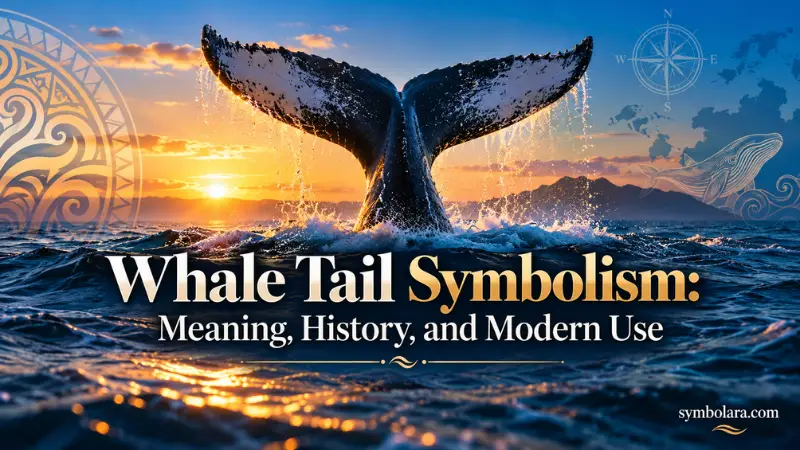
A whale’s tail rising above the ocean is one of the most recognizable sights in marine life. Its wide, curved shape appears on necklaces, tattoos, coastal artwork, and conservation signs. The image captures a brief moment when an enormous animal disappears beneath the water.
Whale tail symbolism commonly represents freedom, strength, protection, and a connection to the ocean. People also associate it with personal growth, family bonds, and respect for marine wildlife.
In American culture, the design has become especially familiar through whale watching, beach jewelry, environmental campaigns, and personal artwork. Its meaning depends on where it appears and why someone chooses it.
Quick Answer
Whale tail symbolism represents freedom, strength, resilience, protection, and a connection to the sea in modern American culture. These meanings draw from people’s observations of whales, older coastal traditions, and the environmental movement that helped transform whales into recognizable symbols of ocean conservation.
TL;DR
- Freedom: The tail suggests movement, independence, and open waters.
- Strength: Whales represent endurance and physical ability.
- Protection: Some cultural traditions connect whales with guidance and guardianship.
- Conservation: The image expresses concern for whales and ocean habitats.
- Personal meaning: Jewelry and tattoos often commemorate travel, change, or cherished memories.
What Does a Whale Tail Look Like, and Why Is It Recognizable?
A whale’s tail consists of two broad sections called flukes. Unlike the vertical tails of most fish, whale flukes extend horizontally from the animal’s body.
Whales move these flukes up and down to swim through water. The movement provides the force needed for travel, diving, and other activities.
Humpback whales are especially familiar for lifting their tails above the ocean before certain dives. For a few seconds, the flukes form a striking shape against the sky.
Several physical features make the tail easy to recognize:
- Two curved flukes: They form a shape resembling outstretched wings.
- Central notch: A small opening separates the two sides.
- Wide silhouette: Its balanced outline works well in jewelry and artwork.
- Natural markings: Some whales have distinctive black-and-white patterns beneath their tails.
- Visible movement: The tail may rise above the surface before the whale disappears underwater.
A humpback whale’s underside markings can help researchers recognize individual animals. These patterns, along with scars and the shape of the flukes, work much like identifying marks.
This gives the familiar image another interesting connection: individuality.
Although whale-tail artwork often uses a simple outline, the real animals have features that distinguish one from another.
What Does the Whale Tail Symbolize Today?
The tail carries several positive meanings in American jewelry, artwork, and personal expression. Most come from the animal’s behavior and the feelings people associate with the ocean.
Freedom and independence
Whales travel across enormous ocean areas, sometimes migrating thousands of miles between feeding and breeding grounds.
Their movement inspires ideas about independence, travel, and living beyond familiar boundaries.
Someone who wears a whale-tail necklace may associate it with the freedom to choose a different path in life.
Strength and resilience
A whale depends on its tail for movement through changing ocean conditions.
Because of this physical role, people sometimes interpret the shape as a reminder to keep moving despite challenges.
Its connection with resilience is a modern personal interpretation rather than a universal cultural rule.
Peace and calm
A whale descending below the surface can appear graceful and unhurried.
For people who enjoy the sea, the image may recall quiet mornings, open horizons, and time away from daily responsibilities.
Protection and belonging
Some people connect whales with guardianship, care, or family relationships.
These meanings can reflect cultural traditions or personal experiences. They should not be treated as beliefs shared by everyone.
The central idea is that the symbol can express both independence and connection.
Where Did Whale Tail Symbolism Come From?
There is no single documented event that established the whale tail as a universal symbol.
Its modern meanings developed through different traditions, changing attitudes toward whales, and the growing popularity of ocean-inspired designs.
For coastal societies, whales were important long before modern jewelry featured their tails.
People encountered whales through fishing, ocean travel, strandings, and hunting. Their enormous size made them important in practical life, stories, and artistic traditions.
During the eighteenth and nineteenth centuries, commercial whaling became a major industry in several American ports.
New Bedford, Massachusetts, was a particularly important whaling center.
At that time, whales appeared in maritime illustrations, records, decorative objects, and accounts of dangerous sea voyages. These images could represent economic activity, adventure, risk, or human relationships with the ocean.
They did not necessarily express the conservation meanings familiar today.
By the twentieth century, public attitudes were changing.
Scientific discoveries, wildlife photography, environmental education, and campaigns against commercial whaling encouraged more Americans to view whales as animals deserving protection.
The whale’s tail gradually became an appealing image for communicating that relationship.
However, the precise origin of the familiar tail-shaped pendant is not firmly established. Modern commercial designs should not automatically be described as direct copies of a single historical tradition.
Why the Whale Tail Matters in American Coastal Culture
For many Americans, the whale tail connects with experiences of the coast rather than a formal belief system.
A person visiting Cape Cod, Monterey Bay, or Hawaii may encounter the image on souvenirs, clothing, paintings, and signs advertising marine activities.
In these settings, it often represents an attachment to a particular place.
Whale watching provides an especially clear example.
When a humpback whale raises its flukes, passengers may recognize the moment as one of the highlights of their trip.
The animal then disappears beneath the surface, leaving only disturbed water behind.
That brief encounter can become a lasting memory.
A person might later choose a necklace or framed photograph to remember the experience.
The tail also fits naturally into American coastal design.
Its shape resembles a broad letter V, allowing artists to combine it with waves, sunsets, boats, and nautical patterns.
In beach communities, these designs help communicate a connection to marine life.
The meaning is often personal: a favorite vacation, childhood summers near the coast, or appreciation for living beside the water.
Unlike a national flag or an official emblem, the image has no single meaning that every American must recognize.
How the Whale Tail Became a Conservation Symbol
One of the most important changes in the whale’s public image occurred during the environmental movements of the 1960s and 1970s.
Campaigners raised concerns about declining whale populations and the effects of commercial hunting.
The phrase Save the Whales became widely recognized in environmental activism.
In 1972, the United States passed the Marine Mammal Protection Act, creating broad federal protections for marine mammals.
The International Whaling Commission later adopted a commercial whaling moratorium in 1982, which took effect during the 1985–1986 whaling seasons.
These developments helped change how the public viewed whales.
Instead of seeing them mainly as commercial resources, many Americans began to associate them with wildlife protection and responsibility for ocean habitats.
Photographs of humpback tails became useful visual reminders of the animals people wanted to protect.
Today, marine conservation efforts address threats such as fishing-gear entanglement, ship strikes, underwater noise, and changing ocean conditions.
A whale-tail design used by an environmental organization may therefore communicate a more specific message than the same image on casual beachwear.
It can represent support for scientific research, responsible wildlife viewing, or efforts to protect marine ecosystems.
Still, displaying the image does not prove that someone supports a particular conservation organization or policy.
Its meaning depends on the setting.
Whale Symbolism in Māori and Hawaiian Traditions
Whales have documented cultural importance in several Pacific societies. However, the meanings attached to whales should not be confused with a single, universal meaning for every whale-tail pendant.
Whales in Māori traditions
Among Māori communities of Aotearoa New Zealand, whales appear in ancestral accounts, traditional stories, and artistic practices.
One well-known tradition involves Paikea, an ancestor associated with riding a whale to safety. Particular versions belong to specific tribal communities.
Other accounts describe relationships involving whales as helpers, guardians, or valuable sources of food and materials.
Whalebone and whale teeth were also used to make important objects, including ornaments associated with status and authority.
These traditions demonstrate the cultural importance of whales.
However, it would be inaccurate to claim that every modern whale-tail necklace carries one fixed Māori meaning.
Specific designs, materials, and stories may have their own origins.
Whales in Hawaiian culture
Humpback whales, known in Hawaiian as koholā, have a long presence in Hawaiian waters and cultural knowledge.
The animals migrate from northern feeding areas to Hawaiian waters, where they breed and give birth.
Hawaiian place names, stories, and traditional imagery also record connections with whales.
Today, whale watching is an important activity in Hawaii, while conservation programs work to protect the animals and their habitats.
Some contemporary artists and jewelry makers connect whale imagery with safe journeys, returning home, or respect for the sea.
Those interpretations should not be presented as identical beliefs held across all Native Hawaiian families or communities.
The important distinction: Whales have cultural histories that deserve recognition, while the simplified tail silhouette also functions as a modern international design.
Why People Associate Whale Tails With Personal Growth and Protection
People often choose symbols because they resemble an experience they cannot easily describe in words.
The whale tail offers several possible connections.
A whale uses its flukes to move forward. Someone facing a difficult transition might see that movement as a reminder that progress remains possible.
This interpretation is especially common in personal artwork and gifts.
For another person, the image may represent reassurance.
Whales are large animals that can appear calm and controlled during ordinary movement. Some viewers interpret that appearance as strength without aggression.
Others think about relationships.
For example, humpback mothers care for their calves, while several other whale species maintain complex social relationships.
These observations can inspire associations with caregiving and belonging.
However, whale species differ greatly in their social behavior. It would be misleading to claim that all whales live in permanent family groups.
The emotional appeal of the tail also comes from memory.
Someone who spent childhood summers near the Pacific Ocean might connect the shape with familiarity and comfort.
A traveler may associate it with discovering a new place.
Someone who has experienced personal loss might choose it to remember a loved one who enjoyed the sea.
None of these personal meanings requires an established tradition.
Sometimes, the value of a symbol comes from a particular memory rather than a shared definition.
Whale Tail Tattoo Meaning and Personal Expression
Whale-tail tattoos are popular choices for people who prefer recognizable nature designs with room for personal interpretation.
The simple outline works in several sizes and artistic styles.
For some wearers, the tattoo represents independence or a desire to travel.
Others choose it to acknowledge a meaningful experience involving the ocean.
A whale-tail tattoo can also mark a change in life, such as finishing school, moving away from home, or beginning a new career.
In these cases, the whale’s movement becomes a personal comparison with moving forward.
Common design choices include:
- Minimalist outline: Often selected for its clean appearance and understated meaning.
- Tail above waves: Emphasizes an attachment to the ocean.
- Tail with flowers: May combine marine imagery with memories, relationships, or personal milestones.
- Tail with a compass: Can express travel, direction, or the search for a new destination.
- Realistic humpback flukes: Highlights appreciation for wildlife and marine biology.
Placement can influence how often the tattoo is seen, but no body location gives the image a universally accepted meaning.
For example, a small wrist tattoo is not automatically a sign of healing, and a larger shoulder design does not necessarily represent protection.
A tattoo’s meaning belongs primarily to the person wearing it.
Anyone considering a design inspired by a specific Indigenous tradition should learn about its origin and cultural context before using it.
What Does a Whale Tail Necklace Mean?
Whale-tail necklaces are familiar accessories in beach shops, ocean-themed jewelry collections, and handmade gift markets.
Their appeal comes partly from the shape itself.
Two curved flukes create a balanced design that is recognizable even when reduced to a small pendant.
Many necklaces feature polished silver, gold-colored metal, or other materials.
Some designs use blue stones or wave patterns to emphasize the ocean connection.
The meaning often changes with the reason for wearing or giving the piece.
A necklace purchased during a vacation may preserve the memory of a particular destination.
A gift between friends might represent a shared interest in marine wildlife.
Someone preparing for a move could choose the design as a reminder of confidence and independence.
Others simply enjoy the appearance.
There is no requirement to attach a personal message to the jewelry.
The following table shows how the same image can carry different associations in American settings.
| Context | Meaning in USA | Common Associations | Notes |
| Graduation gift | New opportunities | Independence, future plans | May mark the beginning of a new chapter |
| Memorial keepsake | Remembering someone | Love, shared experiences | Meaning comes from the person’s memories |
| Marine science classroom | Learning about wildlife | Curiosity, discovery | May accompany lessons about whale behavior |
| Coastal tourism sign | Regional identity | Local waters, recreation | Often identifies ocean-related activities |
| Fundraising merchandise | Support for marine protection | Research, public awareness | A purchase may benefit a particular cause |
These examples show why context matters.
A whale-tail necklace might carry emotional value for one person while remaining an attractive accessory for another.
Neither interpretation is automatically more correct.
Whale Tails in Home Decor, Art, and Modern Design
The whale-tail silhouette has become a familiar part of ocean-inspired design.
Its simple outline makes it suitable for wall art, pottery, decorative signs, and printed fabrics.
In American coastal homes, artists often combine whale tails with muted blue colors, natural wood, or illustrations of waves.
These combinations suggest the appearance and atmosphere of seaside places.
A framed photograph of a humpback tail can also preserve a real wildlife encounter.
Unlike an abstract drawing, the photograph records a particular animal at a particular moment.
The design appears in commercial branding as well.
Marine tourism businesses may use whale silhouettes to indicate whale-watching experiences or other ocean-related services.
Conservation groups can use similar images to make wildlife themes recognizable.
Meanwhile, clothing and accessories may feature the shape without making any environmental claim.
These differences matter because visual meaning changes with use.
A whale tail on a research organization’s poster carries a different message from the same outline on a beach towel.
The first may encourage concern for living animals. The second may simply suggest a relaxed coastal setting.
Both belong to the symbol’s modern American life.
Common Misunderstandings About Whale Tail Symbolism
Several popular explanations make whale-tail imagery seem more fixed than it really is.
Understanding these misconceptions helps separate cultural traditions from personal interpretations.
Misunderstanding 1: Every whale tail means protection.
Protection is one possible meaning, especially where people associate whales with guardianship.
However, a plain tail design does not automatically express this idea.
Misunderstanding 2: Whale tails have one universal Indigenous meaning.
Different communities maintain different traditions involving whales.
Modern jewelry descriptions sometimes combine these traditions into one simplified explanation.
That approach can overlook important differences.
Misunderstanding 3: A whale tail always represents a spiritual belief.
Many people choose the image for its connection to wildlife, travel, or coastal life.
It does not require a religious or spiritual interpretation.
Misunderstanding 4: All whale-tail imagery has conservation origins.
Whales appeared in artwork and cultural traditions long before modern environmental campaigns.
Conservation added an important association rather than creating every earlier meaning.
Misunderstanding 5: The phrase always refers to an animal.
In American fashion slang, whale tail can also describe a thong waistband visible above low-rise pants.
That clothing term refers to the resemblance between the waistband’s shape and a whale’s tail.
It is separate from the meaning of marine-life tattoos and jewelry.
Recognizing the context prevents confusion when the same phrase appears in different conversations.
How Whale Tail Meaning Has Changed Over Time
The meaning of whale imagery has shifted as people’s relationships with the ocean have changed.
In earlier coastal societies, whales often had practical importance through food, materials, travel, and traditional knowledge.
Some communities also developed stories and artistic forms that expressed their particular relationships with these animals.
During the American commercial whaling era, whale images frequently reflected the industry and its maritime setting.
The twentieth century introduced another major association.
Public concern about whale populations helped turn the animal into a recognizable conservation emblem.
Whale watching, wildlife documentaries, and marine research also gave more people opportunities to appreciate living whales.
By the late twentieth and early twenty-first centuries, simplified tail designs had become familiar in jewelry, souvenir shops, and decorative artwork.
Today, in 2025–2026, the image continues to serve several purposes at once.
For one person, it may represent environmental concern. For another, it recalls a trip to Hawaii or a childhood spent along the Atlantic Coast.
Younger wearers may also use the design as a simple expression of their personal style without knowing its broader history.
This variety reflects how symbols change when they move between cultural traditions, public campaigns, and everyday objects.
The whale tail has no single historical meaning that cancels out every other interpretation.
Instead, its uses have expanded as more people encounter whales through photography, travel, education, and art.
FAQs
Some people wear whale-tail jewelry as a personal good luck charm, especially when traveling or starting something new. However, there is no universal tradition requiring the symbol to bring good fortune, and individual beliefs vary.
The whale tail is not an established biblical emblem with a specific traditional definition. Although the story of Jonah involves a great fish, the biblical text does not identify its tail as a separate symbol.
An upside-down tail does not have a widely recognized, fixed meaning. Artists may change its orientation to show movement, create a balanced design, or fit a particular piece of jewelry or artwork.
Whales and dolphins both have horizontal tail flukes, so simplified designs may look similar. A dolphin-tail image may be associated with playfulness or social interaction, while a whale-tail design more often emphasizes large marine animals and the open ocean.
No. Humpback whales often display their flukes before certain dives, making them especially familiar to whale watchers. Other species may dive without raising their tails clearly above the surface.
A generic whale-tail shape is not automatically disrespectful. However, jewelry that reproduces a culturally specific design deserves more care, especially when sellers claim that it represents a particular Indigenous tradition without explaining its origin.
Yes, someone may choose the design to mark a personal achievement or recovery from a challenging period. Still, that interpretation cannot be assumed from appearance alone; the wearer may have chosen it for an entirely different reason.
Conclusion
Whale tail symbolism brings together several familiar ideas: freedom, resilience, protection, ocean conservation, and personal connection. Its modern meanings reflect the whale’s natural movement, the history of human relationships with marine life, and the memories people attach to coastal places.
The design does not have one universal interpretation. A whale-tail necklace may recall a family vacation, while a tattoo may celebrate independence or a love of wildlife.
A real whale’s tail appears above the water for only a short moment. Yet that brief sight can become a lasting image in a photograph, a piece of jewelry, or someone’s personal story.