Red Shouldered Hawk Symbolism centers on alertness, protection, clear perception, and the need to pay attention to what is happening close to home. Unlike eagles, which often represent national ideals, the red-shouldered hawk feels more local and immediate: a bird of wooded neighborhoods, river corridors, wetlands, and suburban edges.
People often notice this hawk because of its piercing call, barred reddish chest, broad wings, and bold presence in trees. It is not usually a distant symbol on a flag or seal. It is a living sign people may encounter while walking near woods, driving past wetlands, or hearing its call above a backyard.
In modern American culture, the red-shouldered hawk often becomes meaningful when someone sees it repeatedly, chooses it for a tattoo, associates it with a loved one, or reads its appearance as a reminder to stay observant. Its symbolism comes from both natural behavior and older human associations with hawks as watchful birds of prey.
Quick Answer
Red Shouldered Hawk Symbolism commonly represents awareness, protection, focus, and paying attention to signs in your immediate environment. Historically, hawks have also been associated with vision, guardianship, hunting skill, spiritual messengers, and the ability to see situations from a higher perspective.
TL;DR
- Red-shouldered hawks symbolize alertness and protection.
- Their call makes them symbols of warning.
- In the U.S., they suggest wildness near home.
- Hawk meanings often come from sight and flight.
- Tattoos usually express focus, freedom, or resilience.
- Misuse happens when people generalize Indigenous meanings.
What the Red-Shouldered Hawk Looks Like
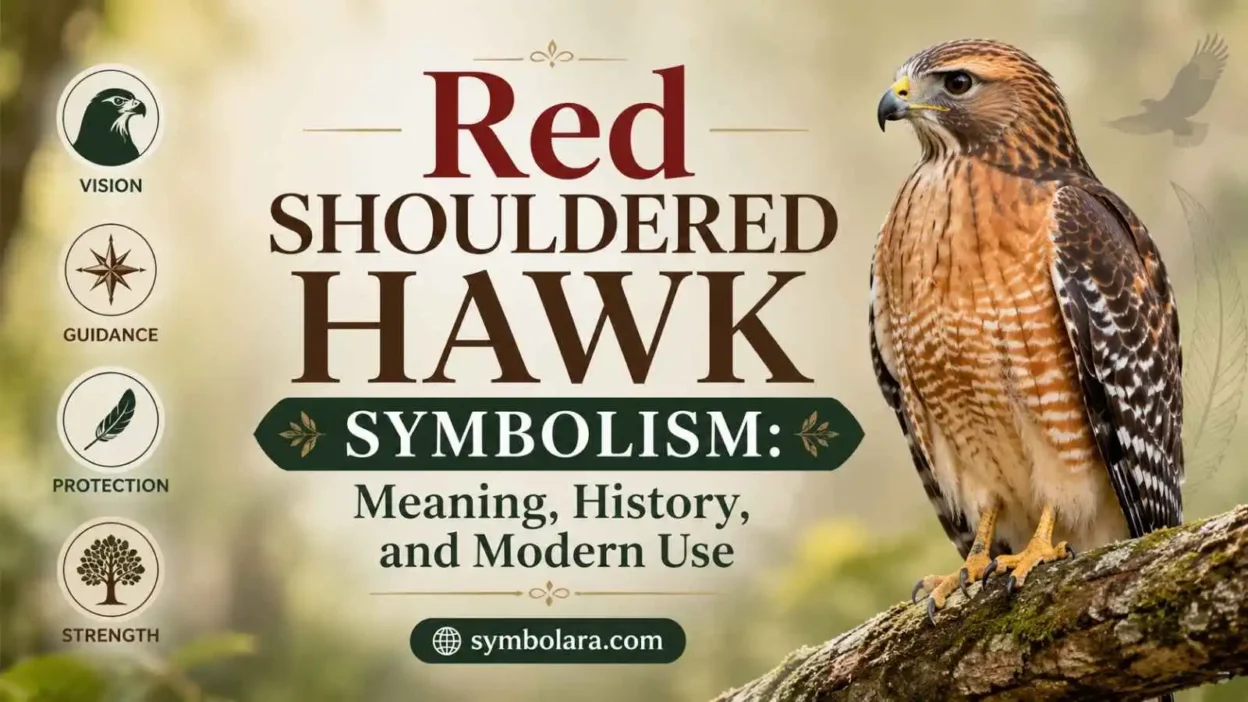
The red-shouldered hawk is a medium-sized North American raptor with warm reddish barring across the chest, dark-and-white banding on the tail, and broad wings suited for forested landscapes. In flight, it often shows pale crescent-shaped marks near the wingtips, which can help birders identify it. It is strongly associated with tall woods, wooded streams, swamps, and other areas where trees and water meet.
Its appearance matters symbolically because it combines two impressions at once. The warm red shoulder and chest suggest vitality, courage, and emotional intensity, while the hawk’s sharp profile suggests precision and control. People rarely describe this bird as soft or passive. Its body language reads as alert, still, and ready.
Many Americans first notice the species by sound rather than sight. Its clear, repeated call can cut through a quiet neighborhood or wooded park. That voice gives the bird much of its symbolic association with warning, announcement, and messages that should not be ignored.
What It Commonly Means in the United States
In the United States, the red-shouldered hawk most often symbolizes watchfulness, personal awareness, and protection of one’s territory. Because it is commonly seen around wooded neighborhoods and wetlands, many people connect it with home, boundaries, and the feeling that nature is closer than expected.
Unlike the bald eagle, which carries official national symbolism, this hawk tends to feel personal. A person may see it on a fence, hear it during a difficult week, or notice it returning to the same trees year after year. That repeated presence can turn the bird into a private emblem of endurance or guidance.
Its meaning is also shaped by its hunting behavior. Hawks scan, wait, and strike when the moment is right. For that reason, the red-shouldered hawk often represents patience before action rather than impulsive force. It suggests the value of observing carefully before making a decision.
Why Vision Is Central to Hawk Symbolism
Nearly all hawk symbolism begins with eyesight. Hawks are predators that rely on keen vision, distance judgment, and quick response. Human beings have long translated that physical ability into symbolic meanings such as insight, foresight, strategy, and truth-seeing.
For the red-shouldered hawk, this symbolism is especially tied to the wooded edge. It does not simply soar over open country; it often watches from trees, scans clearings, and moves through habitats where visibility is broken by branches and shadow. Symbolically, that makes it a bird of noticing what is partly hidden.
This is why people often interpret a hawk sighting as a reminder to look more carefully. The meaning is not necessarily supernatural. It may be psychological: the bird becomes a visual cue to pause, assess, and pay attention to details that were easy to overlook.
The Symbolism of Its Call
The red-shouldered hawk’s call is one of its most memorable traits. Bird guides often describe the species as a hawk that is heard before it is seen, especially in spring. Its loud, repeated cry can announce territory, signal presence, or draw attention across wooded areas.
Symbolically, that call gives the bird a meaning different from silent predators. It is more than just a watcher; it is also a communicator. Through its calls, it announces its presence, captures attention, and encourages people to pause and notice what is happening around them.
In personal symbolism, this can represent a warning, a wake-up call, or the need to speak clearly. For someone going through confusion, the red-shouldered hawk may feel like a symbol of directness: stop drifting, pay attention, and name what is happening.
Connection to Home, Territory, and Boundaries
Red-shouldered hawks are strongly connected with wooded territories. They often return to suitable habitats and may be seen repeatedly in the same general area. This gives them a natural link to boundaries, defended space, and familiar ground.
In American neighborhoods near forests, creeks, and wetlands, seeing one can feel like a reminder that human property lines are not the only boundaries that matter. The hawk belongs to an older map: tree lines, nesting areas, hunting routes, water sources, and seasonal movement.
For symbolic interpretation, this makes the bird especially meaningful for people thinking about home, protection, and personal space. It can represent the need to defend what matters without becoming aggressive. The hawk watches first. It acts when necessary.
Historical Roots of Hawk Meaning
Hawk symbolism did not begin with one culture or one text. Across many societies, birds of prey gained meaning because they occupied the sky, hunted with skill, and saw from heights humans could not reach. Flight linked them with distance and perspective; talons linked them with power; eyesight linked them with knowledge.
In ancient Egypt, falcon imagery was closely associated with Horus, a sky god connected with kingship, protection, power, and the sun and moon through the symbolism of his eyes. While Horus was specifically falcon-shaped rather than a red-shouldered hawk, the broader pattern is important: raptors often became symbols of authority because they ruled the air visually and physically.
In European and Mediterranean traditions, hawks and falcons were also connected with hunting, nobility, omen-reading, and disciplined control. Falconry reinforced the idea that raptors represented trained focus and elite skill. Over time, those older associations blended into modern meanings of precision, freedom, and higher perspective.
Native American and Indigenous Contexts
Many Native American traditions give birds of prey important roles, but it is important not to flatten hundreds of distinct cultures into one meaning. Hawks may be associated with messages, vision, protection, courage, or connections between earthly and spiritual realms, depending on the specific nation, story, ceremony, and context. Generalized claims can easily become misleading.
In the United States today, this is one of the most common areas where hawk symbolism is misused. Online descriptions often treat “Native American hawk meaning” as if it were a single belief system. A more respectful approach is to say that some Indigenous traditions honor hawks and other raptors, while recognizing that meanings vary and may be connected to living communities rather than public decoration.
There is also a legal and ethical dimension. In the U.S., many native birds, including raptors, are protected under federal law, and possessing feathers or bird parts is restricted without authorization. The Migratory Bird Treaty Act prohibits taking, killing, selling, transporting, or possessing protected migratory birds except as legally allowed.
Red Shouldered Hawk Symbolism in Native American Culture
Red shouldered hawk symbolism in Native American culture requires a respectful and specific approach because Indigenous nations have different traditions, stories, and relationships with birds of prey.
Across some Indigenous traditions, hawks are respected as birds connected with awareness, observation, courage, and messages. Their ability to fly high and see across great distances has often made them powerful symbols of perspective and attention. However, there is no single “Native American hawk meaning” shared by every tribe or nation.
The red-shouldered hawk itself is a specific species found across parts of North America. Its symbolism may connect with broader hawk meanings, but interpretations depend on location, community, oral traditions, and cultural context.
Today, many people appreciate the red-shouldered hawk as a reminder to respect nature, protect wildlife, and understand that animal symbolism comes from living relationships rather than simple definitions.
For a respectful interpretation, it is better to focus on the bird’s real qualities: sharp vision, patience, territorial awareness, and connection to the natural world.
Christian and Spiritual Interpretations
The red-shouldered hawk is not a central Christian symbol in the way doves, lambs, fish, or eagles are. Still, some modern Christians interpret hawks through broader biblical themes: watchfulness, discernment, wilderness, and the need to remain spiritually alert.
Because hawks are predators, their symbolism can feel more severe than gentle bird imagery. A dove may suggest peace; a hawk suggests attention. For some readers, that difference matters. The hawk does not comfort by softness. It reminds by sharpness.
In contemporary spiritual writing, seeing a hawk is often described as a sign to trust perception, rise above confusion, or watch for guidance. These interpretations are modern and personal rather than universal doctrine. They can be meaningful, but they should not be presented as fixed religious rules.
Emotional and Psychological Meaning
Emotionally, the red-shouldered hawk often represents the moment when a person becomes more aware of their surroundings. It can symbolize waking up from distraction, recognizing a pattern, or seeing a situation more honestly.
Psychologically, hawk imagery appeals to people who value independence and self-command. The bird is not frantic. It waits, watches, and moves with purpose. That makes it a strong symbol for people trying to become less reactive and more deliberate.
There is also a protective emotional quality. Because the hawk is territorial and attentive, people may associate it with guardianship: watching over family, land, memory, or personal identity. This is especially common when someone links a hawk sighting with grief, transition, or the presence of a loved one in memory.
Red Shouldered Hawk Meaning in Love and Relationships
In relationship symbolism, the red-shouldered hawk often represents loyalty, protection, and awareness. Because these birds form strong connections with their territories and partners, some people associate them with commitment and staying attentive to what matters.
The hawk’s symbolism in love is less about romance alone and more about responsibility. It suggests watching over a relationship, communicating clearly, and noticing small changes before problems grow.
For some people, seeing a red-shouldered hawk during an important relationship moment becomes a personal reminder of trust, patience, or emotional strength. This meaning comes from individual experience rather than a fixed rule.
As a symbol, the hawk encourages people to combine independence with care maintaining personal strength while protecting meaningful connections.
Red Color and Shoulder Symbolism
The “red-shouldered” name adds a layer of meaning that general hawk symbolism does not have. Red commonly suggests vitality, courage, urgency, passion, danger, and life force in American color psychology. On this bird, the reddish coloring is not theatrical; it is woven into its natural pattern.
The shoulder area also carries symbolic weight. In human language, shoulders suggest responsibility, burden, strength, and carrying what must be carried. This makes the red-shouldered hawk easy to interpret as a symbol of courageous responsibility: not reckless aggression, but alert readiness.
Of course, the bird did not evolve its coloring for human symbolism. The meaning comes from how people read physical traits through human experience. Still, that reading explains why this species can feel more emotionally vivid than a gray or brown bird of similar size.
Meaning in Dreams and Repeated Sightings
Dreams involving red-shouldered hawks are often interpreted through themes of awareness, perspective, boundaries, and moments that require careful judgment. A hawk perched in a tree may represent observation, patience, or the need to pay closer attention. Hearing a hawk’s call in a dream may suggest a message, warning, or insight that has been overlooked. When the hawk appears flying overhead, it can symbolize the importance of stepping back and viewing a situation from a broader perspective.
Repeated sightings often feel more meaningful than a single encounter. In ordinary life, repetition creates significance. If a person hears or sees the same hawk during a period of uncertainty, the bird may become associated with that season of life.
The best interpretation depends on context. A peaceful sighting near home may symbolize protection or belonging. A startling call during stress may feel like a warning. A hawk appearing after a loss may become part of remembrance. The bird’s meaning is shaped by both its behavior and the viewer’s emotional state.
What Does a Red Shouldered Hawk Mean as a Spirit Animal?
For people who use animal symbolism as a personal reflection tool, the red-shouldered hawk often represents awareness, patience, and the ability to recognize important details.
Its behavior offers several symbolic lessons. The hawk does not rush constantly. It watches, waits, and acts when the right moment appears. Because of this, many people connect it with thoughtful decisions and emotional control.
A red-shouldered hawk spirit animal interpretation may encourage someone to:
- Pay closer attention to their surroundings
- Trust their ability to recognize patterns
- Protect their personal boundaries
- Take action after careful observation
- Stay connected with nature
These interpretations are personal rather than universal beliefs. The meaning someone finds in a hawk depends on their own experiences, culture, and relationship with the natural world.
Red-Shouldered Hawk Symbolism by Context
| Context | Meaning in the USA | Common Associations | Notes |
| Backyard sighting | Awareness close to home | Protection, boundaries, attention | Often feels personal and immediate |
| Tattoo | Focus and independence | Vision, courage, resilience | Usually chosen for identity symbolism |
| Dream | Need for perspective | Warning, insight, decision-making | Meaning depends on dream mood |
| Repeated call | Wake-up message | Alertness, announcement, urgency | The sound often shapes interpretation |
| Wetland or forest encounter | Wildness nearby | Habitat, balance, hidden life | Connects the symbol to place |
Tattoos and Personal Style
As a tattoo, the red-shouldered hawk often represents sharp perception, independence, survival, and the courage to trust one’s instincts. People who choose hawk tattoos often want something more grounded than a fantasy creature but more intense than a decorative bird.
A realistic red-shouldered hawk tattoo can emphasize connection to North American wildlife, especially for someone from the eastern U.S., Florida, California, or wooded suburban areas where the species is familiar. A more stylized design may focus on the eye, wings, talons, or reddish shoulder markings.
The tattoo meaning can also be memorial. Some people associate hawks with loved ones because a hawk appeared during a funeral period, anniversary, move, illness, or major life change. In that case, the tattoo may symbolize watchful presence rather than the bird alone.
Jewelry, Decor, and Digital Culture
In jewelry and home decor, hawk imagery usually signals independence, protection, and a connection to wild landscapes. A red-shouldered hawk design may appeal to birders, nature lovers, conservation-minded homeowners, or people who want an emblem of alert calm.
In digital culture, hawk sightings often appear in photos, short videos, neighborhood groups, and social media posts. People share them because the bird feels dramatic without being exotic. It is impressive, but still local. That balance makes it a strong modern symbol of everyday wildness.
The rise of backyard birding has also changed how Americans interpret birds of prey. More people now identify specific species rather than saying “a hawk.” That specificity matters. A red-shouldered hawk is not just a generic predator; it is tied to woods, water, sound, and repeated neighborhood presence.
Conservation Meaning in Modern America
The red-shouldered hawk also carries environmental symbolism. Because it depends heavily on wooded and wetland habitats, it can represent the health of local ecosystems. Clearing forests, draining wetlands, and fragmenting habitat can affect where the bird thrives, even though it remains present in many areas.
For Americans in 2025–2026, this gives the hawk a modern civic meaning. It reminds people that wildlife is not separate from zoning, development, pesticide use, water quality, and tree preservation. A hawk calling from a suburban woodlot can become a sign of what still survives at the edge of human expansion.
This meaning is not sentimental. Raptors need prey, nesting places, and safe habitat. When people read the red-shouldered hawk as a symbol of balance, that symbolism is grounded in real ecological dependence.
Negative Meanings and Common Fears
Because hawks are predators, some people associate them with danger, aggression, or loss. Backyard chicken keepers, small-pet owners, and hunters may view raptors with anxiety. This fear is understandable, but it can lead to distorted symbolism when hawks are treated as villains.
In symbolic terms, the red-shouldered hawk does not usually represent cruelty. It represents natural order, survival, and attentiveness. Predation can be uncomfortable to watch, but it is part of ecological balance.
A more balanced negative interpretation would be intensity without compassion, over-vigilance, or the feeling of being watched. If the bird appears in a tense dream or story, it may symbolize pressure, scrutiny, or a warning that something needs to be confronted.
Misunderstandings and Misuse
The most common misuse of hawk symbolism is treating all hawks, eagles, falcons, and vultures as interchangeable. Each bird carries different associations. Eagles often suggest national identity and grandeur. Falcons often suggest speed and trained precision. Vultures suggest death, cleanup, and transformation. The red-shouldered hawk is more closely tied to local watchfulness, wooded territory, and vocal warning.
Another misuse is claiming that the bird has one universal spiritual meaning. Symbolism changes with culture, place, and personal experience. A birder, a tattoo artist, a Native elder, a suburban homeowner, and a grieving person may all understand the hawk differently.
There is also the issue of illegal harm and trade involving raptors. Recent U.S. cases involving the killing or trafficking of hawks and eagles show how reverence for birds of prey can be contradicted by exploitation, black-market demand, or conflict with human land use. The symbolic lesson is clear: honoring a hawk should include respecting the living bird and the laws that protect it.
Red Shouldered Hawk Symbolism vs Red Tailed Hawk Symbolism
Although red-shouldered hawks and red-tailed hawks share some symbolic meanings, they represent different qualities because they live and behave differently.
The red-shouldered hawk is strongly connected with wooded areas, wetlands, and familiar territories. Its symbolism often focuses on awareness, protection, communication, and paying attention to what happens nearby.
The red-tailed hawk is more commonly associated with open skies, wide landscapes, freedom, and broad perspective because it often appears soaring above fields and mountains.
| Hawk TypeCommon Symbolic Meaning in the USANatural Association | ||
|---|---|---|
| Red-shouldered Hawk | Awareness, protection, alertness | Forests, wetlands, wooded neighborhoods |
| Red-tailed Hawk | Freedom, vision, strength | Open fields and large skies |
| Both Hawks | Focus, patience, perspective | Sharp eyesight and hunting skill |
Understanding the difference helps avoid treating every hawk as the same symbol. Each species creates its own connection between nature and human interpretation.
How Its Meaning Has Changed Over Time
Older hawk symbolism often emphasized omens, hunting, nobility, divine messages, and sky power. These meanings came from a world where raptors seemed closer to gods, rulers, and warriors because they moved above human life and struck with visible force.
Modern American meaning is more personal and ecological. Today, many people read a red-shouldered hawk as a sign of awareness, resilience, habitat, and connection to place. The bird is less likely to be treated as a royal emblem and more likely to be understood through backyard encounters, birding, tattoos, and nature photography.
This change reflects a broader cultural shift. Americans increasingly interpret animal symbols through psychology and conservation rather than only myth. The hawk still means vision and power, but it also means paying attention to the living world nearby.
FAQs
What does seeing a red-shouldered hawk mean?
Seeing a red-shouldered hawk often symbolizes awareness, protection, and the need to pay closer attention to your surroundings. In a practical sense, it may also mean you are near wooded or wetland habitat where the bird hunts or nests.
Is a red-shouldered hawk a good omen?
Many people interpret it as a positive sign of clarity, courage, and guidance. It can also feel like a warning if the call or sighting happens during a stressful moment, but the warning usually points to awareness rather than bad luck.
What does a red-shouldered hawk tattoo mean?
A red-shouldered hawk tattoo usually represents focus, independence, protection, and trust in one’s own perception. It may also honor a personal encounter with the bird or symbolize a loved one remembered through hawk sightings.
What is the spiritual meaning of a red-shouldered hawk?
Spiritually, it is often understood as a messenger of alertness, perspective, and discernment. This is a modern personal interpretation rather than a single universal belief shared by all cultures.
Does the red shoulder change the symbolism?
Yes. The reddish coloring adds associations with courage, vitality, urgency, and emotional strength. The “shoulder” part of the name can also suggest responsibility, protection, and carrying what matters.
Is red-shouldered hawk symbolism the same as red-tailed hawk symbolism?
They overlap, especially in meanings of vision, freedom, and awareness, but they are not identical. Red-tailed hawks are often associated with open skies and broad soaring, while red-shouldered hawks feel more connected to wooded places, water, territory, and vocal warning.
Are red-shouldered hawks protected in the United States?
Yes. Like many native raptors, they are protected under federal migratory bird law. This means people should not harm them, capture them, sell them, or keep feathers or parts without proper authorization.
Are red shouldered hawks considered spiritual signs?
Some people interpret red-shouldered hawk sightings as spiritual reminders of awareness, guidance, or protection. These meanings are personal beliefs rather than universal rules shared by every culture.
Conclusion
The red-shouldered hawk symbolizes alertness, protection, clear sight, and the importance of noticing what is happening close to home. Its meaning comes from its real behavior: watching from trees, calling sharply through wooded areas, defending territory, and living at the meeting point of forest and water.
Red Shouldered Hawk Symbolism is strongest when understood through both culture and nature. It is not just an abstract emblem of freedom; it is a specific American bird with a specific voice, habitat, and presence.
To see one is to be reminded that awareness is not passive. Sometimes it means looking up, listening closely, and recognizing the signs already moving through the world around you.