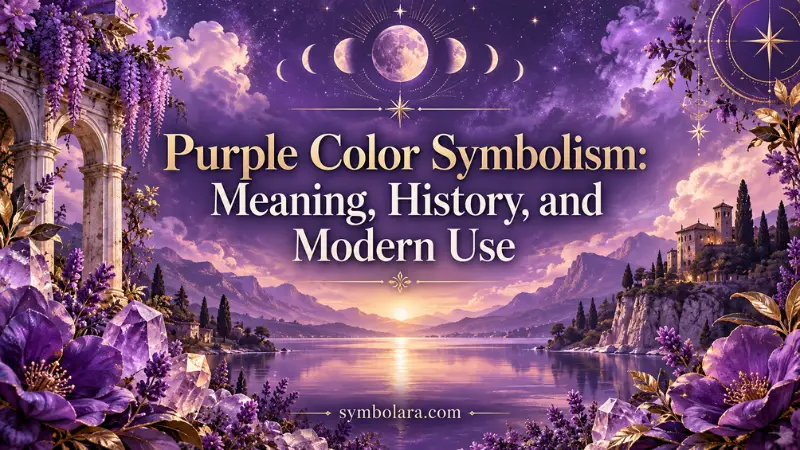
Purple once marked the clothing of emperors, but today it appears on everything from graduation decorations to bedroom walls. Its connection to royalty began partly because certain purple dyes were difficult and expensive to produce.
Purple color symbolism now includes royalty, luxury, creativity, individuality, and spiritual reflection. The shade can feel elegant, peaceful, bold, or playful, depending on how people use it.
Americans encounter purple in fashion, sports, religious traditions, awareness campaigns, and personal celebrations. A purple ribbon may express support for a cause, while a lavender room may create a gentle, welcoming atmosphere.
Understanding the color means looking at both its history and its surroundings. Purple does not communicate one fixed message. Its meaning changes with the shade, culture, occasion, and person choosing it.
Quick Answer
Purple color symbolism commonly represents royalty, luxury, creativity, wisdom, individuality, and spiritual reflection. Its association with status developed partly from the high cost of purple dyes used by Mediterranean elites and rulers. Today, Americans also connect purple with personal expression, dignity, imagination, and meaningful causes.
TL;DR
- Purple commonly represents royalty, luxury, creativity, and individuality.
- Expensive historical dyes helped establish its connection to wealth.
- Lavender often suggests gentleness, while violet can suggest reflection.
- American suffragists used purple to represent loyalty to their cause.
- Purple appears in religious observances, awareness campaigns, fashion, and art.
- Its meaning depends on the shade, setting, and cultural background.
What Does the Color Purple Look Like?
Purple occupies the space between red and blue in many everyday color systems. Its appearance ranges from pale lavender to dark plum, with some shades leaning toward red and others toward blue.
You can recognize purple in violet flowers, amethyst gemstones, grapes, irises, and certain sunset skies. These natural examples help explain why people associate different purples with beauty, softness, and unusual visual character.
Purple also appears in several familiar shades:
- Lavender: A soft, pale purple commonly linked with tenderness and calm.
- Violet: A blue-leaning purple often associated with imagination and reflection.
- Lilac: A gentle purple with a light, romantic appearance.
- Plum: A darker, reddish purple that often suggests maturity and elegance.
- Royal purple: A saturated shade commonly associated with authority and luxury.
- Mauve: A muted purple with a subtle, understated appearance.
Technically, violet is also a spectral color, while many colors called purple result from combining red and blue light. However, people often use the names interchangeably in clothing, decorating, and everyday conversation.
The exact shade matters because a pale lavender sweater communicates something different from a dark purple ceremonial robe.
Why Does Purple Symbolize Royalty and Luxury?
Purple’s association with royalty comes partly from the difficulty of producing certain purple dyes in the Mediterranean world.
One famous example was Tyrian purple, a dye traditionally made from secretions of certain marine snails. Producing usable quantities required considerable labor and many snails, making the process expensive.
Phoenician communities became especially known for purple dye production. Archaeological evidence also points to earlier purple dye production elsewhere in the eastern Mediterranean, so its exact beginnings should not be credited to one location without qualification.
As purple textiles became desirable luxury goods, rulers and wealthy families used them to display status.
Roman emperors later strengthened this association through ceremonial clothing and restrictions on certain imperial garments. Byzantine imperial traditions also treated particular purple fabrics and garments as signs of authority.
The meaning developed through a visible connection between clothing and social position. Most people could not easily obtain these valuable textiles, while privileged groups could.
Modern purple clothing no longer requires costly marine dyes. Still, the historical association survives.
A dark purple velvet jacket, an amethyst necklace, or purple-and-gold packaging can still suggest elegance and importance.
Purple symbolizes luxury today because generations of people learned to associate certain purple materials with wealth, formal clothing, and respected positions.
What Does Purple Mean in American Culture Today?
In modern American culture, purple can communicate individuality, dignity, sophistication, or personal creativity.
Its meaning often depends on where someone encounters it.
A person wearing purple at a formal dinner may appear confident and stylish. The same color on a child’s birthday invitation may suggest imagination and excitement.
Purple also has recognizable roles in American public life.
College and professional sports teams use purple in uniforms, logos, and fan merchandise. For example, the Minnesota Vikings use purple as a central part of their team identity.
In those settings, purple represents shared loyalty and belonging rather than royal authority.
The color also appears in community events, awareness campaigns, and celebrations. People may wear purple clothing to show support for a particular group or cause.
American audiences have also encountered purple through popular music and entertainment. Prince’s 1984 album and film Purple Rain helped make the color closely associated with his artistic identity.
For many listeners, purple in that context suggests emotional expression, creative freedom, and memorable performance.
These examples show how a color can gain new associations through repeated public use.
Royal history remains part of purple’s identity, but American culture has given it meanings that extend far beyond wealth.
Purple in Women’s Rights and American History
Purple holds a documented place in the history of women’s voting rights.
During the early twentieth century, American suffrage campaigners used colors to communicate their goals and identify supporters.
The National Woman’s Party adopted purple, white, and gold as its identifying colors.
In a 1913 explanation, the organization associated purple with loyalty, constancy, and commitment to its cause.
White represented purity of purpose, while gold suggested light and guidance.
Supporters displayed the colors on banners, sashes, flags, and other campaign materials.
Purple helped turn political commitment into something visible. Someone watching a suffrage procession could recognize a shared message without reading every banner.
The American color combination was influenced by British suffragettes, who had used purple, white, and green.
However, not every American suffrage organization used the same colors. Gold and white also had separate histories within the movement.
The Nineteenth Amendment was ratified in 1920, prohibiting the denial of voting rights on the basis of sex, although discriminatory barriers continued to prevent many women from voting.
Purple’s place in this history gives it another meaning: determination toward a shared goal.
Today, historical displays and women’s rights commemorations sometimes use purple to recall that commitment.
What Does Purple Symbolize Spiritually?
Purple often represents reflection, devotion, dignity, and preparation in religious or spiritual settings.
These meanings come from particular traditions rather than from any proven property of the color itself.
In many Western Christian churches, purple or violet appears during Advent and Lent.
Advent marks a period of preparation before Christmas, while Lent is traditionally associated with repentance, prayer, and preparation for Easter.
Purple vestments, altar coverings, and other church decorations can indicate these seasons.
Some churches use blue during Advent, and practices differ among Christian denominations.
Purple’s religious meaning also connects with its older association with royal clothing.
In Christian art, purple garments may suggest kingship, authority, or the suffering of Jesus, depending on the scene.
For someone outside these traditions, purple may simply feel quiet or contemplative.
People sometimes choose purple candles, journals, or decorative objects for personal reflection because they associate the color with thoughtfulness.
Such choices express personal or cultural beliefs. They do not establish that purple changes spiritual experiences or produces special effects.
Its significance comes from the meaning people give it.
Purple Symbolism Across Different Cultures
Purple does not carry the same meaning in every society. Its interpretation depends on historical clothing practices, religious traditions, and local customs.
Ancient Rome and Byzantium
Certain purple textiles became signs of imperial rank.
Roman and Byzantine rulers used them to communicate authority, privilege, and ceremonial importance.
This history helped shape the modern Western connection between purple and royalty.
Japan
In parts of Japanese history, purple dyes and garments were associated with high rank and the imperial court.
Purple also became important in clothing, decorative arts, and traditional color systems.
However, Japanese purple shades have different names and cultural uses. They should not all be reduced to a single meaning.
Thailand
Purple is associated with Saturday in traditional Thai weekday color customs.
People born on Saturday may identify purple as their birth-day color within that tradition.
The association is cultural and conventional rather than a universal rule about personality.
Western Christian Traditions
Purple has a ceremonial role during particular religious seasons.
Its meaning is connected to the church calendar and established practices, not simply to personal color preferences.
These examples show why interpreting purple requires cultural context.
A purple garment worn for rank, a church decoration used during Lent, and a birthday color in Thailand may look similar while communicating different messages.
The Emotional and Psychological Meaning of Purple
Purple can suggest creativity, confidence, comfort, or thoughtfulness. However, people’s emotional responses to color vary.
Psychologists study color preferences and associations, but there is no reliable rule that a particular shade produces the same feeling in everyone.
Personal memories, cultural habits, brightness, and surrounding colors can all influence the response.
Someone who associates lavender with a family garden may find it comforting. Another person may connect the same shade with a hospital room or an unpleasant memory.
Purple’s appearance also helps shape its emotional character.
Blue-leaning shades may look cooler and more restrained. Red-leaning purples can appear warmer or more dramatic.
Dark purple often feels formal when paired with black, gray, or gold. Lighter shades tend to look softer beside white or cream.
Designers use these visual relationships to create a mood, but the effect is not automatic.
A purple room will not necessarily make someone creative, and wearing purple does not prove that someone is confident.
Instead, the color offers a way to communicate an intended feeling.
People choose it because they enjoy how it looks, what it reminds them of, or what they want others to understand.
What Different Shades of Purple Represent
A shade can change the way purple is understood, even when the basic color remains recognizable.
| Context | Meaning in USA | Common Associations | Notes |
| Lavender wedding decorations | Gentle affection | Romance, spring, tenderness | Often paired with white or sage |
| Royal purple clothing | Formal elegance | Ceremony, confidence, status | Gold accents strengthen the formal look |
| Plum home furnishings | Comfort and maturity | Warmth, traditional style | Works well with wood and neutral tones |
| Violet artistic designs | Original expression | Imagination, experimentation | Common in colorful digital artwork |
| Purple graduation gifts | Achievement and pride | Success, celebration, school identity | Meaning may depend on school colors |
| Purple memorial ribbons | Remembrance or support | Respect, solidarity, awareness | The specific cause must be identified |
Color combinations also affect interpretation.
Purple and gold often look ceremonial. Purple and pink can feel playful or romantic. Purple and black may suggest drama, while purple and white can create a clean, gentle contrast.
There is no official rule that assigns every shade a single emotion.
The most useful interpretation considers the color, surrounding details, and occasion together.
Why Purple Is Popular in Fashion and Jewelry
Purple gives people a way to stand out without relying only on bright red or traditional neutral colors.
Its wide range of shades makes it suitable for casual clothing, business outfits, and formal events.
Lavender shirts and dresses can create a soft, relaxed appearance. Plum coats and dark violet accessories often feel more formal.
A purple scarf may serve as the main color in an otherwise neutral outfit.
Fashion trends change, but purple’s versatility helps it remain a familiar choice.
Jewelry adds another layer of meaning.
Amethyst, a purple variety of quartz, is the traditional February birthstone. Its color ranges from light lilac to saturated violet.
People may select amethyst jewelry because of its appearance, family connections, birth month, or personal significance.
Purple gemstones can also symbolize affection and remembrance when given as gifts.
For example, someone might give an amethyst pendant to celebrate a February birthday. In that case, the personal occasion is more important than any general interpretation of purple.
Purple jewelry does not have to communicate royalty or spirituality.
Sometimes it simply represents a favorite color, a meaningful relationship, or a cherished memory.
What Does Purple Mean in Art and Literature?
Artists and writers use purple to create atmosphere, develop character, and direct attention.
The meaning depends on the details surrounding the color.
In a painting, purple shadows may make a landscape appear cooler or suggest evening light.
Artists working with contrasting colors sometimes place purple near yellow to create a noticeable visual difference.
In fiction, a character wearing an expensive purple coat might appear wealthy or socially important. A room painted pale lilac could establish a quieter, more personal setting.
However, the color alone cannot establish a character’s personality.
The surrounding story must support that interpretation.
A notable American literary example is Alice Walker’s 1982 novel The Color Purple.
The title’s significance connects with the novel’s treatment of beauty, attention, suffering, and self-worth.
The novel is not simply an illustration of royal purple or luxury.
Its use of color shows how a familiar visual detail can become meaningful through a particular story.
This distinction matters when interpreting symbolism in literature.
Rather than assuming purple always means wealth or spirituality, readers should notice who encounters it, when it appears, and how the characters respond.
Purple in Tattoos and Personal Expression
A purple tattoo may symbolize individuality, remembrance, affection, or a personal achievement.
Unlike an official emblem, a tattoo does not necessarily have a meaning that strangers can identify.
Someone might choose a purple butterfly to mark a personal change. Another person may select violet flowers to remember a relative who loved gardening.
Purple can also add visual character to a design.
A lavender floral tattoo may look gentle and delicate, while darker purple shading can make the same flower appear more dramatic.
The imagery surrounding the color matters.
A purple crown could suggest personal dignity or a connection to royalty. A purple heart might express love, friendship, or support.
People also use purple in digital avatars, phone wallpapers, social media graphics, and personal stationery.
These everyday choices allow them to build a recognizable style.
An important point is that personal symbolism belongs to the person using it.
A stranger’s interpretation may be interesting, but it cannot replace the explanation of someone who chose the design.
Purple Ribbons, Awareness Campaigns, and Community Causes
Purple has become a familiar color in American awareness campaigns.
Several organizations use purple ribbons, clothing, or graphics to represent support for different causes.
For example, purple is widely associated with domestic violence awareness activities in the United States.
October is recognized as Domestic Violence Awareness Month, and participating organizations often incorporate purple into events and educational materials.
Purple also appears in Alzheimer’s awareness efforts and certain cancer awareness campaigns.
Because several causes share the color, a purple ribbon does not always identify a specific issue.
Additional wording, logos, dates, or event details provide the needed context.
Purple has a separate role in military recognition.
The Purple Heart is a United States military decoration awarded to qualifying service members who have been wounded or killed under specified circumstances involving hostile action.
Its purple design and historical connection to military honor give it a meaning distinct from ordinary purple awareness ribbons.
These uses show how organizations can establish specific meanings through public recognition and repeated practice.
The color becomes a visible sign of solidarity, service, or remembrance because a community has chosen to use it that way.
How Purple Is Used in Branding, Homes, and Digital Design
Purple works well in design because it can appear formal, friendly, imaginative, or comforting.
Businesses often select purple to distinguish themselves visually.
The packaging of Cadbury chocolate products, for example, has made purple a recognizable part of the brand’s appearance in many markets.
In the United States, FedEx uses purple alongside orange and other colors in its visual identity.
These examples do not mean every customer interprets purple the same way.
Rather, repeated exposure helps people associate a color combination with a particular business.
Home decorating offers another application.
Lavender walls can create an airy appearance when paired with pale wood, white bedding, and natural light.
A plum-colored sofa may become a dramatic centerpiece in a room with cream walls and brass accents.
Purple bedding, flowers, or curtains can also provide a small amount of color without changing an entire space.
In digital design, purple gradients often appear in applications, illustrations, and creative portfolios.
The color can help separate a product from competitors using blue, black, or green.
Still, practical concerns matter.
Text must remain readable against purple backgrounds, and designers need enough contrast for people with visual impairments.
A meaningful color is most useful when people can clearly see and understand the information presented with it.
Common Misunderstandings About Purple Symbolism
Purple has several established associations, but some popular claims go beyond the available evidence.
One misconception is that purple always means royalty.
Historical elite clothing helped create that interpretation, but purple can also represent political commitment, sports loyalty, religious preparation, or personal taste.
Another misunderstanding is that liking purple reveals a specific personality type.
Popular color-personality descriptions sometimes claim that purple lovers are naturally imaginative, independent, or unusually sensitive.
Research does not support using someone’s favorite color as a dependable personality test.
Purple also does not have one universally accepted spiritual meaning.
A church congregation, an artist, and a person practicing private meditation may interpret it differently.
Likewise, seeing purple in a dream does not establish that a particular event will happen.
Dream interpretations are personal and culturally influenced, and no scientific evidence supports fixed predictions based on dream colors.
Some people also assume purple is always associated with women or feminine fashion.
That idea overlooks purple’s roles in royal clothing, military decorations, sports uniforms, and clothing worn by people of all genders.
The best approach is to avoid treating purple as a secret code with a single answer.
Its meaning becomes clearer when the specific situation is known.
How Purple’s Meaning Has Changed Over Time
Purple’s history shows a gradual shift from restricted luxury to widespread personal expression.
In parts of the Mediterranean world, certain purple dyes were valuable enough to become associated with elite clothing.
Imperial traditions strengthened those connections.
Over time, dye-making techniques expanded, and different methods allowed people to create purple fabrics without relying on rare marine dyes.
A major change came in 1856, when British chemist William Henry Perkin discovered mauveine, an early synthetic dye, while experimenting with chemicals.
His discovery helped make fashionable purple shades more widely available.
During the late nineteenth century, mauve became popular in clothing and decorative items.
Purple was no longer limited to people who could purchase particularly costly natural dyes.
The color also gained new public meanings through social movements.
Early twentieth-century suffragists used it to communicate political commitment, while later generations encountered it through music, fashion, sports, and visual design.
By the late twentieth century, purple had become strongly associated with Prince’s music and stage identity.
In 2025–2026, Americans continue to use purple in branding, digital artwork, clothing, awareness campaigns, and interior design.
Its older meanings have not disappeared. Royalty and luxury remain familiar associations, especially with darker shades.
What changed is the number of contexts in which purple can appear.
A color once used to distinguish privileged clothing is now available to nearly everyone as a form of personal expression.
FAQs
Purple is generally viewed positively in many American settings, especially when associated with creativity, elegance, and celebration. However, dark purple can contribute to a gloomy atmosphere in some artwork, so its emotional effect depends on the surrounding details.
Purple can represent admiration, emotional closeness, or a relationship that feels personally meaningful. It does not have an officially recognized romantic meaning like the commonly understood red heart, so couples may create their own associations.
The purple heart emoji, 💜, commonly expresses affection, friendship, appreciation, or support. It is also used by fans of BTS, whose fan community has a special association with purple, but the meaning depends on who sends it and why.
Some people regard purple as lucky because they associate it with success, good fortune, or personal beliefs. There is no scientific evidence that wearing or displaying purple changes the probability of an outcome.
Purple appears in several LGBTQ+ symbols, but its meaning varies. On the traditional six-stripe rainbow Pride flag, violet represents spirit, while the lavender stripe in the bisexual Pride flag connects with a color historically associated with queer communities.
Purple in a dream may reflect memories, emotions, or experiences connected to that color. A person who recently bought purple flowers or attended a purple-themed event might dream about the shade without it carrying a separate symbolic message.
Purple wedding decorations may communicate elegance, creativity, or a couple’s personal style. Lavender can suit spring celebrations, while plum and aubergine shades may create a more formal autumn or winter appearance.
Conclusion
Purple color symbolism includes royalty, luxury, creativity, dignity, and personal expression. Its historical meanings developed through expensive dyes, ceremonial clothing, and established traditions, while modern Americans have given it additional roles in art, public life, fashion, and community causes.
The color does not have one meaning that applies everywhere. A lavender flower, a purple military decoration, and a violet stage costume can communicate entirely different ideas.
That flexibility helps explain why purple remains a familiar part of American culture. Whether someone chooses an amethyst ring to mark a birthday or wears purple to support an awareness campaign, the occasion gives the color its particular meaning.