
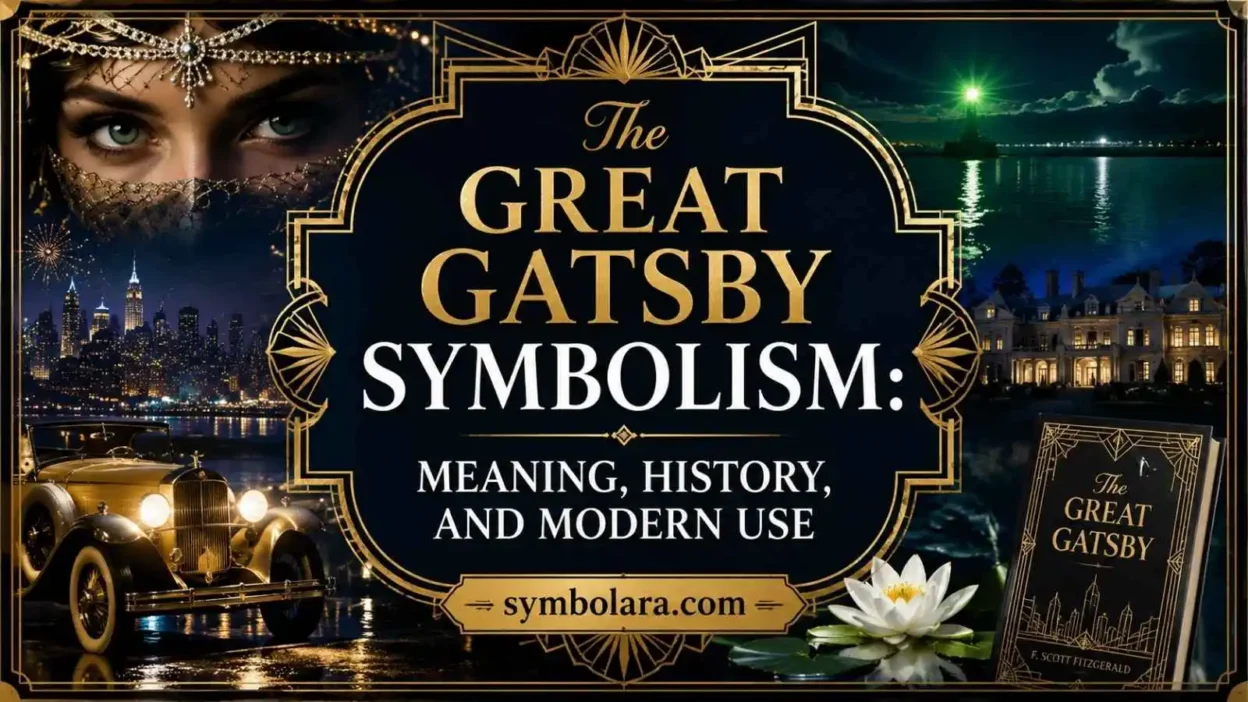
The Great Gatsby Symbolism remains central to how American readers understand F. Scott Fitzgerald’s 1925 novel because the book turns ordinary objects into sharp social commentary. A green dock light, a gray wasteland, a pair of fading billboard eyes, a yellow car, and glittering parties all carry meanings that reach beyond the plot.
The symbols matter because The Great Gatsby is not only a love story or a portrait of rich people behaving badly. It is a study of American desire: the wish to start over, become someone else, buy status, recover the past, and believe that success will finally make life whole.
In modern U.S. culture, Gatsby’s symbols are especially recognizable because they connect with ideas Americans still debate: wealth, reinvention, class mobility, celebrity image-making, nostalgia, and the gap between appearance and reality.
Quick Answer
The Great Gatsby Symbolism commonly points to the promise and failure of the American Dream in modern American culture, especially through images of wealth, longing, and social performance. Historically, its major symbols grew out of the 1920s Jazz Age, Prohibition-era money, and Fitzgerald’s concern with class, illusion, and the past.
TL;DR
- The green light represents hope and unreachable dreams.
- The valley of ashes exposes wealth’s human cost.
- Eckleburg’s eyes suggest lost moral authority.
- Gatsby’s parties symbolize performance, excess, and loneliness.
- Colors reveal class, innocence, corruption, and decay.
- Modern Americans read Gatsby through wealth and reinvention.
What the Symbols in Gatsby Look Like
Fitzgerald’s symbols are memorable because they are concrete. They are not abstract emblems dropped into the story; they are places, objects, colors, and social rituals that characters physically encounter.
The green light sits at the end of Daisy Buchanan’s dock, across the water from Gatsby’s mansion. Gatsby sees it from a distance, which is why it becomes more than a lamp. It represents a goal that looks visible but remains out of reach.
The valley of ashes is a gray industrial wasteland between the wealthy Long Island world and New York City. It is where George and Myrtle Wilson live and work, and it visually interrupts the glamour of the novel.
The eyes of Doctor T. J. Eckleburg appear on an old advertising billboard above the valley. They are not living eyes, but their size and placement make them feel watchful.
Gatsby’s mansion, his lavish parties, Daisy’s white clothing, Tom’s expensive world, cars, colors, and even geography all work the same way. They show readers what the characters want others to see, while also revealing what they are trying to hide.
The Most Important Symbols in The Great Gatsby at a Glance
The Great Gatsby uses many symbols, but a few carry the strongest meanings throughout the novel. These symbols connect personal emotions with larger ideas about American society, ambition, wealth, and identity.
- Green light: Represents Gatsby’s hopes, future dreams, and desire to recreate the past.
- Gatsby’s mansion: Symbolizes wealth, self-invention, and the performance of success.
- Valley of ashes: Shows the hidden struggles and social costs behind luxury.
- Doctor T. J. Eckleburg’s eyes: Suggest questions about morality, judgment, and a society searching for meaning.
- Cars: Represent freedom, modern progress, wealth, and reckless behavior.
- Colors: Reveal emotions and themes such as innocence, money, danger, and decay.
- East Egg and West Egg: Show the divide between inherited privilege and newly earned wealth.
Together, these symbols transform the novel from a simple story about love into a wider reflection on American dreams and disappointments. Fitzgerald uses ordinary things to reveal how people create identities, chase success, and struggle with reality.
What the Novel Commonly Means in the United States
In the United States, the novel’s symbolism is most often read as a critique of the American Dream. Gatsby believes he can invent himself, accumulate wealth, and win back Daisy as if the past can be restored through money and determination.
That dream has an appealing American shape. Gatsby comes from modest origins, changes his name, builds a new identity, and pursues a life that seems larger than the one he inherited. In another kind of story, that might be a celebration of ambition.
Fitzgerald complicates it. Gatsby’s dream depends on illusion, illegal money, emotional denial, and Daisy’s willingness to become a symbol rather than a real person. The novel asks whether a dream built on wealth and fantasy can ever lead to genuine fulfillment.
| Symbol | Common U.S. Meaning | Emotional Association | Important Note |
| Green light | American Dream and longing | Hope, distance, yearning | It is visible but unreachable |
| Valley of ashes | Cost of wealth and inequality | Desolation, neglect, exhaustion | It contrasts with elite luxury |
| Eckleburg’s eyes | Moral judgment or spiritual emptiness | Unease, exposure, guilt | They are an advertisement, not God |
| Gatsby’s parties | Status performance and excess | Excitement, loneliness, spectacle | Guests enjoy him but barely know him |
| Yellow car | Wealth, danger, carelessness | Speed, glamour, destruction | It turns luxury into violence |
Why Fitzgerald Used Symbolism Instead of Direct Messages
Fitzgerald used symbolism because objects and images can communicate complex ideas without directly explaining them. Instead of simply saying that wealth can create illusions, he shows a mansion filled with guests who barely know its owner.
This approach makes readers think about meaning instead of receiving a simple answer. A green light can represent hope, but it can also represent obsession and the danger of chasing an impossible future.
The symbolism also reflects the uncertainty of the 1920s. America was experiencing economic growth, new technology, changing social values, and rising consumer culture. Fitzgerald captured both the excitement and the emptiness of that period through images readers could easily remember.
For modern American audiences, this technique still feels powerful because people continue to use symbols every day. Homes, clothing, brands, cars, and social media images often communicate identity and success without words.
The Green Light and the Dream That Stays Out of Reach
The green light is the novel’s most famous symbol because it condenses Gatsby’s entire emotional life into one image. It represents Daisy, but not only Daisy. It also represents the future Gatsby imagines with her, the self he wants to become, and the belief that desire can overcome time.
Its placement matters. Gatsby can see the light, but he cannot touch it. That distance makes the symbol work. The dream is close enough to keep him reaching, but far enough to remain idealized.
Green also carries American associations with money, growth, renewal, and permission. A green traffic light says “go.” U.S. paper money is green. Spring growth is green. Fitzgerald uses those meanings while also undercutting them. Gatsby’s “go” signal leads him toward a future that does not exist.
For modern readers, the green light often feels like the symbol of chasing a life that looks perfect from across the water: the dream job, the ideal romance, the expensive neighborhood, the curated social image. Its meaning still works because Americans continue to live with the tension between aspiration and dissatisfaction.
Gatsby’s Mansion and the Performance of Success
Gatsby’s mansion is not just a house. It is a stage set for the identity he has built. Its size, parties, music, food, and guests all advertise success. The mansion tells the world that Gatsby has arrived, even though the people who attend his parties often know little about him.
The house symbolizes new money: wealth acquired recently, displayed loudly, and used to gain entry into elite spaces. Gatsby is not careless with wealth in the same way Tom and Daisy are. He uses money with purpose. Every extravagant detail is part of his attempt to become acceptable to Daisy.
Yet the mansion also reveals the emptiness of performance. Gatsby throws parties for crowds, but he is emotionally fixed on one absent woman. The rooms are full, but his life is lonely. People consume his hospitality while spreading rumors about him.
In American culture today, Gatsby’s mansion often represents luxury as self-branding. It resembles the modern urge to prove success through homes, events, photos, clothes, and social visibility. Fitzgerald’s point is not that beauty or celebration are wrong. The problem is that spectacle cannot replace belonging.
The Valley of Ashes and the Cost of Wealth
The valley of ashes is the novel’s harshest visual contrast. Between the glittering worlds of Long Island and Manhattan lies a place covered in industrial waste. Fitzgerald uses it to show what the rich prefer not to see.
Symbolically, the valley represents the underside of the American Dream. The wealth of the novel does not float above society without consequences. Someone works, sweats, waits, loses, and gets discarded. George Wilson’s garage sits in this gray zone, making him part of the world that wealth passes through but does not respect.
The valley also carries environmental meaning for modern readers. Its ash heaps suggest industrial damage, pollution, and the physical residue of progress. The glamorous world of Gatsby depends on cars, fuel, roads, parties, and city money, but the waste is pushed out of sight.
In the United States, this symbol remains especially relevant because it connects class inequality with landscape. It asks a question that still feels current: who gets the mansion, and who lives near the dump?
The Eyes of Doctor T. J. Eckleburg and Moral Emptiness
The eyes of Doctor T. J. Eckleburg are unsettling because they resemble divine judgment while being nothing more than an old advertisement. That tension is the point. The billboard looks like a moral presence, but it belongs to commerce.
George Wilson later connects the eyes with God, which gives the symbol its strongest emotional charge. In his grief and confusion, he wants the world to contain a witness. He wants betrayal, suffering, and violence to be seen by something higher than human selfishness.
But Fitzgerald makes the image ambiguous. The eyes do not intervene. They do not correct anyone’s behavior. They stare over a world where people lie, cheat, exploit, and escape consequences.
For American readers, the billboard can symbolize a society where advertising has replaced spiritual authority. The image of watchful eyes is still there, but it is faded, commercial, and powerless. It suggests that a culture obsessed with money may keep the appearance of morality while losing its substance.
Daisy Buchanan and the Symbol of Beautiful Illusion
Daisy is a character, not an object, but Gatsby turns her into a symbol. To him, she represents love, status, youth, beauty, and the final proof that his invented identity has succeeded.
Her name even helps shape the symbolism. A daisy is a white flower with a yellow center, and those colors fit her role in the novel. White suggests innocence, elegance, and social purity. Yellow hints at money, carelessness, and moral compromise.
Daisy’s voice is famously associated with wealth. That detail matters because Gatsby is not only attracted to Daisy as a woman. He is drawn to the world her voice represents: inherited privilege, ease, and social protection.
Modern readers often interpret Daisy as the danger of idealizing another person. Gatsby does not fully love Daisy as she is. He loves what she promises. That makes her one of the novel’s most painful symbols: the dream that becomes less real the closer one gets to it.
Cars, Speed, and Careless Modern Life
Cars in The Great Gatsby symbolize modern freedom, wealth, recklessness, and danger. In the 1920s, automobiles were changing American life. They made movement faster, expanded leisure, and became visible markers of status.
Fitzgerald uses cars to show how speed can become moral carelessness. Characters move between Long Island, the valley of ashes, and Manhattan with ease, but they rarely consider the people they pass. The car becomes a machine of privilege.
The yellow car is especially important because it turns glamour into violence. Its bright color suggests wealth and display, but its role in Myrtle Wilson’s death makes it impossible to separate luxury from harm.
In a modern U.S. reading, cars in the novel still feel familiar as status symbols. They communicate taste, income, personality, and freedom. Fitzgerald’s warning is that mobility without responsibility can become destructive.
East Egg and West Egg as Class Geography
The geography of the novel is symbolic. East Egg and West Egg are not just locations; they represent different kinds of wealth and social identity.
East Egg is associated with old money, inherited status, and polished entitlement. Tom and Daisy live there, protected by family wealth and social confidence. Their privilege is quiet because it does not need to explain itself.
West Egg represents new money. Gatsby’s wealth is spectacular but socially insecure. His mansion is impressive, yet he remains outside the world he wants to enter. He can buy the house, the clothes, and the parties, but not the past.
This division still makes sense to American readers because the United States often claims to be classless while remaining deeply attentive to class signals. Neighborhoods, schools, accents, manners, clubs, and family histories still shape opportunity. Fitzgerald turns geography into a map of belonging.
Color Symbolism in the Novel
Fitzgerald uses color to guide emotional interpretation. Green is the color of Gatsby’s dream, but also of money and longing. White surrounds Daisy and Jordan, suggesting elegance and innocence while also hinting at emptiness or concealment.
Yellow and gold appear around wealth, but they are not identical. Gold suggests genuine value, luxury, and old-world richness. Yellow often feels cheaper, flashier, or more dangerous, especially when connected to Gatsby’s car and the novel’s surfaces of display.
Gray dominates the valley of ashes. It strips life of glamour and suggests exhaustion, poverty, and spiritual dullness. Blue appears in Gatsby’s gardens and atmosphere, often creating a mood of romantic distance or sadness.
Pink, such as Gatsby’s suit, carries social meaning too. It marks him as conspicuous and slightly out of step with old-money codes. His clothing shows aspiration, but also exposes his vulnerability to judgment.
Jazz Age Roots and Prohibition-Era Money
The novel’s symbols come from the world of the 1920s, a period associated with jazz, consumer culture, urban nightlife, changing gender norms, and Prohibition. Fitzgerald understood the glamour of that world, but he also saw its instability.
Prohibition is important because Gatsby’s money is tied to illegal or shadowy business. That context makes his wealth feel different from Tom’s inherited fortune. Gatsby’s money is energetic, recent, and morally compromised, while Tom’s money is older and socially protected.
The party scenes reflect the Jazz Age fascination with youth, music, cocktails, fashion, and rebellion. Yet Fitzgerald does not present celebration as simple liberation. The parties are noisy, beautiful, and emotionally thin.
Historically, this is why the novel’s symbols have lasted. They capture a moment when America was becoming more modern, more consumer-driven, and more image-conscious, while still carrying older inequalities beneath the surface.
The Emotional Meaning: Longing, Reinvention, and Loss
At the emotional level, the novel’s symbolism centers on longing. Gatsby longs for Daisy, but also for a version of himself that can erase shame, poverty, and time. His dream is romantic, social, and psychological all at once.
The symbols also speak to reinvention. Gatsby’s life is built on the American belief that a person can become new. He changes his name, his manners, his surroundings, and his story. The tragedy is that reinvention cannot completely free him from the past.
Loss runs beneath every major image. The green light glows because Daisy is absent. The mansion shines because Gatsby feels incomplete. The valley of ashes exists because wealth has left damage behind. Eckleburg’s eyes stare because moral certainty has faded.
This emotional pattern helps explain why the novel still affects readers. Its symbols are not puzzles to decode and forget. They name feelings many people recognize: wanting more, trying to become worthy, and discovering that the desired object may not heal the original wound.
Modern Use in American Culture
Today, Gatsby imagery appears in classrooms, parties, fashion, theater, film, social media, and design. The phrase “Gatsby” often suggests 1920s glamour: tuxedos, beaded dresses, champagne towers, Art Deco patterns, jazz music, and gold-and-black decorations.
That modern use is understandable, but incomplete. The novel does contain glamour, but it is not mainly a celebration of luxury. A Gatsby-themed party often borrows the surface while ignoring the warning underneath.
In classrooms, the symbols remain useful because they help students discuss ambition, inequality, gender, class, and the American Dream without reducing the novel to a moral slogan. The symbols invite debate, which is one reason the book continues to be widely taught.
Since entering the public domain in the United States, the story has also become easier to adapt and reinterpret. New versions can shift perspective, explore characters differently, or challenge the limits of the original. Even so, the central symbols continue to anchor the story.
Gatsby Imagery in Fashion, Decor, and Social Media
In fashion and decor, “Gatsby” usually means Art Deco glamour: metallic colors, geometric shapes, pearls, feathered accessories, sharp suits, and dramatic lighting. These images come from the broader 1920s style world as much as from the novel itself.
On social media, Gatsby references often frame luxury as aspiration. A mansion, a party, a night skyline, or a romantic image across water can all be described as “Gatsby-like.” The green light has become shorthand for a desired future.
The risk is that modern style can flatten the novel’s meaning. Gatsby’s world looks beautiful, but Fitzgerald keeps showing the cost of that beauty. The champagne, cars, and silk shirts are not neutral decorations. They are part of a social system that confuses appearance with worth.
A more thoughtful use of Gatsby imagery recognizes both sides: the appeal of elegance and the sadness underneath it. That balance is closer to the spirit of the novel.
Common Misunderstandings About Gatsby’s Symbols
One common misunderstanding is that the green light simply means “hope.” It does, but Fitzgerald’s version of hope is unstable. Gatsby’s hope is admirable in its intensity, yet it is aimed at a fantasy that cannot survive reality.
Another misunderstanding is that the novel praises wealth. The book is full of wealth, but its symbols repeatedly show wealth failing to create moral responsibility, emotional honesty, or real safety.
Some readers also treat Daisy as only a villain or only a victim. Symbolically, she is both a person shaped by her class and a figure Gatsby overloads with meaning. Reducing her to one role makes the novel less interesting.
The eyes of Eckleburg are sometimes read as a simple symbol of God. That interpretation is possible inside George Wilson’s mind, but the billboard’s commercial nature complicates it. The eyes may suggest the absence of God as much as the presence of judgment.
Positive and Negative Meanings
The novel’s symbols are not entirely negative. Gatsby’s dream contains courage, imagination, and emotional commitment. His ability to believe in transformation is part of what makes him memorable.
The positive side of the symbolism lies in aspiration. The green light speaks to the human need for a future. Gatsby’s reinvention shows the American belief that origins do not have to define the whole life.
The negative side is illusion. Gatsby’s dream requires him to deny Daisy’s reality, ignore time, and imagine that money can repair emotional loss. The novel respects his hope while exposing its danger.
That double meaning is why the symbolism remains so effective. Fitzgerald does not tell readers simply to stop dreaming. He asks what happens when a dream becomes detached from truth, responsibility, and other people’s humanity.
How the Meaning Has Changed Over Time
When The Great Gatsby was published in 1925, it spoke directly to the Jazz Age world Fitzgerald knew. Its symbols reflected new money, parties, cars, changing manners, and the uneasy glamour of postwar America.
Later readers, especially after the Great Depression and World War II, often saw the novel more clearly as a critique of American illusion. Gatsby’s glittering world looked different once the economic crash revealed how fragile the 1920s boom had been.
By the late twentieth and early twenty-first centuries, the novel became a standard American classroom text. Its symbols were increasingly connected to discussions of class, race, gender, consumer culture, and national mythology.
In 2025 and 2026, the novel’s centennial-era relevance is tied to questions that feel current: who gets to reinvent themselves, how wealth protects people from consequences, why nostalgia can distort politics and personal life, and how image-making shapes identity.
Why These Symbols Still Feel American
The symbols still feel American because they are tied to promises the country continues to make: work hard, become new, move upward, find love, own beauty, and reach the shining thing across the water.
They also feel American because they reveal the limits of those promises. The world does not offer reinvention equally. Wealth is often judged by its appearance rather than its origin, dreams can hide selfish desires, and beauty can disguise dishonesty.
Fitzgerald’s symbols endure because they hold attraction and criticism together. The green light is beautiful and misleading. Gatsby’s house is dazzling and lonely. Daisy is enchanting and careless. The valley of ashes is ugly but truthful.
That combination keeps the novel alive in U.S. culture. It lets readers admire the dream while questioning the system that shapes it.
The Great Gatsby Symbolism and the American Dream Today
The symbolism of The Great Gatsby remains relevant because many Americans still wrestle with questions about success, identity, and personal reinvention. Gatsby’s dream reflects the belief that someone can create a new future through determination, money, and ambition.
At the same time, the novel questions whether external success always creates happiness. A large house, expensive possessions, or public recognition may create an image of achievement, but they cannot automatically provide connection or purpose.
Modern readers often connect Gatsby’s symbols with social media culture, where people carefully choose what parts of their lives others see. Like Gatsby’s parties, online images can appear impressive while hiding loneliness or pressure.
The novel’s lasting message is not that ambition is wrong. Instead, Fitzgerald asks readers to consider whether their goals are based on genuine values or only on appearances.
FAQs
What does the green light symbolize in The Great Gatsby?
The green light symbolizes Gatsby’s hope, longing, and belief that he can build a future with Daisy. It also represents the American Dream as something visible and desirable but ultimately unreachable for him.
What does the valley of ashes represent?
The valley of ashes represents poverty, industrial waste, and the human cost hidden behind wealthy lifestyles. It shows that the glamour of Gatsby’s world depends on social and economic neglect elsewhere.
Are the eyes of Doctor T. J. Eckleburg supposed to represent God?
They can be read that way, especially through George Wilson’s grief-stricken interpretation. However, because the eyes are part of a faded advertisement, they also suggest a world where spiritual authority has been replaced by commerce.
Why is color symbolism important in the novel?
Color helps Fitzgerald connect mood, class, and moral meaning without stopping the story to explain them. Green, white, yellow, gold, gray, and blue all guide how readers understand desire, wealth, innocence, decay, and sadness.
Is Gatsby’s symbolism positive or negative?
It is both. Gatsby’s symbols honor hope and reinvention, but they also warn against illusion, obsession, and the belief that money can recover the past.
Why do Americans still connect with Gatsby’s symbols?
Americans still connect with them because the novel addresses ambition, class mobility, self-invention, and the pressure to appear successful. Those themes remain part of American life, even though the 1920s setting is now historical.
Why are Gatsby-themed parties controversial?
They can be controversial because they often celebrate the novel’s luxury while ignoring its criticism of excess, inequality, and carelessness. A thoughtful Gatsby theme recognizes that the glamour is part of the warning, not separate from it.
Is The Great Gatsby symbolism still relevant in 2026?
Yes. Modern readers still connect with Gatsby’s symbols because they reflect current ideas about success, social image, wealth, and personal identity. The novel’s themes continue to appear in conversations about status and ambition.
Conclusion
The symbols in The Great Gatsby matter because they make American desire visible. A dock light becomes a future that cannot be reached. A mansion becomes a performance of success. A gray wasteland becomes the hidden cost of wealth. A billboard becomes the uneasy feeling that someone should be watching, even when no one acts.
That is why The Great Gatsby Symbolism continues to feel relevant in modern American culture. Fitzgerald’s images do not only belong to the Jazz Age; they still describe the way people chase status, romance, reinvention, and belonging.
The novel’s lasting insight is simple but uncomfortable: dreams can inspire people, but they can also blind them. Gatsby’s world shines because it is beautiful, and it breaks because beauty alone is not enough.
[…] a color pattern, or a setting that changes with the speaker’s mood. Unlike a direct statement, a symbol gathers meaning through placement and […]
[…] the same time, creators occasionally deny symbolic meaning even when audiences strongly identify patterns. Interpretation often becomes part of cultural […]