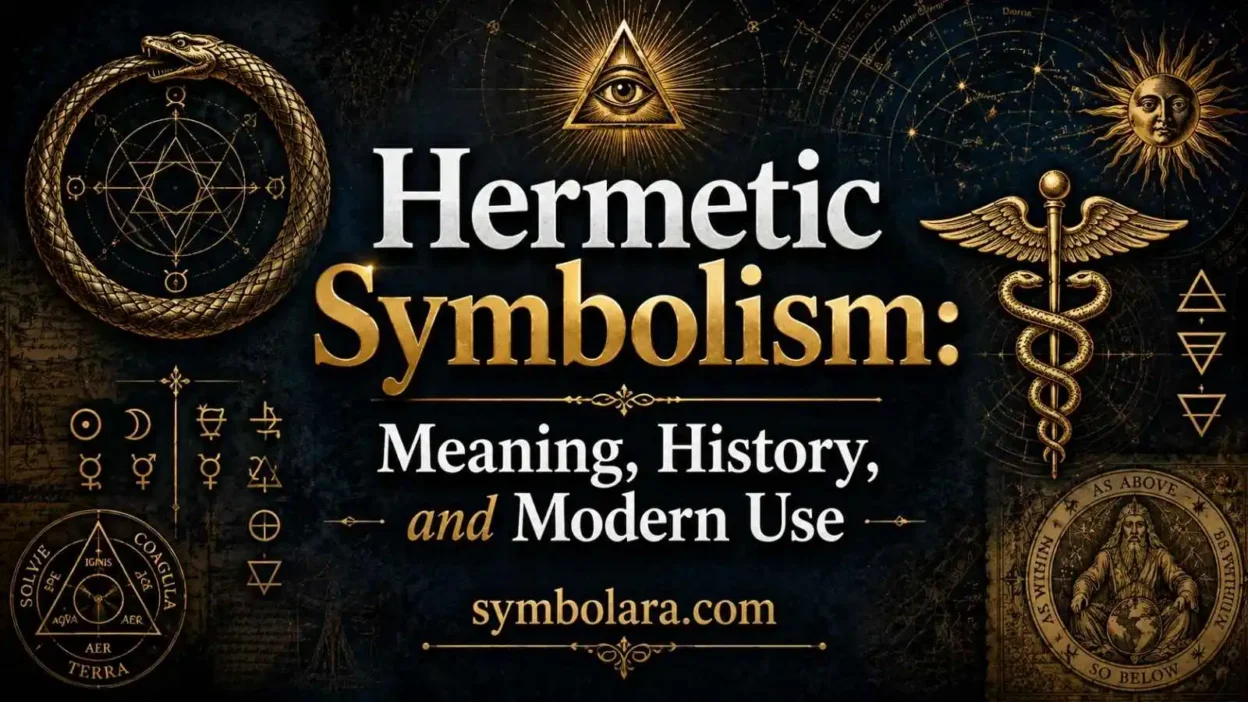
Hermetic Symbolism refers to the visual language connected with Hermetic thought: alchemy, astrology, sacred geometry, transformation, hidden knowledge, and the relationship between the human being and the wider cosmos. People encounter it in old alchemical illustrations, occult books, tattoo designs, jewelry, tarot-inspired art, fantasy media, and modern spiritual aesthetics.
For many Americans, these symbols feel intellectual, mysterious, and alternative rather than strictly religious. They often suggest a search for meaning outside mainstream institutions: personal transformation, curiosity about ancient wisdom, or a desire to connect inner life with the patterns of nature.
The subject matters today because Hermetic imagery has moved far beyond old manuscripts. It appears in boutique decor, album covers, social media graphics, tattoos, fashion, wellness branding, and pop culture. Yet many of its most common meanings are older and more specific than modern design trends suggest.
Quick Answer
Hermetic Symbolism commonly symbolizes hidden knowledge, personal transformation, and the connection between the inner self and the universe in modern American culture. Historically, it is tied to Hermetic philosophy, alchemy, astrology, and the idea that earthly life reflects larger cosmic patterns.
TL;DR
- It often represents transformation and hidden knowledge.
- Its roots are Greco-Egyptian and late antique.
- Alchemy shaped many of its most famous images.
- Americans often read it as mystical or intellectual.
- Tattoos use it to signal growth and self-mastery.
- Misuse often comes from confusing symbols with magic.
What Hermetic Symbols Usually Look Like
Hermetic imagery is not one single symbol. It is a family of symbols that developed around the writings attributed to Hermes Trismegistus and the later traditions that used his name.
Common images include serpents, circles, triangles, suns, moons, stars, wings, staffs, vessels, eyes, elemental signs, and geometric diagrams. Many are arranged symmetrically because Hermetic thought often emphasizes balance: above and below, spirit and matter, sun and moon, male and female, visible and invisible.
A typical Hermetic design might show a triangle inside a circle, an ouroboros biting its tail, the sun and moon facing one another, or a winged staff with two snakes. In older alchemical books, these symbols can look crowded and strange because they were meant to compress several ideas into one image. In modern design, they are often simplified into clean line art.
What It Commonly Means in the United States
In the United States, Hermetic symbols usually communicate one of four ideas: transformation, hidden wisdom, spiritual independence, or the unity of opposites.
A person wearing an ouroboros tattoo, for example, may not be declaring loyalty to a formal Hermetic order. They may be using the image to represent renewal after grief, recovery, reinvention, or the feeling that life moves in cycles. Someone who wears a sun-and-moon pendant may be drawn to the balance between action and reflection, reason and intuition, or outer identity and private emotion.
In American culture, these symbols often sit between philosophy, spirituality, and aesthetic taste. They can feel more personal than institutional. They are also common among people interested in tarot, astrology, alchemy, mythology, Jungian psychology, fantasy literature, occult history, or alternative spirituality.
The Ancient Roots of Hermes Trismegistus
Hermetic tradition centers on Hermes Trismegistus, a legendary figure whose name means “thrice-great Hermes.” He is usually understood as a fusion of the Greek god Hermes and the Egyptian god Thoth.
Hermes was associated with language, boundaries, messages, travel, trade, and cleverness. Thoth was associated with writing, wisdom, measurement, sacred knowledge, and the ordering of the cosmos. When Greek and Egyptian cultures interacted in the Hellenistic world, these figures became linked in a new symbolic identity.
The writings attributed to Hermes Trismegistus were not written by one person at one moment. They formed over time, especially in the ancient Mediterranean world. Some texts were philosophical and religious, asking how the human mind relates to God, nature, and the cosmos. Others were more technical, dealing with astrology, alchemy, ritual, and hidden correspondences in nature.
This background explains why Hermetic symbols are rarely simple. They carry the feeling of a bridge: between Egypt and Greece, religion and philosophy, science and magic, heaven and earth.
The Emerald Tablet and “As Above, So Below”
One of the most famous Hermetic ideas is often summarized as “as above, so below.” The phrase is associated with the Emerald Tablet, a short and cryptic text traditionally linked to Hermes Trismegistus.
The basic idea is correspondence: the small world reflects the larger world. The human body, mind, and soul are seen as a microcosm, while the universe is the macrocosm. In symbolic terms, this means patterns repeat across levels of existence.
In modern American usage, the phrase often means that inner life and outer life mirror one another. A person may interpret it psychologically: what happens in the mind affects the world a person builds. Others understand it spiritually: earthly events reflect a larger order.
Historically, the idea helped shape alchemy and astrology. Alchemists saw material transformation as connected to inner purification. Astrologers treated the movement of the heavens as meaningful for life on earth. Today, the phrase is often quoted more loosely, but its central meaning remains the same: reality is interconnected.
The Seven Hermetic Principles and Their Symbolic Meaning
Many modern discussions of Hermeticism mention the Seven Hermetic Principles. These ideas became especially popular through the 20th-century text The Kybalion, which presented a simplified version of Hermetic philosophy.
The principles include concepts such as mentalism, correspondence, vibration, polarity, rhythm, cause and effect, and gender. While these ideas are widely associated with modern Hermetic teachings, historians distinguish them from the ancient Hermetic writings of late antiquity.
Symbolically, these principles focus on relationships and patterns. Correspondence connects with the famous idea of “as above, so below,” suggesting that different levels of reality reflect similar structures. Polarity represents the relationship between opposites, such as light and darkness or action and rest.
Today, many people encounter these principles through personal development communities, spirituality content, books, and online discussions. They are often interpreted as tools for reflection, mindset, and understanding personal change.
Alchemy and the Symbolism of Transformation
Alchemy is one of the strongest sources of Hermetic imagery. Many people think of alchemy as the attempt to turn base metals into gold, but its symbolism became much broader.
Gold represented perfection, incorruptibility, and completion. Lead or base matter represented the unrefined beginning. The alchemical process became a way to imagine transformation: not only of substances, but of the person doing the work.
That is why Hermetic alchemical symbols often feel psychological to modern readers. The sealed vessel can suggest containment and pressure. Fire can represent purification, intensity, or trial. Mercury can symbolize changeability and mediation. The union of sun and moon can represent the integration of opposites.
In the United States today, this symbolism often appeals to people who see growth as a difficult but meaningful process. A tattoo of an alchemical triangle or a piece of jewelry with elemental signs may stand for discipline, healing, or the choice to become more whole.
The Caduceus, Ouroboros, and Other Common Emblems
Several symbols are closely associated with Hermetic and alchemical traditions, even though each has its own history.
| Symbol | Meaning in the USA | Common Associations | Notes |
| Ouroboros | Renewal, cycles, self-recreation | Alchemy, eternity, rebirth | Often used in tattoos and fantasy art |
| Caduceus | Knowledge, mediation, mistaken medicine | Hermes, trade, balance | Often confused with the Rod of Asclepius |
| Sun and moon | Opposites in balance | Alchemy, gender symbolism, rhythm | Common in jewelry and decor |
| Triangle | Elemental force or spiritual ascent | Fire, water, air, earth | Meaning depends on direction and context |
| Circle | Unity, wholeness, protection | Cosmos, eternity, completion | Often frames other symbols |
The ouroboros, a serpent eating its own tail, is among the clearest symbols of cyclical renewal. It suggests that endings and beginnings are joined. In American tattoo culture, it often marks survival, rebirth, or a refusal to see loss as final.
The caduceus is more complicated. As the staff of Hermes, it belongs to a world of messages, exchange, thresholds, and mediation. In the United States, however, it has often been mistakenly used as a medical symbol. The older medical emblem is the Rod of Asclepius, which has one snake and no wings. This confusion is a good example of how ancient symbols can gain new public meanings by accident.
Famous Hermetic Symbols and Their Meanings
Hermetic traditions use many symbols to express ideas about transformation, balance, knowledge, and the relationship between humanity and nature.
Ouroboros Symbolism
The ouroboros, shown as a serpent or dragon eating its own tail, represents cycles, renewal, and continuous transformation. In modern culture, people often connect it with personal growth, healing, and new beginnings.
Mercury Symbolism
Mercury is one of the most important images in Hermetic and alchemical traditions. It represents change, communication, adaptability, and the connection between different states of being.
Sun Symbolism
The sun often represents energy, consciousness, power, and clarity. In alchemical imagery, it is frequently paired with the moon to represent balance between different forces.
Moon Symbolism
The moon represents reflection, intuition, mystery, and change. Together, the sun and moon often symbolize the joining of opposites.
Triangle Symbolism
Triangles appear frequently in Hermetic and alchemical designs. Depending on direction and context, they may represent elements, transformation, spiritual development, or balance.
Understanding these symbols requires looking at their historical setting. A symbol may have several meanings depending on whether it appears in an ancient manuscript, a modern tattoo, or a decorative design.
Hermetic Symbols in American Spiritual Culture
Hermetic imagery fits naturally into American spiritual culture because the United States has a long history of religious experimentation, self-improvement movements, metaphysical bookstores, occult societies, and alternative approaches to meaning.
Many Americans encounter these symbols through tarot decks, astrology apps, meditation spaces, New Age shops, ceremonial magic groups, or online communities. The symbols often serve as a visual shorthand for seeking knowledge outside ordinary categories.
This does not mean every use is historically accurate. A candle label, pendant, or social media graphic may borrow Hermetic imagery mainly for atmosphere. Still, the appeal is understandable. These symbols suggest that ordinary life may contain patterns worth studying. They also invite personal interpretation, which makes them especially adaptable in a culture that values individual identity.
Emotional and Psychological Meaning
Emotionally, Hermetic symbols often communicate introspection. They suggest that the person using them is interested in self-knowledge, transformation, and the hidden structure of experience.
Psychologically, the symbols can feel like maps. A circle can represent wholeness. A serpent can represent fear, wisdom, or renewal. A ladder or ascending path can represent development. Sun and moon imagery can show the need to bring conscious and unconscious parts of the self into balance.
This is one reason Hermetic imagery became attractive to artists, writers, and modern spiritual seekers. It gives visual form to experiences that are hard to explain directly: inner conflict, personal change, grief, discipline, curiosity, and the search for a larger pattern.
A person does not need to believe in literal alchemy or astrology to find meaning in the imagery. Many Americans read these symbols metaphorically, as signs of inner work.
Why It Appears in Tattoos and Personal Style
Hermetic symbols are popular in tattoo culture because they are compact, visually striking, and open to layered interpretation. They can look simple from a distance while holding a private meaning for the wearer.
An ouroboros tattoo may represent starting over. A sun-and-moon design may represent emotional balance. Alchemical symbols may represent endurance, transformation, or the desire to refine the self. A triangle or circle may be chosen for its clean geometry as much as its symbolic meaning.
Jewelry works in a similar way. A pendant with Hermetic imagery can signal curiosity, independence, or a taste for esoteric history. In fashion, these symbols often create an atmosphere of intellectual mystery without requiring the wearer to explain every historical detail.
The danger is that style can flatten meaning. When symbols are used only because they look occult or dramatic, their older philosophical context can disappear. Still, personal use does not have to be scholarly to be sincere.
Home Decor, Art, and Visual Design
Hermetic imagery appears in wall prints, altar spaces, book covers, candles, notebooks, album art, and boutique branding. In decor, it often creates a mood of study, reflection, and old-world mystery.
The most common design style is minimal line art: thin circles, geometric diagrams, moons, stars, hands, eyes, and alchemical marks. These designs are popular because they blend easily with modern interiors while still suggesting older traditions.
In art, Hermetic symbols can point to transformation, hidden structure, or the relationship between matter and spirit. A painter might use the sun and moon to show divided identity. A graphic designer might use an ouroboros to suggest continuity. A musician might use alchemical imagery on an album cover to imply reinvention or emotional purification.
For American audiences, the symbols often feel more philosophical than religious. They suggest a mood of searching rather than a fixed doctrine.
Digital Culture and Pop Culture Use
Online culture has made Hermetic imagery more visible than ever. Social media platforms circulate symbols rapidly, often detached from their original sources. A person may first see an alchemical sign in a tattoo photo, fantasy game, astrology meme, music video, or dark academia mood board.
Pop culture often uses Hermetic imagery to suggest secret knowledge, ancient orders, hidden libraries, magical training, or forbidden texts. Fantasy and horror especially rely on circles, sigils, alchemical diagrams, and Latin-looking inscriptions to create a sense of ritual.
This has helped make the imagery familiar, but it has also blurred the difference between Hermeticism, witchcraft, astrology, ceremonial magic, medieval Christianity, Gnosticism, and modern occult fiction. In popular design, these traditions are often mixed together for visual effect.
A careful interpretation separates the historical tradition from the aesthetic. Hermetic symbols are not just “spooky old signs.” They come from a long conversation about knowledge, nature, transformation, and humanity’s place in the cosmos.
Hermetic Symbolism in Movies, Books, and Popular Culture
Hermetic imagery has become a popular visual language in movies, books, video games, and fantasy storytelling. Writers and artists often use these symbols because they create a feeling of mystery, discovery, and hidden knowledge.
Alchemy circles, ancient manuscripts, secret societies, and symbolic diagrams frequently appear in stories about magical worlds, lost civilizations, and personal transformation. These images help audiences understand themes such as power, identity, sacrifice, and change.
However, entertainment often adapts Hermetic ideas for storytelling rather than historical accuracy. A symbol used in a fantasy movie may borrow the appearance of alchemy or Hermetic traditions while changing its original meaning.
For many American viewers, this exposure creates the first connection with Hermetic imagery. Later, some people explore the historical background and discover that these symbols have much deeper roots than their fictional appearances suggest.
Cross-Cultural Connections and Religious Boundaries
Hermetic symbols developed through cultural exchange. They reflect Greek, Egyptian, Roman, Jewish, Christian, Islamic, and later European currents at different points in history. This does not make the tradition simple or universal. It means the imagery grew in contact zones where ideas moved across languages and religions.
Some Hermetic texts speak in philosophical language about God, mind, creation, and the soul. Some later traditions connected Hermetic ideas with Christian theology. Others connected them with astrology, alchemy, Kabbalah, Rosicrucianism, ceremonial magic, or occult revival movements.
In the United States, people sometimes assume Hermetic imagery is anti-Christian or purely pagan. That is too simple. Historically, some Christian thinkers engaged Hermetic texts, while others rejected them. Today, interpretations vary widely. Some people use the symbols spiritually, some artistically, some psychologically, and some only as design.
The safest way to understand the symbolism is to avoid forcing it into one category. It is better described as esoteric, philosophical, alchemical, and historically layered.
Hermetic Symbolism vs Occult Symbolism: Key Differences
Although Hermetic symbolism and occult symbolism are often discussed together in modern culture, the two concepts are not exactly the same. The Hermetic tradition specifically comes from ideas associated with Hermes Trismegistus, Hermetic philosophy, alchemy, and astrology. Its symbols explore hidden patterns, universal principles, and the perceived connections between human experience and the wider cosmos.
Occult symbolism is a much broader category. It includes symbols from many different traditions, including astrology, ceremonial magic, mysticism, secret societies, alchemy, and other esoteric movements. Some Hermetic symbols are considered occult because they involve hidden knowledge, but not every occult symbol has Hermetic origins.
The difference matters because modern media often combines many symbolic systems into one visual style. A design may include an ouroboros, zodiac signs, geometric shapes, and mystical imagery without representing one specific tradition.
For modern American audiences, Hermetic symbols are usually understood as signs of curiosity, transformation, self-discovery, and philosophical exploration rather than belonging to one fixed belief system.
Common Misunderstandings and Misuse
The biggest misunderstanding is that Hermetic symbols are automatically magical in a literal sense. Many were used in traditions that included ritual and occult practice, but symbolic meaning does not require belief in spellwork.
Another misunderstanding is that all occult-looking symbols mean the same thing. A pentagram, ouroboros, caduceus, astrological glyph, and alchemical triangle may appear together in modern art, but they do not share one single origin.
There is also misuse through fear. Some people see any esoteric symbol and assume it is dangerous, evil, or linked to secret control. That reaction usually says more about modern anxiety than historical meaning. At the same time, it is fair to recognize that some groups and influencers use old symbols irresponsibly, exaggerating their age, power, or authority.
A grounded reading keeps two things separate: what the symbol meant in historical traditions, and what modern users claim about it now.
How to Interpret Hermetic Symbols Correctly
Interpreting Hermetic symbols requires attention to context. A symbol does not have one permanent meaning that applies everywhere. Its meaning changes depending on the time period, culture, and purpose of use.
For example, a serpent may represent renewal and wisdom in one tradition, while another context may view it differently. A triangle may represent an element in alchemical texts but simply represent balance or strength in modern design.
A helpful approach is to ask three questions:
- Where did the symbol originally appear?
- What ideas did the original users connect with it?
- How is the symbol being used today?
This method prevents oversimplified interpretations. Hermetic symbols are powerful because they contain layers of meaning, not because they have one secret definition.
For modern audiences, the most common interpretations involve personal growth, curiosity, transformation, and the search for deeper understanding.
How the Meaning Has Changed Over Time
Hermetic symbols began in religious, philosophical, and technical contexts. They were used to think about the divine, the cosmos, astrology, alchemy, matter, and the soul. During the Renaissance, they became part of a European search for ancient wisdom. In later occult revivals, they were organized into ritual systems and secret societies.
In modern American life, the meaning is often more individual. The symbols are less likely to be read as part of a complete philosophical system and more likely to represent personal growth, mystery, balance, or alternative spirituality.
That shift does not erase the older meanings. Instead, it shows how symbols survive by adapting. The same ouroboros that once appeared in alchemical contexts can now appear on a forearm tattoo after a divorce, illness, or major life change. The meaning changes, but the core idea of transformation remains recognizable.
Positive and Negative Associations
Hermetic imagery has both positive and uneasy associations in American culture.
On the positive side, it suggests wisdom, disciplined self-knowledge, transformation, curiosity, and the belief that life has hidden patterns. It can also represent intellectual independence and respect for old traditions of learning.
On the uneasy side, it can be associated with secrecy, elitism, manipulation, or vague occult claims. Some people use Hermetic language to make unsupported spiritual or historical claims sound authoritative. Others use the imagery for shock value without understanding it.
The symbols themselves are not inherently good or bad. Their meaning depends on context, use, and interpretation. A sun-and-moon ring worn for balance communicates something very different from a conspiracy graphic using esoteric symbols to imply hidden control.
Why the Symbolism Still Appeals Today
The modern appeal of Hermetic imagery comes from a very human desire: to believe that change has structure and that the self can be refined.
In a culture often focused on speed, visibility, and surface identity, Hermetic symbols suggest patience and hidden work. They point toward study, discipline, and inner transformation. That makes them attractive to people who want symbols that feel serious without being tied to a single public institution.
They also appeal because they are visually flexible. They can look ancient, modern, elegant, dark, spiritual, intellectual, or artistic depending on design. Few symbolic systems move so easily between old manuscripts, tattoo studios, jewelry shops, fantasy games, and meditation rooms.
FAQs
What does Hermetic symbolism mean spiritually?
Spiritually, it often means the search for hidden wisdom, inner transformation, and connection between the human mind and the wider cosmos. Many people interpret it as a reminder that personal growth and universal order are linked.
Is Hermetic symbolism religious?
It can be religious, but it is not limited to one religion. Historically, Hermetic ideas interacted with Greek, Egyptian, Christian, Jewish, Islamic, and esoteric traditions, while modern users may interpret the symbols spiritually, psychologically, or artistically.
What does a Hermetic tattoo mean?
A Hermetic tattoo usually represents transformation, balance, renewal, or the pursuit of knowledge. The exact meaning depends on the symbol, such as an ouroboros for cycles and rebirth or alchemical signs for personal refinement.
Is the ouroboros a Hermetic symbol?
The ouroboros is strongly associated with alchemy, Gnosticism, and Hermetic-influenced traditions. It usually symbolizes cycles, unity, destruction and renewal, or the idea that life continually transforms itself.
Why are sun and moon symbols common in Hermetic art?
The sun and moon often represent paired opposites: active and receptive, visible and hidden, rational and intuitive, fixed and changing. In alchemical symbolism, their union can suggest integration or completion.
Is Hermetic symbolism the same as occult symbolism?
Not exactly. Hermetic symbols are part of the broader world of Western esotericism, but “occult symbolism” is a wider category that includes many traditions, practices, and images not specifically Hermetic.
Are Hermetic symbols negative or dangerous?
No symbol is automatically negative or dangerous by itself. Some people may fear them because of occult associations, but historically they often represented knowledge, transformation, cosmic order, and spiritual development.
Conclusion
Hermetic symbols endure because they give visible form to ideas that are difficult to express plainly: transformation, hidden knowledge, balance, renewal, and the relationship between the self and the universe. Their meanings come from a long history of cultural exchange, philosophical speculation, alchemy, astrology, and spiritual experimentation.
In modern American culture, Hermetic Symbolism is most often used as a language of personal meaning. It appears in tattoos, jewelry, art, decor, and digital media because it suggests that growth is not random; it can be studied, shaped, and understood.
At its best, this symbolism does not ask people to escape ordinary life. It invites them to look more carefully at the patterns already within it.
[…] interpretation avoids two mistakes: treating every dark image as dangerous, and treating every symbol as harmless because “meaning is personal.” Symbols live between personal intent and public […]