A river can begin as a small stream, cross mountains and farmland, pass through busy cities, and finally reach the ocean. Along the way, it carries soil, shapes the land, supports wildlife, and connects communities. Its movement has made it a familiar symbol of life’s journey.
River symbolism commonly represents life, change, personal growth, freedom, and the passage of time. People often connect rivers with new beginnings because water keeps moving, even when its path changes. Others see them as reminders of family history, emotional struggles, or the connection between people and nature.
In the United States, rivers appear in national history, literature, music, memorials, landscape paintings, and personal tattoos. The Mississippi River, for example, has become closely connected with American identity, trade, travel, and stories about freedom and opportunity.
The meaning depends on the setting. A calm river may suggest peace, while a flooded river can represent uncertainty or a situation that feels difficult to control.
Quick Answer
River symbolism most commonly represents life’s journey, change, freedom, renewal, and the passage of time. These meanings developed from the practical importance of rivers in early settlements, transportation, farming, trade, and religious traditions, as well as their constant movement through the natural world.
TL;DR
- Rivers commonly represent life, change, growth, and the passage of time.
- Flowing water often suggests freedom and movement toward new opportunities.
- Ancient civilizations connected rivers with farming, survival, and sacred traditions.
- American rivers represent exploration, commerce, regional identity, and cultural memory.
- River tattoos often express personal growth, resilience, or a new beginning.
- A river’s condition can change its meaning from peaceful to uncertain.
What Does a River Look Like, and Where Is It Found?
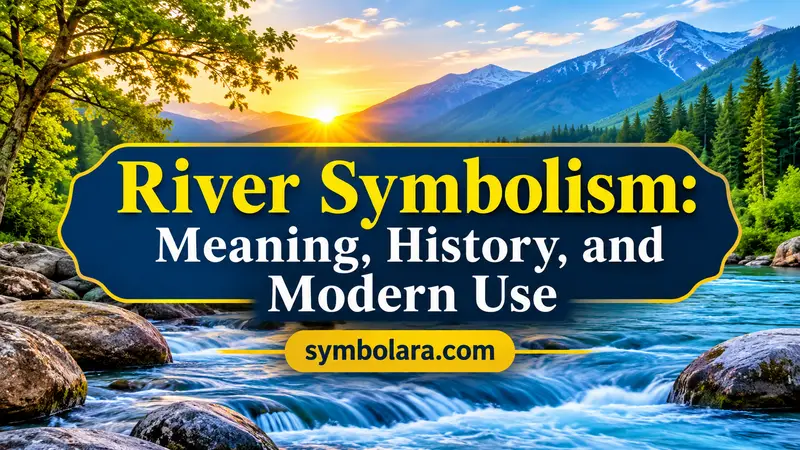
A river is a natural stream of flowing water that usually moves from higher ground toward a lake, another river, or an ocean. Some rivers begin in mountains, where melting snow and rainfall feed small streams. Others develop from springs, wetlands, and connected waterways.
Rivers vary greatly in appearance. Some are narrow and shallow, with clear water moving over stones. Others are wide, muddy, and slow-moving, with forests, farms, bridges, and cities along their banks.
In the United States, well-known examples include the Mississippi, Colorado, Hudson, Missouri, and Columbia rivers.
Their physical features also help explain their symbolic associations:
- Source: The beginning of a river can represent birth, origins, or a fresh start.
- Current: Moving water can suggest progress, change, and the passage of time.
- Riverbanks: The edges can represent boundaries, safety, or the limits people face.
- Bends: A winding river can reflect unexpected experiences and changing directions.
- Mouth: Where a river meets a larger body of water can suggest completion, connection, or transition.
Even without a religious or spiritual interpretation, these features provide recognizable images of human experience.
What Does a River Symbolize in Modern American Culture?
In modern American culture, rivers most often represent the movement of life and the ability to adapt to change. Their meaning comes partly from their natural behavior: water continues forward, even when rocks, hills, and other obstacles change its direction.
Several interpretations appear regularly in American writing, artwork, and personal expression.
Life and personal growth
A river can represent the stages of a person’s life. Its source may suggest childhood, its middle course may represent adulthood, and its final destination may stand for old age or the completion of a journey.
This interpretation is common in poems, graduation speeches, and personal reflections.
Change and moving forward
A river never remains exactly the same. Rainfall, seasons, erosion, and human activity constantly affect its shape and flow.
People may use this image when discussing a major life change, such as moving to another state, changing careers, or leaving a difficult relationship.
Freedom and independence
Wide, open waterways can suggest space and freedom. In American culture, this association is particularly visible in stories about frontier travel, exploration, and movement across the country.
Peace and emotional balance
A slow-moving river surrounded by trees can create a feeling of quiet and comfort. This image appears in landscape photography, meditation spaces, and home decoration.
Resilience
A river can move around obstacles without stopping completely. This makes it a useful image for people who have experienced setbacks and continued working toward their goals.
These meanings are related, but they are not identical. Someone choosing a river tattoo after a difficult period may be expressing resilience, while someone displaying a river landscape at home may simply appreciate peace and nature.
Where Did the Historical Meaning of Rivers Begin?
Rivers became important to human societies long before modern cities, roads, and transportation systems existed.
Early communities depended on nearby water for drinking, fishing, farming, and everyday survival. Seasonal flooding could leave fertile soil behind, making river valleys suitable for agriculture.
Because rivers supported entire communities, they became connected with ideas about life, prosperity, protection, and the natural order.
Some of the earliest documented river traditions developed around major waterways.
Ancient Egypt and the Nile
The Nile River supported agriculture in ancient Egypt. Its seasonal flooding deposited fertile soil across nearby farmland, helping communities grow crops in an otherwise dry environment.
The Nile also held religious importance. The annual flood was associated with agricultural renewal and the Egyptian understanding of life and fertility.
The river was not simply a geographical feature. It was closely tied to the survival and organization of Egyptian society.
Mesopotamia and the Tigris and Euphrates
The Tigris and Euphrates rivers supported some of the earliest cities in Mesopotamia. Their water helped sustain farming, trade, and permanent settlements.
However, flooding could also cause serious damage. This made rivers symbols of both opportunity and danger in the region’s historical experience.
Ancient India and the Ganges
The Ganges has a documented sacred role in Hindu traditions. It is associated with purification, religious devotion, and spiritual practices.
Its cultural importance continues today through ceremonies, pilgrimages, and daily religious activities.
These examples show that river meanings did not develop from one single belief. They grew from different societies’ experiences with water, agriculture, religion, and survival.
Why Does the Mississippi River Matter to American Identity?
The Mississippi River holds a special place in American cultural history because it connects geography with stories of settlement, commerce, migration, and regional identity.
It runs from northern Minnesota to the Gulf of Mexico, passing through or alongside several states. Together with its tributaries, it forms one of North America’s major river systems.
Its historical importance has shaped several American interpretations.
Trade and economic opportunity
Before modern highways and rail networks became widespread, rivers served as major transportation routes. The Mississippi allowed goods, crops, and people to travel between inland communities and important commercial centers.
The river became associated with work, business, and economic opportunity.
Exploration and westward movement
The river played a major role in exploration and territorial expansion. The Lewis and Clark expedition, which began in 1804, followed the Missouri River, a major Mississippi tributary, as part of its journey west.
This history connects American waterways with exploration, ambition, and national expansion.
Music and literature
The Mississippi appears in American literature, blues traditions, and popular music. It became a recognizable setting for stories about Southern life, racial inequality, labor, and cultural change.
Mark Twain’s Adventures of Huckleberry Finn (1884) uses the Mississippi River as a central setting. The journey along the water becomes part of the novel’s exploration of friendship, social rules, and freedom.
For many Americans, the Mississippi represents more than a natural landmark. It carries memories of different communities and competing versions of the country’s past.
How Do Different Cultures Interpret Rivers?
Rivers have documented cultural and religious meanings in several parts of the world. Their interpretations differ according to local history, geography, and belief systems.
| Context | Meaning in USA | Common Associations | Notes |
| Ancient Egypt | Historical interest and renewal | Fertility, agriculture, survival | The Nile’s annual flooding supported farming. |
| Hindu traditions | Cultural and religious recognition | Purification, devotion, sacred practice | The Ganges holds an important place in Hindu religious life. |
| Ancient Mesopotamia | Historical connection | Farming, settlement, uncertainty | The Tigris and Euphrates supported early urban societies. |
| Native American traditions | Recognition of Indigenous heritage | Place, community, relationships with nature | Meanings differ among individual nations and communities. |
| American literature | Personal and national identity | Freedom, travel, change | The Mississippi appears in major American literary works. |
Native American traditions require particular care.
There is no single Native American interpretation of rivers. Hundreds of Indigenous nations have distinct histories, languages, and cultural traditions.
For many communities, specific rivers are connected with ancestral homelands, food systems, transportation, cultural practices, and community identity. Some waterways also hold religious or ceremonial importance.
The Columbia River, for example, has long supported Indigenous fishing communities in the Pacific Northwest. Salmon fishing remains an important part of cultural identity for several Columbia River Basin tribes.
It is more accurate to discuss the history of a particular nation and waterway than to assign one meaning to all Indigenous traditions.
Why Do Rivers Have Such Strong Emotional Meaning?
People often connect rivers with emotions because their movement resembles experiences they recognize in everyday life.
A river can look calm from the bank while moving quickly underneath. It can change direction, become wider, or disappear temporarily during dry conditions. These features provide natural comparisons for emotions and personal experiences.
A feeling of peace
The sound of running water can create a relaxing environment. People visit riverside parks, walking trails, and fishing areas to spend time away from busy surroundings.
A sense of release
Some people associate flowing water with letting go of past experiences. Watching a river move downstream can provide a simple visual reminder that not every situation needs to remain part of the future.
Acceptance of change
A river does not follow a perfectly straight path. Its course develops around the land. People may connect this with accepting unexpected changes rather than expecting life to follow one fixed plan.
Connection with memories
A particular river may remind someone of childhood fishing trips, family vacations, a hometown, or time spent with someone who has passed away.
This personal connection can be more important than any general cultural meaning.
What Does a Flowing River Mean Compared With a Still or Flooded River?
The condition of a river can change the message it communicates. Artists, writers, and photographers often use these differences to express particular experiences.
A flowing river
Moving water commonly represents progress, freedom, and the natural passage of time. A river moving steadily toward the sea can suggest confidence about the future.
A calm river
A quiet river with a smooth surface often suggests peace, reflection, and emotional stability. This image is common in landscape photography and paintings of rural America.
A fast-moving river
Strong currents can represent urgency, pressure, or a period of rapid change. In a story, fast water may reflect a character who feels overwhelmed by events.
A flooded river
Floodwater can represent loss of control, emotional pressure, or unexpected disruption. However, flooding also has natural benefits in some ecosystems, so its meaning depends on the setting.
A dry riverbed
An empty river channel may suggest loss, hardship, or something that once supported life but is no longer present.
In the American Southwest, dry riverbeds and seasonal waterways are familiar parts of the landscape. They can also reflect the challenges of drought and limited water supplies.
How Are Rivers Used in American Literature, Art, and Music?
American artists and writers have used rivers as settings, storytelling devices, and ways to explore social issues.
One of the best-known examples is Mark Twain’s Adventures of Huckleberry Finn. The Mississippi is central to the novel’s movement and structure. Huck and Jim travel along the river, while the surrounding communities reveal conflicts involving slavery, race, morality, and social expectations.
The water provides a changing space where the characters can move away from some of the rules imposed by society.
Rivers also appear frequently in American blues music.
The Mississippi Delta became an important center of blues development during the late nineteenth and twentieth centuries. Songs and musical traditions from the region often reflect labor, hardship, migration, relationships, and everyday life.
In visual art, rivers frequently appear in:
- Landscape paintings showing rural communities.
- Photographs of bridges and city skylines.
- Images of waterfalls and mountain streams.
- Historical illustrations of river transportation.
- Environmental artwork focused on pollution and conservation.
The river’s role changes depending on the artist. It may be a peaceful landscape, a place of struggle, or a reminder of the relationship between people and the environment.
Why Do People Choose River Tattoos?
River tattoos are popular with people who want a design connected to personal experiences, movement, or a meaningful place.
Unlike some symbols with fixed cultural meanings, a river tattoo can represent a very personal story.
Common interpretations include:
Personal growth: A river moving through different landscapes can represent the stages of someone’s life.
Resilience: A winding river can express the ability to continue despite setbacks.
Family roots: A tattoo based on a hometown river can preserve memories of childhood and family history.
Freedom: A river flowing through an open landscape can communicate independence and a desire to follow one’s own path.
New beginnings: A river emerging from a mountain spring can represent starting over.
Design details can add another layer of meaning:
- A winding river may represent an unpredictable life journey.
- A river meeting the ocean may represent completion or a major transition.
- A mountain stream may represent beginnings and simplicity.
- A river with trees may suggest family roots and a connection with nature.
- A bridge over water may represent moving from one stage of life to another.
Some people also include a geographical outline or the name of a hometown river. This makes the design more personal and connects it to a real place rather than a general idea.
How Are Rivers Used in Jewelry, Home Decor, and Fashion?
River-inspired designs appear in many everyday products. Their popularity comes partly from the natural patterns of flowing water, which work well in both simple and detailed designs.
Jewelry
River-themed jewelry may include blue or turquoise stones, flowing silver patterns, wave-shaped pendants, and small landscape designs.
A person may wear a river pendant to remember a special location or represent a period of personal change.
Home decoration
River photographs and landscape paintings are common choices for living rooms, bedrooms, and offices.
A picture of a quiet river surrounded by trees can create a natural atmosphere. Abstract river artwork may use curved blue lines to suggest movement without showing an actual landscape.
Fashion
Clothing designers sometimes use river-inspired colors and patterns, including shades of blue, green, gray, and earth brown.
These designs often connect with outdoor activities, travel, and nature-inspired fashion.
Interior design
Some furniture and decorative surfaces use flowing blue resin patterns to resemble rivers. River tables, for example, commonly feature a wooden slab with a colored resin section running through its center.
The result combines natural wood patterns with the appearance of moving water.
What Do Rivers Represent in Dreams and Personal Reflection?
Dream interpretations often use rivers to represent emotions, life changes, and the direction a person feels their life is taking.
However, there is no scientifically established universal meaning for a river in a dream. Personal experiences, memories, and emotions matter more than a fixed interpretation.
Some common interpretations include:
- Swimming in a river: You may associate the experience with adapting to a current situation.
- Crossing a river: The image may reflect a transition or an important decision.
- Watching a calm river: It may connect with a desire for rest or emotional balance.
- Falling into a river: It may reflect feelings of uncertainty or a lack of control.
- Standing beside a dry river: It may bring up memories of loss or an unmet need.
- Reaching the other bank: It may represent finishing a difficult task or entering a new stage.
These are possibilities, not predictions. A dream about a river after a family vacation may simply reflect a recent memory.
The most useful question is often how the river made you feel and what was happening in your life when you had the dream.
Can a River Symbolize Something Negative?
Yes. Although rivers are often connected with positive ideas, they can also represent danger, loss, and uncertainty.
Their natural behavior explains why.
A peaceful river can become dangerous after heavy rainfall. A strong current can carry away objects, damage buildings, and make crossing unsafe.
This contrast appears in American stories, films, and artwork.
For example, a character trying to cross a flooded river may face a difficult decision or a situation that seems beyond their control.
A polluted river can also represent environmental neglect. In the United States, the Cuyahoga River in Ohio became associated with industrial pollution. Its 1969 fire helped draw public attention to water pollution and contributed to growing environmental concern.
This history created another modern interpretation: rivers can represent the responsibility people have to protect natural resources.
A negative image does not mean that every river has an unfavorable meaning. The surrounding story and circumstances determine the interpretation.
How Has the Meaning of Rivers Changed Across Generations?
The cultural meaning of rivers has developed as human relationships with water have changed.
Early agricultural societies
For early communities, rivers were closely connected with survival. They supplied drinking water, supported crops, provided fish, and helped settlements grow.
Their symbolic associations often centered on fertility, life, and protection.
Ancient religious traditions
As societies developed religious systems, some rivers became associated with sacred practices, purification, creation, and the relationship between people and the natural world.
The Ganges in Hindu traditions is a well-known example.
Nineteenth-century America
During the nineteenth century, rivers played major roles in transportation, trade, exploration, and westward expansion.
They became part of the national story through literature, travel accounts, and commercial development.
Twentieth-century America
Industrialization changed how many Americans viewed rivers. Waterways became important for factories, electricity, transportation, and growing cities.
At the same time, pollution and environmental damage encouraged conservation movements. The 1969 Cuyahoga River fire became a widely recognized example of the need for stronger environmental protection.
Twenty-first-century America
Today, rivers are discussed in connection with climate change, drought, flood protection, recreation, Indigenous rights, and clean-water access.
For younger generations, a river may represent both personal freedom and environmental responsibility. Outdoor activities such as kayaking, fishing, hiking, and camping also keep rivers visible in everyday American culture.
The meaning has expanded from survival and agriculture to include identity, personal experiences, and environmental awareness.
What Are the Biggest Misunderstandings About River Symbolism?
Several common assumptions can make river interpretations less accurate.
Misunderstanding 1: Every river represents positive change.
Not necessarily. Rivers can represent danger, destruction, or uncertainty, especially when flooding or strong currents are involved.
Misunderstanding 2: All cultures give rivers the same meaning.
Different communities have different histories and beliefs. The Ganges, Nile, and Mississippi each have distinct cultural associations.
Misunderstanding 3: River tattoos always represent freedom.
A tattoo may instead represent family, grief, a hometown, a personal achievement, or an important memory.
Misunderstanding 4: A river dream predicts the future.
There is no reliable scientific evidence that dreams about rivers predict specific events. Personal associations provide a more reasonable way to understand them.
Misunderstanding 5: Rivers are only religious symbols.
Many river associations come from ordinary experiences, including farming, travel, fishing, recreation, and community life.
Understanding these differences helps avoid assigning one meaning to every river image.
Why Do Rivers Still Matter in American Life?
Rivers remain important because they connect practical needs with personal and cultural experiences.
They supply water, support wildlife, provide recreation, and help shape local economies. They also create places where people build memories.
A family may return to the same river every summer for fishing. Someone who moves away may remember a hometown through the river that ran beside it. A photographer may spend hours waiting for the right light over a quiet stretch of water.
These experiences keep rivers meaningful beyond their physical purpose.
American communities also face real questions about water quality, drought, flooding, and access to clean water. As a result, rivers have become reminders of both natural beauty and shared responsibility.
Their meaning is not limited to the past. It continues to develop through the ways people live, work, travel, and care for their surroundings.
FAQs
Is a river a symbol of good luck?
A river is not universally recognized as a good-luck symbol in American culture. However, some people associate flowing water with opportunity, prosperity, and positive changes because rivers have historically supported farming, trade, and communities.
Does a river have a biblical meaning?
Yes. Rivers appear in several biblical passages and are associated with life, abundance, healing, and God’s provision. For example, Revelation 22 describes a river of the water of life flowing from the throne of God.
What does a river meeting the ocean symbolize?
This image can represent completion, connection, or the end of one stage of life. It may also suggest that individual experiences become part of something larger.
What does a bridge over a river represent?
A bridge can represent connection between two places, stages of life, or groups of people. In personal artwork, it may communicate reconciliation, transition, or overcoming separation.
Why are rivers associated with freedom in American culture?
American rivers supported exploration, transportation, and movement between distant communities. Their role in frontier stories and literature helped connect them with independence and the possibility of a different life.
What does a river symbolize in a wedding ceremony?
A river may represent the continuing journey of a relationship and the ability of two people to move through life’s changes together. Some couples use river locations for outdoor ceremonies because of personal memories or a connection to nature.
What does a river symbolize in environmental movements?
Rivers can represent the protection of shared natural resources and the importance of clean water. Environmental campaigns often use river images to draw attention to pollution, habitat loss, and the need for conservation.
Conclusion
River symbolism most commonly represents life, change, personal growth, freedom, and the passage of time. Its historical associations developed from the importance of rivers in agriculture, transportation, settlement, and religious traditions. In American culture, these meanings expanded through literature, music, exploration, regional identity, and environmental movements.
A river can communicate different ideas depending on its appearance and the experience connected to it. A quiet stream may remind someone of peace, while a wide river may represent independence or a difficult journey.
Sometimes the most meaningful river is not a famous waterway or a carefully chosen design. It is the one beside a childhood home, the place where a family spent summer afternoons, or the stretch of water someone remembers after moving far away.