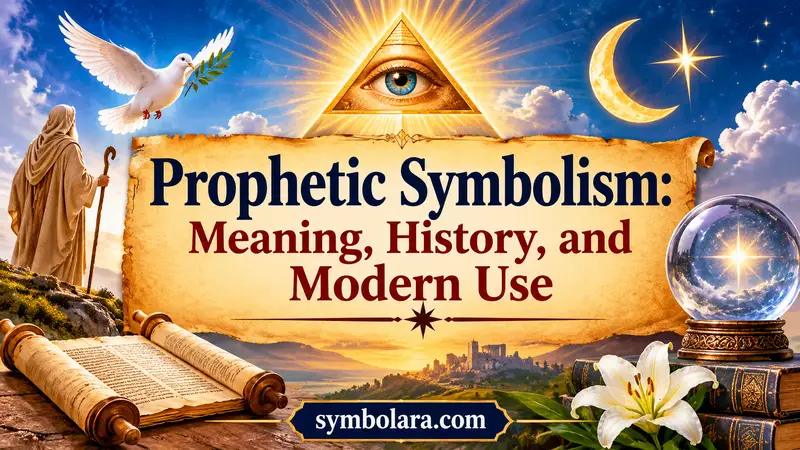
A burning bush, a dream about a falling star, or a vision of a doorway opening can all carry meanings beyond their literal appearance. In religious stories, literature, and personal experiences, these images may suggest a warning, a change, a future event, or a message that calls for attention. This is the basic idea behind prophetic symbolism.
People often search for this subject because they want to understand why certain images appear in religious texts, dreams, artwork, or personal experiences. Some want to explore biblical visions, while others are interested in how symbols can represent possible changes in life.
In the United States, these interpretations appear in churches, books, films, spiritual discussions, and everyday conversations. However, not every unusual image is a prediction. Understanding its background helps separate traditional meanings from personal beliefs and modern interpretations.
Quick Answer
Prophetic symbolism refers to the use of images, objects, animals, numbers, and events to communicate a message about the future, a warning, or a meaningful change. Its historical roots are especially visible in biblical visions, ancient religious traditions, and the symbolic language used by prophets to communicate ideas that ordinary descriptions could not easily express.
TL;DR
- Prophetic symbols often represent warnings, change, hope, or future possibilities.
- Biblical visions are an important historical source of prophetic imagery.
- Animals, natural events, numbers, and objects can carry symbolic meanings.
- American religious communities interpret these images through different beliefs.
- Modern films, books, and artwork continue to use prophetic imagery.
- Personal interpretations are beliefs, not proof of future events.
What Does Prophetic Symbolism Look Like?
Unlike a symbol such as a national flag or a wedding ring, prophetic imagery does not have one fixed appearance. It can take many forms, depending on the story, religious tradition, or cultural setting.
Some of the most recognizable examples include:
- Animals: Lions, lambs, horses, eagles, and serpents may represent leadership, innocence, conflict, freedom, or deception.
- Natural events: Earthquakes, storms, floods, droughts, and unusual weather may represent major changes or periods of difficulty.
- Celestial objects: The sun, moon, stars, and eclipses often appear in descriptions of major events or changes in the world.
- Objects: Keys, scrolls, trumpets, crowns, and swords can represent authority, communication, knowledge, victory, or judgment.
- Numbers: Certain numbers, particularly seven, twelve, and forty in biblical traditions, carry established religious associations.
- Colors: White, red, black, and gold can suggest purity, conflict, mourning, authority, or honor, depending on the context.
These images appear in paintings, stained-glass windows, illustrated religious books, sculptures, and modern entertainment.
The important detail is context. A lion in one story may represent courage, while a lion in another may represent danger. Its meaning depends on how the image is used and what the surrounding text communicates.
What Does This Imagery Mean in Modern American Culture?
In contemporary American culture, prophetic imagery is most commonly associated with warnings, hope, major changes, and religious expectations.
However, people do not always interpret these ideas in the same way.
Warning and preparation: Some people understand a symbolic vision as a reminder to prepare for difficult circumstances. A storm, for example, might represent a coming period of conflict or uncertainty.
Hope and renewal: Images such as sunrise, new growth, and a clear sky may suggest that a difficult period is ending. They can communicate the possibility of a fresh beginning.
Change and transformation: A door opening, a journey beginning, or an old structure falling may represent a major turning point.
Justice and accountability: In biblical literature, images of judgment can communicate the idea that human actions have consequences.
Spiritual responsibility: Some religious readers understand symbolic messages as reminders to act honestly, care for others, or reconsider their choices.
These meanings are not universal predictions. They are interpretations shaped by religious teachings, cultural background, and the details of a particular story.
Where Did Prophetic Imagery First Develop?
Symbolic communication about future events has roots in several ancient civilizations.
In the ancient Near East, people used dreams, visions, omens, and unusual natural events when trying to understand what might happen. Mesopotamian societies, for example, developed written traditions for interpreting dreams and observed signs. Such records connected certain events with possible outcomes for rulers, cities, and communities.
Ancient Egyptian traditions also included dream interpretation and religious images associated with divine communication.
These practices were not identical to biblical prophecy. Each society had its own religious ideas, methods, and expectations.
In ancient Israel, prophetic communication became closely connected with religious responsibility. Prophets such as Isaiah, Jeremiah, Ezekiel, and Daniel used vivid descriptions, symbolic actions, and visions to communicate messages about their communities and their relationship with God.
The historical development was gradual. There was no single person or event that created this form of symbolic communication.
Its use grew through religious storytelling, written traditions, and interpretations passed between generations.
How Did Biblical Prophets Use Symbols?
The Hebrew Bible contains some of the best-known examples of symbolic prophetic language.
Rather than always explaining a message directly, biblical prophets sometimes used familiar objects, unusual actions, animals, and dramatic scenes to communicate ideas.
Several examples help explain this approach.
Ezekiel’s vision of the wheel: In Ezekiel 1, the prophet describes a vision involving living creatures and unusual wheels. The scene presents divine movement, authority, and a vision of the heavenly realm. The detailed imagery has inspired many religious paintings and interpretations.
Jeremiah’s almond branch: In Jeremiah 1:11–12, Jeremiah sees an almond branch. The vision connects the branch with God’s watchfulness over the fulfillment of a message.
Amos and the plumb line: In Amos 7:7–9, the plumb line becomes an image of judgment and the measurement of Israel’s conduct.
Daniel’s symbolic animals: Daniel 7 describes four beasts rising from the sea. In the chapter, these creatures are connected with kingdoms and political power.
These examples show that prophetic images were often connected to specific historical and religious concerns. They were not simply decorative details.
Why Do Animals Appear in Prophetic Visions?
Animals are common in symbolic stories because their recognizable qualities make complicated ideas easier to communicate.
A lion, for instance, can suggest strength, leadership, or danger. A lamb may suggest innocence, sacrifice, or vulnerability.
Some biblical examples have especially clear textual connections.
| Context | Meaning in USA | Common Associations | Notes |
| Lion in biblical imagery | Authority and strength | Leadership, courage, kingship | Also represents danger in some passages |
| Lamb in Christian tradition | Innocence and sacrifice | Jesus Christ, redemption, vulnerability | Especially important in Christian artwork |
| Eagle in religious imagery | Protection and renewal | Freedom, strength, divine care | Also widely used in American national imagery |
| Horse in Revelation | Conflict and major events | War, conquest, famine, death | The four horsemen have specific biblical roles |
| Serpent in biblical stories | Deception or temptation | Evil, danger, disobedience | Other cultures may interpret serpents differently |
One important distinction is that animals do not carry identical meanings in every religious or cultural tradition.
For example, an eagle can represent national freedom in American public imagery, while biblical passages may use eagle imagery to describe protection or renewal.
The same animal can therefore communicate different ideas depending on where it appears.
What Do Numbers and Colors Represent?
Numbers and colors are two important parts of religious symbolic language.
Their meanings often come from repeated use in particular texts rather than from a universal system that applies everywhere.
The number seven
In biblical literature, seven is frequently associated with completion and sacred order. Genesis describes creation in a seven-day structure, while Revelation uses groups of seven churches, seals, trumpets, and other images.
The number twelve
Twelve is associated with the twelve tribes of Israel and the twelve apostles in Christian tradition. It often communicates ideas of community, organization, and religious completeness.
The number forty
Forty appears in accounts of testing, preparation, and periods of waiting. Examples include the forty days of rain in Genesis and Jesus’ forty days in the wilderness.
Colors also have contextual associations:
- White: Often represents purity, victory, or righteousness in biblical passages.
- Red: Can represent blood, sacrifice, conflict, or violence.
- Black: May represent mourning, famine, or hardship.
- Gold: Often suggests royal authority, wealth, honor, or sacred objects.
- Green: Can suggest life and growth, although its meaning depends on the passage.
Readers should avoid treating these associations as automatic rules. A color or number needs to be understood within the larger story.
How Is It Interpreted in American Religious Communities?
The United States has a wide range of religious communities, and their interpretations of prophetic images differ.
Among many Protestant Christians, especially in evangelical communities, the Book of Daniel and the Book of Revelation receive attention because they contain visions connected with kingdoms, judgment, conflict, and the future.
Some readers understand these passages as descriptions of events that will happen in the future. Others interpret them as symbolic accounts of historical struggles, spiritual conflicts, or recurring patterns in human society.
Catholic readers also study prophetic passages, often considering their relationship to scripture, church teaching, and the historical setting of the text.
Jewish interpretations of prophetic literature place particular attention on the Hebrew Bible, its original setting, ethical teachings, and the historical experiences of the Jewish people.
Outside organized religion, some Americans explore prophetic imagery through spiritual reading, personal reflection, and discussions about dreams.
These approaches should not be treated as one shared belief. Religious communities may disagree strongly about what a particular vision means and whether it refers to a future event.
How Does This Imagery Connect With American History?
Religious interpretations of signs and future events have appeared at different points in American history.
During the colonial period, some Christian communities understood political and social events through biblical prophecy. Religious leaders sometimes connected their experiences with passages from Daniel and Revelation.
The Great Awakening of the eighteenth century brought renewed interest in religious conversion, biblical teaching, and expectations about spiritual change.
Another major period came during the nineteenth century. William Miller, an American preacher, became known for predicting that Christ would return around 1843–1844. His movement attracted thousands of followers.
When the expected event did not occur, the disappointment became known as the Great Disappointment of 1844. The episode influenced the development of the Seventh-day Adventist movement.
This history illustrates an important point: symbolic interpretation can influence real decisions, communities, and public expectations.
It also shows why historical context matters when examining claims about future events.
Why Do People Connect With These Images Emotionally?
People often turn to symbols when they are trying to understand experiences that feel uncertain or difficult to explain.
A symbolic image can give an abstract concern a recognizable form.
For example, someone going through a major career change might connect with the image of an open door. A person dealing with grief might find comfort in a sunrise or a growing plant.
Religious readers may also find reassurance in images associated with protection, hope, or renewal.
There are several reasons these images can feel meaningful:
- They make abstract ideas easier to understand: A broken chain can represent freedom more clearly than a long explanation.
- They connect personal experiences with familiar stories: Someone may relate a difficult period to a biblical story of testing.
- They encourage reflection: An unusual dream or image may lead someone to reconsider a decision.
- They create a sense of continuity: Familiar symbols connect modern experiences with traditions that have been passed down through generations.
Psychologically, people naturally look for patterns and meaning. This can make symbolic images especially memorable.
However, an emotionally meaningful experience does not automatically establish that an image predicts an actual event.
Why Do People See Prophetic Meaning in Dreams?
Dreams are one of the most common subjects connected with prophetic interpretation.
Some religious traditions include stories in which dreams communicate warnings, instructions, or information about future events.
Joseph’s dreams in Genesis are a familiar example. His dreams about sheaves and celestial bodies become important in the story of his relationship with his family.
In the New Testament, Joseph receives guidance through dreams in Matthew 1–2.
These stories have influenced how many Christians think about dreams.
In modern America, people may interpret certain dream images as signs of change or personal concern:
- Falling: A feeling of losing control or facing uncertainty.
- Water: Emotional experiences, cleansing, or change.
- A journey: A transition or a new stage of life.
- A closed door: An obstacle or an opportunity that seems unavailable.
- A bright light: Hope, understanding, or a new perspective.
These are common modern interpretations, not established predictions.
Sleep research also offers a different way to understand dreams. Dreams can reflect memories, emotions, and experiences from waking life. Scientists have not established a reliable method for using dream images to predict future events.
A person can still find personal meaning in a dream without treating it as a guaranteed message about what will happen.
How Does Modern Media Use Prophetic Imagery?
Movies, television shows, novels, and video games frequently use prophetic images to create suspense and communicate future possibilities.
The technique is especially common in fantasy, science fiction, and religious storytelling.
For example, a character might discover an old prophecy describing the fall of a kingdom. A mysterious painting might reveal a future disaster. An eclipse might appear before a major turning point in the story.
These devices help audiences understand that something important may happen before the characters recognize it.
Several familiar types of media use this approach:
Fantasy literature: Stories often use prophecies to establish a character’s possible future or create conflict between personal choices and expectations.
Science fiction: Visions of technological disasters or destroyed cities can represent fears about the direction of society.
Horror films: Unusual dreams, repeated numbers, and unexplained warnings often create tension.
Religious films: Biblical visions and symbolic events may be presented through visual scenes inspired by scripture.
Modern entertainment does not always follow historical religious interpretations. Writers often adapt older imagery to fit a fictional world.
That distinction matters when comparing a movie’s version of a prophecy with the original religious text.
Why Do People Use These Images in Tattoos and Artwork?
In modern American fashion and personal expression, symbolic imagery can communicate values, experiences, and beliefs.
Some people choose designs connected with religious traditions, while others prefer images that represent personal growth or major life changes.
Common choices include:
- An open door: A new opportunity or a fresh beginning.
- A dove: Peace, hope, or Christian associations with the Holy Spirit.
- A trumpet: A warning, announcement, or reference to biblical imagery.
- A crown: Authority, responsibility, or victory.
- A rising sun: Renewal, recovery, and the beginning of another chapter.
- A scroll: Knowledge, revelation, or an important message.
These designs can appear in tattoos, necklaces, wall art, journals, and decorative objects.
For some people, a religious image represents commitment to a particular faith. For others, it is a reminder of an important personal experience.
The intended meaning belongs partly to the person choosing the design. Someone wearing a dove tattoo may be expressing peace rather than making a statement about future events.
What Are the Most Common Misunderstandings?
Several misconceptions make this subject harder to understand.
Misunderstanding 1: Every unusual event is a sign of the future.
An unusual cloud formation, unexpected animal sighting, or strange dream does not automatically carry a prophetic message. Natural explanations should be considered before assigning a special meaning.
Misunderstanding 2: Every symbol has one universal meaning.
A serpent, storm, or red color can have different associations across religious texts and cultures. Its meaning depends on the particular tradition and situation.
Misunderstanding 3: Biblical visions always describe future events.
Some visions address the political, social, or religious circumstances of the prophet’s own time. Others have been interpreted as referring to future events. The distinction is important.
Misunderstanding 4: Personal dreams can reliably predict major events.
There is no established scientific method that allows people to confirm future events through ordinary dream interpretation.
Misunderstanding 5: All Christians interpret Revelation in the same way.
Christian traditions have several approaches to Revelation, including preterist, historicist, futurist, and idealist interpretations. These approaches differ in how they understand the book’s visions and their relationship to history.
Careful interpretation requires patience rather than assuming that every image provides a direct answer.
How Has Its Meaning Changed Across Generations?
The way Americans understand prophetic images has changed as religious movements, education, media, and technology have developed.
Ancient societies: Dreams, omens, and visions were sometimes treated as sources of information about rulers, communities, and religious matters.
Biblical and early Christian periods: Symbolic visions became part of written religious traditions, particularly in prophetic books and apocalyptic literature.
Medieval period: Religious artwork, illuminated manuscripts, and church decorations helped communicate biblical stories to people who might not have had access to written texts.
Eighteenth and nineteenth centuries: Religious revivals and movements increased public interest in biblical prophecy and expectations about future events.
Twentieth century: Radio, television, printed books, and religious broadcasts brought discussions about prophecy to larger American audiences.
Twenty-first century: Social media, podcasts, online religious communities, and video platforms allow people to share interpretations immediately. Images from current events are sometimes connected with older religious passages, although these connections are often debated.
Younger generations may encounter these ideas through entertainment, online discussions, and personal spirituality rather than traditional religious instruction.
The central concept remains recognizable, but the ways people encounter and discuss it continue to change.
FAQs
Is prophetic symbolism positive or negative?
It can be either, depending on the image and its context. A vision of a new beginning may communicate hope, while an image of destruction may communicate warning, judgment, or the consequences of harmful actions.
Does it always have a religious meaning?
No. Although the term has strong connections with religious traditions, similar symbolic techniques appear in literature, political storytelling, art, and popular entertainment. A fictional prophecy in a fantasy novel does not necessarily express a religious belief.
What is the difference between a prophecy and a symbolic vision?
A prophecy is a message understood as communicating something about God’s will, human conduct, or future events within a religious tradition. A symbolic vision is a form of communication that uses images and scenes; it may contain a prophecy, but not every symbolic vision makes a prediction.
Can a person receive a prophetic message through an animal?
Some religious traditions contain stories of animals appearing in visions or carrying symbolic messages. However, there is no reliable way to establish that an ordinary animal encounter predicts a particular event. Its personal meaning depends on the individual’s beliefs and circumstances.
hy is the Book of Revelation associated with so many symbols?
Revelation uses a literary style known as apocalyptic literature. This style communicates religious and political ideas through visions, unusual creatures, numbers, cosmic events, and dramatic scenes rather than relying only on ordinary descriptions.
Are prophetic symbols the same as omens?
They are related but not identical. An omen is generally understood as an event or sign that suggests something may happen, while prophetic symbolism can communicate broader messages about morality, history, religious beliefs, or the future.
Conclusion
Prophetic symbolism uses recognizable images to communicate ideas about warnings, hope, change, responsibility, and possible future events. Its historical background includes ancient dream traditions, biblical visions, religious teachings, and the development of symbolic storytelling across different periods.
In modern American culture, these images appear in religious communities, personal artwork, tattoos, books, films, and online discussions. Their meanings depend on historical background, religious tradition, and the situation in which they appear.
Understanding these images does not require accepting every interpretation as a prediction. Sometimes a symbol matters because it encourages someone to reflect on a decision, remember a lesson, or find meaning during an uncertain period. A familiar image can carry a personal message even when it cannot tell anyone exactly what will happen next.