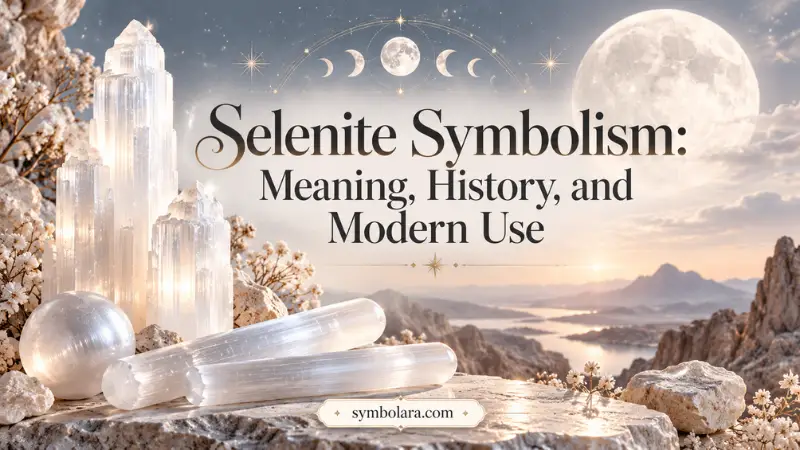
Selenite is a pale, often translucent crystal known for its soft glow and smooth, delicate appearance. Some pieces look like clear sheets of glass, while others resemble white ribbons of light. These qualities help explain why people associate the mineral with peace, clarity, and fresh beginnings.
Selenite symbolism often centers on calmness, emotional renewal, and the desire for a more peaceful environment. Its name also connects it to the moon, giving the mineral a place in both historical naming traditions and modern personal beliefs.
Today, Americans display selenite in bedrooms, wear it as jewelry, and give it as a thoughtful gift. Some appreciate its natural beauty, while others use it as a personal reminder to slow down, reflect, or welcome change.
Understanding its meaning begins with the mineral itself, followed by the history and cultural ideas that shaped its modern reputation.
Quick Answer
Selenite symbolism represents peace, mental clarity, emotional balance, purification, and new beginnings in modern American culture. Its moon-related associations come from its Greek-derived name and luminous appearance, while many beliefs about personal renewal and spiritual protection developed through more recent crystal traditions.
TL;DR
- Main meaning: Peace, clarity, purification, and emotional renewal.
- Historical origin: Its name comes from the Greek word for moon.
- Appearance: Transparent or milky-white gypsum with a gentle sheen.
- American culture: Popular in jewelry, home decoration, and personal reflection.
- Spiritual interpretation: Some believe it encourages protection and clearer thinking.
- Important distinction: Symbolic beliefs are not established scientific effects.
What Does Selenite Look Like, and Why Does Its Appearance Matter?
Selenite is a crystalline variety of gypsum, a naturally occurring mineral made of calcium sulfate and water. Pure selenite is usually colorless and transparent, although natural inclusions can create pale shades or cloudy areas.
Its appearance varies according to how the crystals form. Some pieces grow as broad, flat plates. Others develop long, blade-like shapes with smooth faces that catch the light.
A related form of gypsum called satin spar has a fibrous structure and a silky white appearance. Many decorative pieces marketed as selenite are actually satin spar.
Both materials share a soft, luminous quality that contributes to their symbolic appeal.
The mineral’s appearance has encouraged several visual associations:
- Transparency: Honesty, openness, and clear thinking.
- White coloring: Simplicity, peacefulness, and fresh beginnings.
- Soft reflections: Quietness, gentleness, and emotional comfort.
- Layered crystal structures: Gradual growth, patience, and personal change.
These meanings come from the way people interpret visual qualities. They are not physical properties of the mineral.
Selenite is also unusually soft, measuring about 2 on the Mohs hardness scale. A fingernail can scratch it.
That physical softness creates an interesting contrast. Although the crystal looks solid, it requires gentle handling. Some people find this a useful metaphor for caring for themselves or treating others with kindness.
Why Selenite Represents Peace, Clarity, and Emotional Balance
The strongest modern associations with selenite involve finding calm and creating a sense of order.
Its pale color and uncomplicated appearance fit naturally into spaces designed for rest. A white crystal placed beside a bedside lamp, for example, can become a small visual reminder to leave the day’s worries behind.
Peace is one of its most recognized symbolic meanings.
For some people, the mineral represents a quiet environment free from unnecessary distractions. Others connect it with resolving disagreements, maintaining patience, or responding thoughtfully to difficult situations.
Clarity is another common interpretation.
Because certain selenite crystals allow light to pass through them, people sometimes associate the material with seeing situations more clearly. Someone facing a difficult choice might keep a piece on a desk as a reminder to consider the facts before acting.
Emotional balance has a slightly different meaning.
It does not suggest that sadness, frustration, or uncertainty should disappear. Instead, the crystal can represent the intention to acknowledge difficult feelings without allowing them to control every decision.
These interpretations are personal rather than universal. One person may value selenite for its symbolism, while another may simply enjoy the way it reflects sunlight.
Neither response requires accepting supernatural explanations.
How Did Selenite Become Connected to the Moon?
The mineral’s name provides one of its clearest historical connections.
The word selenite comes from the Greek word selēnē, meaning moon. Selene was also the name of the moon goddess in Greek mythology.
The name is generally understood as a reference to the mineral’s moonlike appearance, particularly its pale color and reflective surfaces.
Greek and Roman writers discussed gypsum and related translucent minerals. The moon association survived in mineral terminology long after the original naming practices developed.
However, an important distinction is often overlooked.
A moon-related name does not prove that every modern belief about selenite existed in classical Greece.
Modern descriptions sometimes portray the mineral as a universal sacred stone of the ancient world. Historical evidence supports a more limited conclusion: its appearance and name have longstanding connections with the moon, but specific spiritual interpretations have varied.
The moon itself has represented cycles, changing seasons, nighttime, and renewal in many cultural settings.
These broader associations help explain why modern crystal enthusiasts connect selenite with personal transitions and fresh starts.
For example, someone may display a pale crystal during a new moon as a personal symbol of setting intentions.
That is a contemporary practice rather than proof of an uninterrupted Greek ritual tradition.
How Ancient Romans Used Selenite to Bring Light Indoors
Selenite’s historical importance was not limited to its appearance or name.
In the Roman world, transparent sheets of crystallized gypsum were used as window material. The substance was known as lapis specularis.
Before manufactured glass became widely available and affordable for many windows, thin mineral sheets offered a practical way to let daylight enter enclosed spaces.
Roman builders used this translucent gypsum in homes and public buildings.
One important production area was around Segóbriga, in what is now central Spain. Mines supplied material that could be cut into panels and transported across parts of the Roman Empire.
The mineral’s practical value came from its ability to transmit light while helping separate indoor spaces from outside conditions.
This historical use creates a meaningful contrast with modern symbolism.
Today, people commonly connect selenite with mental clarity. Roman builders valued a related form of the same mineral because it physically allowed light into buildings.
The two meanings should not be treated as identical historical beliefs. Still, the material’s relationship with light provides an understandable connection between its earlier uses and modern interpretations.
Roman examples also demonstrate that selenite has a broader history than modern crystal shops suggest.
It was once a useful building material, a traded commodity, and a product of specialized mining industries.
How Selenite Became a Popular Symbol in American Wellness Culture
The meaning of selenite changed considerably as mineral collecting and alternative spiritual practices became more visible in the United States.
For generations, gypsum crystals attracted the attention of geologists, collectors, museums, and people interested in natural history.
Their unusual shapes made them appealing even without symbolic interpretations.
During the second half of the twentieth century, alternative spiritual movements helped popularize crystals as objects connected with meditation, personal development, and emotional well-being.
These movements combined ideas from several traditions, along with modern interpretations that were not always historically connected.
Selenite became associated with purification, peaceful surroundings, and personal reflection.
By the 2000s and 2010s, decorative mineral objects were increasingly visible in lifestyle stores, gift shops, and online marketplaces.
The popularity of mindfulness practices and minimalist interiors also created space for objects that looked simple and calming.
By 2025–2026, selenite commonly appeared in several overlapping settings:
- Crystal collections and mineral displays.
- Meditation corners and yoga spaces.
- Modern home decoration.
- Personal gifts and keepsakes.
- Jewelry and handmade accessories.
Not everyone uses the mineral for the same reason.
For one buyer, it represents a spiritual belief. For another, it is an attractive natural object that complements a carefully arranged room.
Its modern popularity comes partly from this flexibility.
Why Americans Display Selenite in Bedrooms and Living Spaces
A long white crystal placed on a wooden shelf can change the appearance of a room without becoming its main attraction.
This is one reason selenite fits many modern American decorating styles.
Its neutral coloring pairs easily with wood, linen, pottery, and houseplants. It also works in interiors that favor simple shapes and limited decoration.
In bedrooms, selenite often represents rest and emotional comfort.
Someone might place a small tower on a nightstand alongside a book and a lamp. The arrangement creates a visual setting associated with winding down before sleep.
In living rooms, larger decorative pieces can communicate openness and a preference for peaceful surroundings.
Home offices offer another setting.
A crystal beside a notebook or computer may serve as a reminder to pause before answering a stressful message or making an important decision.
The meaning comes from the owner’s intention.
There is no scientific evidence that placing selenite in a room automatically changes people’s emotions or removes harmful influences.
However, familiar objects can become reminders of personal habits and goals.
A person who associates a particular object with relaxation may use its presence as a cue to practice a calming routine.
This explains how a decorative crystal can hold emotional value without needing to produce a measurable physical effect.
What Wearing Selenite Jewelry Can Communicate
Selenite jewelry often combines visual simplicity with personal meaning.
Pendants, earrings, and carefully protected decorative pieces may feature pale gypsum crystals or the silky-looking satin spar variety.
Unlike brightly colored gemstones, these materials usually attract attention through reflected light and subtle texture.
People choose them for different reasons.
Someone who values peaceful communication might wear a white pendant as a reminder to remain patient during difficult conversations.
Another person may associate the jewelry with leaving behind an upsetting experience.
Others simply prefer understated accessories.
Selenite can communicate several personal messages:
A preference for simplicity: The pale appearance complements clothing without requiring elaborate decoration.
A commitment to self-reflection: The wearer may associate the stone with thoughtful decisions.
An appreciation of nature: Natural crystal patterns make each piece visually distinctive.
A connection with lunar imagery: Moon-shaped jewelry can emphasize the mineral’s historical name.
Jewelry symbolism is not a fixed code. Seeing someone wear selenite does not reveal their personality, beliefs, or emotional condition.
There is also a practical limitation.
Because gypsum scratches easily and can break along its natural crystal structure, it is less suitable for rough daily wear than harder gemstones.
For that reason, selenite often works better in occasional accessories than in rings exposed to constant contact.
Why Selenite Makes a Meaningful Gift During Life Changes
A gift becomes more memorable when its meaning matches the occasion.
Selenite is sometimes selected for someone beginning a new stage of life because its modern symbolism includes peace, fresh starts, and thoughtful change.
Consider a friend moving into a first apartment.
A small decorative crystal might be presented as a wish for a comfortable and welcoming home.
For a recent graduate, the same gift could represent the hope of making clear decisions about work and future plans.
During a difficult period, someone might offer selenite as a gentle reminder that support and patience are available.
The object does not solve the recipient’s problems. Its value lies in the thought behind the gesture.
Weddings and other personal celebrations provide additional opportunities for symbolic gifts.
A pale crystal displayed with white flowers may contribute to an atmosphere of simplicity and quiet elegance.
However, selenite does not have a universal traditional role in American weddings.
Its use is a personal design choice rather than a required custom.
A short handwritten message can make the intended symbolism clear:
May your new home be filled with peaceful moments and happy memories.
This gives the gift meaning without promising supernatural results.
What Oklahoma’s Hourglass Selenite Crystals Represent
Selenite also has a distinctive connection with American natural heritage.
At Salt Plains National Wildlife Refuge in north-central Oklahoma, visitors can discover unusual gypsum crystals containing hourglass-shaped inclusions.
These patterns develop as the crystals grow and trap materials from their surroundings.
The result is a natural hourglass design visible inside the mineral.
Oklahoma designated the hourglass selenite crystal as its official state crystal in 2005.
The area has become known for educational crystal collecting during designated seasonal access periods.
This example shows a different side of the mineral’s meaning.
For mineral collectors, a piece from Oklahoma may represent curiosity, patience, and the excitement of discovering something in nature.
For families, collecting can become a shared outdoor memory.
The hourglass shape may also inspire personal comparisons with passing time, although that interpretation is not an official state meaning.
A child who finds a crystal on a family trip may treasure it for years because it recalls a specific day.
Its emotional value can develop from experience rather than an established spiritual tradition.
The Oklahoma example reminds us that symbolism sometimes begins with a place, an event, or a personal memory.
How Selenite’s Meaning Changes in Different Settings
The meaning assigned to selenite often depends on where someone encounters it and why it is being used.
A museum specimen, a wedding decoration, and a personal keepsake may be made from the same mineral but communicate different ideas.
| Context | Meaning in USA | Common Associations | Notes |
| Wedding decorations | A hopeful beginning | Unity, simplicity, shared plans | Usually a personal design choice |
| Graduation gifts | Confidence about the future | Decisions, independence, growth | Meaning often comes from the giver’s message |
| Memorial displays | Quiet remembrance | Respect, comfort, reflection | Not a universal mourning tradition |
| Creative workspaces | A thoughtful approach | Focus, patience, careful planning | Functions as a personal reminder |
| Mineral collections | Appreciation of natural processes | Discovery, geology, preservation | No spiritual belief is necessary |
| Moon-themed artwork | Change and renewal | Lunar cycles, reflection, transitions | Builds on the mineral’s name and appearance |
These interpretations illustrate how material objects gain meaning from context.
A crystal purchased while traveling may become a reminder of that journey. The same type of crystal received after a major achievement might represent encouragement.
Neither meaning is more authentic simply because it follows a particular custom.
Personal symbolism can exist alongside cultural and historical meanings.
What Do Cleansing, Protection, and Spiritual Renewal Mean in Selenite Beliefs?
Many contemporary crystal traditions describe selenite as a stone of cleansing, protection, or spiritual renewal.
These descriptions are best understood as belief-based interpretations.
In such practices, cleansing generally refers to the intention to release upsetting thoughts, leave behind difficult experiences, or establish a fresh emotional starting point.
Protection may represent a person’s wish to establish boundaries and feel more secure in their surroundings.
Neither idea should be confused with a verified physical property.
Scientific research has not established that selenite can remove harmful spiritual influences, treat medical conditions, or protect someone from danger.
Some people still find symbolic rituals personally meaningful.
For example, arranging a room, clearing unnecessary belongings, and placing a chosen object on a shelf can mark the beginning of a new routine.
The practical benefits of organizing a space should not be attributed automatically to the mineral.
Selenite also appears in contemporary discussions of meditation and spiritual awareness.
Its moon-related name contributes to associations with reflection, intuition, and personal growth.
Yet these beliefs should not be presented as universal religious teachings.
Selenite has no single meaning shared by all faiths or cultures.
Although modern crystal practices sometimes borrow language from different spiritual traditions, there is insufficient evidence to claim that every current interpretation comes from an established historical custom.
Respecting this distinction makes the mineral’s cultural story more accurate.
Someone may appreciate its symbolism without accepting claims about invisible forces.
Why Knowing the Difference Between Selenite and Satin Spar Matters
One common misunderstanding involves the name printed on decorative products.
Many white towers, wands, and bowls sold as selenite are made from satin spar gypsum.
True selenite generally forms transparent or nearly transparent crystals with flat, glassy surfaces.
Satin spar has tightly arranged mineral fibers that create a silky appearance.
The two belong to the same mineral family and share the same basic chemical composition.
Their differences are mainly structural and visual.
This distinction matters when people connect symbolism to appearance.
A transparent crystal may encourage associations with openness and clarity. A white satin spar tower may instead suggest softness and peaceful simplicity.
Neither interpretation requires the object to be a different mineral species.
Another misunderstanding concerns durability.
Gypsum is somewhat soluble in water, making prolonged soaking unsuitable for decorative specimens. Repeated moisture exposure can damage the surface.
It can also scratch or chip with relatively little force.
Owners should therefore handle pieces carefully, store them in dry locations, and avoid using them as ordinary waterproof decorations.
Some sellers also make absolute claims about the mineral’s ability to change emotions or guarantee protection.
Such promises go beyond what can be demonstrated.
The most reliable approach is to separate three things: the mineral’s physical properties, its documented history, and the personal beliefs attached to it.
Each adds something different to the story.
FAQs
Selenite is generally interpreted positively in contemporary American crystal traditions. It is commonly chosen to represent kindness, peaceful intentions, and thoughtful change, rather than conflict or misfortune.
Selenite is not an official sacred symbol shared by any major religion. Individual believers may include it in private spiritual practices, but these personal uses should not be confused with established religious teachings.
No. Selenite is a variety of gypsum, while moonstone belongs to the feldspar mineral group. Their similar lunar names and pale appearances can cause confusion, but they have different compositions and physical characteristics.
Despite the similar names, selenite gypsum does not contain selenium as a required part of its chemical formula. It is composed of calcium sulfate and water, and its name comes from the Greek word associated with the moon.
Prolonged water exposure is not recommended because gypsum is slightly soluble and its surface can deteriorate. A soft, dry cloth is generally a better choice for removing loose dust from decorative pieces.
Some modern crystal enthusiasts associate orange or peach varieties with warmth, confidence, and creativity. These color meanings are contemporary personal interpretations, not universally documented historical beliefs; the coloration itself can result from mineral impurities.
Yes. Selenite can be collected as a geological specimen, displayed as natural decoration, or valued for a personal memory. Appreciation of its appearance and history does not require belief in healing or supernatural effects.
Conclusion
Selenite symbolism brings together several distinct ideas: the Greek association with the moon, the mineral’s historical relationship with light, and modern interpretations of peace, clarity, and emotional renewal.
Its meaning has changed as people have found new ways to appreciate the material. Roman builders valued transparent gypsum for practical purposes, while modern collectors, decorators, and crystal enthusiasts often connect it with beauty and personal reflection.
A small piece of selenite resting on a bedroom shelf does not need extraordinary abilities to be meaningful. It may simply remind its owner of a new beginning, a thoughtful gift, or a quieter approach to everyday life.