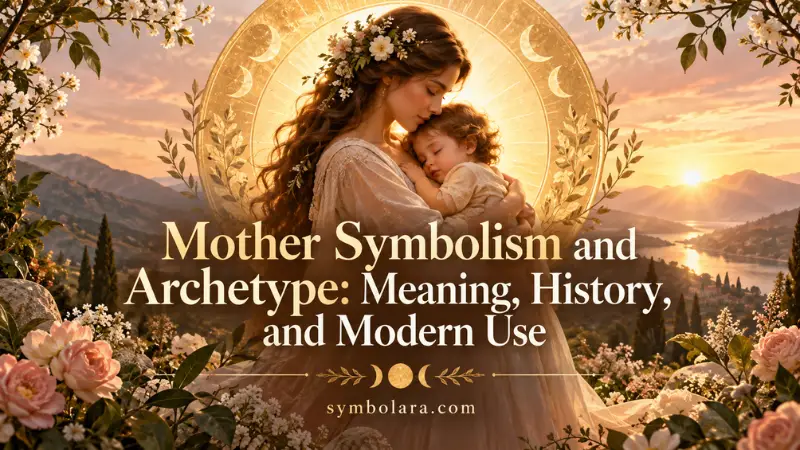
A mother holding a sleeping child is one of the most recognizable images of care and protection. The same idea appears in family photographs, religious paintings, public monuments, and stories about people who sacrifice their comfort to help others.
Mother symbolism and archetype represent nurturing, protection, emotional security, creation, and the complicated relationship between love and responsibility. Although motherhood is commonly associated with kindness, its symbolic meaning can also include authority, sacrifice, fear, and control.
These meanings developed through family experiences, religious traditions, mythology, and psychology. In American culture, they appear in Mother’s Day celebrations, literature, movies, memorial tattoos, and discussions about parenting.
Understanding this figure means looking beyond the familiar image of a caring parent. It also means recognizing how different people experience motherhood and why the same symbol can inspire affection, gratitude, sadness, or conflict.
Quick Answer
Mother symbolism and archetype commonly represent unconditional care, protection, emotional security, creation, and personal growth. These associations developed through family relationships, historical traditions, religious imagery, and psychological theories, including Carl Jung’s description of the mother as both nurturing and potentially controlling.
TL;DR
- Core meaning: Care, protection, creation, belonging, and emotional security.
- Historical roots: Mother figures appear in Egyptian, Greek, and Christian traditions.
- Psychology: Carl Jung described both nurturing and threatening maternal qualities.
- American culture: Mother’s Day celebrates caregiving, gratitude, and family relationships.
- Personal meaning: Experiences with mothers shape how individuals interpret the figure.
- Modern interpretation: Motherhood includes biological, adoptive, foster, and chosen family relationships.
What Does the Mother Archetype Look Like?
Unlike a geometric shape or an animal emblem, the mother archetype has no single physical appearance. Artists communicate it through recognizable actions, relationships, and visual details.
A common image shows an adult holding an infant close to the chest. This arrangement suggests warmth, protection, and physical dependence. Other illustrations feature a parent guiding a young child, preparing food, or standing protectively beside family members.
Several visual elements frequently communicate maternal meaning:
- Open arms: Welcome, affection, and emotional acceptance.
- A mother holding a child: Protection, care, and dependence.
- A protective embrace: Safety during uncertainty or distress.
- A cradle: Early childhood, comfort, and responsibility.
- A garden: Growth, patience, and sustained attention.
- A family home: Belonging, stability, and shared memories.
These images are not limited to biological mothers.
A grandmother raising her grandchildren, an adoptive parent comforting a child, or a caregiver helping someone recover can express similar qualities.
In visual storytelling, body language matters as much as appearance. A protective stance may communicate responsibility, while an extended hand suggests guidance.
The setting can also change the meaning. A parent standing near an open doorway might represent encouragement toward independence. The same figure blocking an exit could suggest excessive control.
Why Mothers Symbolize Love, Protection, and Belonging
The central meaning of the mother figure comes from the relationship between a dependent child and a caregiver.
Newborns need assistance with feeding, warmth, movement, and safety. These early needs help explain why maternal imagery became associated with protection and survival.
However, biological motherhood and caregiving are not identical. Children can form meaningful bonds with fathers, grandparents, adoptive parents, and other dependable adults.
Three familiar ideas shape the symbolism.
Love and emotional acceptance
The idealized mother welcomes a child even when that child struggles or makes mistakes. This image represents the hope of being valued without having to prove personal worth.
Protection and security
A parent shielding a child from danger represents the responsibility to notice risks and respond appropriately. In stories, this protective role may involve courage, difficult choices, or personal sacrifice.
Belonging and continuity
Mothers can represent family history and connections between generations. Recipes, photographs, holiday customs, and shared expressions often carry memories of maternal relatives.
These associations describe cultural ideals rather than guarantees about real relationships.
Not every mother provides affection or safety. Likewise, many people who provide outstanding care are not mothers.
The symbolic figure represents qualities people value, not a standard that every woman must meet.
Historical Origins of Mother Figures and Maternal Imagery
Maternal figures appear in surviving art and religious traditions from several early societies. However, historians cannot identify one universal origin for motherhood symbolism.
Its development took different forms across cultures.
In ancient Egypt, the goddess Isis became associated with motherhood, protection, and royal legitimacy. Artworks from the first millennium BCE frequently show her nursing her son Horus.
These images communicate more than ordinary childcare. Within Egyptian religious beliefs, Isis protects Horus, whose identity is closely connected with kingship and rightful succession.
Ancient Greek traditions also included maternal figures.
Demeter, the goddess associated with agriculture and grain, was central to stories about her daughter Persephone. Their separation and reunion connected family relationships with seasonal change and the agricultural cycle.
The story presents motherhood through grief, determination, and the desire for reunion.
Christian art later developed familiar images of Mary holding the infant Jesus.
Paintings and sculptures showing Mary and Jesus became important devotional images. They often communicate tenderness while also expressing specific Christian beliefs about Mary’s religious role.
These traditions share some visual qualities, but they are not interchangeable.
Each developed within its own historical and religious setting. Similar maternal images do not establish that every culture inherited the same belief from a single source.
Carl Jung’s Mother Archetype in Psychology
Swiss psychiatrist Carl Gustav Jung gave the mother archetype a specific place within his theory of analytical psychology.
Jung used archetype to describe recurring patterns of imagery and meaning that he believed appeared in dreams, myths, and human experience.
He proposed that the mother figure could represent both personal relationships and broader psychological ideas.
In his writing, maternal images include actual mothers, grandmothers, nurturing figures, goddesses, and certain representations of nature.
Jung also connected the archetype with places such as gardens, forests, and bodies of water.
These associations formed part of his interpretive framework rather than a scientifically established code for understanding symbols.
The nurturing mother
Jung’s positive maternal figure includes qualities such as compassion, care, wisdom, and support for growth.
A character who offers shelter during a crisis may represent this side of motherhood.
Such imagery can express the desire for reassurance or the comfort of familiar relationships.
The threatening or controlling mother
Jung also described a darker side of the maternal figure.
This includes possessiveness, excessive control, and the fear of being overwhelmed or prevented from developing independence.
For example, a fictional parent who refuses to let an adult child make personal decisions may illustrate this pattern.
Jung believed opposite qualities could appear within the same symbolic figure.
Modern psychology does not universally accept his claims about inherited archetypes or a collective unconscious. Researchers continue to debate how these ideas relate to evidence about learning, culture, and emotional development.
His framework remains influential in literary criticism and symbolic interpretation, but it should not be treated as a diagnostic tool.
How Mother Symbolism Appears in American Culture
American culture often presents mothers as figures of gratitude, dedication, responsibility, and family continuity.
These meanings appear in holidays, advertising, entertainment, schools, and everyday family traditions.
Mother’s Day provides a clear example.
Anna Jarvis promoted a national observance after the death of her mother, Ann Reeves Jarvis, in 1905. The first widely recognized Mother’s Day services associated with her campaign took place in 1908.
In 1914, President Woodrow Wilson proclaimed the second Sunday in May a national occasion honoring mothers.
White carnations were associated with Jarvis’s early commemorations. Over time, flowers, greeting cards, meals, and family gatherings became familiar ways of observing the day.
The holiday now recognizes many forms of motherhood, including adoptive, foster, and stepmother relationships.
However, Americans do not experience the occasion in the same way.
Some celebrate close family bonds. Others remember deceased mothers, reflect on difficult relationships, or experience sadness connected with infertility or family separation.
Public celebrations often emphasize the ideal of a caring mother, while personal experiences reveal a wider range of emotions.
American discussions about parenting have also changed. Today, many families place greater emphasis on shared responsibilities, emotional communication, and recognizing unpaid caregiving work.
The maternal figure continues to communicate affection, but it also raises questions about fairness, independence, and expectations placed on women.
Mother Figures Across Religious and Cultural Traditions
Different traditions attach specific meanings to maternal imagery. Comparing them helps explain why the figure cannot be reduced to one definition.
The Virgin Mary in Christianity
Mary, the mother of Jesus, holds a significant place in Christian traditions.
In Catholic and Orthodox devotion, she is especially associated with compassion, maternal intercession, and religious faithfulness.
Paintings of the Madonna and Child present an intimate relationship while expressing theological ideas about Jesus.
Some Protestant traditions honor Mary’s role without sharing the same devotional practices.
Isis in ancient Egyptian religion
Isis represents maternal protection within the stories surrounding Osiris and Horus.
Her care for Horus reflects both personal motherhood and the safeguarding of an important divine heir.
Her symbolism belongs to a religious system with its own beliefs about kingship, family, and the gods.
Demeter in Greek mythology
Demeter’s relationship with Persephone illustrates maternal grief and determination.
In the traditional myth, Persephone’s absence affects Demeter and becomes connected with changes in the agricultural world.
The story emphasizes the emotional consequences of separation.
Pachamama in Andean traditions
Pachamama holds an important place in various Indigenous Andean traditions.
She is frequently translated as Mother Earth, although the meaning of pacha can also involve time, space, and the surrounding world.
Practices honoring Pachamama may express reciprocity, respect, and responsibility toward the environment.
Reducing this figure to a general Western idea of nature as a mother would overlook the cultural meanings attached to her.
These examples show how maternal imagery can express protection, devotion, agricultural continuity, or relationships with the natural world.
Why the Mother Figure Has Both Positive and Negative Meanings
The mother archetype is not always presented as comforting.
Its meaning can change depending on whether care supports independence or becomes a form of control.
A nurturing parent responds to a child’s needs while allowing that child to grow.
By contrast, a controlling parent may use guilt, fear, or excessive supervision to discourage independence.
This contrast appears frequently in fiction.
A mother who works long hours to provide for her family might symbolize commitment. Yet a character who demands constant obedience may represent the difficulties of an unequal relationship.
The difference lies partly in how authority is exercised.
Protection becomes restrictive when it prevents reasonable choices. Guidance becomes manipulation when affection is made conditional on compliance.
Popular discussions sometimes divide maternal figures into labels such as the good mother and the bad mother.
Real people are more complicated.
A parent can be affectionate in some situations and overly controlling in others. Personal stress, social expectations, and family circumstances influence behavior.
Symbolic interpretation should recognize these differences without reducing someone to a fixed personality type.
The Emotional Meaning of Motherhood and Attachment
Mother imagery often carries personal emotional weight because early caregiving relationships can influence expectations about comfort and trust.
Developmental psychology studies how children form attachments with caregivers.
Consistent, responsive care can help children develop a sense of security. However, attachment is not limited to mothers, and adult experiences can also change relationship patterns.
A familiar maternal image may remind someone of:
- Comfort during childhood illness.
- Encouragement before a difficult experience.
- Family routines and shared meals.
- Support following a personal disappointment.
- Separation, grief, or an unresolved conflict.
The emotional response depends on personal history.
Someone raised by a supportive grandmother may associate maternal care with that relationship instead of their biological mother.
Another person may experience maternal imagery as uncomfortable because it recalls neglect or criticism.
Neither response makes the symbol universally positive or negative.
In dreams and personal artwork, mother figures may reflect memories, current worries, relationship concerns, or recent experiences.
There is no reliable psychological rule stating that seeing a mother in a dream predicts a particular event.
The most useful interpretation considers the person’s circumstances and feelings rather than assigning one fixed meaning.
Mother Earth and the Symbolism of Creation
Nature is often described through maternal language because it supports life and provides resources necessary for survival.
Expressions such as Mother Earth and Mother Nature connect the natural environment with ideas of care, renewal, and dependence.
Several visual features support this comparison.
Seeds develop in soil, plants require favorable conditions, and seasonal cycles create opportunities for new growth.
These processes can serve as metaphors for patience and sustained support.
The symbolism also appears in environmental communication.
Illustrations may portray Earth as a woman holding plants, animals, or the planet itself. Such images encourage viewers to consider the relationship between human communities and their surroundings.
However, the comparison has limitations.
Natural processes are not always gentle. Storms, droughts, and disease are also part of the environment.
Similarly, caregiving involves more than constant comfort. It may require difficult decisions, boundaries, and practical responsibility.
Modern environmental interpretations often use the mother metaphor to encourage care for natural resources.
This is a cultural comparison, not evidence that nature has human emotions or intentions.
Mother Archetypes in Literature, Fairy Tales, and Movies
Storytelling gives the mother figure different roles depending on the needs of the plot.
Sometimes a maternal character protects the hero. Elsewhere, her absence creates emotional conflict, or her authority becomes an obstacle.
These patterns are visible in familiar works.
In Disney’s Brave (2012), Queen Elinor represents parental expectations, family responsibility, and the difficulty of understanding a growing child’s independence.
Her relationship with Merida changes as both characters begin recognizing each other’s concerns.
In Coraline (2009), the Other Mother initially appears affectionate and generous.
Her behavior eventually reveals manipulation and possessiveness. The contrast illustrates how apparent care can become a means of control.
Louisa May Alcott’s Little Women portrays Marmee as a source of guidance and emotional support.
She teaches her daughters about responsibility, kindness, and personal conduct while acknowledging that family members have different temperaments.
These characters do not represent every real mother.
Instead, writers use maternal relationships to examine questions about love, freedom, duty, and belonging.
The mother’s role often changes as the central character matures. Someone who first appears to provide unquestioned authority may later become a person with individual fears, limitations, and needs.
Mother Symbols in Tattoos, Jewelry, and Personal Keepsakes
Maternal imagery often appears in objects that preserve family memories or express relationships.
These designs can communicate affection without requiring an elaborate explanation.
A tattoo showing an adult holding a child’s hand may represent guidance and lifelong connection.
Birth flowers, initials, and significant dates allow someone to personalize the design.
Memorial tattoos frequently include handwriting copied from a card or letter. The original handwriting can make the image especially meaningful to the person wearing it.
Jewelry offers similar possibilities.
Birthstone necklaces, engraved bracelets, and lockets containing photographs can serve as reminders of family relationships.
The interpretation depends on the object and its owner.
| Context | Meaning in USA | Common Associations | Notes |
| Mother-and-child tattoo | Personal connection and commitment | Family identity, loyalty | May honor an adoptive or chosen parent |
| Memorial jewelry | Remembrance after loss | Grief, gratitude, continuing affection | Engraving can preserve a personal message |
| Birth-flower necklace | Individual family identity | Birth months, children, generations | Flower choices may be purely personal |
| Family photography | Shared history and continuity | Milestones, ancestry, belonging | Often passed between generations |
| Maternal artwork in nurseries | Welcome and reassurance | Early childhood, comfort | May represent hopes for a growing family |
A symbol does not need a fixed cultural definition to matter.
A simple recipe card framed in a kitchen may carry more personal meaning than an expensive sculpture.
Its value comes from the relationship and memories associated with it.
How the Meaning of Motherhood Has Changed Over Time
Ideas about motherhood have changed alongside family structures, employment patterns, and social expectations.
In many earlier American communities, household responsibilities were strongly divided by gender.
Women were often expected to manage childcare and domestic work, while men were presented as primary financial providers.
These expectations never described every household, but they influenced public images of the ideal mother.
During the nineteenth century, some American cultural writing praised domestic motherhood as a woman’s central duty.
In the twentieth century, changing employment opportunities and women’s rights movements challenged the idea that motherhood should define a woman’s entire identity.
Popular media also began portraying more varied family arrangements.
By the late twentieth and early twenty-first centuries, adoptive families, single-parent households, blended families, and families with same-sex parents received greater public visibility.
In 2025–2026, discussions frequently include mental health, parental leave, childcare costs, shared household work, and the importance of personal boundaries.
These changes affect the symbol itself.
The mother figure is no longer limited to the image of a woman who stays home and devotes every moment to her children.
It can also represent a working parent, a foster caregiver, a grandmother raising grandchildren, or a person balancing family care with other responsibilities.
The central association with nurturing remains recognizable, while the public understanding of who provides that nurturing has expanded.
Common Misunderstandings About the Mother Archetype
One misconception is that every mother must naturally possess endless patience, affection, and emotional understanding.
Caregiving abilities involve learning, circumstances, relationships, and available support. They cannot be explained by biology alone.
Another misunderstanding is that women who do not become mothers are somehow missing an essential personal quality.
Motherhood is not a requirement for compassion, maturity, or fulfillment.
People without children can provide care through friendships, teaching, mentoring, community work, and family relationships.
A third misconception involves Jung’s psychological theory.
The presence of a mother figure in a dream, painting, or fictional story does not prove that someone has a particular psychological condition.
Archetypal interpretation offers one way of discussing imagery. It is not a substitute for evidence-based psychological assessment.
Another mistake is treating culturally distinct mother figures as identical.
Isis, Mary, Demeter, and Pachamama have different religious and historical meanings.
Grouping them under a broad maternal category can be useful for comparison, but their individual traditions deserve accurate representation.
Finally, maternal sacrifice is sometimes romanticized.
Appreciating caregiving does not mean expecting parents to ignore their health, relationships, or personal needs.
A healthy understanding of nurturing can include rest, boundaries, and support from others.
FAQs
Mother symbolism refers broadly to meanings attached to mothers and maternal images in art, religion, and everyday life. The mother archetype is a more specific idea associated with Jungian psychology, where recurring maternal patterns help interpret stories, dreams, and emotional experiences.
The Great Mother is a concept in Jungian writing that represents an expanded maternal figure associated with nurturing, creation, fertility, and sometimes destruction. It may be used to interpret mythological goddesses or natural imagery, but it is not a single deity recognized by every culture.
Traditional Jungian interpretations frequently connect the mother figure with femininity and qualities considered maternal. Contemporary readers may separate those associations from gender because nurturing and protection are abilities that people of any gender can express.
A dream involving your mother may reflect recent contact, family memories, emotional concerns, or an unresolved disagreement. The meaning depends on the dream’s details and your personal relationship, and no scientifically established interpretation applies to everyone.
Yes, when the term is used symbolically. A person may express nurturing, protection, and mentorship through relationships or responsibilities without becoming a parent.
Its meaning depends on the tradition. It may be associated with compassion, divine protection, fertility, sacred responsibility, or the relationship between living beings and the natural world. These interpretations should be understood within their own religious and cultural settings rather than treated as universal beliefs.
Conclusion
Mother symbolism and archetype represent care, protection, belonging, creation, and the complicated responsibilities involved in nurturing others. Historical traditions, Jungian psychology, and modern American culture have given maternal images different meanings, from compassionate guidance to restrictive authority.
Although motherhood is often portrayed as an ideal of unconditional affection, actual family relationships are more varied. A meaningful interpretation recognizes both supportive experiences and difficult ones without treating either as universal.
A handwritten recipe, a photograph of a parent holding a child, or a necklace engraved with a family member’s initials can preserve a particular relationship. These ordinary objects show why maternal symbolism remains personally meaningful: it gives people a way to remember care, acknowledge loss, and express the bonds that have shaped their lives.