
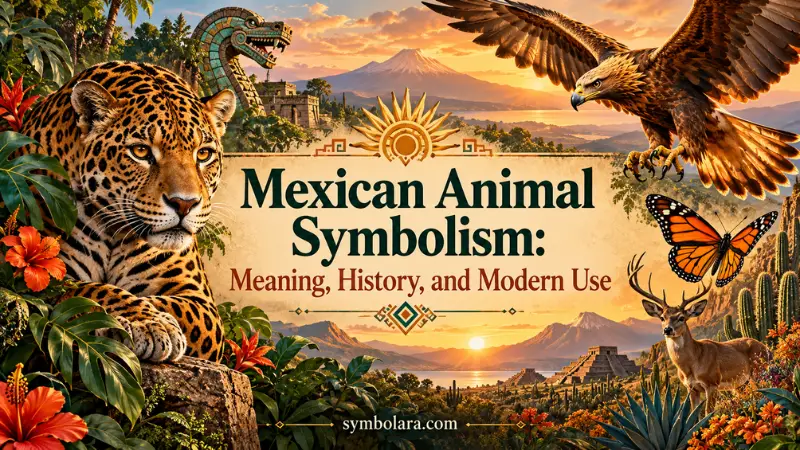
An eagle gripping a snake on the Mexican flag, a spotted jaguar carved into stone, and a brightly painted wooden animal from Oaxaca may look very different. Yet each carries meaning connected to Mexico’s history, beliefs, and artistic traditions.
Mexican animal symbolism reflects ideas about strength, protection, identity, life, death, and the natural world. Many of these associations developed within Indigenous civilizations, including the Mexica, Maya, Mixtec, and Zapotec peoples. Other meanings emerged through colonial history, regional customs, and modern Mexican art.
Today, these animal images appear in Mexican American neighborhoods, cultural festivals, tattoos, jewelry, murals, and home decorations across the United States. Their meanings depend on the animal, its cultural background, and the setting in which it appears.
Learning these differences helps explain why a jaguar might represent authority, while a Mexican hairless dog may suggest loyalty and guidance.
Quick Answer
Mexican animal symbolism commonly represents courage, protection, cultural identity, transformation, and connections between life and death. These meanings come from different Indigenous Mesoamerican traditions, historical beliefs, national imagery, and Mexican folk art.
There is no single meaning shared by every animal. For example, the eagle represents Mexican national identity, the jaguar often suggests authority and strength, and the Xoloitzcuintli dog has historical associations with guiding the dead.
TL;DR
- The eagle represents Mexican identity, national heritage, and historical continuity.
- Jaguars often symbolize authority, courage, and connections with the night.
- Xoloitzcuintli dogs have traditional associations with death and spiritual guidance.
- Butterflies may represent remembrance, change, or seasonal migration.
- Alebrijes celebrate imagination, craftsmanship, and Mexican folk art.
- Animal meanings vary among Indigenous communities and historical periods.
What Makes Mexican Animal Symbols Recognizable?
Mexican animal imagery appears in many forms, from detailed archaeological carvings to colorful handmade decorations.
Some symbols resemble real animals. Others combine features from several creatures or use patterns that change their natural appearance.
A few recognizable examples include:
- Golden eagle: A large bird with broad wings, curved talons, and a hooked beak.
- Jaguar: A muscular wild cat with a golden coat covered in dark rosettes.
- Quetzal: A bird known for its brilliant green feathers and long tail feathers in males.
- Xoloitzcuintli: A Mexican dog breed often recognized by its nearly hairless body and upright ears.
- Alebrije: A brightly decorated fantasy creature that may combine wings, horns, claws, and other animal features.
These images appear in pottery, textiles, paintings, sculptures, and public monuments.
Materials can also help identify their origins. A carved wooden creature decorated with tiny dots may come from an Oaxacan craft tradition. An eagle standing on a cactus points toward Mexican national imagery.
However, appearance alone does not establish an object’s exact cultural meaning. Its maker, location, and intended purpose matter.
What Do Animals Commonly Represent in Mexican Culture?
Animals often communicate ideas connected to their visible behavior and their place in a particular cultural tradition.
An eagle’s flight can suggest freedom and a commanding position. A jaguar’s hunting abilities may evoke courage or authority. Dogs can bring to mind loyalty because of their long relationship with people.
However, these modern associations do not always match historical Indigenous interpretations.
In several Mesoamerican societies, animals also appeared in religious narratives, calendars, ceremonies, and political imagery. Certain creatures were associated with specific deities or rulers.
A single animal could carry several meanings.
For instance, the jaguar was associated with rulership in some traditions, but it could also have connections with caves, darkness, warfare, and the world of the dead.
In contemporary American settings, Mexican animal designs often express:
- Heritage: Pride in Mexican or Mexican American family roots.
- Courage: Admiration for bravery and determination.
- Protection: A personal wish for safety or a reference to traditional beliefs.
- Remembrance: Honoring relatives and cultural customs.
- Creativity: Appreciation for Mexican artists and handmade crafts.
These meanings reflect personal choices as well as cultural history.
How Ancient Mesoamerican Civilizations Used Animal Imagery
Long before modern Mexico existed as a nation, different civilizations used animal figures in art, religious practices, and political symbols.
The Olmec civilization, which flourished in parts of present-day Veracruz and Tabasco during the first millennium BCE, created artwork featuring jaguar characteristics and human-animal combinations.
Later, Maya artists depicted birds, serpents, jaguars, and other creatures on painted pottery, monuments, and architectural decorations.
Animal imagery sometimes communicated a ruler’s status or a relationship with the sacred world.
The Mexica, who established Tenochtitlan in the Valley of Mexico, also gave certain animals prominent places in political and religious life.
Eagles and jaguars were particularly important in Mexica military traditions. Elite warrior groups used names and clothing connected to these creatures.
Different communities developed their own interpretations, even when they used similar animals.
This distinction matters because the word Mesoamerican describes a broad historical and cultural region. It does not refer to one unified belief system.
Many Indigenous peoples also maintain living cultural traditions today. Their interpretations should not be treated only as remains of the distant past.
Why the Eagle Became Mexico’s National Animal Symbol
The eagle is among Mexico’s most recognizable national emblems.
On the Mexican flag, a golden eagle stands on a prickly pear cactus while holding a snake in its beak and talon. The cactus grows from a rock surrounded by water.
This image refers to the founding tradition of Tenochtitlan, the Mexica capital located where Mexico City stands today.
According to a familiar version of the story, the Mexica searched for a sign that would identify the location of their future settlement. An eagle on a cactus marked the place.
Historical representations vary, however. Some early depictions do not show the eagle holding a snake, and researchers continue to examine how the image changed over time.
The eagle also had associations with the sun and the Mexica deity Huitzilopochtli.
Following Mexico’s independence from Spain in the nineteenth century, the eagle became central to national imagery. Its appearance on the flag connected the new nation’s identity with its pre-Hispanic past.
Today, the eagle can suggest:
- Mexican independence and sovereignty.
- Pride in national heritage.
- Historical continuity.
- Courage and determination.
Mexican Americans may display the flag at family celebrations, parades, cultural events, and community gatherings.
In these settings, the eagle usually communicates national belonging rather than an individual religious belief.
Jaguar Symbolism: Strength, Authority, and the Night
The jaguar was important in several Mesoamerican cultures, including the Olmec, Maya, Mixtec, and Mexica.
Its reputation came partly from its physical abilities. Jaguars are strong predators that can move through forests with little noise and hunt effectively at night.
These characteristics helped shape associations with authority, warfare, nighttime, and the supernatural in different historical traditions.
Among some Maya communities, jaguar imagery connected rulers with the night and the underworld.
The Mixtec also gave the animal an important place in expressions of political authority. Historical manuscripts record nobles whose names included references to jaguars.
One famous example is the ruler known as Eight Deer Jaguar Claw.
Jaguar imagery also appeared in ceremonial objects, clothing, and architectural decorations.
In contemporary Mexican and Mexican American art, the jaguar may represent:
Bravery: Facing difficulties without retreating.
Leadership: Confidence and the ability to make difficult decisions.
Protection: A guardian figure inspired by historical traditions.
Connection to heritage: Recognition of Indigenous artistic and cultural history.
These modern interpretations are meaningful, but they should not be presented as identical to every historical belief about the animal.
Xoloitzcuintli Symbolism: Loyalty and Guidance After Death
The Xoloitzcuintli, often called the Xolo, is a dog breed native to Mexico. Its name comes from Nahuatl and is associated with Xolotl, a deity in Mexica religion, and itzcuintli, meaning dog.
The breed is recognizable for its smooth skin, although coated Xolos also exist.
In some pre-Hispanic central Mexican funerary traditions, dogs were believed to help deceased people travel through the world of the dead.
The Xoloitzcuintli is especially associated with this role in popular descriptions of the journey to Mictlan, the Mexica realm of the dead.
Archaeological discoveries, including dog representations and some animal remains associated with burials, help illustrate the importance of dogs in historical funerary customs.
Today, the Xolo has several overlapping meanings.
Loyalty comes from the familiar relationship between dogs and their human companions.
Guidance reflects historical stories about accompanying the deceased.
Continuity expresses the survival of an animal breed associated with Mexico’s past.
The dog is also recognized as part of Mexico’s cultural and biological heritage.
For Mexican American families, images of Xolos may appear in paintings, sculptures, and decorations related to cultural remembrance.
Not every Xolo image has a funerary meaning, however. Many people simply admire the breed’s appearance, history, and affectionate temperament.
The Quetzal, Hummingbird, and Feathered Serpent
Birds held important places in several Indigenous Mesoamerican traditions.
Their feathers, movement, and colors contributed to their cultural associations.
The resplendent quetzal is known for its green plumage and long tail feathers. In parts of ancient Mesoamerica, these feathers were valuable materials used in prestigious objects and ceremonial clothing.
Today, the bird may evoke natural beauty, cultural heritage, and appreciation for the region’s wildlife.
The hummingbird has connections with Huitzilopochtli, whose name is commonly interpreted as referring to a hummingbird on the left or southern side.
In modern personal symbolism, hummingbirds may suggest persistence, quick movement, and joy. Those interpretations should be distinguished from specific historical religious associations.
Feathered Serpent: Sacred authority and cultural knowledge
The Feathered Serpent appears in multiple Mesoamerican traditions, including those connected with Quetzalcoatl.
Combining bird and serpent characteristics, the figure had different religious roles across places and periods. It cannot be reduced to a single universal interpretation.
These examples show why bird imagery needs historical context. An ordinary hummingbird decoration does not automatically represent Huitzilopochtli, just as a green bird does not always refer to the quetzal’s ceremonial importance.
Butterflies, Monarch Migration, and Remembrance
Butterflies are another recognizable part of Mexican cultural imagery.
Their visible transformation from caterpillar to butterfly makes them natural symbols of change in many modern settings.
Mexico also has a special connection with monarch butterflies.
Each year, large numbers of monarchs migrate from parts of the United States and Canada to overwintering sites in central Mexico.
Their arrival generally occurs during the autumn season, near the period when families observe Día de los Muertos, or Day of the Dead.
In some communities, this seasonal arrival has become associated with the return or remembrance of deceased loved ones.
The connection is particularly meaningful in places where monarch migration is part of local experience and tradition.
However, the belief should not be treated as universal across Mexico.
Modern butterfly designs may communicate several ideas:
- Personal change after a difficult experience.
- Remembrance of someone who has died.
- Family continuity across generations.
- Appreciation for the monarch’s migration.
- Concern for wildlife conservation.
In the United States, monarch imagery may also connect Mexican American cultural identity with a natural event that crosses national borders.
This makes the butterfly a fitting image for some families whose lives and histories connect Mexico and the United States.
Alebrijes: Colorful Animals in Mexican Folk Art
Alebrijes are among the most visually distinctive animals associated with contemporary Mexican art.
They often have unusual bodies, striking colors, and combinations of features from different creatures.
A single figure might have a lizard’s body, an eagle’s wings, a dog’s head, and curling horns.
Their origin is connected to Mexican artisan Pedro Linares López, who developed imaginative papier-mâché animal figures in Mexico City during the twentieth century.
Family accounts connect the designs with unusual creatures he described seeing during an illness.
Later, artisans in Oaxaca developed distinctive wooden animal figures, often using copal wood and detailed painted patterns.
Today, alebrijes represent several ideas.
Creativity: Their invented forms allow artists to imagine animals that do not exist in nature.
Craftsmanship: Many pieces involve careful carving, painting, and knowledge passed through families.
Regional identity: Oaxacan wooden figures have become internationally recognized examples of Mexican folk art.
Personal expression: Buyers may connect with a particular animal’s personality or appearance.
Alebrijes also gained international attention through popular entertainment, including the animated film Coco.
However, the movie’s portrayal of these creatures as guides to the afterlife is a fictional interpretation. It should not be treated as the original or universal purpose of alebrijes.
Although some contemporary artists use them to explore spiritual ideas, their documented modern artistic origins should remain clear.
How Indigenous Traditions Give Animals Different Meanings
Mexico is home to many Indigenous peoples with distinct languages, customs, and historical experiences.
This diversity means that the same animal may hold different meanings across communities.
For example, jaguar imagery can relate to rulership in historical Mixtec art, while certain Maya traditions connect the animal with the night, ritual life, and relationships between different parts of the cosmos.
Another important example involves beliefs about animal companions.
In some Indigenous traditions, a person’s life may be understood as connected with an animal counterpart. The terms nahual, nagual, and tonal appear in discussions of these beliefs, although their meanings vary by language and community.
Some traditions describe a special relationship established at birth. Others distinguish animal companions from people believed to possess unusual abilities or specialized knowledge.
It would be inaccurate to describe all these concepts as simply a Mexican spirit animal.
The popular American phrase spirit animal can overlook important distinctions between specific Indigenous belief systems.
Similarly, animal representations in Maya, Zapotec, Mixtec, and Nahua contexts should not automatically be treated as interchangeable.
For readers interested in a particular design, identifying its community of origin is often more useful than assigning it a general meaning.
Mexican Animal Symbols in American Life and Celebrations
In the United States, Mexican animal imagery appears in public celebrations, family traditions, artwork, and everyday objects.
The meaning often changes depending on where the image is displayed.
A golden eagle on a Mexican flag usually communicates national identity. A jaguar painted on a neighborhood mural may express pride, courage, or respect for Indigenous history.
During Día de los Muertos celebrations, animal imagery can appear alongside photographs, flowers, candles, and other remembrance objects.
Specific decorations depend on family practices and regional traditions. There is no required set of animal symbols for every celebration.
Mexican Independence Day events, especially those held around September 16, commonly feature the national flag and its eagle emblem.
Across Mexican American communities, animal motifs can also appear in educational programs, museum displays, and cultural festivals.
These settings sometimes introduce younger generations to stories that relatives learned in Mexico.
An animal image may become a starting point for conversations about family history, language, or artistic traditions.
For some people, displaying these designs is a public expression of identity. For others, it is a personal reminder of home.
What Animal Designs Mean in Tattoos, Jewelry, and Home Decor
Animal symbols are popular choices for personal decoration because they can express ideas without lengthy explanations.
Their meanings, however, depend on the person using them.
The following examples illustrate how interpretations may change across modern American settings.
| Context | Meaning in USA | Common Associations | Notes |
| Eagle tattoo | Heritage and personal determination | Mexico, independence, belonging | National emblems may carry additional cultural responsibilities |
| Jaguar jewelry | Confidence and self-expression | Leadership, courage, individuality | A modern interpretation may differ from historical religious uses |
| Xolo artwork | Family remembrance | Companionship, loyalty, continuity | Not every depiction relates to death |
| Monarch butterfly tattoo | Personal change or remembrance | Migration, resilience, family | Meaning often depends on the wearer’s experience |
| Alebrije home decor | Creativity and artistic appreciation | Imagination, handmade craft | Authentic pieces can reflect specific artisan traditions |
Tattoos often carry especially personal meanings.
Someone might choose a jaguar after overcoming a difficult period. Another person may wear an eagle design to honor Mexican ancestry.
Neither interpretation must match the original purpose of an archaeological image.
Jewelry and home decorations can work differently. These objects may primarily express artistic taste or a connection with a particular craft region.
When choosing a traditional design, learning about its maker and historical setting can make the object more meaningful.
It also helps avoid confusing a sacred representation with a purely decorative motif.
Why People Feel Connected to Mexican Animal Imagery
People often respond to animal images because the creatures display behaviors they recognize or admire.
A bird that travels long distances may suggest endurance. A protective dog can remind someone of trust. A jaguar may represent confidence because of its imposing appearance.
These emotional connections do not require belief in supernatural abilities.
Psychologically, symbols can help people communicate values that are difficult to describe directly.
A Mexican American adult who grew up seeing an eagle on family flags may associate the image with celebrations, relatives, and childhood memories.
Someone who remembers butterflies near a grandparent’s home may develop an entirely different association.
Such meanings can become stronger through repeated experiences.
They may also change over time.
A person might first appreciate an alebrije because of its colors, then later become interested in the artist who made it and the community where the craft developed.
The image remains the same, but the person’s understanding becomes more specific.
This is one reason cultural symbols can hold several legitimate meanings without requiring a single explanation for everyone.
How Animal Meanings Changed From Ancient Mexico to 2026
Mexican animal imagery has changed through major historical events, artistic developments, and cultural exchanges.
Before Spanish colonization, animals appeared in Indigenous religious practices, political traditions, calendars, and everyday art.
Following the Spanish conquest in the sixteenth century, religious institutions, political structures, and artistic practices changed significantly.
Some Indigenous traditions continued, while others adapted to new circumstances or combined with introduced customs.
During Mexico’s independence movement in the early nineteenth century, the eagle gained renewed importance as a symbol of the emerging nation.
The twentieth century brought further developments through Mexican muralism, public education, folk art promotion, and growing international interest in Mexican crafts.
Pedro Linares’s alebrijes became an important example of a newer artistic tradition rather than a direct survival of a pre-Hispanic animal form.
Mexican migration and cultural exchange also carried animal imagery into the United States.
By 2025–2026, these symbols appeared across digital art, contemporary clothing, tattoos, museums, festivals, and family celebrations.
Social media has made certain images especially recognizable, but it can also remove the historical context behind them.
The eagle, jaguar, Xolo, butterfly, and alebrije remain visible today for different reasons.
Some represent national identity. Others connect to regional customs, historical beliefs, personal memories, or artistic innovation.
Their continued use shows how cultural meanings can change while remaining connected to recognizable traditions.
Common Misunderstandings About Mexican Animal Symbols
One common mistake is assuming that every Mexican animal has a single, fixed meaning.
Mexico contains many communities with different traditions. An interpretation that belongs to one community may not apply elsewhere.
Another misunderstanding involves assigning supernatural qualities to every animal design.
A jaguar carving can be an artistic object, a historical religious image, or a modern expression of confidence. Its meaning depends on context.
Alebrijes create a similar problem.
Because they often look fantastic, some people assume they have existed in their current form since pre-Hispanic times.
In reality, modern alebrijes have a documented twentieth-century history, although artists may draw inspiration from older regional traditions.
There is also a difference between cultural appreciation and careless use.
Buying art directly from Mexican artisans, learning an object’s background, and identifying its community of origin can show respect for the people who maintain the tradition.
Copying a ceremonial design without understanding its meaning may create concerns, especially when it involves imagery regarded as sacred by a living community.
No single rule applies to every object.
The important questions are who made the design, what it originally represented, and how it is being used today.
FAQs
The golden eagle has a particularly important national role because it appears on Mexico’s coat of arms and flag. Its official status makes it more widely recognized as an emblem of the country than most other animal images.
There is no universal Mexican belief that jaguars bring good luck. Their historical associations often involve authority, warfare, the night, and sacred traditions, while some modern people may personally regard jaguar images as encouraging or protective.
The Xoloitzcuintli is strongly associated with the journey after death in certain historical central Mexican traditions. Other animals also appear in stories about death, but their roles depend on the particular community and narrative.
Some Mesoamerican calendar systems included animal day signs, but they differ from Western zodiac astrology. Interpreting a person’s character through one of these traditional systems requires understanding the specific calendar and cultural setting.
Alebrijes are imaginative works of Mexican folk art, not a single traditional category of spirit animals shared by all Indigenous communities. Individual artists and families may give them personal interpretations, including protective or spiritual associations.
Many Mexican animal-inspired accessories are sold for general use, and wearing them does not automatically imply a religious or cultural claim. Choosing work made by Mexican artisans and avoiding the careless use of sacred designs can make the choice more respectful.
A nahual belongs to Indigenous belief traditions whose meanings vary among communities and may involve animal counterparts or people with special abilities. An alebrije is a modern Mexican artistic creation, typically made from papier-mâché or carved wood.
Conclusion
Mexican animal symbolism reflects many traditions rather than one shared set of meanings. Eagles, jaguars, dogs, birds, butterflies, and imaginative animal figures all have distinct histories shaped by Indigenous beliefs, national identity, regional art, and personal expression.
In contemporary American culture, these images can represent family heritage, courage, remembrance, creativity, or appreciation for Mexican craftsmanship. Their meaning becomes clearer when the specific animal and its cultural background are considered together.
An eagle on a national flag and an alebrije carved by an Oaxacan artist may both express Mexican identity, but they tell different stories. Recognizing those differences allows each design to be appreciated for what makes it distinctive.

[…] pets are often considered part of the family. This shift has influenced how people interpret animal symbols. A white cat today is more likely to represent affection, comfort, or personal memories than a […]