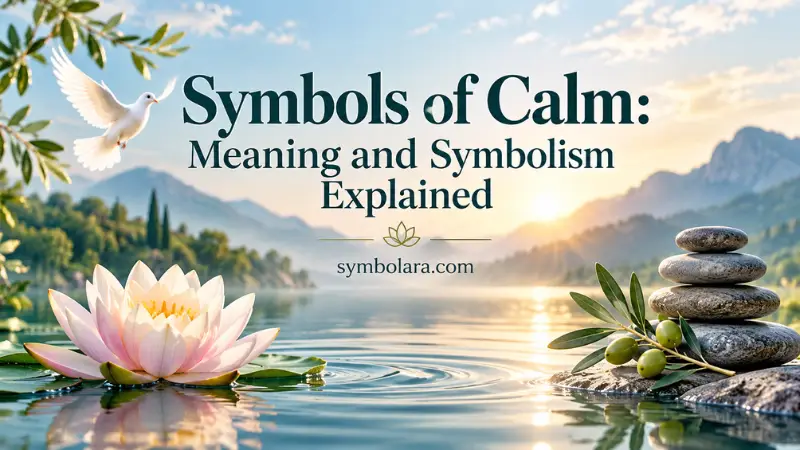
A quiet lake reflects the morning sky. A white dove rests on an olive branch, while a lotus flower opens above still water. These familiar images share something important: people often associate them with peace, comfort, and emotional balance.
Symbols of calm include natural objects, animals, flowers, colors, and simple designs that represent tranquility, patience, and a settled mind. Some have meanings rooted in religious or cultural traditions. Others became popular because they remind people of peaceful places and comforting experiences.
In modern American life, these symbols appear in tattoos, jewelry, home decorations, artwork, and personal keepsakes. People choose them to express a desire for quiet, remember meaningful experiences, or encourage a more thoughtful approach to everyday challenges.
However, calm does not mean exactly the same thing to everyone. A gentle ocean wave may comfort one person, while another finds greater peace in mountain scenery or a familiar garden.
Quick Answer
Symbols of calm commonly include still water, lotus flowers, white doves, olive branches, lavender, gentle waves, and peaceful landscapes. They represent tranquility, emotional balance, patience, and harmony, with meanings shaped by nature, religious traditions, historical peace movements, and modern American culture.
TL;DR
- Main meaning: Calm symbols represent tranquility, balance, patience, and emotional comfort.
- Natural symbols: Still water, mountains, and gentle waves suggest stability.
- Historical origins: Doves and olive branches have longstanding peace associations.
- Cultural meanings: Lotus flowers and Japanese gardens carry specific religious or artistic traditions.
- Modern uses: Americans display calming imagery in tattoos, jewelry, and home decorations.
- Personal significance: Familiar symbols may recall comforting memories and peaceful experiences.
What Do Symbols of Calm Look Like?
Calming symbols do not share one fixed shape or design. Some appear as natural landscapes, while others use flowers, animals, or simple geometric patterns.
What connects them is their association with quietness, stability, and reduced tension.
A smooth stone suggests something steady and settled. A flower resting above water can communicate gentleness, while an open sky creates an impression of space.
Several visual features commonly appear in calming artwork:
- Gentle curves: Flowing lines resemble water, clouds, or slowly moving branches.
- Balanced arrangements: Evenly spaced shapes can suggest stability and order.
- Natural elements: Trees, flowers, water, and mountains recall outdoor environments.
- Muted colors: Pale blue, sage green, and soft neutrals often appear in restful designs.
- Open spaces: Simple compositions provide room between visual elements.
- Familiar peaceful images: Doves and olive branches communicate harmony.
These features do not automatically create the same emotional response in everyone.
For example, a photograph of the ocean might remind one person of relaxing vacations. Someone who fears rough water may interpret the image differently.
The surrounding details also matter.
A single moon above a quiet hillside may suggest rest, while the same moon in a dark storm scene could communicate uncertainty.
The strongest interpretation usually comes from the image’s setting and the viewer’s personal experience.
Why Still Water Represents a Peaceful Mind
Still water is one of the clearest natural representations of calm.
When a lake has little surface movement, it can reflect surrounding trees, clouds, and mountains. The smooth surface creates a recognizable image of quietness.
This physical appearance helps explain its symbolic meaning.
People often describe emotional calm using words such as steady, clear, or settled. Still water provides a visual comparison for those feelings.
When wind disturbs the surface, reflections become harder to recognize. Once the movement slows, the reflected scene becomes clearer.
The comparison suggests that a settled emotional state can make it easier to consider situations without feeling overwhelmed.
However, it remains a metaphor rather than a scientific explanation of human emotions.
Gentle waves and accepting change
Gentle waves carry a related but slightly different meaning.
Unlike completely still water, waves continue moving.
Their repeated motion can suggest the ability to experience change without losing one’s sense of balance.
In American coastal communities, ocean imagery may also hold personal significance.
Someone who grew up near the Atlantic Ocean might associate small waves with childhood visits, familiar sounds, and family experiences.
Another person may find the same comfort in a quiet lake.
Water symbols often communicate an important idea: being calm does not require life to remain unchanged.
Instead, calm can represent the ability to respond patiently as circumstances develop.
White Doves and Olive Branches: Peace After Conflict
White doves and olive branches are widely recognized symbols of peace in Western art and culture.
Their meanings developed through religious narratives, classical traditions, and public movements.
The dove in biblical tradition
In the Book of Genesis, Noah releases a dove following the flood.
The bird eventually returns carrying an olive leaf, indicating that the waters have receded enough for vegetation to become accessible.
Within the story, the image signals a change after destruction.
Later interpretations connected the dove and olive leaf with hope, reconciliation, and peaceful conditions.
Christian art also uses the dove to represent the Holy Spirit, although that religious meaning differs from its general modern association with peace.
The olive branch in classical cultures
Olive trees were important throughout the Mediterranean region.
In Greek and Roman traditions, olive branches could be associated with peace, requests for protection, or reconciliation.
Roman representations of Pax, the personification of peace, sometimes included an olive branch.
This helped establish the plant as a recognizable image of harmony.
Their meaning in America
Today, doves and olive branches appear on memorial cards, wedding invitations, public artwork, and messages encouraging peaceful relationships.
A dove may express the hope that disagreements can end without further harm.
An olive branch can also represent someone’s willingness to repair a damaged relationship.
The distinction between peace and calm is worth remembering.
Peace often concerns the absence of conflict between people or groups. Calm usually refers to a quieter emotional state.
These meanings overlap, but they are not identical.
How the Peace Sign Became an American Symbol of Harmony
The familiar peace sign consists of a circle containing a vertical line and two downward-slanting lines.
Many Americans recognize the design from clothing, bumper stickers, jewelry, and protest signs.
Although people now associate it broadly with peace, the symbol had a specific political beginning.
British designer Gerald Holtom created it in 1958 for the nuclear disarmament movement.
The design incorporated the semaphore signals for the letters N and D, referring to nuclear disarmament.
It first appeared publicly during an anti-nuclear weapons march in Britain.
During the 1960s, the image spread through peace movements in the United States.
It became particularly visible during demonstrations opposing the Vietnam War.
Eventually, its use expanded beyond its original anti-nuclear purpose.
Americans began placing the design on everyday objects to communicate goodwill, nonviolence, or a preference for peaceful relationships.
By the twenty-first century, it had become a familiar decorative symbol.
Some people wear it because they support nonviolence. Others simply associate it with harmony or a relaxed attitude.
The original design was connected with a political cause, however, not specifically with personal relaxation.
That historical difference explains why a peace sign may carry more public meaning than a simple picture of a quiet lake.
Lotus Flowers and the Meaning of Inner Peace
Lotus flowers are commonly associated with purity, renewal, and spiritual development in several Asian religious traditions.
The plant’s natural growing conditions help explain its symbolism.
Lotus plants grow in aquatic environments, with leaves and flowers rising above the water.
Their blossoms can appear strikingly clean even when the water beneath them contains mud.
This contrast has contributed to the flower’s religious interpretations.
The lotus in Buddhism
Buddhist art frequently uses lotus imagery to represent purity and spiritual awakening.
Figures of the Buddha may appear seated or standing on lotus-shaped bases.
The flower can suggest the possibility of developing wisdom despite difficult circumstances.
However, its traditional meaning involves more than feeling relaxed.
The lotus has a specific place within Buddhist teachings and artistic practices.
The lotus in Hindu traditions
Lotus flowers also appear in Hindu religious imagery.
Deities such as Lakshmi and Brahma are closely associated with the flower.
Depending on the context, the lotus can represent purity, beauty, creation, or spiritual qualities.
These meanings should not be treated as interchangeable with Buddhist interpretations.
Modern American interpretations
In the United States, lotus imagery commonly appears in tattoos, yoga-related designs, jewelry, and meditation spaces.
Some people choose the flower to represent patience, personal growth, or emotional balance.
A lotus tattoo might remind someone to remain composed during uncertainty.
For a Buddhist or Hindu practitioner, the same image may hold additional religious meaning.
Recognizing that difference makes the symbol more understandable and culturally respectful.
Japanese Rock Gardens and the Value of Quiet Reflection
Japanese dry landscape gardens, called karesansui, use stones, gravel, sand, and sometimes moss to create simplified landscape scenes.
These gardens have historical connections with Japanese art and Zen Buddhist temples.
One famous example is the rock garden at Ryōan-ji Temple in Kyoto.
It contains fifteen stones arranged within an area of raked gravel.
The garden’s exact original meaning remains uncertain.
Some interpretations compare the arrangement to islands surrounded by water. Others describe mountains rising above clouds.
The important feature is its carefully organized appearance.
Visitors observe a limited collection of materials arranged with considerable attention.
Unlike a busy flower garden filled with competing colors and shapes, a dry landscape garden presents a more restrained scene.
For some viewers, the arrangement encourages patient observation.
Japanese garden imagery in American homes
Small tabletop gardens inspired by Japanese designs appear in American offices, bedrooms, and relaxation areas.
People sometimes arrange stones or rake patterns into the sand as a quiet activity.
However, these decorative products are not equivalent to historical temple gardens.
Traditional gardens belong to specific artistic and cultural settings.
Modern designs often borrow their visual simplicity without preserving every original meaning.
Their popularity shows how an arrangement of ordinary materials can become associated with reflection and calm.
Lavender, Chamomile, and Flowers Associated With Rest
Flowers commonly appear in images intended to suggest comfort or relaxation.
Their colors, shapes, scents, and seasonal associations can contribute to their meaning.
Lavender is especially familiar in American products.
Its narrow stems carry clusters of small purple flowers, and its fragrance appears in soaps, candles, lotions, and scented household items.
Because lavender frequently appears in products marketed for relaxation, many Americans associate the plant with restful surroundings.
That association does not mean its scent guarantees better sleep or emotional relief.
Research into lavender aromatherapy has produced mixed findings, and the effects can vary.
Chamomile and evening routines
Chamomile is another plant commonly linked with rest.
Its small white-and-yellow flowers resemble daisies.
Chamomile tea frequently appears in evening routines, which helps explain why the plant can suggest winding down before bedtime.
In decorative artwork, the flowers may communicate gentleness and domestic comfort.
Other plants with calming associations
Additional examples include:
- Willow branches: Their hanging shapes can suggest softness and quiet movement.
- Ferns: Often associated with shaded forests and natural surroundings.
- White water lilies: May suggest stillness when depicted on quiet ponds.
- Olive leaves: Can communicate harmony through their historical peace associations.
These meanings differ in their origins.
Some developed through documented cultural traditions. Others reflect modern design preferences.
A flower may also become comforting because it reminds someone of a family garden or a familiar place.
Personal memories often give ordinary botanical images their strongest meaning.
Why Blue, Green, and Soft Colors Are Linked With Calm
Colors can influence how people interpret an image, although their meanings are not universal.
In American design, blue and green frequently appear in spaces intended to look comfortable and restful.
Their associations partly reflect familiar natural environments.
Blue recalls clear skies and open water.
Green suggests grass, leaves, and woodland landscapes.
Both colors often appear in photographs of places people consider peaceful.
Blue and quiet surroundings
Pale blue commonly communicates openness, softness, and a gentle atmosphere.
It appears in bedroom decorations, coastal artwork, and designs featuring clouds or water.
However, blue can also represent sadness in English-language expressions.
Its meaning therefore changes with the image and setting.
Green and natural balance
Muted green shades, including sage and olive, are commonly used in nature-inspired interiors.
They can suggest plant life, steadiness, and comfort.
Brighter greens may communicate freshness or activity instead.
White and neutral colors
Cream, beige, and soft white often provide simple backgrounds.
In modern American interiors, these colors may contribute to an uncluttered appearance.
Still, colors do not produce identical emotional effects for everyone.
Research shows recurring relationships between colors and emotional associations, but cultural background and individual preferences also matter.
A person may find a brightly colored family room more comforting than a neutral space.
The most suitable choice depends on the individual rather than a universal rule.
Mountains, Smooth Stones, and Quiet Night Skies
Some calming symbols suggest stability rather than softness.
Mountains are a good example.
Their large, familiar shapes may communicate endurance and a sense of permanence.
A person who enjoys hiking might associate a mountain silhouette with peaceful mornings outdoors.
For someone else, the same landscape could represent a demanding journey.
The symbol’s emotional meaning depends on the experience connected with it.
Smooth stones and balance
Smooth stones often appear in spa photography and contemporary decorative arrangements.
Their rounded surfaces may result from natural weathering and movement.
When arranged carefully, they can create an orderly design.
However, stacked stones should not automatically be treated as traditional religious objects.
Their meanings vary, and placing rock stacks outdoors can disturb habitats or create problems for trail visitors.
The crescent moon and nighttime rest
The crescent moon commonly appears in bedroom artwork, children’s decorations, and sleep-themed illustrations.
Its association with rest comes partly from the familiar connection between nighttime and sleeping.
A moon above a quiet landscape may suggest comfort.
However, crescent imagery also carries established meanings in religious and cultural contexts.
Those meanings should not be replaced by a general interpretation of relaxation.
Stars and familiar patterns
A clear night sky can communicate stillness through its open space and recognizable patterns.
Someone who remembers watching stars with a family member may find the image especially comforting.
In this case, personal history matters more than any formal symbolic definition.
How Americans Use Calming Symbols in Everyday Life
In 2025–2026, peaceful imagery appears across American art, fashion, digital communication, and home decoration.
People often select these images because they communicate a personal preference without requiring lengthy explanations.
A small wave tattoo might express patience. A framed photograph of a lake could preserve a favorite vacation memory.
The setting changes the message.
| Context | Meaning in USA | Common Associations | Notes |
| Minimalist wave tattoo | Responding patiently to change | Adaptability, self-control, acceptance | Personal experiences often determine the meaning |
| Olive-branch wedding design | Hope for a harmonious partnership | Reconciliation, commitment, goodwill | Uses an established historical peace association |
| Botanical bedroom artwork | Creating a restful visual setting | Comfort, nature, familiarity | Personal color preferences influence the effect |
| Memorial jewelry | Remembering someone with affection | Continuity, remembrance, respect | A chosen plant or landscape may hold family meaning |
| Workplace landscape print | Encouraging a quieter atmosphere | Focus, simplicity, natural surroundings | Decorative imagery does not guarantee reduced stress |
| Personal phone wallpaper | A reminder to approach situations patiently | Reflection, steady habits, personal goals | Meaning may remain private to the owner |
Tattoos and jewelry
Many people choose small images that fit easily into personal designs.
A thin wave, lotus outline, olive branch, or simple mountain silhouette can represent a chosen value or meaningful memory.
Some designs include initials, dates, or short phrases.
These additions help establish a more personal interpretation.
Home decoration
American homes frequently feature botanical prints, landscape photographs, and abstract artwork with gentle curves.
A photograph of a quiet beach may suit someone who enjoys coastal settings.
Another person may prefer a forest scene because it reminds them of childhood walks.
Digital artwork and social media
Peaceful imagery also appears on phone backgrounds, greeting cards, and digital posts.
Gentle waves, clouds, and natural landscapes provide recognizable visual themes.
However, these images do not always communicate the same message.
A peaceful scene may represent gratitude, remembrance, relaxation, or simply an appreciation of nature.
Its accompanying words and personal context help explain the intended meaning.
Why Peaceful Images Feel Reassuring to Different People
The emotional meaning of a calming symbol often comes from memory and familiarity.
People do not interpret images without context.
They connect what they see with places, experiences, and feelings they already recognize.
A photograph of pine trees might remind one person of camping trips with family.
Another person may associate the same forest with isolation or unfamiliar surroundings.
Neither interpretation is automatically incorrect.
Familiar images carry personal memories
A small shell collected during a beach vacation may serve as a comforting keepsake.
Its significance does not require an established cultural tradition.
The shell matters because it recalls a particular experience.
Simple patterns can feel orderly
Some people prefer evenly arranged objects and repeated shapes because they appear predictable.
Others enjoy detailed illustrations or colorful surroundings.
Visual simplicity is therefore one possible preference rather than a universal requirement for calm.
Symbols can remind people of their intentions
Someone might wear a wave pendant as a reminder to pause before reacting to frustrating situations.
The pendant does not control emotions.
Instead, it represents a habit the wearer wants to practice.
This is an important distinction.
Peaceful images can carry personal meaning, but their appearance alone cannot guarantee reduced anxiety, improved sleep, or emotional stability.
Their main value is symbolic: they provide a recognizable reminder of something the individual considers important.
How Calm Symbolism Has Changed and What People Often Misunderstand
Many familiar calming images had cultural meanings before they became popular in modern decoration.
Doves and olive branches appeared in religious and classical traditions.
Lotus flowers developed specific roles in Buddhist and Hindu art.
Japanese dry landscape gardens emerged within particular artistic and religious settings.
During the twentieth century, these images became more widely recognized through museums, international exchange, popular art, and commercial design.
The peace sign followed a different path.
Created for the nuclear disarmament movement in 1958, it became closely associated with American antiwar activism during the 1960s.
Later generations also adopted it as a general image of harmony.
By the twenty-first century, digital artwork and mass-produced decorations made many symbols accessible to people outside their original cultural settings.
This wider use created new personal interpretations, but it also introduced misunderstandings.
Peace and calm are not identical
Peace can describe the absence of conflict, while calm usually concerns emotional steadiness or a quiet atmosphere.
A dove may therefore communicate a public wish for peace rather than an individual’s desire for relaxation.
Not every symbol has a universal spiritual meaning
A circle, stone, wave, or cloud does not automatically carry a fixed religious message.
Some interpretations come from personal experience or modern decorative trends.
Traditional religious meanings deserve respect
A lotus flower in Buddhist art communicates ideas connected with religious teachings.
Using the same flower as a decorative design does not erase that history.
Recognizing its background allows people to appreciate the image more accurately.
Calming products cannot promise emotional results
A candle, bracelet, or wall print may be enjoyable and meaningful.
However, claims that a symbol can automatically remove stress or treat a health condition go beyond what its appearance can establish.
Understanding these differences helps preserve the historical context while allowing room for personal expression.
FAQs
Still water is one of the most easily understood visual representations of calm because its smooth surface suggests quietness and stability. However, no single image has the same meaning for everyone, and personal associations can make other symbols more meaningful.
Doves are widely associated with peace, especially in Western art and religious traditions. Turtles may also suggest patience or steadiness in some interpretations because of their measured movements, although their traditional meanings vary across cultures.
Lavender is commonly associated with relaxation in modern American decorative products and scented items. White water lilies can also suggest tranquility through their appearance on quiet ponds, although this is a visual association rather than a universal flower meaning.
A gentle wave may represent the ability to respond patiently to changing circumstances. Some people prefer a mountain image because it reminds them of stability, while others choose a familiar object connected with a comforting memory.
Several religious traditions contain symbols that people associate with qualities related to inner peace. The lotus has an established place in Buddhist and Hindu imagery, but there is no single symbol accepted across all spiritual traditions.
Yes. People often choose waves, olive branches, lotus flowers, or quiet landscapes to express personal values or experiences. Before selecting a religious design, it is helpful to understand its traditional meaning rather than assuming it is only decorative.
A peace symbol often communicates harmony, reconciliation, or opposition to conflict. A calm symbol usually represents emotional steadiness, rest, or a quiet atmosphere, although an image such as a dove can suggest both ideas depending on context.
Conclusion
Symbols of calm represent tranquility, patience, comfort, and emotional balance through familiar images such as still water, gentle waves, lotus flowers, olive branches, and peaceful landscapes. Their meanings developed through natural observations, religious traditions, historical movements, and personal experiences.
In modern American culture, people use these symbols in tattoos, home decorations, jewelry, and artwork to communicate their values or preserve meaningful memories. The same image may carry a historical meaning for one person and a personal association for another.
A small picture of a familiar lake or a simple wave engraved on a bracelet can become a useful reminder of a place, person, or experience connected with feeling settled. That connection explains why ordinary images of nature continue to find a place in people’s everyday lives.