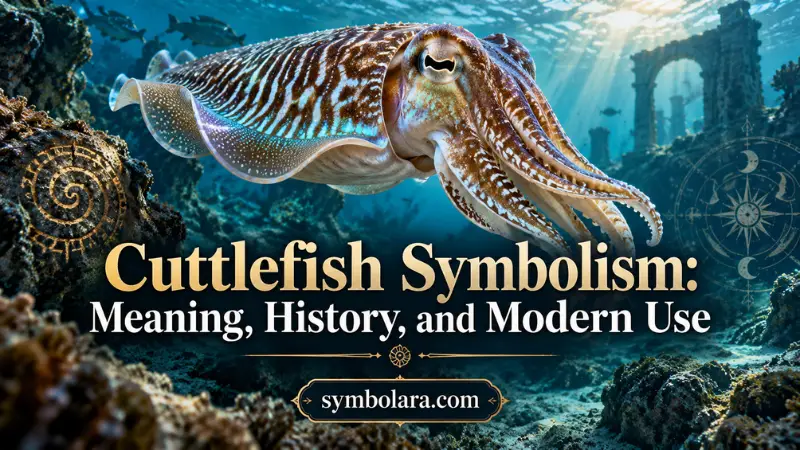
A cuttlefish can change its skin from sandy brown to bright stripes in seconds. It can hide against a rocky seabed, display moving patterns to another cuttlefish, or release a cloud of ink when threatened. These remarkable abilities make cuttlefish symbolism especially appealing to people interested in adaptability, intelligence, creativity, and self-protection.
Unlike familiar symbols such as doves or roses, the cuttlefish does not have one widely accepted meaning. Its modern associations come mainly from its natural behavior, historical appearances in Mediterranean artwork, and its connection with sepia ink.
In the United States, cuttlefish appear in marine documentaries, aquarium education, science discussions, tattoos, and ocean-inspired illustrations. Their unusual abilities encourage people to think about adjusting to change without losing their individuality.
The most useful way to understand this animal as a symbol is to separate documented cultural history from the personal meanings people give it today.
Quick Answer
Cuttlefish symbolism represents adaptability, creativity, intelligence, and self-protection. These modern meanings come from the animal’s remarkable camouflage, changing skin patterns, problem-solving abilities, and defensive ink.
Historically, cuttlefish appeared in Bronze Age Mediterranean pottery and later became connected with artistic expression through sepia ink used for writing and drawing.
TL;DR
- Adaptability: Rapid camouflage suggests flexibility during changing circumstances.
- Creativity: Shifting colors and patterns inspire artistic expression.
- Intelligence: Learning abilities encourage associations with thoughtful decisions.
- Protection: Defensive ink suggests boundaries and personal safety.
- History: Mycenaean pottery included recognizable cuttlefish designs.
- Modern use: Tattoos and ocean artwork express individuality and resilience.
What a Cuttlefish Looks Like and Where It Lives
Despite its name, a cuttlefish is not a fish. It is a marine mollusk belonging to a group called cephalopods, which also includes octopuses, squid, and nautiluses.
Its body looks somewhat like a broad, flattened oval. A thin fin runs along each side, allowing the animal to move smoothly through the water.
A cuttlefish has eight arms surrounding its mouth and two additional feeding tentacles. These longer tentacles can shoot forward quickly to capture shrimp, fish, and other prey.
Its eyes are another unusual feature. In bright light, many cuttlefish have distinctive W-shaped pupils that help them gather visual information about their surroundings.
Inside the body sits a lightweight structure called the cuttlebone. This internal shell contains small chambers that help the animal control its buoyancy.
Cuttlefish live mainly in the coastal waters of Europe, Africa, Asia, and Australia. Their habitats include sandy bottoms, rocky areas, and seagrass environments.
True cuttlefish are naturally absent from waters surrounding the Americas. Most Americans encounter them through aquariums, educational videos, wildlife photography, or imported seafood rather than observing them in local waters.
The animal’s physical characteristics help explain its symbolic appeal. Its flowing fins can suggest graceful movement, while its changing appearance encourages comparisons with flexibility and personal transformation.
Yet these comparisons are interpretations created by people. The animal developed its remarkable features to survive in the ocean.
Why Its Changing Colors Represent Adaptability
Adaptability is one of the clearest modern meanings associated with cuttlefish.
A cuttlefish can rapidly change the color, pattern, and sometimes texture of its skin. It uses specialized pigment cells called chromatophores, along with reflective structures beneath the skin, to create different appearances.
When resting on sand, it may display pale, uneven markings. Near rocks or seaweed, it can produce patterns that make its outline harder to recognize.
This behavior gives people an easy comparison with adjusting to new situations.
A person starting a new job may need to learn unfamiliar routines. Someone moving to another city might gradually become comfortable with different surroundings.
In both examples, adaptation means recognizing the environment and responding thoughtfully.
The cuttlefish offers a visual reminder of that process.
However, the animal’s camouflage also introduces an important distinction: adapting does not necessarily mean abandoning personal identity.
The cuttlefish changes its appearance while remaining the same animal.
For people who value flexibility, this can represent learning new skills without giving up their principles.
Its symbolism can also encourage patience. Instead of responding to every challenge with immediate action, people sometimes benefit from observing their surroundings first.
This interpretation comes from human experience rather than evidence that cuttlefish intentionally demonstrate a lesson about personal growth.
Still, their natural abilities make them memorable examples of how living things respond to change.
Moving Skin Patterns and the Meaning of Communication
Cuttlefish do more than change colors to hide. They also use their skin to communicate with other members of their species.
During courtship, some males display bold stripes or moving patterns across their bodies. These visual signals can help attract potential mates or discourage competing males.
Their ability to communicate without sound offers an interesting comparison with human expression.
People communicate through more than words. Facial expressions, clothing, posture, and small gestures often reveal feelings before a conversation begins.
A cuttlefish’s changing patterns can therefore represent awareness of how appearance influences communication.
One particularly unusual example involves the mourning cuttlefish, a species found around Australia.
Researchers have observed males displaying courtship patterns toward a female on one side of their bodies while showing female-like markings toward a competing male on the other.
This behavior demonstrates remarkable control over visual signaling.
As a human symbol, it can suggest strategic thinking and the importance of understanding one’s audience.
However, the behavior also involves deception. It would be inaccurate to describe every cuttlefish display as a sign of honesty or openness.
The more useful interpretation concerns communication itself: appearances can carry information, but their meaning depends on the situation.
For people interested in art, photography, or visual design, the cuttlefish offers a striking example of how colors and patterns influence what others notice.
What Cuttlefish Intelligence Teaches Us About Patience
Cuttlefish have attracted scientific interest because they can learn from experience and adjust their behavior.
Researchers have studied their memory, hunting decisions, and ability to recognize visual patterns.
A particularly interesting experiment was reported in 2021.
Scientists tested whether common cuttlefish could wait for a preferred food reward instead of immediately eating a less desirable option.
Some animals waited between 50 and 130 seconds for the better reward.
The researchers also found that individuals showing greater patience tended to perform better on certain learning tasks.
These findings suggest that cuttlefish possess more flexible decision-making abilities than their unusual appearance might suggest.
They do not prove that cuttlefish think exactly like humans.
Nevertheless, the research gives their modern symbolism a clear foundation.
Patience Rather Than Immediate Reward
For someone facing an important decision, the cuttlefish can represent choosing carefully instead of acting immediately.
A student preparing for an examination, for example, may need to postpone entertainment to complete a difficult assignment.
Someone saving money might similarly choose a future goal over an immediate purchase.
These situations involve different human abilities, but the comparison remains understandable.
The animal also challenges the assumption that intelligence must resemble human behavior.
Its learning abilities developed within a very different environment, where successful decisions can affect feeding and survival.
This makes the cuttlefish an interesting symbol for curiosity, patience, and respecting unfamiliar forms of intelligence.
How Defensive Ink Became a Symbol of Protection
When threatened, a cuttlefish can release dark ink into the surrounding water.
The cloud may confuse a predator, interrupt its view, or create an opportunity for the cuttlefish to escape.
This natural defense has inspired modern associations with privacy, protection, and personal boundaries.
Unlike animals that depend primarily on armor or physical strength, the cuttlefish can sometimes avoid danger by changing the conditions around it.
That difference offers a useful comparison with human conflict.
People do not always need to confront every difficult situation directly.
Sometimes, leaving an uncomfortable conversation or stepping away from unnecessary conflict is the safer choice.
The cuttlefish’s defensive response can therefore represent knowing when to withdraw.
It may also appeal to people who prefer careful planning over confrontation.
However, its ink should not be described as a supernatural shield.
The substance has a biological purpose, and its effectiveness depends on the predator and surrounding conditions.
As a symbol, the ink becomes meaningful through comparison rather than magic.
In artwork, a dark cloud surrounding a cuttlefish might suggest creating distance from unwanted attention.
The same image could represent privacy, escaping pressure, or protecting personal space.
What makes the interpretation useful is the animal’s actual response to danger.
It reminds viewers that survival sometimes depends on avoiding unnecessary risks.
Cuttlefish in Bronze Age Mediterranean Pottery
Cuttlefish were familiar enough to Mediterranean artists that their forms appeared on decorated pottery thousands of years ago.
One documented example is a Mycenaean stemmed cup from the fourteenth century BCE.
The cup, now associated with the collection of the Walters Art Museum in Baltimore, features a stylized cuttlefish with its arms spreading across the surface.
Its design reflects an artistic tradition influenced by earlier Minoan pottery.
During the Bronze Age, artists on the island of Crete frequently decorated vessels with marine life.
Fish, octopuses, sea plants, and other aquatic forms appeared in designs that reflected the importance of the surrounding Mediterranean Sea.
These images were not simply photographs translated into clay.
Artists adjusted the shapes of marine animals to fit curved surfaces, creating movement and balance within each composition.
The Mycenaean cuttlefish design belongs to this broader artistic development.
It shows that the animal had a recognizable place in Mediterranean visual culture.
However, the surviving evidence does not establish that the cuttlefish universally represented wisdom, protection, or transformation to the people who made these objects.
Its appearance could reflect familiarity with marine life, artistic fashion, religious ideas, or a combination of influences.
Assigning one definite interpretation would go beyond the available evidence.
The historical importance of these designs lies partly in their survival.
They show how people incorporated recognizable sea creatures into everyday objects long before modern wildlife photography existed.
For contemporary artists, such pottery offers a connection between natural forms and centuries of creative expression.
Sepia Ink and the Connection With Writing and Art
One of the cuttlefish’s most direct contributions to human culture comes from its ink.
The word sepia comes through Latin and Italian from an ancient Greek term for cuttlefish.
Over time, the word also became associated with the reddish-brown pigment produced from cuttlefish ink.
This material was used for writing and drawing in earlier periods, including ancient Roman times.
It became especially popular among European artists from the Renaissance onward.
During the eighteenth and nineteenth centuries, sepia was widely used for drawings and washes.
Artists valued its warm brown tones, which could create shadows and gentle changes in light.
The pigment allowed them to build images using different strengths of the same color.
Sepia later became familiar through photography, where brown-toned images developed associations with age and nostalgia.
Not every sepia photograph contains material derived from cuttlefish. The color name remained in use even as photographic and artistic methods changed.
This history gives the animal a more specific cultural connection than many modern symbolic interpretations.
The cuttlefish is linked not only to natural adaptation but also to the physical materials people used to create images.
For artists, writers, and designers, that connection may suggest imagination, expression, and the preservation of memories.
A cuttlefish illustration beside an ink bottle or sketchbook can acknowledge this history.
Such a design carries a meaning grounded in documented artistic practice rather than an invented tradition.
Mediterranean Food Traditions and Their Cultural Connections
Cuttlefish have also played a practical role in coastal food traditions.
In Italy, dishes featuring cuttlefish include seppie al nero, which uses cuttlefish and their dark ink.
In Spain, black rice dishes such as arroz negro may use squid or cuttlefish ink to give the rice its distinctive color.
These foods reflect the relationship between coastal communities, fishing, and regional cooking.
The animal is part of everyday culinary knowledge rather than an unusual creature known only through scientific research.
Preparing seafood can also involve family recipes and local customs passed between generations.
For a person whose family has lived near the Mediterranean, a cuttlefish image might therefore bring back memories of food, fishing, or coastal life.
This is a personal cultural association, not proof that all Mediterranean communities assign the animal one symbolic meaning.
In some settings, the cuttlefish may represent familiarity with the sea and the resources it provides.
In others, it may simply be recognized as seafood.
Understanding that difference prevents ordinary food traditions from being incorrectly described as spiritual beliefs.
How Americans Understand Cuttlefish in Modern Culture
For many Americans, the cuttlefish is more familiar from a screen than from the ocean.
Unlike octopuses and squid, which occur in American waters, true cuttlefish are native mainly to other parts of the world.
Their appearance in American culture therefore comes largely through science education, aquarium programs, photography, and nature documentaries.
Programs explaining camouflage often feature cuttlefish because their changing skin patterns are easy to demonstrate visually.
A short video showing one animal shifting from a sandy pattern to bright stripes can make viewers curious about marine biology.
Social media has made these unusual abilities more visible to younger audiences.
The animal can appeal to people interested in science, art, animation, or unusual ocean creatures.
Still, it is not a widely established national symbol.
There is no recognized American holiday, civic tradition, or common religious celebration centered on cuttlefish.
Its significance remains more personal and specialized.
Different settings can also create different interpretations.
| Context | Meaning in USA | Common Associations | Notes |
| Science classroom | Curiosity and discovery | Marine biology, learning | Often introduced through camouflage demonstrations |
| Tattoo design | Personal flexibility | Independence, changing circumstances | Meaning depends on the wearer’s experience |
| Creative workspace | Artistic inspiration | Drawing, experimentation | Can reference the historical use of sepia ink |
| Aquarium education | Respect for marine life | Conservation, observation | Encourages interest in unfamiliar ocean animals |
| Marine-themed clothing | Individuality | Unusual patterns, originality | Mainly an aesthetic choice rather than a fixed tradition |
These examples show how modern interpretations develop through personal interests.
A marine biology student might associate the animal with scientific discovery.
A designer could choose it because its patterns resemble changing graphic designs.
Someone who has overcome a difficult life transition may see its adaptability as a personal reminder.
None of these associations requires everyone to interpret the animal in the same way.
Why People Choose Cuttlefish Tattoos and Ocean-Inspired Art
Cuttlefish make visually interesting subjects because their bodies combine curved shapes, flowing fins, and intricate patterns.
Unlike a simple fish outline, a cuttlefish illustration can include several distinctive details.
Its W-shaped pupils, broad mantle, and extended feeding tentacles help make the design recognizable.
Cuttlefish Tattoos
A tattoo showing a cuttlefish changing color may represent personal growth or adjusting to difficult circumstances.
Someone might choose this image after moving to a new place, changing careers, or overcoming a challenging period.
A cuttlefish surrounded by ink can communicate a different idea.
It might represent personal privacy, independence, or the ability to leave harmful situations.
Artists can also create designs based on historical sepia drawings.
Brown shading and fine lines can connect the tattoo with older artistic materials.
There is no established universal meaning for these tattoos. Their significance depends on the wearer and the chosen design.
Jewelry and Personal Accessories
Small cuttlefish pendants, earrings, or decorative pins can appeal to marine science enthusiasts.
Their unusual shape makes them an alternative to familiar ocean motifs such as dolphins, turtles, and seashells.
For some people, wearing the animal communicates curiosity about less familiar wildlife.
Others may simply appreciate its appearance.
Home Decor and Digital Illustration
A cuttlefish illustration can fit naturally into an ocean-themed room, classroom, or creative studio.
Artists may use shifting blues, golds, and browns to suggest movement.
Digital illustrations can emphasize the animal’s changing patterns through contrasting shapes and colors.
These choices reflect modern creativity rather than an inherited symbolic code.
They also show how one animal can inspire several artistic styles without requiring a single interpretation.
Why People Feel Connected to Such an Unusual Animal
An emotional connection with an animal does not always depend on seeing it in person.
People can become interested in cuttlefish through documentaries, photography, books, or educational experiences.
The animal’s appearance challenges familiar expectations.
It has an internal shell, several arms, unusual pupils, and the ability to change its appearance almost instantly.
These characteristics can create surprise and curiosity.
For someone who often feels different from others, the cuttlefish may become a symbol of individuality.
Its unusual features provide an image of succeeding without following the same physical design as more familiar animals.
Other people may connect with its defensive behavior.
Someone who values privacy might appreciate the comparison between releasing ink and setting boundaries.
An artist could feel attached to its connection with traditional drawing materials.
These responses come from individual memories, preferences, and experiences.
Human beings naturally associate images with situations that matter to them.
A marine animal may remind someone of a childhood aquarium visit, a favorite documentary, or a meaningful conversation.
Over time, that personal connection can give the animal a symbolic role.
This does not mean the cuttlefish communicates human emotions or intentionally offers guidance.
It means people can use a real animal’s characteristics to express feelings that are otherwise difficult to describe.
Common Misunderstandings About Cuttlefish Meanings
Several misconceptions can make discussions of cuttlefish less accurate.
One is the claim that cuttlefish have always symbolized transformation in every coastal culture.
Historical evidence supports their presence in some Mediterranean artwork, but it does not establish a single interpretation shared across different societies.
Another misunderstanding concerns their color-changing abilities.
People sometimes describe cuttlefish as changing appearance only to hide.
In reality, their patterns can serve several functions, including camouflage, communication, and courtship.
This makes their behavior more varied than a simple symbol of secrecy.
Does a Cuttlefish Represent Dishonesty?
Certain cuttlefish use deceptive visual signals during mating.
For example, researchers have observed males presenting different patterns to potential mates and competing males.
This behavior might inspire an artistic interpretation involving disguise or misleading appearances.
However, it would be inappropriate to assign human moral judgments directly to the animals.
Their reproductive strategies developed through natural selection, not human ethical rules.
Is the Cuttlefish a Traditional Spiritual Guide?
Some modern interpretations describe cuttlefish as spiritual guides connected with intuition, transformation, or protection.
Individuals may personally find such meanings useful within their own beliefs.
However, there is no clearly established worldwide religious tradition giving cuttlefish these exact roles.
Descriptions that claim otherwise should identify the specific historical community and supporting evidence.
Does Changing Color Mean Changing Identity?
The animal changes its external appearance to respond to different situations.
That does not mean it becomes another species or loses its biological identity.
A more accurate human comparison concerns flexibility in behavior rather than a complete change in who someone is.
Recognizing these distinctions keeps the animal’s natural abilities separate from personal interpretations.
FAQs
It is usually interpreted positively in modern personal artwork, especially when associated with creativity, patience, and adaptability. However, an image emphasizing disguise or an ink cloud could communicate secrecy or avoidance, depending on the artist’s intention.
A dream about a cuttlefish might reflect recent thoughts about adapting to change, being noticed, or keeping something private. There is no scientifically established universal meaning for this dream, so the dreamer’s experiences and emotions provide more useful context than a fixed interpretation.
Cuttlefish do not have a widely recognized biblical symbolic role. Although marine creatures appear in religious texts, assigning specific meanings such as prophecy or divine protection to cuttlefish would require evidence that is not established.
Modern octopus imagery often emphasizes flexibility, problem-solving, and multiple abilities, while cuttlefish imagery may place greater attention on camouflage and visual communication. These distinctions are creative interpretations rather than rules followed across all cultures.
Someone may personally use a cuttlefish image as a reminder to remain flexible when opportunities arise. However, there is no broadly documented American tradition identifying the animal as a good-luck charm or predicting success from an encounter with one.
In modern artwork, a pale or white cuttlefish might suggest simplicity, a fresh beginning, or calmness. Those meanings come from general color associations, not an established tradition specifically connected with white cuttlefish.
Their connection with creativity has a historical foundation because cuttlefish ink was used to produce sepia drawing material. Their rapidly changing skin patterns also appeal to artists interested in visual experimentation, although neither feature means the animal creates art in the human sense.
Conclusion
Cuttlefish symbolism is most commonly associated with adaptability, creativity, intelligence, and self-protection. Its modern interpretations come from recognizable natural behaviors, while its documented cultural history includes Bronze Age Mediterranean pottery and the use of sepia ink in writing and art.
In American life, the cuttlefish has become an interesting subject for science education, wildlife photography, tattoos, and personal expression. Its meaning is not fixed by a universal tradition. Instead, people choose the characteristics that connect with their own experiences.
Perhaps the most memorable feature is the contrast between the animal’s changing appearance and its recognizable identity. A cuttlefish can display a new pattern in seconds while remaining the same creature, offering a practical image of how adaptation and individuality can exist together.