A bright blue ribbon pinned to a prize-winning quilt tells a different story from the same colored ribbon worn during an awareness campaign. One celebrates achievement. The other may express concern, remembrance, or support for an important cause.
Blue ribbon symbolism has several meanings in American culture. Most commonly, it represents excellence, first place, honor, and outstanding achievement. However, blue ribbons also appear in public awareness campaigns, historical traditions, and everyday expressions of recognition.
The meaning depends on where the ribbon appears and why someone displays it. At a county fair, it usually celebrates success. During Child Abuse Prevention Month, it carries a message about protecting children.
Today, Americans encounter blue ribbons at school competitions, livestock shows, community events, and online. Understanding these different uses helps explain how a simple piece of colored fabric became a familiar symbol of achievement and public support.
Quick Answer
Blue ribbon symbolism most commonly represents excellence, first-place achievement, honor, and recognition in the United States. Its association with distinction developed through European honors and American prize-giving traditions, while modern awareness campaigns have added meanings of remembrance, solidarity, and public support.
TL;DR
- Main meaning: Excellence, achievement, honor, and recognition.
- Historical roots: European orders used blue ribbons to mark special distinction.
- American tradition: Blue commonly identifies first-place winners in competitions.
- Awareness campaigns: Blue ribbons can represent child abuse prevention.
- Modern interpretation: Meaning changes according to the event or cause.
- Emotional message: Pride, encouragement, remembrance, and shared responsibility.
What Does a Blue Ribbon Look Like?
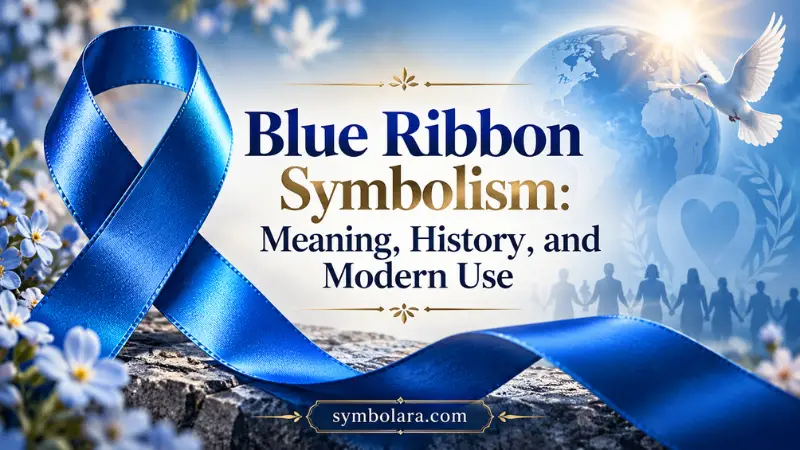
A blue ribbon is a strip of fabric or ribbon-shaped decoration used to communicate recognition, identity, or support.
Its appearance varies depending on its purpose.
At agricultural fairs, award ribbons often have a circular center with folded fabric arranged around the edge. Long ribbon tails hang below, displaying information about the prize.
These decorative awards are commonly called rosettes.
Other blue ribbons appear as small folded loops attached to clothing with a pin. This simple design is especially common in awareness campaigns.
Typical designs include:
- Award rosettes: Circular decorations with blue ribbon tails.
- Awareness ribbons: Folded fabric loops worn on clothing.
- Decorative bows: Blue ribbons tied around gifts or objects.
- Printed ribbon images: Digital illustrations used in announcements.
- Recognition badges: Blue designs featuring names, dates, or achievements.
The shade can range from light blue to navy, although traditional American first-place awards often use a vivid medium or royal blue.
Color alone does not establish the ribbon’s message.
An award printed with “First Place” clearly celebrates achievement. A small blue loop worn during a community awareness event may communicate something entirely different.
The surrounding words, event, and design provide the most reliable clues.
Why Blue Ribbons Represent First Place in America
The connection between blue ribbons and achievement is especially familiar at American fairs.
In many United States competitions, blue identifies first place, red represents second place, and white identifies third place.
This convention appears in livestock shows, craft exhibitions, baking contests, and some school competitions.
The tradition helps people recognize winners without reading every award label.
Consider a county fair where participants enter homemade pies.
Judges evaluate the entries using standards such as appearance, texture, and taste. When the winning pie receives a blue ribbon, visitors immediately recognize it as an outstanding entry.
The prize communicates more than a favorable opinion.
It shows that the entry has received public recognition through an organized judging process.
American agricultural fairs began developing during the early nineteenth century. The New York State Fair, first held in 1841, became an important example of the growing fair tradition.
As agricultural exhibitions expanded, competitions offered farmers and craftspeople opportunities to display their work and receive recognition.
Prize ribbons became a visible part of that culture.
The familiar blue award now appears well beyond agriculture. Photography competitions, art exhibitions, and community contests may use the same color system.
However, organizers establish their own award rules, so blue does not mean first place in every competition.
The European History Behind the Blue Ribbon
The association between blue ribbons and special distinction existed before American county fairs became popular.
Two European traditions help explain the color’s connection with honor.
France’s Order of the Holy Spirit
In 1578, King Henry III of France established the Order of the Holy Spirit.
Members wore an identifying decoration suspended from a blue ribbon.
The French expression cordon bleu, meaning blue ribbon, became associated with exceptional distinction.
Over time, the phrase gained wider use.
It eventually became connected with outstanding cooking, helping explain the name of the culinary institution Le Cordon Bleu.
The historical association was with formal recognition rather than everyday decoration.
Britain’s Order of the Garter
The Order of the Garter, established in England during the fourteenth century, also became associated with blue ceremonial insignia.
Its members wear distinctive decorations, including a blue sash in formal settings.
These honors helped establish blue as a color linked with elevated status and recognition in European traditions.
Still, it would be inaccurate to claim that one royal order directly created every modern blue-ribbon competition.
Award customs developed across different places and periods.
What these examples demonstrate is that blue had an established connection with distinction long before the ribbon became a common American prize.
What Blue Ribbons Mean in 4-H and Agricultural Shows
Blue ribbons hold a familiar place in American youth agricultural programs, particularly 4-H.
Young participants may receive ribbons for raising animals, growing plants, preparing foods, or completing educational projects.
A ribbon recognizes the work involved in learning a skill.
For many families, these awards become keepsakes displayed in bedrooms, scrapbooks, or family photo collections.
However, a blue ribbon does not always mean that a participant defeated everyone else.
Some 4-H programs use a system that evaluates each project against established standards.
Under this approach, multiple participants can receive blue ribbons if their work meets the required level.
For example, Nebraska 4-H describes blue as an excellent achievement level within its Danish system of evaluation. Purple represents a higher level of performance in that particular system.
Nebraska
+1
This distinction matters because the purpose is partly educational.
A young person who receives a blue ribbon may have demonstrated strong knowledge, responsibility, and effort without being the sole winner.
The emotional meaning also extends beyond the award itself.
A ribbon can remind someone of early mornings caring for livestock, months spent practicing a skill, or encouragement received from family members.
In this setting, the symbol represents both accomplishment and the process of learning.
Why Blue Ribbons Represent Child Abuse Prevention
One of the most important American awareness uses of the blue ribbon is connected with preventing child abuse.
This meaning developed from a specific family tragedy rather than from prize-giving traditions.
In 1989, Virginia grandmother Bonnie Finney began displaying a blue ribbon after the death of her grandson, who had suffered abuse.
She tied the ribbon to her vehicle’s antenna as a public reminder of what had happened.
The color was connected with the bruising her grandson had experienced.
Her personal act of remembrance helped inspire a broader awareness campaign.
Over time, organizations and communities adopted blue ribbons to encourage discussion about child safety and abuse prevention.
April is recognized in the United States as National Child Abuse Prevention Month.
During that month, blue ribbons may appear on clothing, public displays, posters, and community decorations.
The meaning in this setting is serious.
A person wearing the ribbon may wish to communicate:
- Concern for children experiencing abuse or neglect.
- Support for families and child protection efforts.
- Remembrance of children harmed by abuse.
- Commitment to safer communities.
- Encouragement for others to learn about prevention.
The ribbon does not automatically identify someone as a survivor or a family member of a victim.
It can simply express support for the cause.
The campaign also shows how a familiar color can acquire an additional meaning through an identifiable historical event.
How Blue Ribbons Became Symbols of Online Free Speech
During the 1990s, blue ribbons acquired another meaning through the growth of the internet.
In 1996, the Electronic Frontier Foundation launched a blue-ribbon campaign supporting freedom of expression online.
The campaign responded to concerns about restrictions on internet speech associated with the Communications Decency Act.
Websites displayed small blue ribbon graphics to show support for online expression and opposition to certain forms of government censorship.
Unlike a physical award ribbon, these images appeared on computer screens.
Their purpose was not to recognize individual achievement.
Instead, they allowed website owners and users to make a public statement about a shared concern.
The campaign emerged during a period when the internet was becoming more important in American communication.
Public debates involved questions about what people could publish, who should control online expression, and how existing laws applied to digital spaces.
The blue ribbon provided a recognizable image for people participating in those discussions.
Its meaning was tied to a particular campaign rather than to every use of the color blue.
The example also demonstrates how ribbon imagery moved beyond clothing and physical decorations.
By the late 1990s, a digital symbol could serve a similar purpose to a ribbon worn at a public gathering.
Why Experts Are Called Blue-Ribbon Panels
Americans sometimes hear the phrase “blue-ribbon panel” in discussions about government, business, or public policy.
The expression does not usually refer to an actual ribbon.
Instead, it describes a group selected because its members are considered knowledgeable, experienced, or especially qualified.
A city government might appoint a blue-ribbon commission to study public transportation.
A university could assemble a panel of specialists to review an important academic issue.
In these situations, the expression suggests that the group deserves serious attention.
It draws on the familiar association between blue ribbons and outstanding quality.
However, the phrase is descriptive rather than a formal guarantee.
Calling a committee a blue-ribbon panel does not prove that its members are independent, unbiased, or correct.
Those qualities depend on how the group was selected and how it performs its work.
The expression remains useful because Americans already understand blue ribbons as signs of excellence.
It transfers the meaning from an award presented to one winner to a group expected to demonstrate unusual expertise.
Blue Ribbons in American Schools and Business Names
The blue ribbon’s association with excellence also appears in education and commercial branding.
These settings use the same general idea, but their purposes differ.
Recognition in education
The U.S. Department of Education established the National Blue Ribbon Schools program in 1982.
The program recognized schools for academic excellence and progress in addressing achievement gaps.
For decades, receiving the designation was a significant public honor.
The federal program ended in 2025. Some states subsequently established their own recognition programs using similar names, including Connecticut and Texas.
The original designation shows how the language of prize ribbons moved into institutional recognition.
Commercial branding
Businesses also use blue-ribbon language to suggest superior products or established quality.
A well-known American example is Pabst Blue Ribbon.
The brewery began attaching blue silk ribbons to bottles during the nineteenth century. Customers came to recognize the distinctive decoration, and the ribbon became part of the product’s identity.
The company incorporated “Blue Ribbon” into its branding during the 1890s.
Stories connecting the name to the 1893 World’s Columbian Exposition exist, although the exact nature of the claimed award has been debated.
The broader lesson is clear: an image originally associated with honor can become a familiar commercial symbol.
A blue-ribbon name expresses a claim of quality, but consumers still need to judge the product on its actual merits.
Do Blue Ribbons Mean the Same Thing in Other Countries?
Blue ribbons are not interpreted identically around the world.
Their meaning depends on local customs, competition rules, and historical traditions.
In the United States, blue commonly identifies a first-place award.
Other countries may use different colors for comparable honors.
For example, British equestrian events often use red for first place and blue for second place.
The exact arrangement can vary by competition, so checking the event’s award rules is important.
The expression blue riband also has a particular history in Britain.
It became associated with outstanding achievement, including the fastest Atlantic crossings by passenger liners.
The transatlantic Blue Riband referred to speed records rather than the kind of ribbon presented at a school fair.
France’s cordon bleu tradition provides another example of blue being connected with special distinction.
These connections are related but not identical.
A blue ribbon on an American prize-winning cake should not automatically be interpreted through French royal history.
Likewise, a British sporting award cannot always be understood using American ribbon colors.
Recognizing these differences prevents the mistaken belief that all blue ribbons communicate one worldwide message.
The Personal Meaning of Wearing or Giving a Blue Ribbon
People often develop emotional attachments to ribbons because of the experiences connected with them.
A child receiving a first award may remember the excitement long after the competition ends.
For a parent, the same ribbon may represent encouragement and pride.
Someone displaying a ribbon connected with a social cause may feel responsibility, concern, or solidarity instead.
These emotions come from the ribbon’s context, not from any special property of blue fabric.
Pride and recognition
Award ribbons provide visible proof that someone’s work received attention.
This can matter especially when the achievement involved patience or repeated practice.
Encouragement and appreciation
A ribbon-shaped decoration can also be used informally to congratulate someone.
Giving a blue ribbon as a keepsake might communicate appreciation for effort, even when no official competition took place.
Remembrance and support
In awareness campaigns, wearing a ribbon may be a quiet way to acknowledge a serious issue.
Some people prefer this simple gesture because it allows them to show support without making a lengthy public statement.
Still, wearing a ribbon is only one form of participation.
Meaningful support may also involve learning about an issue, helping community organizations, or taking other practical steps.
A ribbon can start a conversation, but it cannot replace action.
How Blue Ribbons Appear in Modern American Life
By 2025–2026, blue ribbons remained familiar across physical and digital settings.
Their appearance often changes to match the message.
A printed blue rosette on a certificate may celebrate achievement. A folded ribbon on a social media graphic may draw attention to a public cause.
The design itself helps viewers identify the intended message.
| Context | Meaning in USA | Common Associations | Notes |
| County fair awards | Recognition for an outstanding entry | Skill, effort, local tradition | Rules determine whether blue means first place or a quality level |
| Charity awareness pin | Support for a specific cause | Compassion, responsibility, remembrance | The campaign name identifies the intended message |
| School achievement display | Institutional or student recognition | Academic effort, accomplishment, pride | May refer to historical or current recognition programs |
| Professional award certificate | Appreciation for exceptional work | Dedication, expertise, reliability | Sometimes uses ribbon imagery without a physical prize |
| Digital ribbon graphic | Public support or celebration | Participation, recognition, advocacy | A caption helps distinguish celebration from awareness |
| Blue ribbon tattoo | Personal accomplishment or commitment | Persistence, memory, identity | Meaning depends on the wearer’s personal explanation |
Tattoos and personal keepsakes
Some people choose ribbon tattoos to remember an achievement or express support for a cause.
Unlike an official fair award, a tattoo may have a meaning known primarily to its wearer.
Including a date, name, or short phrase can make the purpose clearer.
Decorations and celebrations
Blue ribbons appear on graduation gifts, handmade cards, trophies, and event decorations.
A ribbon attached to a gift can make an ordinary item feel like a prize.
This works particularly well when celebrating a personal milestone, such as completing a training program or finishing a difficult project.
Social media and digital design
Digital blue ribbons can appear in congratulatory graphics, event announcements, and campaign materials.
Their small size makes them easy to recognize on screens.
However, a ribbon image without supporting text may be misunderstood, especially when several organizations use similar colors.
A short explanation usually provides the needed context.
Common Misunderstandings About Blue Ribbons
The number of different uses can create confusion.
One common mistake is assuming that every blue ribbon represents a first-place award.
That interpretation fits many American competitions but does not explain awareness ribbons or programs using standards-based evaluations.
Another misunderstanding involves health and social awareness campaigns.
Blue, dark blue, and light blue ribbons may be associated with different causes. For example, dark blue is commonly connected with colorectal cancer awareness, while light blue appears in some prostate cancer awareness materials.
The precise shade and the organization using it matter.
A blue ribbon also should not automatically be confused with the thin blue line symbol sometimes used to express support for law enforcement.
Both may involve the color blue, but they come from different traditions and carry different associations.
Political or institutional uses can also prompt disagreement.
Some people may support the message attached to a ribbon while others question the organization, campaign, or policy it represents.
These disagreements concern the specific use rather than the fabric itself.
The clearest approach is to consider three questions: Who is displaying the ribbon? What event or organization is involved? What message does that group say the ribbon represents?
Those details provide more reliable answers than color alone.
How the Blue Ribbon’s Meaning Has Evolved
The blue ribbon did not develop all its meanings at once.
Its history reflects changes in public recognition, communication, and social participation.
In European ceremonial traditions, blue ribbons marked distinguished membership or formal honor.
As prize-giving customs became common in American public competitions, blue ribbons became familiar signs of excellent performance.
County fairs gave the ribbon a practical role.
People could display their work, receive an award, and take home a lasting reminder of the event.
During the twentieth century, the language of blue ribbons expanded into schools, organizations, and product names.
It came to describe not just winners but also institutions, products, and people presented as exceptional.
Awareness campaigns introduced another important change.
The ribbon could now represent concern for others rather than personal accomplishment.
The child abuse prevention campaign that began in 1989 is a clear example of this shift.
Digital campaigns during the 1990s extended the idea further, allowing people to display ribbon images without wearing physical fabric.
Today, all these meanings can exist at the same time.
A child can receive a blue ribbon at a fair while a community organization uses a similar ribbon to promote child safety.
The two messages differ, yet both depend on people recognizing the ribbon as a deliberate sign rather than an ordinary decoration.
FAQs
Yes, blue ribbons generally have positive associations with achievement, excellence, and recognition. However, awareness ribbons may address painful subjects, so their message can be supportive and serious rather than celebratory.
There is no single established spiritual meaning for blue ribbons across religions or belief systems. Individuals may connect the color with peace, faith, or personal commitment, but these meanings should not be presented as universal religious teachings.
No. Although blue commonly means first place in American competitions, some educational programs award ribbons according to performance standards. Several participants may therefore receive blue ribbons in the same event.
A small folded blue ribbon often indicates support for an awareness campaign or social cause. Its exact meaning depends on the event, organization, and any message accompanying the ribbon.
In many American prize competitions, blue traditionally means first place and red means second. Outside competitions, red ribbons also have a separate association with HIV/AIDS awareness, while blue ribbons can support several different campaigns.
A blue ribbon at a memorial may represent remembrance, solidarity, or a cause associated with the person being honored. There is no universal funeral meaning, so the family’s wishes or event description provide the best explanation.
Generally, supporters can wear awareness ribbons when the relevant campaign welcomes public participation. It is respectful to understand the cause first and avoid presenting yourself as a member of a group or a person with an experience you do not share.
Conclusion
Blue ribbon symbolism has developed from traditions of honor and excellence into a familiar American sign of achievement, remembrance, and public support. Its meaning changes with its setting, whether it appears at a county fair, on a school certificate, or during an awareness campaign.
The ribbon’s history also shows how symbols can gain new purposes without losing their earlier associations. Recognition remains its most familiar meaning, but advocacy and community participation have made it useful in other settings.
A blue ribbon attached to a handmade quilt and one pinned to a volunteer’s shirt may communicate different messages. In both cases, the person displaying it wants others to notice something worth recognizing.