A red dragon with seven heads, ten horns, and seven crowns appears in Revelation 12:3, one of the Bible’s most striking descriptions of a monster. Unlike a typical fantasy dragon, this creature represents an enemy of God and a threat to the people it pursues.
The image raises several questions. Why does the dragon have seven heads? What do its crowns mean? And why does a creature from an early Christian text still appear in religious artwork and modern fantasy?
7 headed dragon symbolism centers on evil, threatening authority, deception, and opposition to God. Its meaning comes mainly from the Book of Revelation, although older stories about many-headed sea serpents provide useful historical background.
Today, Americans may encounter the image in Bible studies, paintings, tattoos, digital illustrations, and discussions about religious prophecy. Its meaning can change with the setting, but its biblical origin remains important.
Quick Answer
7 headed dragon symbolism primarily represents Satan, evil, deception, and authority used against God in Christian tradition. The image comes from Revelation 12, where a red dragon has seven heads, ten horns, and seven crowns. Older Near Eastern stories about many-headed serpents also provide historical parallels.
TL;DR
- Main meaning: Evil, deception, threatening authority, and opposition to God.
- Biblical origin: Revelation 12 describes a red dragon with seven heads.
- Seven heads: Often associated with completeness and widespread influence.
- Historical background: Older Near Eastern stories feature many-headed serpents.
- American culture: Appears in Christian teaching, religious artwork, and fantasy imagery.
- Personal interpretation: Can express danger, resistance, or fascination with apocalyptic stories.
What Does a Seven-Headed Dragon Look Like?
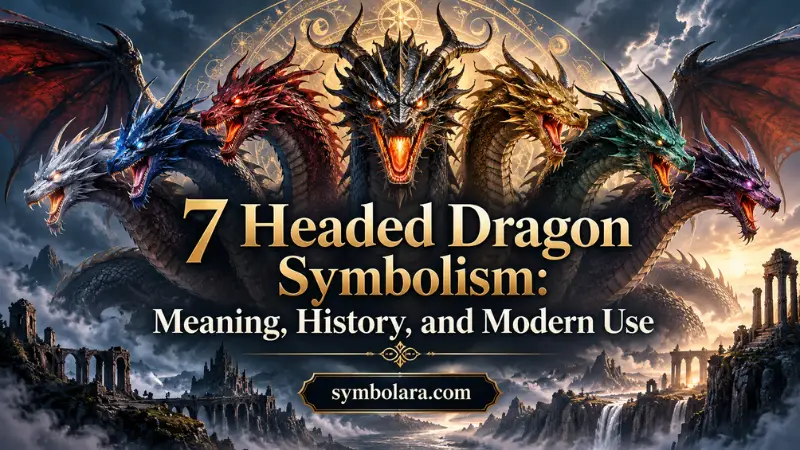
A seven-headed dragon is usually shown as one large creature with seven separate heads emerging from its body. Artists often give it a long tail, sharp claws, horns, and a threatening expression.
In Christian artwork, the dragon frequently appears red because Revelation 12:3 describes it that way.
Its most recognizable features include:
- Seven heads: Multiple faces of a single threatening creature.
- Ten horns: Features associated with strength and authority.
- Seven crowns: Signs of royal status and claimed control.
- Red body: A visual feature linked to the biblical description.
- Long tail: A detail connected with its actions in Revelation 12:4.
Not every illustration follows these details exactly. Some artists arrange the heads in a row, while others place them around a central neck or body.
Modern fantasy drawings may add flames, wings, armor, or different colors. These additions can make the creature look more dramatic, but they do not necessarily come from the biblical text.
The number of heads matters more than the artistic style. It distinguishes this creature from an ordinary dragon and connects it with a particular set of religious stories.
What Does the Dragon Mean in Revelation 12?
The Book of Revelation provides the clearest explanation of the seven-headed dragon.
Revelation 12 describes a woman clothed with the sun who is preparing to give birth. A large red dragon waits nearby, hoping to destroy her child.
The story then describes a conflict in heaven involving Michael and his angels. The dragon loses the battle and is thrown down.
Revelation 12:9 identifies the dragon as the ancient serpent, the devil, and Satan.
This identification gives the creature its central meaning in Christian interpretation.
The dragon as an image of evil
The dragon represents more than an ordinary dangerous animal. It acts as an enemy that attempts to destroy what the biblical story presents as good.
Its actions connect it with:
- Deception and falsehood
- Destruction and hostility
- Resistance to divine authority
- Persecution of God’s people
- The misuse of worldly control
The dragon’s threatening appearance supports these ideas. Its many heads and horns make it seem unusually difficult to confront.
However, the story does not present the dragon as equal to God. It eventually loses its position in heaven.
For Christian readers, this difference matters. The creature represents a serious threat, but not an undefeated one.
Why Does the Dragon Have Seven Heads?
The number seven appears frequently in the Bible. Depending on the passage, it can suggest completeness, fullness, or a finished pattern.
Genesis describes a seven-day creation sequence, including the day of rest. Revelation itself also contains seven churches, seven seals, seven trumpets, and seven bowls.
Against that background, the dragon’s seven heads may suggest the broad reach of its influence.
The creature appears to possess more than one source of authority or way of causing harm.
However, the text does not say that each head represents a specific personal weakness or emotion.
Do the seven heads represent seven kingdoms?
Some Christian interpretations connect the heads with kingdoms, rulers, or systems of political control.
Revelation 17:9–10 describes the seven heads of a related beast as seven mountains and seven kings.
That passage helps explain why many interpreters associate seven-headed creatures in Revelation with political authority.
Still, the dragon in Revelation 12 and the beast in Revelation 17 are not described as identical figures.
The connection between their heads is important, but readers should distinguish what the text directly states from later interpretation.
The safest general explanation is that the seven heads suggest a threatening authority whose influence extends beyond a single ruler or individual.
What Do the Ten Horns and Seven Crowns Symbolize?
The dragon’s heads are not its only important features.
Revelation 12:3 also gives the creature ten horns and seven crowns, sometimes translated as royal diadems.
These details draw on the symbolic language of biblical prophecy.
Ten horns and political strength
Horns often represent strength or ruling authority in biblical visions.
Daniel 7 describes a beast with ten horns. In that chapter, the horns are connected with kings.
Revelation 17:12 also identifies the ten horns of a related beast with ten kings.
These passages help explain why many readers understand the dragon’s horns as signs of political strength and the ability to exercise control.
The text does not require readers to identify the horns with ten modern countries.
Seven crowns and claimed sovereignty
The crowns add another layer of meaning.
A crown commonly signals kingship, rule, or recognized authority. Placing seven crowns on the dragon’s heads makes it look like a creature claiming an unusually wide scope of rule.
Yet the story questions that claim.
The dragon may display signs of royal status, but Revelation presents its authority as limited and destined to fail.
This contrast helps explain why the creature can symbolize both threatening control and the eventual defeat of that control.
Older Roots: Lotan and the Seven-Headed Sea Serpent
The idea of a many-headed serpent existed before the Book of Revelation.
One important example comes from Ugarit, an ancient city located in what is now Syria.
Texts associated with the Ugaritic Baal Cycle describe a serpent commonly called Lotan. A passage refers to a serpent with seven heads.
In these stories, the storm god Baal is associated with victory over a dangerous sea creature.
The serpent belongs to a larger pattern of stories in which threatening waters or monsters represent disorder.
How Lotan relates to Leviathan
The Hebrew Bible contains a related creature called Leviathan.
Isaiah 27:1 describes Leviathan using images of a fleeing and twisting serpent.
Psalm 74:14 refers to the heads of Leviathan, although it does not give their exact number.
The similarities between Lotan and Leviathan have attracted scholarly attention because they share recognizable language and imagery.
Both belong to older traditions about dangerous serpents and their defeat.
Still, these stories should not be treated as identical.
The Ugaritic account belongs to a different religious setting, while Revelation uses the dragon within a Christian account of conflict involving Satan.
The evidence supports a historical relationship among these traditions, but it does not establish a single, uninterrupted meaning for every seven-headed creature.
How First-Century Readers May Have Understood the Dragon
Revelation emerged in the Roman world, probably during the late first century CE, although scholars debate its exact date.
Its original audience included Christian communities in Roman Asia Minor, in the region of present-day western Turkey.
For those readers, images of kings, beasts, and threatening rulers could carry political meaning.
Rome held great authority over the communities addressed in Revelation. Roman rulers, public ceremonies, and imperial institutions shaped everyday life.
Some scholars therefore interpret Revelation’s monsters partly as criticism of Roman imperial rule.
The connection with Rome’s seven hills
Revelation 17 describes seven mountains associated with a seven-headed beast.
Because Rome was famously linked with seven hills, many interpreters see a possible reference to the city.
This explanation has historical support, but scholars do not agree on every detail of the passage.
Some emphasize the Roman setting. Others give greater attention to broader religious or future-oriented meanings.
The dragon of Revelation 12 is directly identified as Satan, while the political beasts elsewhere in the book represent related but distinct figures.
That distinction helps readers understand why the same visual details can suggest both spiritual opposition and harmful human authority.
From Medieval Tapestries to Printed Bibles
The seven-headed dragon became an important subject in European Christian artwork.
Medieval artists used images to explain biblical stories to audiences who might not have owned books or been able to read them.
The creature’s unusual appearance made it easy to recognize.
One notable example is the Apocalypse Tapestry, created in France during the late 14th century for Louis I, Duke of Anjou.
The tapestry illustrates scenes from Revelation, including its dragons, angels, and conflicts.
Its imagery also reflects the political and military concerns of medieval Europe.
Albrecht Dürer’s dragon
German artist Albrecht Dürer created a famous series of woodcuts illustrating Revelation in the late 1490s.
One print, commonly called The Woman Clothed with the Sun and the Seven-Headed Dragon, shows the creature threatening the woman described in Revelation 12.
Another print, The Whore of Babylon, shows a woman riding a seven-headed beast from Revelation 17.
These works demonstrate how artists distinguished biblical scenes while using similar creatures.
Printed images also made such designs easier to reproduce and circulate.
Over time, the dragon moved beyond handwritten religious manuscripts into printed Bibles, illustrated books, and art collections.
Its basic religious meaning remained recognizable, even as artists changed its shape, scale, and appearance.
Where Americans Encounter the Image Today
In the United States, the seven-headed dragon is not a common national emblem or holiday symbol.
Its strongest established connection remains Christian religious teaching.
A person might encounter it during a Bible study about Revelation, in a church presentation, or while viewing historical religious art.
American interpretations also depend on religious background.
Some Christians focus on the dragon as a representation of Satan. Others emphasize the text’s criticism of oppressive authority or its message that evil will eventually be defeated.
Outside church settings, the creature can appear in fantasy illustrations, independent artwork, or online discussions about mythology.
The same design may therefore communicate different ideas depending on who uses it.
How context changes its meaning
| Context | Meaning in USA | Common Associations | Notes |
| Bible study | Opposition to God | Revelation, Satan, prophecy | Usually interpreted within its biblical narrative |
| Religious artwork | Conflict and judgment | Michael, the woman, the dragon | Often follows traditional Christian imagery |
| Political illustration | Threatening or divided authority | Control, corruption, competing rulers | Meaning depends on the artist’s message |
| Fantasy illustration | An unusually dangerous creature | Multiple opponents, monster design | May have no religious meaning |
| Personal tattoo | Individual belief or artistic identity | Conflict, warning, rebellion | The wearer’s explanation matters |
These differences show why the number of heads alone cannot tell viewers exactly what an image means.
A dragon painted beside an angel may communicate something very different from one appearing on a fantasy book cover.
What It Can Mean in Tattoos, Drawings, and Fantasy Art
A seven-headed dragon can make a striking visual design because its heads create movement and complexity.
Artists can show each head facing a different direction, opening its mouth, or reacting to another figure.
This makes the creature useful in illustrations that need to communicate conflict.
Seven-headed dragon tattoos
A tattoo featuring this dragon does not have one universal meaning.
Someone may choose the design because of its connection to Revelation. Another person may simply appreciate its unusual appearance.
Possible personal interpretations include:
- A reminder of religious teachings about evil
- An image representing a struggle against harmful authority
- Interest in biblical history or apocalyptic artwork
- Appreciation for fantasy creatures and detailed tattoo designs
- A personal warning against deception or uncontrolled ambition
These are possible meanings, not established rules.
A tattoo owner may also reject the creature’s traditional religious meaning entirely.
For that reason, viewers should avoid assuming that someone with a dragon tattoo supports the beliefs or behavior represented by the biblical creature.
Fantasy creatures with several heads
Many modern fantasy stories use dragons or monsters with multiple heads.
Such creatures can threaten a hero from several directions at once. Their bodies may suggest that defeating one part does not solve the whole problem.
However, a seven-headed fantasy creature is not automatically based on Revelation.
Some fantasy monsters borrow from several older traditions, while others result from independent artistic choices.
The design itself is not enough to establish its source.
Why the Image Can Feel Threatening or Defiant
The seven-headed dragon often creates a stronger sense of danger than a single-headed creature.
One reason is simple: people normally expect an animal to have one head.
Seven heads disrupt that expectation.
Each additional head may suggest another point of attack, another intention, or another threat.
The creature also combines familiar signs of danger, including claws, horns, teeth, and an enormous body.
The meaning of facing the dragon
A picture showing someone confronting the creature can change its emotional meaning.
The dragon may still represent danger, but the person facing it may symbolize courage, endurance, or resistance.
In Christian artwork, Michael’s battle against the dragon illustrates this contrast.
The emphasis shifts from the monster itself to the struggle against it.
For viewers outside a religious setting, a similar image might represent opposition to an overwhelming challenge.
That interpretation is a personal or artistic reading rather than a fixed historical definition.
The important distinction is between what the dragon traditionally represents and what someone may express by choosing to confront it.
Mistakes That Change the Symbol’s Meaning
Several misunderstandings can lead to inaccurate explanations of the seven-headed dragon.
Mistaking the dragon for the seven deadly sins
A common modern explanation assigns one head to each of the seven deadly sins.
The traditional list includes pride, greed, lust, envy, gluttony, wrath, and sloth.
However, Revelation 12 does not identify the dragon’s heads with these sins.
An artist may choose that interpretation, but it should not be presented as the original biblical meaning.
Confusing the dragon with the Hydra
The Hydra from Greek mythology is another many-headed monster.
In the story of Heracles, the hero confronts the Hydra, whose severed heads can be replaced by new ones.
Ancient accounts differ about the creature’s head count.
The Hydra and Revelation’s dragon share a visual feature, but they belong to separate stories with different meanings.
Assuming all seven-headed serpents represent Satan
South Asian religious art sometimes features serpents with several heads or hoods.
For example, representations of the naga Mucalinda may show seven serpent hoods sheltering the Buddha.
That image is associated with protection, not the Christian depiction of Satan.
The resemblance in head count does not make the traditions interchangeable.
Confusing the dragon with Revelation’s beasts
Revelation describes several creatures with related features.
The red dragon in chapter 12 is explicitly identified as Satan.
The beast from the sea in chapter 13 has seven heads and ten horns, but its crowns appear on the horns rather than the heads.
Revelation 17 also describes a scarlet beast with seven heads and ten horns.
These figures are connected within the book’s imagery, yet their roles are not exactly the same.
Treating every political interpretation as a proven prediction
Some readers associate the dragon’s features with specific governments, world leaders, or future events.
Such interpretations belong to particular approaches to biblical prophecy.
They are not established historical facts simply because they use the number seven or ten.
Reading the surrounding chapters helps separate the biblical description from claims made by later interpreters.
FAQs
In Revelation, the dragon is an evil figure because the text directly identifies it as Satan. However, a similar-looking creature in another tradition may have a different role. Its appearance alone does not prove that it represents evil.
Revelation identifies the dragon as Satan rather than directly naming it the Antichrist. Some Christian interpretations connect the dragon with figures and systems opposed to Christ, including the beast described in chapter 13. The relationship depends on how the reader interprets those passages.
Revelation 12:3 describes the dragon as red, but the verse does not provide a separate explanation for that color. Christian artists and interpreters often associate red with violence, bloodshed, anger, or destruction. Those associations fit the creature’s actions, although they are interpretations rather than an explicit biblical definition.
Not exactly. Leviathan appears in several passages of the Hebrew Bible, while Revelation specifically identifies its dragon as Satan. Scholars recognize links between their serpent imagery, but the texts use these creatures in different ways.
There is no reliable evidence that dreaming about this creature predicts danger or future events. A dream may reflect recent reading, religious concerns, fantasy media, or ordinary stress. Its meaning, if personally important, depends more on the dreamer’s experiences than on a fixed symbol dictionary.
Someone can assign that personal meaning to an image, particularly if the design represents confronting danger. However, protection is not the dragon’s standard role in Revelation. In Christian imagery, protection is more closely connected with divine help and the figures resisting the dragon.
Conclusion
7 headed dragon symbolism is most firmly connected with Satan, deception, threatening authority, and opposition to God in the Book of Revelation. Its seven heads, ten horns, and crowns contribute to an image of widespread influence and claimed control.
Older stories about Lotan and Leviathan help explain the background of many-headed serpents. Later Christian artists carried the image into tapestries, woodcuts, and illustrated books. Today, it remains recognizable in American religious discussion and appears in some personal and fantasy artwork.
The most useful way to understand this dragon is to look at its setting. A creature shown threatening the woman in Revelation carries a specific biblical meaning, while a similar design in a tattoo or fantasy illustration may tell a different story. The details surrounding the image often reveal as much as its seven heads.