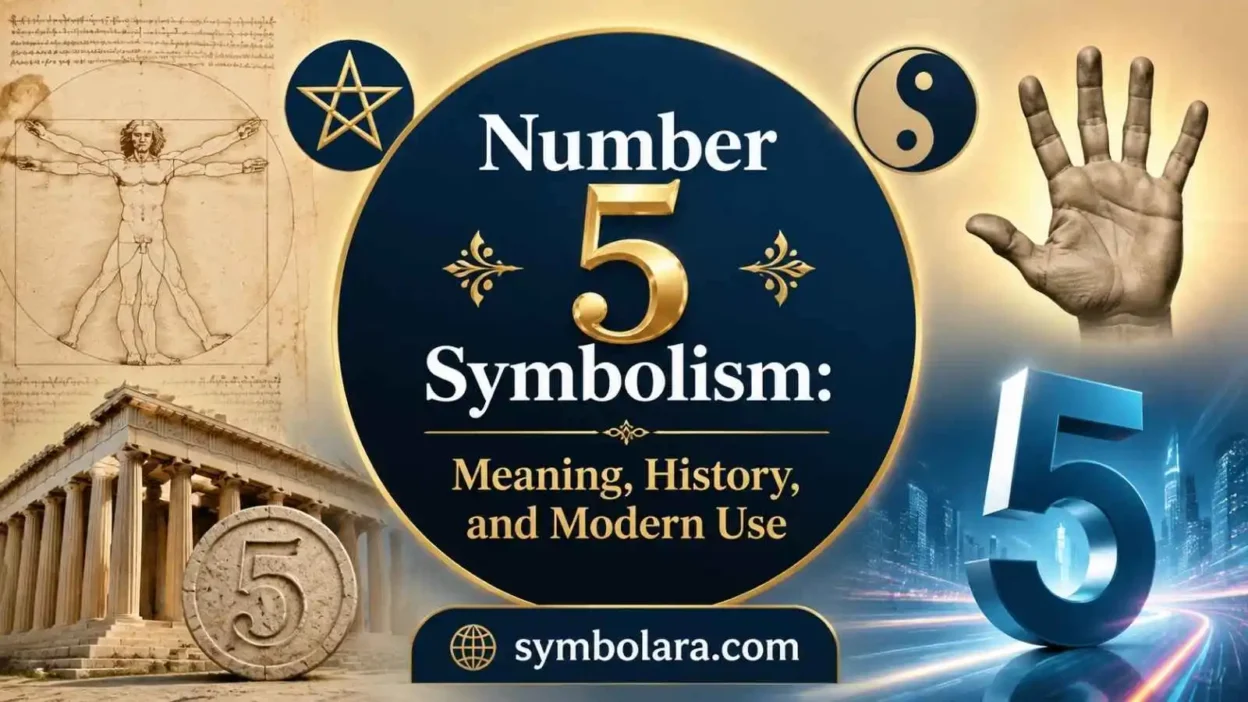
Number 5 Symbolism often points to human experience, change, freedom, balance, and the space where the physical and spiritual sides of life meet. In everyday American culture, the number appears in familiar places: five fingers, five senses, five-star ratings, five-pointed stars, sports jerseys, addresses, lucky numbers, tattoos, and personal milestones.
The number feels natural because people meet it first through ordinary life. We count with five fingers on one hand, give high fives, rate products out of five stars, and recognize five-pointed stars on the American flag. Long before five becomes philosophical, religious, or mystical, it already feels practical and human.
Across history, five has carried many meanings. Ancient number traditions connected it with union and life. Religious systems used it to organize duties, teachings, and sacred memory. Chinese cosmology placed five at the center of cycles and natural patterns. In modern design, five often adds movement, balance, and visual interest. Its meaning changes by context, but one idea stays strong: five often represents life in motion.
Quick Answer
Number 5 Symbolism commonly represents change, freedom, human experience, balance, and movement. In the United States, it often appears through five-star ratings, high fives, five-pointed stars, sports numbers, tattoos, and personal milestones. Historically, five has also been linked with the human body, religious structure, ancient number philosophy, and five-part systems that explain the world.
TL;DR
The number 5 often symbolizes freedom, change, and human experience.
Its meaning is strongly tied to the hand, body, and traditional five senses.
In American culture, five appears in ratings, stars, sports, tattoos, and design.
Religious traditions often use five to organize duties, teachings, or sacred ideas.
Ancient and cross-cultural systems connect five with balance, life, and movement.
The meaning of five depends on context, not one universal rule.
What the Number 5 Looks Like as a Symbol
The number 5 can appear as a written numeral, a counted group, or a five-part shape. You may see it on clocks, street addresses, sports jerseys, school grades, price tags, product ratings, and countdowns. It can also appear indirectly through five-pointed stars, pentagons, pentagrams, five-petal flowers, five-fingered hands, and five-part designs.
In American visual culture, the five-pointed star is one of the clearest symbols connected with five. It appears on the U.S. flag, military designs, sheriff badges, children’s stickers, review systems, and award imagery. Because of this, five can suggest achievement, recognition, public honor, service, or excellence.
The number also feels physical. One open hand shows five immediately. That makes the number easier to understand than symbols that exist mostly in math, myth, or religion. Five often feels personal because the human body gives it shape.
What Five Commonly Means in the United States
In the United States, five usually symbolizes movement, variety, quality, achievement, and human-centered experience. It does not have one fixed meaning in every situation. Its message depends on where it appears and how people use it.
A five-star review suggests excellence or top quality. A high five shows celebration, agreement, or shared success. A five-pointed star may suggest patriotism, authority, service, decoration, or recognition. A number 5 tattoo may point to freedom, personal change, a birthday, a family number, a sports memory, or a private life milestone.
The number is also tied to American habits of ranking and measuring. Hotels, restaurants, apps, schools, entertainment platforms, and service reviews often use five-part rating systems because they are simple to understand. In that practical sense, five can symbolize judgment, approval, and completion on a human scale.
Why Five Feels So Human
Five feels human because people first understand it through the body. Most people have five fingers on each hand and five toes on each foot. One raised hand can mean greeting, action, help, work, protection, or connection.
The traditional five senses also give the number a strong link to lived experience. Sight, hearing, smell, taste, and touch are commonly used to explain how people experience the world. Modern science recognizes more than these five senses, such as balance and body position, but the traditional list still shapes everyday language.
Because of this, five often represents ordinary human awareness. It can suggest seeing, hearing, touching, tasting, smelling, grasping, making, and responding. The number does not feel distant or abstract. It feels close to the body and connected to daily life.
Ancient Greek and Pythagorean Meaning of Five
In ancient Greek number symbolism, five carried special meaning because some traditions saw it as a union of two and three. In that symbolic system, two could represent a feminine principle, while three could represent a masculine principle. Their combination made five a number of union, marriage, harmony, and human life.
This does not mean every modern use of five is about marriage. A five-star review, a sports jersey, or a street address does not automatically carry that ancient meaning. Still, the old idea shows how early thinkers saw numbers as more than tools for counting.
Five also connects strongly with geometry. The pentagon and pentagram both use five-part structure. A five-pointed star is balanced, memorable, and easy to recognize. Because its shape can also suggest the human form, it became symbolically useful in many different cultures and visual traditions.
The Five-Pointed Star and the Pentagram
The five-pointed star is one of the most common symbols linked with the number five. In everyday American use, it often means excellence, recognition, patriotism, guidance, or decoration. A child may receive a gold star for good work. A hotel may earn five stars. The U.S. flag uses stars to represent the states.
The pentagram is related but more specific. It is usually a five-pointed star drawn with continuous intersecting lines. Across different times and settings, it has been used for geometry, identity, protection, religious symbolism, and esoteric practice.
A common mistake is to treat every five-pointed star as if it means the same thing. Context matters. A star on a flag, a sheriff badge, a holiday ornament, a review page, and a ritual symbol are not automatically saying the same thing. The shape may be similar, but the meaning changes with use.
Religious Meanings of Five
Five appears in several major religious traditions as a number of structure, devotion, teaching, and sacred practice. In Islam, the Five Pillars organize the central duties of Muslim life: profession of faith, prayer, charity, fasting, and pilgrimage. The practice of five daily prayers also gives the number deep religious importance in Islamic life.
In Judaism, the Torah refers to the first five books of the Hebrew Bible. These books hold central religious, legal, and spiritual importance. In Christianity, the same first five books are often called the Pentateuch and form the beginning of the Old Testament.
Christian devotional traditions may also connect five with the wounds of Christ, though that is a more specific religious meaning rather than a general meaning of the number. Overall, five often becomes meaningful in religion when it gives structure to faith, memory, duty, teaching, or sacred story.
Cross-Cultural Meanings of Five
Beyond the United States, five appears in many systems that organize the world. In Chinese thought, the concept known as wuxing describes five phases: wood, fire, earth, metal, and water. These are not “elements” in the modern chemical sense. They describe processes, relationships, seasons, cycles, directions, colors, and patterns of change.
Other traditions use five to represent orientation. Four points may stand for north, south, east, and west, while the fifth point represents the center. In that structure, five can symbolize a person standing within the world, not outside it.
This pattern helps explain why five often suggests balance without stillness. Four may feel like a square, a set of directions, or a stable frame. Five adds a center, a body, a person, or a moving force inside that frame.
Number 5 in American Public Life
Five is easy to repeat, recognize, and remember, which is why it appears so often in American public life. The most familiar example is the American flag, where each star represents a state. Over time, the five-pointed star has become a broad sign of recognition, identity, and civic meaning.
Public rating systems also rely heavily on five. A five-star score usually means the highest rating, strongest approval, or best visible recommendation. Restaurants, hotels, movies, apps, products, and rideshare services all use this simple scale because most people understand it quickly.
Sports add another personal layer. A number 5 jersey may become meaningful because of a player, team, position, school, or memory. In American culture, numbers often become identity markers through sports, neighborhoods, family stories, and personal milestones.
Common Meanings of Five by Context
| Context | Common Meaning | Example | Important Note |
| Five-star rating | Excellence or top quality | Hotels, apps, restaurants, products | Usually practical, not mystical |
| Five-pointed star | Recognition, identity, or honor | Flag, badges, awards, stickers | Meaning depends on placement |
| High five | Celebration or agreement | Sports, friendship, teamwork | Casual social symbol |
| Number 5 tattoo | Change, identity, or personal milestone | Birthdays, sports, family, life events | Meaning is often private |
| Five senses | Human experience | Sight, hearing, smell, taste, touch | Traditional model, not full science |
| Religious use | Duty, teaching, or sacred structure | Islam, Torah, Pentateuch, devotion | Meaning depends on tradition |
| Five in design | Balance with movement | Stars, petals, patterns, decor | Odd numbers create visual interest |
Emotional and Psychological Meaning of Five
Emotionally, five often suggests movement. It sits between smaller numbers linked with beginnings and larger numbers linked with systems or completion. Because of that, people may connect five with transition, choice, curiosity, freedom, and personal growth.
The number can also feel confident. A five-star rating signals approval. A high five shows shared success. An open hand with five fingers can suggest honesty, greeting, action, or readiness. These everyday gestures give the number an active and expressive feeling.
Psychologically, five works well because it is easy to remember. A list of five items can feel complete without feeling too long. That is one reason five-part guides, top-five lists, five-step plans, and five-star systems are common in education, branding, marketing, and online content.
Why People Choose Five for Tattoos and Jewelry
People choose the number 5 for tattoos and jewelry because it can feel personal, simple, and flexible. It may represent a fifth child, a birth month, a lucky number, a sports number, a family group, a date, or a major turning point in life.
Some people connect five with freedom and independence. Others like its link to the hand, the star, the senses, or the idea of balance through movement. A small number 5 tattoo can feel minimal and private, while a five-pointed star can look bold, patriotic, spiritual, decorative, or rebellious depending on the design.
Placement also changes the message. A number 5 on the wrist may feel intimate. A large five-pointed star on the shoulder may feel more public and identity-based. Jewelry with five stones, five charms, or five points often suggests harmony, memory, family, or a meaningful set.
Five in Design, Decor, and Fashion
Designers often use five because odd numbers can make a layout feel natural and visually interesting. In home decor, groups of three or five objects often look more relaxed than perfectly even arrangements. Five points, five petals, or five repeated shapes can create balance without making the design feel stiff.
In fashion, five-pointed stars can feel playful, patriotic, western, punk, military-inspired, glamorous, or youthful. The same shape can appear on denim jackets, sneakers, jewelry, children’s clothes, uniforms, and stage costumes. Color, material, placement, and style all affect the message.
Digital culture uses five constantly. Five-star ratings, top-five lists, five-step guides, and five-second countdowns all work because the number feels quick, complete, and easy to scan. Modern life has made five a symbol of practical organization as much as symbolic meaning.
Positive and Negative Meanings of Five
The positive meanings of five include freedom, adaptability, achievement, curiosity, sensory awareness, and human wholeness. It can suggest someone who is open to experience, willing to change, and able to move between different parts of life.
Negative meanings usually come from instability or excess. When five is linked with constant change, it may suggest restlessness, distraction, impatience, or difficulty settling down. In numerology-style readings, five is often described as adventurous, but sometimes hard to contain.
In religious or cultural settings, negative meanings usually come from misuse or misunderstanding rather than from the number itself. A symbol can become confusing when people remove it from its tradition, flatten it into superstition, or treat it like a secret code with one fixed meaning.
Common Misunderstandings About Five
One common misunderstanding is that five always means luck. It can be a lucky number for some people, families, or belief systems, but luck is not its only meaning. In many contexts, five is more about the body, experience, change, structure, or recognition.
Another mistake is assuming the pentagram is always negative. Five-pointed forms have had many uses, including geometry, decoration, identity, protection, and religious symbolism. Modern fear around the symbol often comes from narrow pop-culture associations, not the full history of the shape.
A third misunderstanding is treating numerology meanings as universal facts. Numerology can be meaningful to people who use it as a personal or spiritual language. Still, its meanings should not be presented as proven rules that apply to everyone in every culture.
How the Meaning of Five Has Changed
The meaning of five has moved from sacred pattern to everyday shorthand. Ancient thinkers saw it in geometry, the body, and cosmic order. Religious traditions used it to organize duties, teachings, and devotion. Folk and magical traditions sometimes connected five-pointed shapes with protection, love, or special knowledge.
In modern American life, five is often more practical. It ranks products, marks excellence, identifies players, decorates clothing, organizes information, and appears in public symbols. Older meanings have not disappeared, but many people meet the number first through ratings, stars, hands, and everyday design.
That flexibility is one reason five remains powerful. It can feel casual in one setting and deeply meaningful in another. The same number can be a rating, a star, a prayer structure, a tattoo, a design choice, a sports number, or a private symbol.
When Five Feels Most Meaningful
Five feels most meaningful when it connects to movement, identity, the body, or a personal story. A high five after a shared win matters because it joins two people in a visible moment of agreement. A five-star review matters because it turns approval into a clear public sign.
A number 5 tattoo may matter because only the wearer knows the full story behind it. A five-pointed star can matter because people recognize it instantly. A religious five-part structure matters because it gives shape to practice, memory, and devotion.
The strongest symbolism of five comes from its mix of the ordinary and the meaningful. It belongs to daily life, but it can still carry history, faith, emotion, identity, and personal change.
FAQs
What does the number 5 symbolize spiritually?
Spiritually, the number 5 often symbolizes human experience, change, movement, balance, and the connection between body and meaning. In specific traditions, it may also refer to sacred duties, teachings, elements, wounds, protection, or spiritual structure.
Is the number 5 lucky or unlucky?
The number 5 can be lucky for people who connect it with freedom, opportunity, change, or personal milestones. It is not universally lucky or unlucky. Its meaning depends on culture, religion, personal belief, and context.
What does a number 5 tattoo mean?
A number 5 tattoo can represent change, independence, a birthday, a family connection, a sports number, a fifth child, or an important turning point. A plain numeral, Roman numeral V, five dots, or a five-pointed star can each create a different message.
What does five mean in the Bible?
In biblical and religious contexts, five can suggest structure, law, teaching, or devotion. The first five books of the Hebrew Bible are central to Judaism and are also known in Christianity as the Pentateuch.
What does five mean in Islam?
In Islam, five is strongly connected with the Five Pillars, which organize the central duties of Muslim religious life. It is also connected with the practice of five daily prayers.
Conclusion
Five is one of the most human-feeling numbers because it begins with the body: one hand, five fingers, five familiar senses, and a natural way to count, touch, greet, and act. From there, it expands into stars, faith traditions, ratings, design, tattoos, sports numbers, and public symbols.
Number 5 Symbolism is best understood as a blend of change, balance, freedom, human experience, recognition, and meaningful structure. It can be casual or sacred, personal or public, ancient or modern.
That flexibility is what keeps five powerful. It is simple enough for daily life, but rich enough to carry history, emotion, identity, and spiritual meaning.
Spiritually, the number 5 often symbolizes human experience, change, movement, balance, and the connection between body and meaning. In specific traditions, it may also refer to sacred duties, teachings, elements, wounds, protection, or spiritual structure.
The number 5 can be lucky for people who connect it with freedom, opportunity, change, or personal milestones. It is not universally lucky or unlucky. Its meaning depends on culture, religion, personal belief, and context.
A number 5 tattoo can represent change, independence, a birthday, a family connection, a sports number, a fifth child, or an important turning point. A plain numeral, Roman numeral V, five dots, or a five-pointed star can each create a different message.
In biblical and religious contexts, five can suggest structure, law, teaching, or devotion. The first five books of the Hebrew Bible are central to Judaism and are also known in Christianity as the Pentateuch.
In Islam, five is strongly connected with the Five Pillars, which organize the central duties of Muslim religious life. It is also connected with the practice of five daily prayers.


[…] is what makes the number worth understanding. It is not just an “unlucky number.” It is a symbol shaped by religion, folklore, architecture, pop culture, national history, and the way people turn […]