
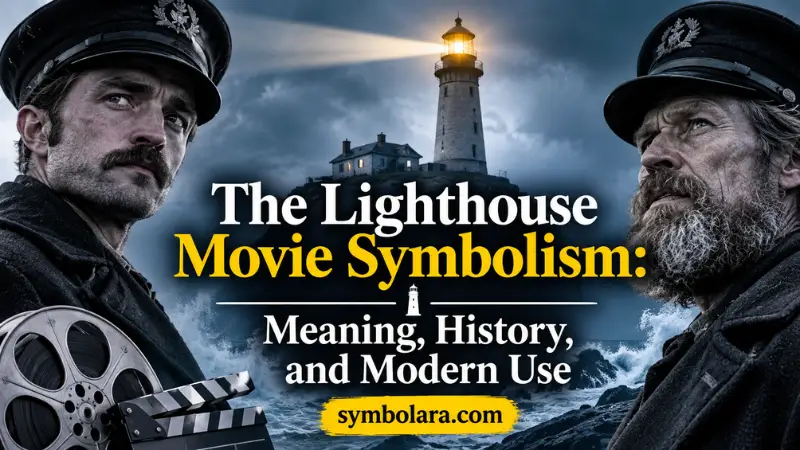
Robert Eggers’s 2019 film The Lighthouse follows two lighthouse keepers stranded on a remote New England island during the 1890s. The older keeper controls access to the lighthouse lamp, while the younger man grows increasingly frustrated with his isolation, exhausting duties, and strange surroundings. As the weather worsens, their relationship becomes more hostile, and the line between reality and imagination begins to blur.
The lighthouse movie symbolism has attracted attention because almost every major element carries more than one possible meaning. The tower, its light, the surrounding ocean, the seabirds, and even the characters’ daily routines connect to ideas about power, guilt, ambition, isolation, and human nature.
For American viewers, the film also draws on New England’s maritime past, working-class history, sailors’ folklore, and Greek mythology. Understanding these connections helps explain why the lighthouse becomes much more than a building in the story.
Note: This article discusses major plot details and the film’s ending.
Quick Answer
The lighthouse movie symbolism primarily represents forbidden knowledge, power, ambition, and humanity’s desire to reach something beyond its control. Drawing on maritime traditions, Greek mythology, and the historical dangers of lighthouse work, the film uses its tower and light to examine what happens when people become obsessed with something they cannot fully understand.
TL;DR
- The lighthouse represents authority, temptation, and unreachable knowledge.
- Its light suggests something desirable but potentially dangerous.
- The ocean reflects uncertainty, isolation, and uncontrollable forces.
- The seabirds connect to maritime superstition and warnings.
- Greek mythology adds themes of forbidden knowledge and punishment.
- The ending challenges viewers to question ambition and human limits.
What Does the Lighthouse Look Like in the Film?
The central lighthouse stands on a small, rocky island surrounded by the rough waters of the North Atlantic. Its tower rises above the keepers’ living quarters, making it the most noticeable structure in the landscape.
The film uses black-and-white photography and an unusually narrow screen ratio. These choices give the setting the appearance of an old photograph or historical record. The result feels closer to a forgotten maritime story than a conventional modern thriller.
Several visual details make the tower important:
- Its height: The lighthouse stands above the surrounding landscape, suggesting authority and separation.
- Its enclosed structure: The narrow staircase creates a sense of restriction and difficult access.
- Its bright lamp: The light becomes the object of desire for both characters, especially Ephraim Winslow.
- Its isolated location: The surrounding ocean separates the keepers from ordinary society.
The tower also creates a visual division between the two men. Thomas Wake, the senior keeper, controls the upper space, while Ephraim performs much of the physical labor below.
This arrangement makes the building resemble a workplace shaped by strict authority. However, as the story progresses, its meaning shifts from a practical structure into something that appears almost sacred to the characters.
What Does the Lighthouse Symbolize in Modern Interpretations?
The tower carries several connected meanings, rather than one fixed message. Its importance comes partly from the way each character views it differently.
Power and authority: Thomas Wake controls the lamp and decides who may approach it. His position gives him control over something Ephraim desperately wants to see. The tower therefore reflects the unequal relationship between the two men.
Forbidden knowledge: The lamp remains hidden behind glass and is treated almost like a secret. Ephraim’s growing desire to see it suggests the human urge to discover something that has been deliberately kept out of reach.
Ambition and obsession: The younger keeper becomes increasingly focused on the light. His interest grows beyond ordinary curiosity, suggesting how ambition can take over someone’s judgment.
Spiritual temptation: The light is presented with an almost religious appearance. Its brightness and the characters’ reactions create an atmosphere similar to stories about sacred objects or forbidden experiences.
Human limitations: The tower also represents something people may want to control but cannot fully understand. The characters’ struggle to reach or possess the light exposes the limits of their knowledge and authority.
These meanings overlap. The same structure can represent a source of safety for sailors, a symbol of authority for a worker, and an object of obsession for someone who feels excluded.
How Did Real Lighthouse History Influence the Film?
The film’s setting draws attention to a period when lighthouse keepers performed demanding and sometimes dangerous work along the American coast.
During the nineteenth century, lighthouses played an important role in maritime safety. Before modern navigation systems, ships depended on visible coastal lights to identify dangerous shorelines, rocky passages, and harbor entrances.
Keepers were responsible for maintaining the lamps, cleaning equipment, managing fuel, and ensuring that the light continued operating during difficult weather.
Their responsibilities could involve:
- Carrying supplies through difficult weather.
- Cleaning and maintaining lighting equipment.
- Watching for damage caused by storms.
- Keeping records of daily operations.
- Maintaining the building and its surrounding grounds.
The work could also be lonely. Some lighthouse stations were located on islands or remote stretches of coastline, where workers spent long periods away from their families and communities.
This historical background helps explain why the film focuses so heavily on routine, labor, and authority.
Thomas and Ephraim do not simply live together in an unusual location. They are assigned different responsibilities within a demanding workplace. Their conflict reflects the pressures that can develop when two people must depend on each other while having unequal power.
The film is not a documentary about a particular lighthouse station. Its historical atmosphere supports a fictional story that combines real working conditions with folklore and psychological horror.
Why Is the Lighthouse Light So Important?
The lamp is the central object of desire in the film. Thomas treats access to it as a privilege reserved for himself, while Ephraim becomes increasingly interested in discovering what makes it so special.
This creates a connection between light and knowledge.
In ordinary life, light allows people to see things that darkness hides. It can therefore represent understanding, discovery, truth, and awareness.
However, the film gives this familiar association a more complicated meaning.
The light is not presented as something that automatically improves the person who sees it. Instead, the characters approach it with expectations that may reveal more about their own desires than about the object itself.
There are several ways to interpret this detail:
- Truth: Ephraim wants access to something he believes has been hidden from him.
- Desire: The lamp becomes an object he cannot stop thinking about.
- Authority: Thomas’s control over the light reinforces his position as the senior keeper.
- Danger: The closer Ephraim gets to the object, the less stable his experience becomes.
The film also contrasts the lighthouse lamp with ordinary daylight. Natural light is part of the surrounding world, but the lamp is enclosed, controlled, and protected.
That difference makes it feel less like a normal source of illumination and more like something that demands attention.
What Do Greek Mythology and Prometheus Have to Do With the Film?
One of the film’s most recognizable mythological connections involves Prometheus.
In Greek mythology, Prometheus steals fire from the gods and gives it to humanity. Zeus punishes him by chaining him to a rock, where an eagle repeatedly eats his liver.
The story is commonly associated with forbidden knowledge, rebellion, human ambition, and the consequences of crossing boundaries set by greater powers.
These themes help explain the film’s ending.
Ephraim’s desire to reach the lighthouse light resembles the Prometheus story in several ways:
- He wants access to something controlled by another authority.
- His curiosity develops into an obsession.
- His pursuit takes him beyond ordinary limits.
- His final experience is connected to suffering and punishment.
The ending also brings to mind the image of Prometheus suffering while an eagle attacks him.
The connection is not simply about copying an ancient myth. It provides a way to understand the film’s interest in human ambition and the consequences of pursuing forbidden experiences.
The lighthouse can therefore be read as a modern version of something once reserved for the gods: an object that people desire but may not be prepared to encounter.
Why Does the Film Use the Names Proteus and Prometheus?
The characters’ names offer another connection to Greek mythology.
Thomas Wake’s surname brings to mind Proteus, a sea-associated figure in Greek mythology known for changing forms and avoiding capture. This connection suits a character who remains difficult to understand and whose stories are not always reliable.
Proteus is also associated with prophecy and knowledge of the future, although obtaining answers from him is not easy.
Ephraim Winslow’s name is more complicated. His identity changes as the story develops, and the film gradually reveals that the name he uses conceals another history.
The Prometheus connection is especially relevant to his relationship with the light.
These mythological references create a contrast between the two characters:
- Thomas resembles a figure associated with the sea, shifting identities, and guarded knowledge.
- Ephraim resembles someone who challenges an authority and suffers for reaching beyond accepted limits.
The names do not provide a complete explanation of either character. Instead, they encourage viewers to consider the story as something larger than a simple conflict between two lighthouse workers.
What Does the Ocean Symbolize?
The ocean surrounds the island and limits the characters’ ability to leave. It is both a practical danger and an important part of the film’s visual meaning.
In maritime traditions, the sea has often represented uncertainty because sailors cannot fully control its weather, currents, or hidden dangers.
The film uses this familiar association to reflect the characters’ situation.
Isolation: The water separates the island from ordinary life. The characters have no easy way to reach another person or escape their responsibilities.
Uncertainty: Storms and rough waves create an unpredictable environment. The men cannot depend on stable conditions.
Loss of control: The ocean does not respond to their arguments, desires, or plans. It continues operating according to natural forces.
Emotional instability: As the characters become increasingly hostile, the surrounding weather reinforces the feeling that their situation is deteriorating.
The sea also contrasts with the lighthouse.
The tower is a fixed structure built to withstand difficult conditions, while the ocean is constantly changing. One represents an attempt to create order, and the other reminds viewers that nature cannot be completely controlled.
For American audiences familiar with New England’s fishing towns and maritime history, this contrast gives the setting a recognizable coastal identity.
What Do the Seabirds and the One-Eyed Gull Represent?
Seabirds are important throughout the film, especially the one-eyed gull that Ephraim encounters.
Their meaning is connected to sailors’ folklore. In some maritime traditions, seabirds were treated with caution because people believed they could carry the spirits of dead sailors or serve as warnings.
These beliefs were not universal. Different sailors and coastal communities had their own customs and explanations.
The film uses this folklore to create tension around the gull.
Thomas warns Ephraim against harming seabirds, suggesting that doing so could bring bad luck. Ephraim eventually ignores the warning and kills the one-eyed bird.
Afterward, the men’s situation becomes increasingly disturbing.
The gull can be interpreted in several ways:
- A warning: Its unusual appearance makes it stand out from the other birds.
- A connection to the dead: Maritime folklore sometimes associates seabirds with lost sailors.
- Guilt: The bird becomes connected to Ephraim’s actions and growing psychological distress.
- Superstition: Its presence shows how old beliefs can influence people living in isolated conditions.
The one-eyed detail also makes the bird visually memorable. Some viewers connect it to mythological figures associated with single eyes, although the film does not establish one definitive explanation.
The important point is that the bird brings maritime superstition into the characters’ daily lives.
What Does Isolation Mean in the Story?
Isolation is one of the film’s main subjects. The two keepers are separated from society, but they also struggle to form a stable relationship with each other.
At first, their responsibilities seem straightforward. Thomas supervises the lighthouse, while Ephraim performs much of the physical work.
Over time, the arrangement becomes increasingly difficult.
The younger man feels controlled and disrespected. The older man becomes suspicious and demanding. Their conversations shift between arguments, strange stories, drinking, and moments of temporary friendship.
The setting contributes to this breakdown.
There are no ordinary social activities, no familiar community, and no easy way to resolve disagreements by leaving. Even small conflicts become more important because the characters cannot escape one another.
The film’s isolation can be understood through three experiences:
Social isolation: The characters lack contact with the outside world.
Emotional isolation: Neither man feels fully understood or trusted.
Psychological isolation: Their experiences become increasingly difficult to separate from imagination, fear, and memory.
The film does not establish that isolation automatically causes madness. Instead, it presents a fictional situation in which loneliness, exhaustion, alcohol, guilt, and conflict combine.
This distinction matters because the story is more complicated than a simple warning about spending too much time alone.
What Do the Characters’ Jobs and Power Struggles Represent?
The relationship between Thomas and Ephraim reflects differences in age, experience, status, and authority.
Thomas is the senior keeper. He decides how the work should be performed and expects Ephraim to follow his instructions.
Ephraim, meanwhile, performs exhausting tasks but receives little control over the most important part of the station: the lamp.
This arrangement creates a clear division between labor and privilege.
The younger keeper cleans, carries supplies, and handles unpleasant responsibilities. The older keeper maintains authority over the tower and its light.
Their conflict can be interpreted as a criticism of unequal working relationships.
It also raises questions about how authority operates when there is little outside supervision. Thomas’s position gives him control, but the film does not present him as a completely reliable leader.
His rules, stories, and behavior become increasingly difficult to understand.
Ephraim also contributes to the conflict through his resentment and growing obsession.
Neither character offers a simple example of right or wrong. Their relationship becomes a struggle in which both men attempt to protect their own sense of control.
Why Does the Film Connect Masculinity With Its Symbolism?
The Lighthouse presents two men who struggle to express vulnerability, affection, fear, and frustration.
Their conversations often involve insults, drinking, physical competition, and arguments about work.
These interactions reflect a form of masculinity shaped by the film’s nineteenth-century setting.
Thomas expects obedience and respect. Ephraim wants independence but struggles to communicate his dissatisfaction directly.
Both characters also show discomfort with emotional dependence.
The film’s drinking scenes are important in this context. Alcohol temporarily creates a sense of friendship, but it also makes their disagreements harder to manage.
Their behavior can be interpreted as a criticism of masculine expectations that discourage men from expressing uncertainty or asking for help.
The film does not claim that all nineteenth-century men behaved this way. Rather, it uses these two fictional characters to examine how pride, authority, and emotional restraint can contribute to conflict.
For modern American viewers, this aspect of the story may connect with conversations about workplace culture, male friendship, emotional health, and the pressure to appear strong.
What Does the Film’s Black-and-White Style Add?
The film’s visual style is an important part of its symbolism.
Rather than using the wide, colorful images common in many modern films, director Robert Eggers uses black-and-white photography and a narrow frame.
This creates several effects.
Historical atmosphere: The images resemble old photographs and archival maritime pictures.
Visual restriction: The narrow frame makes the island feel enclosed, even when the ocean stretches into the distance.
Contrast: The difference between light and darkness becomes especially noticeable.
Uncertainty: Shadows make it harder to distinguish details, supporting the film’s unclear relationship between reality and imagination.
The visual style also prevents the setting from feeling like an ordinary vacation destination. The island appears cold, rough, and difficult to inhabit.
The lighthouse lamp stands out because brightness becomes an important visual event rather than an everyday background detail.
This makes the film’s use of light and darkness part of its storytelling, not simply a choice of appearance.
How Has the Meaning of Lighthouse Symbolism Changed Over Time?
Lighthouses have carried several meanings in American culture, and their associations have changed with technology and popular entertainment.
During the nineteenth century, a lighthouse was primarily a practical safety structure. Its purpose was to help ships navigate dangerous coastal areas.
For sailors and their families, the light could represent guidance, protection, and the possibility of reaching shore safely.
As transportation and communication systems developed, the lighthouse also became an image associated with coastal identity, historical preservation, and maritime heritage.
In the twentieth century, lighthouses appeared frequently in paintings, postcards, literature, and tourism materials. They became familiar images of American coastal life.
Modern films have added another layer.
In psychological horror and suspense stories, isolated lighthouses can suggest loneliness, hidden secrets, and the uncertainty of being cut off from society.
The 2019 film builds on both traditions. It retains the lighthouse’s historical association with safety while turning its light into something inaccessible and unsettling.
This change is especially important. An object once associated mainly with helping others find their way becomes the focus of a dangerous personal obsession.
How Do Americans Interpret the Film’s Symbolism Today?
Modern American audiences can connect the film to several familiar subjects.
Its workplace conflict may remind viewers of unequal professional relationships, especially when one person controls opportunities that another person desperately wants.
Its treatment of isolation can connect with discussions about loneliness, remote work, and the difficulty of maintaining relationships without regular social contact.
The mythological references also appeal to viewers interested in stories about ambition, forbidden knowledge, and the consequences of challenging authority.
The film’s coastal setting has a separate cultural connection. New England lighthouses remain recognizable parts of American maritime heritage, appearing in travel photography, historic preservation projects, paintings, and regional souvenirs.
However, the movie gives this familiar image an unsettling interpretation.
Instead of presenting the lighthouse as a welcoming sign for people returning home, it turns the tower into a place of conflict and temptation.
That contrast is one reason the film’s imagery remains open to discussion.
Common Misunderstandings
The story intentionally leaves several questions unanswered. As a result, viewers sometimes treat one interpretation as the only correct explanation.
A few distinctions help keep the discussion grounded.
Misunderstanding 1: The lighthouse represents only heaven or God.
The religious appearance of the lamp encourages spiritual interpretations, but the film also draws on mythology, maritime history, ambition, and psychological horror. A religious reading is possible without being the only explanation.
Misunderstanding 2: The ocean simply represents evil.
The sea is dangerous, but it also represents nature, uncertainty, and the limits of human control. Its meaning is broader than a simple good-versus-evil contrast.
Misunderstanding 3: The film provides a clear explanation of everything that happens.
It does not. The story deliberately mixes unreliable memories, strange experiences, and possible hallucinations. Some events remain open to interpretation.
Misunderstanding 4: The one-eyed gull has one universally accepted meaning.
The bird connects to maritime superstition, but its exact meaning is not established. It can function as a warning, a reminder of guilt, or an image connected to the film’s mythological themes.
Misunderstanding 5: The ending proves that ambition is always harmful.
The story presents the consequences of Ephraim’s particular obsession. It does not suggest that curiosity, learning, or ambition are inherently wrong.
The Lighthouse’s Symbolism Across Different Contexts
| Context | Meaning in USA | Common Associations | Notes |
| Maritime history | Safety and navigation | Coastal protection, guidance | Reflects the lighthouse’s original practical purpose. |
| Film interpretation | Forbidden knowledge and authority | Temptation, obsession, control | Connected to Ephraim’s desire to reach the lamp. |
| Greek mythology | Challenging limits | Prometheus, rebellion, punishment | Adds another layer to the ending. |
| Coastal artwork | Regional identity | New England, heritage, the sea | Common in paintings and historic coastal imagery. |
| Psychological interpretation | Isolation and uncertainty | Loneliness, fear, loss of control | Reflects the characters’ deteriorating relationship. |
FAQs
Is The Lighthouse based on a true story?
The film is fictional, but its setting and working conditions draw on historical lighthouse operations. It is also associated with the real-life Smalls Lighthouse incident of 1801, involving two keepers on an isolated Welsh lighthouse, although the film is not a direct retelling of that event.
Why is The Lighthouse filmed in black and white?
Robert Eggers and cinematographer Jarin Blaschke used black-and-white photography to create a historical appearance and strengthen the contrast between light and darkness. The narrow aspect ratio also makes the island feel enclosed and restrictive.
What does the ending of The Lighthouse mean?
The ending is commonly interpreted through the Prometheus myth, especially the connection between forbidden knowledge and punishment. However, the film does not provide a single official explanation, allowing psychological and mythological readings to coexist.
Is The Lighthouse a religious movie?
It contains imagery that resembles religious experiences, including the lamp’s almost sacred appearance and the characters’ intense reactions to it. However, its story is not limited to a particular religion and also draws on Greek mythology and maritime folklore.
Why does Thomas Wake refuse to let Ephraim see the light?
Thomas’s control over the lamp reinforces his authority and creates conflict between the characters. His refusal can also be interpreted as a way of protecting something he considers private, valuable, or beyond ordinary understanding.
What does the mermaid symbolize in the film?
The mermaid connects to sailors’ folklore, sexual desire, and the dangers of imagination and obsession. Its appearance also reflects how stories about the sea can influence people living far from ordinary society.
Why is The Lighthouse considered psychological horror?
The film focuses on the characters’ changing mental states rather than relying mainly on conventional monsters or sudden scares. Its isolated setting, unreliable experiences, disturbing imagery, and growing hostility create much of its horror.
Conclusion
The lighthouse movie symbolism brings together several ideas, including forbidden knowledge, ambition, authority, isolation, and the limits of human understanding. Its meaning comes from the relationship between the tower, the light, the surrounding ocean, and the two men who struggle to control their lives on the island.
The film also draws on American maritime history, sailors’ folklore, and Greek mythology to give its setting additional meaning. These connections help explain why an ordinary coastal structure becomes the center of such an unsettling story.
Ultimately, the lighthouse represents something people may desperately want to reach without knowing what they will find. That question makes the film’s central image especially memorable: sometimes the thing that promises to show us everything is also the thing we are least prepared to face.