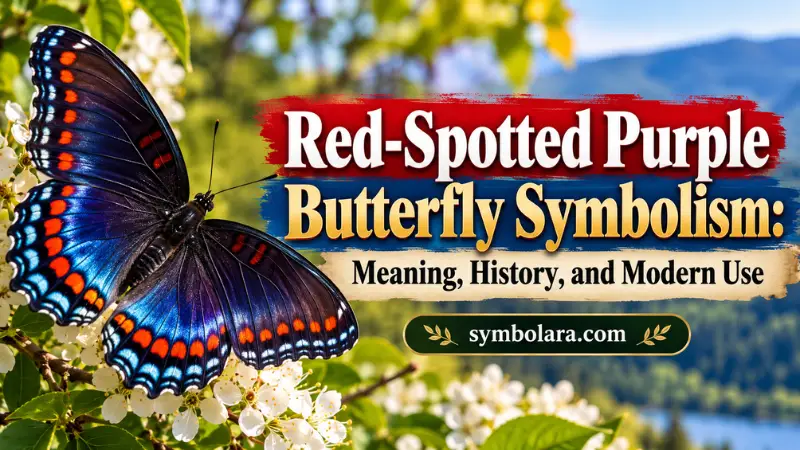
A butterfly with nearly black wings can suddenly flash bright blue as sunlight touches its surface. Turn it over, and small red-orange markings appear beneath the wings. This is the red-spotted purple butterfly, a North American woodland species with an appearance that can change dramatically depending on the viewing angle.
Red-spotted purple butterfly symbolism is often connected with personal transformation, resilience, individuality, and the ability to adapt. These meanings come mainly from the butterfly’s life cycle, appearance, and survival behavior rather than one established cultural tradition.
In the United States, people encounter this butterfly along forest trails, in wooded neighborhoods, and near streams. Its unusual colors may inspire photographs, artwork, tattoos, or personal reflections.
Understanding what it represents begins with understanding the actual butterfly. Its biology offers several interesting connections to the meanings people give it today.
Quick Answer
Red-spotted purple butterfly symbolism commonly represents transformation, resilience, adaptability, and individuality in modern American interpretations. These meanings draw from general butterfly traditions and the species’ changing appearance and survival habits. There is no well-documented historical belief that assigns this particular butterfly one universal spiritual meaning.
TL;DR
- Transformation: Its life cycle represents growth and personal change.
- Resilience: Its survival strategies suggest persistence through challenges.
- Individuality: Its changing blue-black colors inspire personal expression.
- History: Species-specific symbolic traditions are not well documented.
- American culture: Nature photography and personal artwork give it modern meaning.
- Interpretation: A sighting has no scientifically established supernatural message.
What Does a Red-Spotted Purple Butterfly Look Like?
The red-spotted purple butterfly belongs to the brush-footed butterfly family, Nymphalidae. Its scientific name is Limenitis arthemis astyanax, and it is closely related to the white admiral.
Despite its name, this butterfly is not usually bright purple or covered with obvious red markings.
Its upper wings are mostly black with shimmering blue or blue-green coloring. The lower surfaces are darker brown-black, with orange-red spots that become easier to see when the wings are folded.
Adults commonly have a wingspan of approximately 2¼ to 3½ inches, although some individuals are larger.
Several features make the species recognizable:
- Dark upper wings with an iridescent blue shine.
- Red-orange spots on the undersides.
- Rounded hindwings without swallowtail extensions.
- A broad, gliding flight that is noticeable around woodland openings.
Sunlight makes a major difference in how the butterfly looks. From one angle, its wings may appear almost black. From another, they reflect brilliant blue.
This changing appearance helps explain why some people associate it with hidden qualities, changing perspectives, or beauty that becomes visible at the right moment.
These are personal interpretations, not meanings that the butterfly itself communicates.
The species is found across much of the eastern United States, especially around deciduous forests, woodland edges, and moist areas. Its presence in ordinary natural spaces makes it a familiar subject for American butterfly watchers.
What Does This Butterfly Symbolize in Modern American Life?
There is no single official meaning for the red-spotted purple butterfly.
Still, several interpretations fit its appearance and behavior. People may choose one of these meanings when they encounter the insect or use its image in personal artwork.
Transformation is perhaps the easiest connection to understand.
Like other butterflies, this species changes from an egg into a caterpillar, then a chrysalis, and finally a winged adult. People may compare this process with leaving behind an old habit, recovering from a difficult period, or entering a new stage of life.
Resilience is another common personal interpretation.
The butterfly survives changing seasons, predators, and environmental challenges. Its life cycle can remind someone that difficult periods do not necessarily define what comes afterward.
Adaptability comes from its striking resemblance to another butterfly species. Its appearance helps protect it from predators, showing how survival can depend on responding effectively to surrounding conditions.
Individuality is linked to its unusual coloring.
Unlike butterflies with large yellow or orange markings, this species often appears dark until its blue wings catch the light. An artist might use that contrast to represent someone whose personality becomes clearer over time.
None of these meanings is required. A person may simply admire the butterfly for its colors and natural behavior.
That distinction matters because symbolic meaning depends partly on what the observer brings to the experience.
Where Did Its Symbolic Meanings Come From?
The butterfly’s modern meanings are easier to trace through general butterfly imagery than through traditions involving this exact species.
Butterflies have appeared in art, storytelling, and symbolic traditions in many parts of the world. Their transformation from caterpillar to adult has long offered a visible comparison with human change.
For example, butterflies have been associated with the soul in some classical Greek imagery. In parts of Christian art, the butterfly’s emergence from a chrysalis has also been used as an image of resurrection.
Those examples concern butterflies generally. They do not establish a historical religious meaning for the red-spotted purple.
The species belongs to a North American group that naturalists began formally describing and classifying during the eighteenth century. Scientific observation gradually clarified its relationship with other admiral butterflies.
Naturalists studied its colors, caterpillar development, geographical variation, and resemblance to the pipevine swallowtail.
These observations supplied facts that modern readers sometimes interpret symbolically.
For instance, someone who learns about the species’ protective resemblance to another butterfly may connect it with self-preservation. A photographer who notices its changing colors may see it as a reminder not to judge appearances too quickly.
Such interpretations are reasonable as personal metaphors.
However, there is no strong documentation that this particular butterfly traditionally represented good luck, messages from deceased relatives, or a fixed spiritual event among early American communities.
Its current symbolism is better understood as a combination of general butterfly meanings, natural history, and individual experiences.
Why Its Resemblance to a Swallowtail Suggests Adaptability
One of the most interesting facts about this butterfly is that it resembles the pipevine swallowtail.
The pipevine swallowtail, Battus philenor, contains defensive chemicals acquired through its caterpillar’s food plants. This makes it unpleasant or harmful for many predators to eat.
The red-spotted purple has a similar dark-blue appearance, which may cause predators to mistake it for the better-defended species.
Biologists call this type of resemblance Batesian mimicry.
The resemblance develops through evolution. The butterfly does not consciously choose its appearance or imitate another species on purpose.
Its wings differ from those of a true swallowtail because they lack the characteristic tail-like extensions. From a distance, though, the overall coloring can look surprisingly similar.
For people looking for a personal metaphor, this resemblance suggests several ideas.
Adaptability does not always require becoming stronger than everything around you. Sometimes survival depends on using the qualities and protections already available.
The butterfly may also suggest careful self-presentation.
People sometimes adjust how openly they express themselves at school, work, or in unfamiliar social settings. They may view the butterfly’s protective appearance as a reminder that personal boundaries can serve a useful purpose.
There is an important difference between this interpretation and claiming the butterfly represents dishonesty.
In nature, mimicry is a survival adaptation. Treating it as a moral lesson about deception would give the insect a human intention it does not possess.
How Its Life Cycle Represents Growth and New Beginnings
Butterfly transformation involves more than the familiar image of a caterpillar turning into a winged adult.
The red-spotted purple begins life as a small egg, usually placed individually near the tip of a suitable host plant leaf.
After hatching, the caterpillar feeds on leaves from trees or shrubs such as wild cherry, willow, and other host plants.
Its early appearance is unusual. Brown, green, and pale markings make the caterpillar resemble a small bird dropping.
This resemblance may help protect it from animals searching for food.
In colder parts of its range, some young caterpillars survive winter inside small shelters made from leaves. They remain inactive until warmer conditions allow development to continue.
Eventually, the insect forms a chrysalis and emerges as an adult butterfly.
This sequence provides a useful metaphor for personal development.
Change can include periods when progress is difficult to see.
A caterpillar spending winter in a leaf shelter may appear inactive, but surviving that season is part of its development.
Someone recovering from illness, completing an education, or adjusting to a major life change might find that comparison meaningful.
The butterfly’s life cycle also challenges the idea that every important change happens quickly.
Growth often involves several stages, with different needs at each stage.
This makes the species a fitting personal symbol for patience as well as transformation.
What Do Its Blue, Black, and Red-Orange Colors Suggest?
Color plays a major role in how people respond to the red-spotted purple butterfly.
However, color meanings are cultural associations, not scientific properties of the insect.
Blue: Calm and confidence
Blue is frequently used in American design to communicate calmness, stability, and trust.
The butterfly’s reflective blue wings may therefore appeal to someone who wants to represent emotional balance or confidence.
Black: Privacy and independence
Black can suggest elegance, seriousness, protection, or independence, depending on its setting.
Because the butterfly’s wings often appear black in shade, an artist might connect the species with privacy or strength expressed without drawing attention.
Red-orange: Warmth and determination
The spots beneath the wings introduce a warmer contrast.
In personal designs, these colors might suggest enthusiasm, courage, or determination.
Yet the spots have no confirmed natural role as emotional signals to humans.
Their appearance is part of the butterfly’s biological identity.
The strongest visual feature is the contrast between all three colors. That contrast may inspire a design about balancing different parts of a personality.
For example, a dark-blue butterfly with small orange accents could represent someone who seems quiet but has a lively creative side.
The meaning comes from the person’s chosen story, not from a universal color code.
Where Americans Encounter This Butterfly in Everyday Life
The red-spotted purple is especially associated with woodland environments in the eastern United States.
People may see it in states such as Missouri, Georgia, Florida, and Pennsylvania, depending on local habitat and season.
It often visits woodland edges, open trails, streams, and yards close to trees.
A surprising feature of this species is its feeding behavior.
Many people imagine butterflies drinking nectar from colorful flowers. Red-spotted purples may occasionally visit flowers, but adults often feed on tree sap, fermenting fruit, and other decaying organic material.
This makes them different from the classic butterfly image commonly printed on greeting cards.
An observer might spot one beside a woodland path rather than in the center of a flower bed.
For American nature photographers, this difference offers a chance to document less familiar butterfly behavior.
It also changes the way people may interpret an encounter.
A butterfly resting on a tree trunk or feeding near fallen fruit can draw attention to overlooked parts of the natural environment.
For some observers, that becomes a reminder to appreciate ordinary surroundings rather than looking only for dramatic scenery.
The insect itself remains a wild animal carrying out its daily activities.
Its value does not depend on whether someone assigns a special meaning to the encounter.
Why Seeing One Can Feel Personally Meaningful
A butterfly sighting can become memorable because of its timing.
Imagine someone walking through a park after receiving difficult news. A dark butterfly passes nearby, lands on a branch, and briefly reveals bright blue wings.
The encounter may feel comforting because the person is already thinking about change or uncertainty.
That emotional connection is real, even if there is no evidence that the butterfly arrived with a message.
Human memory naturally connects experiences with events that matter to us.
Unusual colors, unexpected movement, and a quiet setting can make an encounter stand out.
A red-spotted purple may also encourage a person to slow down.
Its appearance changes as the wings move, rewarding careful observation. Someone who notices the insect might spend an extra moment watching rather than immediately continuing a walk.
That brief pause can become meaningful in its own right.
For people who associate butterflies with deceased loved ones, a sighting may bring back a particular memory.
It is reasonable to describe the moment as a personal reminder of that person.
It is less accurate to present the butterfly as proven evidence of a supernatural visit.
The difference allows people to value meaningful experiences without treating private interpretations as established facts.
Why People Choose It for Tattoos, Artwork, and Keepsakes
Butterfly designs are common in American tattoos, jewelry, illustrations, and decorative art.
The red-spotted purple offers a distinctive option for someone who prefers darker colors over the familiar orange-and-black monarch pattern.
Its blue-black wings work especially well in detailed illustrations, botanical artwork, and nature-inspired tattoo designs.
A tattoo based on this species might represent a personal transition, a period of recovery, or an appreciation for wildlife.
The meaning would depend on the individual choosing it.
For example, someone could select a design showing one wing in shade and the other reflecting blue light.
That artistic contrast might represent different sides of their personality or a change in how they see themselves.
A memorial design could use the butterfly alongside a meaningful date, flower, or place.
Still, there is no established American tattoo tradition assigning one fixed memorial meaning to this species.
The design’s personal context matters more than the insect’s common name.
In home decor, realistic illustrations may appeal to people interested in woodland animals or natural history.
A framed print can also create a connection between a living space and local wildlife.
For jewelry, the blue-black color combination offers a less conventional butterfly appearance.
People may choose it for beauty alone, without attaching any additional meaning.
Accurate depictions usually preserve the dark wings, iridescent blue areas, and smaller orange-red markings underneath.
These details help distinguish the species from a generic blue butterfly.
How Its Meaning Has Changed Through Nature Photography and Online Culture
For much of its documented scientific history, the red-spotted purple was primarily discussed as a North American butterfly with unusual coloring and protective mimicry.
Field guides, museum collections, and butterfly studies focused on how to identify it and understand its behavior.
Its broader symbolic appeal has developed through the way people engage with wildlife.
Digital photography now allows observers to capture the brief moments when its wings appear bright blue.
Wildlife identification apps and online nature communities also help people distinguish it from similar-looking butterflies.
During 2025–2026, someone encountering the species can compare photographs, learn its scientific name, and share an observation with other nature enthusiasts.
This creates more opportunities for personal interpretation.
An insect once known mainly through local field guides can become the subject of a digital illustration, a nature journal entry, or a social media post.
However, online descriptions sometimes attach broad butterfly meanings to a particular species without explaining their origins.
Transformation and renewal may be meaningful interpretations, but they should not automatically be presented as inherited cultural beliefs about the red-spotted purple.
The distinction between scientific knowledge and modern interpretation helps keep its story accurate.
What People Commonly Misunderstand About This Butterfly
The red-spotted purple is visually striking, but several misconceptions can affect how people identify or interpret it.
It is not always visibly purple.
Its name may lead someone to expect violet wings. In most lighting, the butterfly looks black with blue or blue-green iridescence.
It is not a swallowtail.
Although it resembles the pipevine swallowtail, it belongs to a different butterfly family. Its hindwings have no swallowtail extensions.
Its red spots are not a warning about human danger.
The red-orange markings help identify the species. Seeing them does not mean the butterfly is poisonous to touch.
Its appearance does not predict future events.
There is no scientific evidence that a sighting foretells marriage, death, financial success, or another personal event.
It does not have one documented Indigenous American meaning.
Indigenous traditions vary widely among nations and communities. General stories about butterflies should not be assigned to this exact species without reliable cultural documentation.
It is not simply a southern version of every white admiral.
Red-spotted purples and northern white admirals are closely related forms within the Limenitis arthemis species complex. Their appearances differ, and populations can interbreed where their ranges meet.
These distinctions make the butterfly more interesting, not less.
They also provide a sound foundation for personal symbolism without relying on invented folklore.
What Its Symbolism Means in Different American Settings
The meaning of a butterfly image often changes with the setting in which someone uses it.
The following examples describe possible modern American interpretations rather than established traditional rules.
| Context | Meaning in USA | Common Associations | Notes |
| Graduation artwork | Entering a new stage | Independence, maturity, opportunity | Can represent a student’s personal growth |
| Recovery journal | Continuing after hardship | Patience, persistence, adjustment | Meaning comes from the writer’s experience |
| Nature photography | Appreciation of local wildlife | Observation, curiosity, discovery | Accurate identification adds educational value |
| Memorial keepsake | Remembering someone important | Affection, remembrance, comfort | No fixed historical memorial meaning |
| Personal fashion | Expressing an unusual aesthetic | Confidence, creativity, individuality | Often inspired by its blue-black coloring |
| Wildlife education | Understanding natural adaptation | Mimicry, biodiversity, survival | Biological facts rather than spiritual claims |
FAQs
Is seeing a red-spotted purple butterfly considered good luck?
Some people personally interpret an unexpected butterfly sighting as a positive experience. However, there is no well-established tradition proving that this particular species brings good luck.
Its appearance may simply offer a welcome moment during an ordinary day.
Does a red-spotted purple butterfly have a biblical meaning?
The Bible does not identify the red-spotted purple butterfly or assign it a specific meaning. Christians may personally use butterflies as symbols of renewal or resurrection, but that broader interpretation should not be confused with a biblical reference to this species.
Is this butterfly rare in the United States?
The species is not generally considered globally threatened, although its local abundance varies. It may be familiar in suitable eastern woodland habitats but uncommon in heavily developed areas or outside its usual range.
Why does the butterfly sometimes look blue instead of purple?
Its wings contain structures that reflect light in ways that produce an iridescent appearance. The colors can shift with the lighting and viewing angle, so a butterfly that looks nearly black in shade may appear brilliant blue in sunlight.
Can red-spotted purple butterflies live in backyard gardens?
Yes, especially when a yard is near suitable woodland habitat and contains host plants for the caterpillars. Native trees such as black cherry and appropriate willows may support breeding, while flower beds alone may not meet all their needs.
What should I do if I find one resting on the ground?
Observe it from a distance before deciding it needs help. A butterfly may be feeding on moisture or minerals, warming itself, or simply resting; unnecessary handling can damage its delicate wings.
Conclusion
Red-spotted purple butterfly symbolism is best understood through the species’ natural characteristics and the personal meanings Americans give them. Its changing blue-black appearance can suggest individuality, while its protective resemblance to the pipevine swallowtail offers a useful image of adaptability and survival.
Its life cycle also makes it a fitting symbol of transformation, patience, and new beginnings. These interpretations can be meaningful without claiming that they come from a single historical or spiritual tradition.
Perhaps the most memorable feature of this butterfly is how different it looks when sunlight reaches its wings. A nearly black insect suddenly appears bright blue. For someone watching it along a woodland trail, that small change may be enough to inspire a fresh perspective.