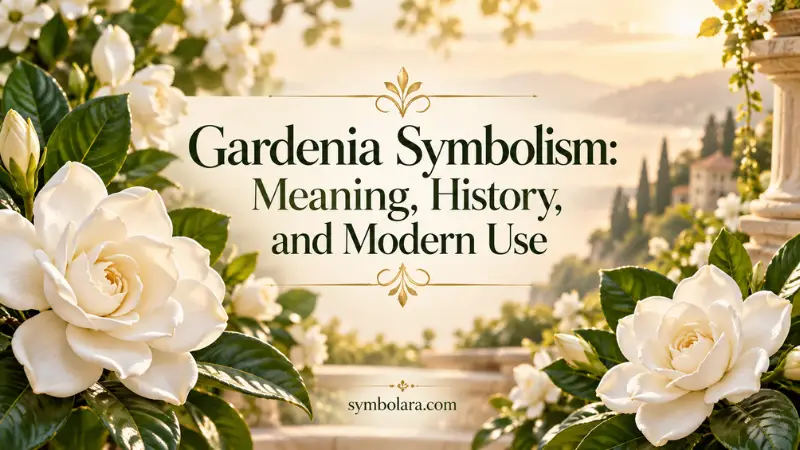
A gardenia is easy to recognize by its creamy white petals, glossy green leaves, and sweet fragrance. Its flowers can resemble small roses, but their smooth texture and distinctive scent give them a character of their own.
Gardenia symbolism often centers on love, purity, admiration, and sincerity. People also connect these flowers with personal memories, especially when their fragrance reminds them of a familiar garden or someone they care about.
In the United States, gardenias appear in wedding bouquets, Southern gardens, perfumes, artwork, and meaningful gifts. Their association with affection has also made them popular among people who prefer flowers that communicate feelings without elaborate messages.
However, the gardenia’s meaning did not develop in one place or follow a single tradition. Its history includes Asian horticulture, European flower language, and American cultural expression.
Quick Answer
Gardenia symbolism represents love, purity, sincerity, admiration, and quiet affection in modern American culture. These meanings developed through the flower’s white appearance, fragrant blossoms, and associations with romantic messages in European flower language during the 19th century.
TL;DR
- Love: Gardenias often express affection, admiration, and romantic interest.
- Purity: White petals suggest honesty, innocence, and sincere intentions.
- History: Gardenias were cultivated in Asia long before reaching Western gardens.
- Secret affection: Victorian-inspired flower language connects gardenias with unspoken feelings.
- American culture: Gardenias appear in Southern gardens, weddings, and classic fashion.
- Modern expression: People choose gardenias for tattoos, gifts, fragrances, and personal memories.
What Gardenia Flowers Look Like and Why Their Appearance Matters
Gardenias belong to the Gardenia genus, part of the coffee family, Rubiaceae. The garden gardenia, Gardenia jasminoides, is among the best-known species grown in the United States.
Its flowers usually have white or creamy petals arranged in either single or double forms. Single flowers often have a simple, star-like appearance, while double varieties resemble compact roses.
The plant also has several recognizable features:
- Glossy green leaves: Their smooth surfaces create a striking contrast with white blossoms.
- Soft, waxy petals: These give the flowers a polished and delicate appearance.
- Sweet fragrance: The scent can be noticeable several feet from a flowering shrub.
- Evergreen growth: Gardenias retain their foliage through the year in suitable climates.
- Seasonal flowering: Many varieties bloom in late spring or early summer, with some flowering again later.
These physical qualities help explain why people associate gardenias with elegance and care.
White flowers often suggest cleanliness and simplicity in American floral design. Against dark green foliage, gardenia blossoms create a particularly clear contrast.
Their fragrance also makes them memorable. Someone may forget the appearance of a garden but recognize its gardenias years later by their scent.
Still, these impressions are cultural associations, not fixed qualities of the plant. A gardenia does not naturally possess human emotions or intentions.
The Feelings Americans Most Often Associate With Gardenias
In modern American flower symbolism, gardenias commonly express affection that feels personal and sincere.
Their meanings are not limited to romantic relationships. People also use them to celebrate friendships, honor family members, or express appreciation.
Love and affection
Gardenias can communicate romantic interest without the familiar message of a red rose. Their pale petals and strong fragrance offer a softer visual approach to romance.
A gardenia given to a partner may suggest lasting affection, especially when the flower already carries a shared memory.
Purity and sincerity
The flower’s white appearance contributes to its association with honest intentions.
In this context, purity usually describes sincerity rather than moral superiority. Someone offering a gardenia might simply want to express genuine appreciation.
Admiration and respect
Gardenias suit occasions when the giver wants to recognize another person’s kindness, accomplishments, or character.
A flower arrangement sent after graduation, for example, may communicate admiration without necessarily suggesting romance.
Grace and elegance
The gardenia’s symmetrical petals and smooth appearance make it a familiar choice for formal floral designs.
This association is especially noticeable in wedding accessories, evening fashion, and classic portrait photography.
Quiet affection
Some people prefer the gardenia because it suggests feelings that do not need a public announcement.
A small floral gift may feel more personal than an elaborate arrangement, particularly when the recipient understands why that flower was chosen.
The meaning ultimately depends on the relationship, occasion, and intention behind the gesture.
From Asian Gardens to 18th-Century Botanical Records
The history of gardenias begins long before they became familiar in American gardens.
Gardenia jasminoides is native to parts of East and Southeast Asia, including regions of China, Japan, and neighboring countries.
People in China cultivated gardenias for more than a thousand years. Their fragrant flowers were appreciated in gardens, while other parts of the plant had practical uses.
Gardenias also appeared in Chinese decorative arts, reflecting their place in established horticultural traditions.
European interest grew during the 18th century, when botanists and plant collectors exchanged specimens from different regions.
The gardenia received its scientific name in connection with this period of botanical study.
In 1761, botanist John Ellis formally published the name Gardenia jasminoides. The genus honored Alexander Garden, a Scottish-born physician and naturalist who lived and worked in South Carolina.
Garden did not discover the flower or introduce it to Asia. Its name reflects the scientific networks of the 18th century rather than the plant’s geographic origin.
During the same period, gardenias attracted attention among European growers because of their unusual fragrance and ornamental appearance.
They eventually became associated with decorative gardens, formal flower arrangements, and fashionable personal accessories.
These developments helped prepare the way for the romantic meanings that became popular in European flower language.
How Victorian Flower Language Linked Gardenias to Affection
During the 19th century, flower dictionaries became fashionable in Britain and the United States.
These books assigned meanings to individual flowers, allowing people to imagine bouquets as messages.
This practice is commonly called floriography, or the language of flowers.
Gardenias became associated with admiration, beauty, and affection. Modern interpretations influenced by Victorian flower language frequently connect them with secret love.
The idea is straightforward: a person may admire someone but feel unable or unwilling to express that affection openly.
A gardenia can therefore represent an emotion held privately.
The flower’s appearance supports this interpretation. Its pale petals suggest restraint, while its noticeable fragrance gives it a romantic character.
However, Victorian flower language was never a completely standardized system.
Different books assigned different meanings to the same flowers. There is no reliable basis for assuming that every Victorian understood a gardenia as a specific romantic message.
Today’s familiar interpretation of secret love is best understood as part of the broader flower-language tradition rather than a universal historical rule.
For modern Americans, that tradition offers an appealing way to personalize gifts.
Someone might give a gardenia to express admiration without making a dramatic romantic declaration. Another person might choose it simply because the recipient loves fragrant white flowers.
Both uses are reasonable because flower meanings depend on shared understanding.
Why Gardenias Became a Familiar Flower in the American South
Gardenias have a strong connection with the American South, where warm summers and suitable growing conditions allow many varieties to flourish.
In states such as Georgia, South Carolina, Louisiana, and Florida, these shrubs appear near porches, walkways, entrances, and garden seating areas.
Gardenias have been grown in South Carolina since the 18th century. Over time, they became recognizable features of Southern ornamental gardens.
Their fragrance plays an important role in that familiarity.
A gardenia planted beside a porch may scent the surrounding air during warm evenings. For someone who grew up near these flowers, the smell can become connected with childhood, family gatherings, or visits to relatives.
This helps explain their association with:
- Family traditions and familiar places
- Hospitality and welcoming homes
- Summer evenings and outdoor gatherings
- Personal memories of parents or grandparents
In Southern-inspired decorating, gardenias can also suggest classic elegance.
A white gardenia arrangement on a wooden dining table, for example, creates a different impression from a brightly colored tropical bouquet.
Still, gardenias are not native to the American South. Their regional importance developed through cultivation, gardening traditions, and personal experience.
What Gardenias Communicate at Weddings and Family Events
Gardenias are popular in formal floral arrangements because their white blossoms work well with many traditional color schemes.
At weddings, they commonly suggest sincerity, commitment, and affectionate intentions.
A bride may choose gardenias for a bouquet because their appearance complements a white dress. Another couple may select them because the scent reminds them of a family garden.
These personal reasons can matter more than traditional flower meanings.
Gardenias also appear in corsages, hair accessories, and small arrangements placed near wedding entrances.
Their fragrance adds another element to the occasion, although it may be too strong for people sensitive to floral scents.
Outside weddings, gardenias can express appreciation during meaningful family events.
For Mother’s Day, a blooming gardenia plant may communicate affection and gratitude. Unlike a cut arrangement, the plant can remain part of someone’s home or garden for years when properly maintained.
At anniversaries, gardenias may represent a relationship built on shared experiences.
They can also appear at memorial gatherings. In that setting, the flower may honor someone’s personal preferences or recall a familiar scent.
No single interpretation applies to every event. The meaning comes from the people involved and the memories they associate with the flower.
Billie Holiday’s White Gardenia and Its Place in American Style
One of the most recognizable gardenia associations in American popular culture comes from jazz singer Billie Holiday.
Holiday frequently wore white gardenias in her hair during performances and publicity photographs.
The flower became an important part of her visual identity.
Against her dark hair, its white petals created a striking contrast that audiences could recognize immediately.
Her use of gardenias also showed how a natural flower could become a signature fashion accessory.
Rather than representing only traditional femininity or romance, the flower became connected with an individual artist’s presence, style, and public image.
Holiday’s performances combined musical skill, emotional expression, and a distinctive appearance. Her gardenia became one of the visual details people remembered.
Today, artists and photographers sometimes use white flowers in hairstyles inspired by classic jazz-era fashion.
However, it would be inaccurate to claim that Holiday wore gardenias to communicate one fixed flower-language message.
Her personal reasons cannot be reduced to a single symbolic meaning.
Her influence illustrates something important: a flower can acquire new associations when a recognizable person makes it part of their identity.
What the Tiare Flower Means in French Polynesia
Not all gardenia traditions concern the same species.
The tiare Tahiti, Gardenia taitensis, holds a special place in French Polynesian culture.
This fragrant white flower belongs to the gardenia genus but differs from the common garden gardenia grown across much of the United States.
In French Polynesia, tiare flowers are associated with hospitality, beauty, affection, and local identity.
People wear them in their hair or use them in floral decorations and welcoming arrangements.
A commonly described custom involves placing a flower behind one ear to indicate relationship status. According to the familiar convention, the right ear suggests someone is available, while the left indicates a relationship.
This custom should not be treated as an unchanging rule followed by every individual.
Tiare flowers also have an important practical use in the production of monoï, a fragrant oil traditionally made by soaking flowers in coconut oil.
These uses show that the tiare is more than an ornamental plant. It participates in cultural practices involving personal care, hospitality, and everyday expression.
American interpretations should not automatically replace these local meanings.
Although the gardenia and tiare share botanical connections, their cultural histories are not identical.
How Gardenias Are Used in China and Japan
Gardenias have a long history in parts of East Asia, especially in China and Japan.
Their significance includes ornamental beauty, practical applications, and established gardening traditions.
In China, Gardenia jasminoides is known as zhizi.
The plant has been cultivated for centuries, and its flowers have appeared in decorative arts.
Its fruit also has a history of use as a natural coloring material and in traditional Chinese medicine.
These practical uses are important because they show that gardenias have not always been valued primarily for romantic meanings.
In Japan, gardenias are known as kuchinashi.
Their flowers are appreciated as seasonal ornamental blooms. The fruit has also been used to produce yellow coloring for certain foods.
For example, gardenia-derived coloring may be used in kuri kinton, a sweet chestnut and sweet potato dish associated with Japanese New Year celebrations.
The plant’s presence in food traditions gives it a cultural role quite different from a Western wedding bouquet.
Some modern flower-meaning lists assign Japanese gardenias messages involving happiness or affection. However, those interpretations should not be presented as universal beliefs.
The main distinction is that East Asian gardenia traditions include botanical, culinary, artistic, and medicinal histories that extend beyond romantic symbolism.
Why Gardenia Fragrance Can Bring Back Personal Memories
A gardenia’s fragrance often contributes as much to its personal meaning as its appearance.
Smell has close connections with systems involved in emotion and memory.
Because of these connections, familiar scents can bring past experiences to mind unexpectedly.
Someone who remembers gardenias growing outside a childhood home may associate their fragrance with family and comfort.
Another person may remember receiving a gardenia corsage before a school dance.
Even years later, encountering that scent in a perfume or garden can recall details of the original experience.
However, gardenias do not produce the same emotional response in everyone.
One person may find the fragrance calming, while another may consider it overwhelming.
Associations also depend on experience.
If someone received gardenias during a difficult period, the flowers might bring sadness rather than happiness.
This explains why personal symbolism can differ from published flower meanings.
A traditional description might connect gardenias with love or innocence, but an individual could associate them with a particular relative, home, or event.
Neither interpretation cancels the other.
Personal experience simply adds another layer to the flower’s cultural meaning.
Gardenias in Tattoos, Gifts, and Home Design
Gardenias continue to appear in American decorative and personal expression.
Their recognizable petals make them suitable for floral illustrations, jewelry designs, tattoos, and printed fabrics.
Unlike flowers associated with one widely recognized holiday, gardenias can work across several occasions.
Gardenia tattoos
A gardenia tattoo may represent sincere affection, family memories, or admiration for someone important.
Some people choose a single blossom for a simple design. Others incorporate leaves, names, or dates to make the image more personal.
The flower does not have a standardized tattoo meaning.
A tattoo honoring a grandmother who grew gardenias may carry a completely different message from one inspired by Billie Holiday.
Gardenia-inspired jewelry
Floral earrings, pendants, and brooches can suggest classic style and understated elegance.
White floral designs are especially compatible with formal clothing, although colored interpretations are also possible.
Home decoration
Gardenias appear in floral prints, decorative ceramics, scented candles, and room fragrances.
In these settings, the flower may communicate freshness, comfort, or a preference for traditional floral design.
A real gardenia plant requires more care than a decorative object. It generally prefers acidic soil, consistent moisture, and appropriate light conditions.
Gifts and personal messages
When choosing gardenias as gifts, the occasion can change their interpretation.
| Context | Meaning in USA | Common Associations | Notes |
| Anniversary flowers | Appreciation for a shared relationship | Loyalty, tenderness, affection | A handwritten message makes the intention clearer. |
| School dance corsage | Recognition of a special occasion | Youthful romance, celebration, elegance | Fragrance strength matters when worn close to the face. |
| Housewarming plant | Good wishes for a new home | Hospitality, care, comfort | A living plant may become part of a family tradition. |
| Sympathy arrangement | Personal remembrance and support | Respect, affection, memory | Especially meaningful if the recipient loved gardenias. |
| Gardenia tattoo | A lasting personal reminder | Family connections, identity, devotion | Names, dates, and other design elements shape the meaning. |
In 2025–2026, gardenias remain useful in both traditional and contemporary styles.
Minimalist tattoos may focus on their petal shapes, while realistic designs emphasize texture and shading.
Floral fragrances and decorative products also keep gardenias familiar to people who may never grow the plant themselves.
The choice often comes down to personal taste rather than a strict cultural message.
How Gardenia Meanings Have Changed—and What People Get Wrong
Gardenias did not develop a single permanent meaning.
Their associations changed as the flowers moved between cultural settings.
In parts of Asia, gardenias were valued through longstanding cultivation, decorative arts, and practical uses.
European interest during the 18th century emphasized their ornamental appeal and botanical importance.
Later, 19th-century flower language encouraged people to interpret gardenias as messages of affection and admiration.
American gardening traditions added regional associations, particularly in the South.
During the 20th century, figures such as Billie Holiday helped connect the flower with recognizable personal style.
Today, gardenias appear in individual expressions ranging from tattoos to memorial arrangements.
These changes have also produced misunderstandings.
A gardenia does not always mean secret love. That is one interpretation, not a guaranteed message.
White petals do not make the flower religious by definition. Some people assign spiritual meanings to white flowers, but gardenias have no single religious interpretation.
A fading gardenia is not a bad omen. Cut blossoms naturally age, sometimes turning cream, yellow, or brown.
Gardenias are not originally Southern American flowers. Their popularity in Southern gardens developed after introduction and cultivation.
Another misconception involves treating all gardenia species as culturally interchangeable.
The tiare Tahiti has traditions connected with French Polynesia that should not be confused with every use of Gardenia jasminoides.
These distinctions matter because symbolism works best when it respects both documented history and personal experience.
FAQs
A single gardenia may express admiration, affection, or romantic interest. In modern flower-language interpretations, it can also suggest feelings that someone has not expressed openly, but the giver’s actual intention matters most.
No. Gardenias belong to the Rubiaceae family, while true jasmine belongs to the Oleaceae family. Gardenias are sometimes called Cape jasmine or Cape jessamine because their flowers share a sweet fragrance with jasmine.
Gardenias generally have positive associations in American floral traditions. However, the meaning may become more personal or bittersweet when someone connects the flower with loss, separation, or an important memory.
Gardenias do not have one established meaning that applies across Christian traditions. Some individuals may interpret their white flowers as reminders of innocence, peace, or sincerity, but these are personal or cultural associations rather than a specific biblical definition.
Gardenia blossoms naturally change color as they age. Heat, handling, moisture, and other growing or storage conditions can also affect their petals, so discoloration should not be interpreted as a symbolic warning.
Conclusion
Gardenia symbolism combines several familiar meanings, including love, sincerity, admiration, purity, and personal remembrance. These associations developed through different traditions, from Asian cultivation and European flower language to American gardening and artistic expression.
In modern American life, gardenias remain meaningful because people connect them with real experiences. A flower worn at a wedding, grown beside a family porch, or remembered from a loved one’s garden can carry a message that no flower dictionary could fully describe.
Their lasting appeal comes from this combination of recognizable beauty, memorable fragrance, and the individual stories people attach to them.