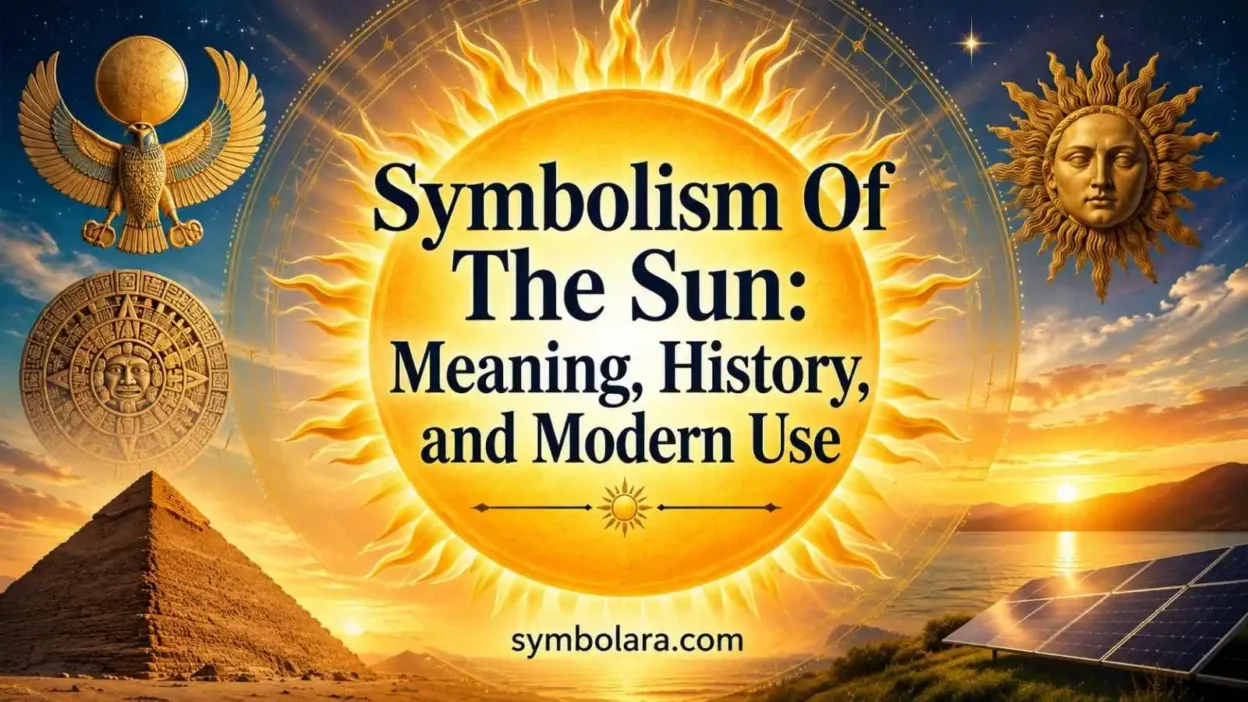
The Symbolism Of The Sun starts with a simple human experience: sunlight makes the world visible, warms the body, marks the day, and helps life grow. Because of that, people have long used the sun as a symbol of life, hope, truth, renewal, strength, and clarity.
In the United States today, the sun appears everywhere from state flags and tattoos to wellness branding, home decor, summer imagery, and social media captions. It often communicates optimism, confidence, vitality, and a fresh start.
The sun can also carry more serious meanings. It may represent authority, judgment, exposure, heat, drought, ego, or cultural identity, depending on where it appears and who is using it.
Quick Answer
The symbolism of the sun commonly represents life, hope, energy, clarity, and renewal in modern American culture. Historically, it has also been associated with divine authority, sacred kingship, wisdom, justice, seasonal cycles, and the daily return of light after darkness.
TL;DR
- The sun most often symbolizes life, hope, and renewal.
- Ancient cultures linked it with gods, rulers, and justice.
- Americans use it for optimism, wellness, summer, and identity.
- Sun tattoos often mean strength, growth, or rebirth.
- Some sun-like symbols require cultural or political context.
- The meaning changes with design, color, and setting.
What the Sun Looks Like as a Symbol
A sun symbol is usually shown as a circle with rays extending outward. The rays may be straight, wavy, triangular, flame-like, or arranged in a repeating pattern. Sometimes the sun has a face, especially in folk art, children’s illustration, vintage design, and celestial decor.
In modern American design, the sun often appears in yellow, gold, orange, red, or white. A sunrise usually suggests beginnings. A midday sun may suggest power, visibility, or confidence. A sunset often suggests closure, peace, memory, romance, or reflection.
People encounter sun imagery on flags, murals, jewelry, yoga studio logos, weather icons, greeting cards, summer products, tattoos, beachwear, garden decor, children’s books, and digital stickers. It is one of the easiest symbols to recognize because it is tied to an experience shared by nearly everyone.
What the Sun Commonly Means in the United States
In the United States, the sun most often carries a positive meaning. It suggests optimism, forward movement, good health, confidence, and emotional warmth. A “sunny” personality is cheerful. A “new day” suggests another chance. A “bright future” means hope.
American culture also connects the sun with summer freedom. It appears in images of beaches, road trips, camping, school vacations, baseball games, cookouts, and outdoor festivals. In advertising, sunlight often implies freshness, openness, cleanliness, and ease.
That does not mean the symbol is always lighthearted. In public life, the sun can stand for regional identity, especially in Southwestern states where desert light, open sky, and Indigenous visual traditions influence art and design. In personal settings, the sun can mark survival, healing, independence, or the decision to keep going after a hard season.
Why the Sun Became a Symbol of Life
The sun became a symbol of life because people could see its effects long before they understood astronomy. Crops depended on warmth and daylight. Animals moved by daily and seasonal patterns. Human work, travel, ritual, and rest were shaped by sunrise and sunset.
Even today, the scientific reality supports the symbolic meaning. Life on Earth depends on the sun’s light and energy. That physical dependence explains why so many cultures connected the sun with nourishment, fertility, protection, and growth.
This is also why the sun differs from many abstract symbols. Its meaning is not only invented by culture. It is rooted in daily life. When people call the sun a sign of life, they are responding to a real relationship between sunlight and the living world.
Ancient Roots and Early Solar Meaning
In ancient societies, the sun often became a symbol of divine order because it rose, crossed the sky, set, and returned with dependable rhythm. That regular movement made it useful for calendars, agriculture, ceremony, and political authority.
Some ancient cultures developed solar deities or solar religious systems. In Egypt, the sun was linked with creation, kingship, and the daily journey of divine power across the sky. In parts of Mesopotamia, India, Greece, Rome, and Mesoamerica, solar figures were connected with law, vision, protection, rulership, or cosmic order.
It is important not to overstate this. Not every culture worshiped the sun, and not every sun symbol meant the same thing. Still, across many traditions, sunlight became a natural image for what sees, reveals, warms, judges, and sustains.
The Sun as Wisdom, Truth, and Visibility
The connection between sunlight and truth is easy to understand. Light reveals what darkness hides. That is why the sun often symbolizes knowledge, honesty, exposure, and moral clarity.
In everyday American speech, people still use light-based language for understanding. A person “sees the light.” A difficult issue is “brought to light.” A clear explanation “sheds light” on a problem. These phrases are not always about the literal sun, but they draw from the same symbolic pattern.
The sun can also suggest accountability. Under bright light, things are visible. In that sense, the sun may represent truth, public attention, justice, or the end of secrecy. This meaning appears in journalism, politics, law, and reform language when “sunshine” is used as a metaphor for transparency.
The Sun in Indigenous and Southwestern American Contexts
In the American Southwest, sun imagery has special cultural weight. Many Indigenous communities have long observed the sky, seasons, light, and landscape in ways connected to ceremony, architecture, agriculture, and community memory.
One well-known example is the Sun Dagger at Chaco Canyon, where sunlight and shadow once interacted with spiral petroglyphs around solstices and equinoxes. This kind of site shows that the sun was not only a decoration. It helped mark time, seasonal change, and relationships between people, place, and sky.
Readers should be careful with broad phrases like “Native American sun symbol.” Indigenous nations are not interchangeable, and their symbols do not all share one meaning. A sun design connected to one Pueblo, tribe, or region should not be treated as a generic spiritual graphic.
The Zia Sun and Respectful Cultural Use
The Zia sun symbol is one of the most recognized sun designs in the United States because it appears on the New Mexico state flag. Its form includes a central circle with four groups of rays extending in four directions.
For many New Mexicans, the design represents home, place, landscape, and state pride. For the Zia Pueblo, it also carries specific cultural meaning that should not be reduced to a general Southwestern logo.
This is where respect matters. A sun symbol may look simple to an outsider, but it can hold community history and identity. Using culturally specific sun imagery without understanding or permission can turn a living symbol into decoration. The safer approach is to learn where the symbol comes from, who created it, and whether it is appropriate to use in art, business, tattoos, or merchandise.
Religious and Spiritual Meanings of the Sun
The sun appears in many religious and spiritual settings, but its role varies widely. The sun appears in many religious and spiritual settings, but its role varies widely. Some ancient traditions personified the sun as a deity, while others treated it as a sign of divine presence, moral illumination, resurrection, protection, or sacred order.
Christianity does not worship the sun, though light often serves as a symbol of God, truth, holiness, and salvation. Modern spiritual communities may connect the sun with masculine energy, outward action, confidence, awakening, or the conscious self. Astrology commonly treats the sun sign as a marker of identity, personality, and life direction.
These meanings should be handled carefully. The sun does not have one universal religious message. Its interpretation depends on the tradition, the image, and the community using it.
These meanings should be handled carefully. The sun does not have one universal religious message. Its interpretation depends on the tradition, the image, and the community using it.
Emotional and Psychological Meaning
Emotionally, the sun often communicates warmth, safety, motivation, and emotional recovery. People associate sunlight with open space, outdoor activity, social connection, and the sense that life is moving again.
This is especially noticeable in seasonal language. After winter, the return of longer days can feel like relief. Spring sunlight often symbolizes renewal because it arrives with visible changes: flowers, green leaves, warmer air, and more time outside.
At the same time, the sun can represent pressure. Too much sun can mean heat, exhaustion, drought, exposure, or danger. That dual meaning keeps the symbol honest. The same force that gives life can also overwhelm.
Sun Tattoos, Jewelry, and Personal Style
Sun tattoos are popular because they can be simple, flexible, and personal. A small sun may represent optimism or a reminder to stay hopeful. A sunrise tattoo may mean a new beginning after grief, recovery, divorce, illness, or personal change. A sun and moon design often represents balance between action and rest, logic and intuition, or two different personalities.
In jewelry, the sun often suggests confidence, radiance, and protection. Gold sun pendants, celestial earrings, and sunburst rings are common because the shape feels bright without needing much explanation.
Style also changes the meaning. A minimalist line-art sun feels calm and modern. A bold sunburst can feel dramatic or royal. A smiling sun feels playful. A dark, sharp, or heavily geometric sun may feel intense, ancient, or political depending on the design.
The Sun in Home Decor, Fashion, and Digital Culture
In home decor, sun imagery often creates a warm and welcoming mood. Sunburst mirrors, gold wall art, desert prints, and sunrise color palettes are common in bohemian, Southwestern, coastal, and mid-century-inspired interiors.
Fashion uses the sun to suggest summer, freedom, travel, and confidence. A sun print on a dress or shirt usually feels casual and cheerful. On festival clothing or celestial-themed accessories, it may lean more spiritual or cosmic.
In digital culture, the sun appears in emojis, mood boards, profile art, and captions. It can mean “good morning,” “vacation,” “healing era,” “main character energy,” or simply a bright mood. Online use is often casual, but the emotional message remains familiar: light has returned.
Quick Comparison of Sun Meanings
| Context | Meaning in the USA | Common Associations | Notes |
| Tattoo | Renewal, strength, survival | Sunrise, growth, confidence | Meaning depends on style and placement |
| Home Decor | Warmth and welcome | Gold, desert, summer, openness | Often used for mood more than religion |
| Religion | Light, truth, divine order | Holiness, awakening, creation | Meaning varies by tradition |
| State or Regional Identity | Place and belonging | Southwest, New Mexico, desert light | Some designs require cultural respect |
| Social Media | Optimism and energy | Morning, vacation, wellness | Usually informal and emotional |
| Misuse Contexts | Extremism or appropriation | Black Sun, copied sacred designs | Context and design matter greatly |
Positive and Negative Meanings
The sun is usually positive, but not always. Its positive meanings include life, hope, vitality, courage, truth, growth, and renewal. These meanings appear in personal art, public murals, greeting cards, wellness branding, and seasonal celebrations.
The negative meanings come from intensity. The sun can symbolize harsh judgment, overexposure, ego, burnout, drought, or danger. In literature and film, a blazing sun can make a scene feel unforgiving rather than comforting.
This contrast is one reason the sun works so well as a symbol. It can be gentle at sunrise, triumphant at noon, melancholy at sunset, and threatening in a desert or heat wave. The meaning changes with the scene.
Common Misunderstandings and Misuse
One common misunderstanding is that all sun symbols mean the same thing. They do not. A children’s book sun, a Pueblo symbol, an ancient Egyptian solar disk, a tattoo sunrise, and a political extremist emblem should not be interpreted as one shared sign.
Another issue is cultural appropriation. Some sun designs belong to specific communities and should not be copied casually. A symbol may appear widely in public life while still carrying a deeper meaning for the people who created it.
A separate misuse involves the Black Sun or Sonnenrad, a Nazi-derived symbol used by many white supremacists and neo-Nazi groups. This does not make ordinary sun symbols hateful. It does mean that certain radial black designs, especially those resembling the Sonnenrad, should be recognized as politically loaded and harmful in many modern contexts.
How Sun Meaning Has Changed Over Time
The sun’s meaning has shifted from survival and sacred order to a wide range of modern personal and cultural uses. Ancient people often connected it with gods, kings, calendars, agriculture, and cosmic stability. Modern Americans are more likely to connect it with optimism, identity, wellness, vacation, creativity, and emotional recovery.
Science also changed the way people understand the sun. It is now known as a star, not a deity moving across a heavenly ocean. Yet the old meanings did not disappear. The sun still feels like life, clarity, and renewal because the daily experience of sunlight has not changed.
Modern design has made the sun more personal. Instead of belonging only to temples, rulers, or calendars, it now appears on skin, clothing, walls, phone screens, logos, and keepsakes. The symbol has moved from public cosmic order into everyday self-expression.
How to Interpret a Sun Symbol in Context
To understand a sun symbol, look first at the setting. A sun on a wellness brand likely means energy or clarity. A sunrise tattoo may mean healing or a new chapter. A sun on a state flag may refer to regional identity. A black radial design in extremist spaces may mean something very different.
Next, look at style. Soft rays feel gentle. Sharp rays feel intense. A face makes the sun personal or playful. A circle without rays may lean toward a solar disk, halo, or abstract design. Color matters too: gold suggests warmth and value, orange suggests vitality, red can suggest heat or danger, and black may require closer attention.
Finally, consider who is using it. Symbols are not only shapes. They carry the intentions of artists, communities, wearers, institutions, and movements. The same basic image can mean hope in one context and harm in another.
FAQs
The sun most often symbolizes life, hope, renewal, energy, clarity, and warmth. In modern American culture, it is usually read as positive unless the design or context suggests heat, danger, ego, or extremist misuse.
A sun tattoo often means strength, survival, personal growth, optimism, or a new beginning. A sunrise design may point to recovery, while a sun and moon tattoo often suggests balance between two sides of life.
The sun can be religious, but it is not always religious. Some ancient cultures treated the sun as divine, while many modern uses are decorative, emotional, seasonal, or personal.
In American culture, the sun often represents optimism, summer, freedom, wellness, openness, and fresh starts. It also appears in regional identity, especially in Southwestern imagery and New Mexico’s state symbolism.
Yes. The sun can symbolize harshness, exposure, drought, pride, judgment, or burnout. In some contexts, it can also be connected to harmful political imagery, especially in the case of the Black Sun or Sonnenrad.
Sunrise usually means beginnings, recovery, hope, and a new chance. Sunset often means closure, reflection, peace, romance, memory, or the end of a chapter.
No. Many simple sun symbols are harmless, but culturally specific designs and extremist-associated symbols require caution. Before using a sun design for a tattoo, logo, or product, check whether it belongs to a particular community or carries a harmful modern association.
Conclusion
The sun remains one of the clearest symbols because its meaning comes from lived experience. It gives light, marks time, warms the earth, and returns after darkness. That is why people continue to connect it with hope, life, truth, renewal, and strength.
The symbolism of the sun is not limited to one culture or one era. In the United States, it can express optimism, summer, healing, identity, design style, spiritual language, or regional pride. In older traditions, it often carried meanings of divine order, authority, wisdom, and seasonal rhythm.
The best way to read any sun symbol is to look at its context. A sunrise on someone’s wrist, a sunburst mirror in a living room, a sacred community symbol, and a harmful extremist emblem do not say the same thing. The shape may be familiar, but the meaning comes from use, history, and intention.