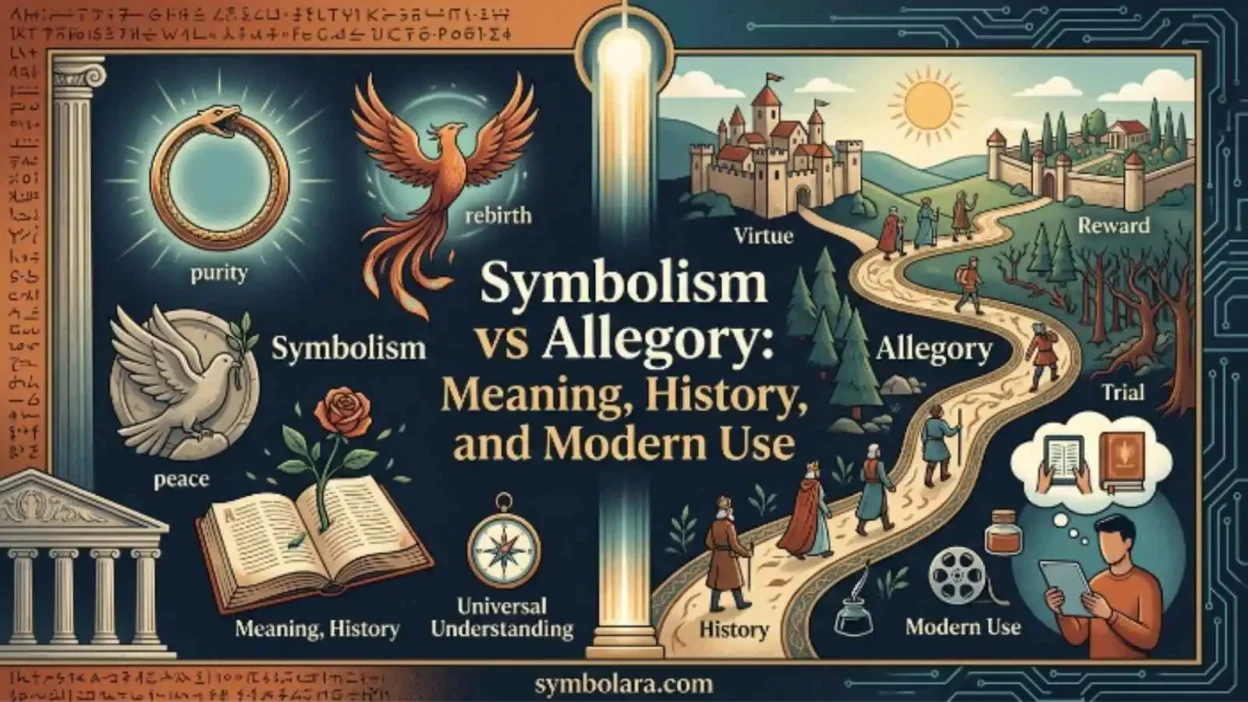
People often use symbolism and allegory interchangeably, but they are not the same thing. Understanding the difference between Symbolism Vs Allegory helps explain how stories, art, films, and even political cartoons communicate ideas beneath the surface.
In American culture, both devices appear everywhere — from novels taught in high school classrooms to superhero movies, advertising campaigns, tattoos, and social media imagery. Yet they work in different ways. One tends to suggest meaning indirectly, while the other builds an entire narrative around a hidden message.
The distinction matters because symbolism and allegory shape how people interpret stories, identity, morality, politics, religion, and culture. Knowing the difference changes how readers understand everything from classic literature to modern entertainment.
Quick Answer
Symbolism commonly refers to using an object, image, color, character, or action to represent a broader idea, emotion, or concept. Allegory goes further by turning an entire story, character system, or narrative structure into a sustained symbolic message, often about morality, politics, religion, or society.
TL;DR
- Symbolism suggests meaning through individual symbols.
- Allegory builds a complete symbolic narrative.
- Symbols can have multiple interpretations.
- Allegories usually carry a clearer message.
- American culture uses both heavily in media.
- Modern audiences often prefer subtle symbolism.
What Symbolism Means
Symbolism happens when something visible represents something beyond its literal meaning. A red rose may symbolize romance. A broken clock may symbolize mortality or lost time. A storm may symbolize emotional conflict.
The symbol itself remains part of the literal story, but it also points toward a larger idea.
In American storytelling, symbolism often appears in films, novels, music videos, and advertising because it allows creators to communicate emotion without explaining everything directly. Viewers interpret the meaning themselves, which makes symbolism feel personal and layered.
A national flag is another familiar example. It is physically a piece of fabric, but culturally it can symbolize patriotism, sacrifice, political identity, or national unity depending on the context.
Symbols rarely have only one fixed meaning. Their interpretation changes with culture, generation, religion, and personal experience.
What Allegory Means
Allegory is more structured and intentional than symbolism. Instead of one object carrying symbolic meaning, the entire narrative operates as a coded representation of another idea.
In an allegory, characters, settings, and events often correspond to political systems, moral struggles, religious teachings, or social criticism.
A classic American classroom example is George Orwell’s Animal Farm. The story works literally as a tale about farm animals, but it also functions as a political allegory about authoritarianism and the Soviet Union.
Allegory usually guides readers toward a more specific interpretation than symbolism does. The message is often deliberate rather than open-ended.
Religious parables, medieval morality plays, and political satire frequently rely on allegorical structure.
The Core Difference Between Symbolism and Allegory
The simplest distinction is scale.
Symbolism works at the level of individual details. Allegory works at the level of the entire story.
A symbol may appear briefly within a narrative and carry emotional or thematic meaning. An allegory organizes the whole narrative around symbolic correspondence.
For example, a bird trapped in a cage may symbolize emotional confinement in a novel. That is symbolism.
But if every major character, setting, and event consistently represents another political or moral reality, the work becomes allegorical.
Another major difference involves interpretation. Symbolism often invites multiple meanings. Allegory usually directs audiences toward a clearer message or argument.
| Element | Symbolism | Allegory |
| Scope | Individual symbols | Entire narrative structure |
| Meaning Style | Suggestive and flexible | Structured and intentional |
| Interpretation | Often open-ended | Usually more specific |
| Common Use | Poetry, film, imagery | Political and moral storytelling |
| Emotional Effect | Atmospheric and personal | Intellectual and thematic |
Symbolism vs Allegory: A Simple Example to Understand the Difference
A simple example can make the difference between symbolism and allegory easier to understand.
Imagine a story where a character carries a broken mirror. The mirror may symbolize a damaged identity, regret, or a lost sense of self. The object has a deeper meaning, but the story itself is not built entirely around that idea. This is symbolism.
Now imagine a whole story where every character, event, and location represents a different part of human society. The broken mirror represents a country’s damaged values, the characters represent social groups, and the entire plot explains a larger message about society. This becomes allegory.
The main difference is that symbolism adds layers of meaning inside a story, while allegory creates a story that represents something else.
Understanding this difference helps readers avoid confusion. Not every meaningful object creates an allegory, and not every allegory depends on only one symbol.
Why Americans Often Prefer Symbolism
Modern American audiences generally respond more positively to symbolism than overt allegory. One reason is cultural preference for ambiguity and personal interpretation.
Contemporary films and television series often avoid obvious moral instruction. Instead, creators use symbols that allow viewers to debate meaning online and develop fan theories.
A superhero’s mask might symbolize hidden identity, trauma, or social alienation without the movie explicitly stating it. Audiences enjoy uncovering meaning themselves.
Allegory, by contrast, can feel heavy-handed if the message becomes too obvious. Many modern critics use phrases like “on-the-nose” when a story pushes its moral lesson too aggressively.
That does not mean allegory disappeared. Political films, dystopian fiction, and social satire still rely heavily on allegorical storytelling, especially during periods of political tension in the United States.
Ancient Roots of Symbolic Thinking
Symbolism is older than written literature itself. Ancient humans used symbols in cave paintings, burial rituals, tribal markings, and religious imagery long before formal storytelling traditions developed.
Early civilizations associated animals, celestial bodies, colors, and natural forces with spiritual or social meaning. Eagles symbolized authority. Snakes symbolized danger, healing, or transformation depending on the culture.
In ancient Greece, myths used symbolic imagery to explore human fears and moral conflict. Egyptian culture relied heavily on symbolic animals and sacred objects tied to divine power.
Humans naturally think symbolically because symbols compress complex ideas into recognizable images.
Modern Americans continue this habit in everyday life through logos, emojis, wedding rings, uniforms, and national icons.
How Allegory Developed Historically
Allegory became especially influential in religious and political writing.
In medieval Europe, Christian writers used allegorical stories to teach moral lessons to largely illiterate populations. Characters often represented virtues, sins, temptations, or spiritual struggles.
During the Renaissance and Enlightenment, allegory expanded into political criticism. Writers used fictional narratives to comment on governments and social systems without directly attacking authorities.
American literature inherited many of these traditions. Nathaniel Hawthorne, Arthur Miller, and other American writers used allegorical elements to examine guilt, conformity, religion, and power.
In the twentieth century, dystopian fiction transformed allegory into a tool for discussing surveillance, propaganda, racism, and authoritarianism.
Symbolism in American Literature and Film
American storytelling often blends realism with symbolic imagery.
In The Great Gatsby, the green light symbolizes desire, ambition, and the illusion of the American Dream. The object itself remains simple, but its meaning expands throughout the novel.
Horror films frequently use symbolic monsters. Zombies may symbolize consumerism, social collapse, or fear of infection. Vampires can symbolize seduction, class anxiety, or forbidden desire.
Color symbolism also plays a major role in American media:
- Red often signals passion, danger, or rebellion.
- White may symbolize innocence or emptiness.
- Black can symbolize elegance, death, secrecy, or authority.
- Blue frequently represents calmness or emotional distance.
Modern audiences often analyze these symbols instinctively, even without formal literary training.
Symbolism vs Allegory in Movies and Popular Culture
Movies and television use both symbolism and allegory to communicate ideas beyond the surface story.
Symbolism appears through visual details. A dark room may represent fear or uncertainty. A repeated color may represent a character’s emotional state. A specific object, such as a photograph or piece of clothing, may represent memory, identity, or loss.
Allegory works on a larger scale. A fictional world may represent real social problems, political conflicts, or cultural debates. The entire storyline becomes a comparison between the imagined world and a real-world issue.
For example, a science fiction movie about a controlled society may symbolize concerns about technology, freedom, or government power. If every part of that fictional society connects to a real political or social system, the story becomes allegorical.
Modern audiences often discuss these meanings online because films allow viewers to analyze hidden messages and different interpretations.
Political Allegory in the United States
Allegory has long been used in American political commentary because it allows criticism through fiction.
Science fiction and dystopian stories frequently operate this way. Fictional governments or imagined futures become stand-ins for real political fears.
Comic books have historically used allegorical themes involving discrimination, immigration, war, and civil rights. Superheroes often symbolize larger social anxieties about identity, power, or national responsibility.
Political cartoons also function as miniature allegories. Characters and visual exaggerations represent entire ideologies or public figures.
During periods of social unrest, allegorical storytelling tends to increase because indirect criticism can feel safer, smarter, or more emotionally effective than direct argument.
Religious Meaning and Moral Teaching
Many religious traditions use both symbolism and allegory, though in different ways.
Religious symbolism appears in objects and imagery:
- Crosses symbolize sacrifice and faith.
- Light symbolizes truth or divine presence.
- Water symbolizes purification or rebirth.
Allegory appears more commonly in narrative teaching. Biblical parables, for example, often use fictional scenarios to communicate ethical or spiritual lessons.
American religious culture continues to rely heavily on symbolic imagery in churches, memorials, holiday traditions, and ceremonial rituals.
At the same time, modern audiences sometimes resist overly moralistic allegory, especially when it feels preachy or politically manipulative.
Emotional and Psychological Differences
Symbolism tends to work emotionally first. Allegory tends to work intellectually first.
A symbolic image can trigger emotion instantly because the brain associates visual elements with memory and feeling. Rain during a funeral scene feels emotionally meaningful even without explanation.
Allegory usually requires interpretation across a larger narrative pattern. Readers gradually recognize that the story represents another system beneath the surface.
Psychologically, symbolism feels intimate because audiences bring their own experiences into interpretation. Allegory feels more guided because the creator shapes the meaning more directly.
This difference explains why symbolism dominates advertising and visual branding. Emotional association works quickly and subconsciously.
Symbolism and Allegory in Social Media Culture
Digital culture changed how symbolism spreads.
Online communities constantly create symbols through memes, emojis, aesthetics, and visual shorthand. A single image can symbolize political identity, generational humor, or emotional mood within hours.
Minimalist symbols are especially effective online because they communicate quickly across platforms.
Allegory exists online too, but usually through longer forms like dystopian television series, video essays, or political satire.
Internet audiences often decode symbolism collectively. Fans analyze hidden imagery in music videos, movies, and celebrity branding frame by frame.
This participatory interpretation culture strengthened interest in symbolic storytelling among younger Americans.
Tattoos, Fashion, and Personal Identity
Symbolism plays a huge role in personal style and identity expression.
People choose symbolic tattoos because images communicate values or experiences without lengthy explanation. A phoenix may symbolize survival after hardship. A compass may symbolize direction or independence.
Fashion brands also rely heavily on symbolic association. Certain colors, logos, or visual styles communicate rebellion, luxury, patriotism, spirituality, or counterculture identity.
Allegory appears less frequently in personal style because it requires narrative structure. Symbolism works better for quick visual communication.
In the United States, symbolic self-expression is closely tied to individuality and personal storytelling.
Common Misunderstandings About Symbolism and Allegory
One common misunderstanding is assuming every symbol has a single universal meaning.
In reality, meaning changes across cultures and historical periods. Owls symbolize wisdom in much of American culture, but other traditions associate them with death or bad luck.
Another misunderstanding is assuming every symbolic story is automatically allegorical. A story can contain many symbols without functioning as a full allegory.
People also sometimes overinterpret accidental details. Not every object in a movie carries intentional symbolic meaning.
At the same time, creators occasionally deny symbolic meaning even when audiences strongly identify patterns. Interpretation often becomes part of cultural conversation itself.
How to Identify Symbolism and Allegory When Reading a Story
Readers can identify symbolism and allegory by looking at how meaning appears throughout a story.
To find symbolism, ask:
- Does an object, color, animal, or action appear repeatedly?
- Does it represent an idea beyond its literal purpose?
- Does its meaning connect with a character’s emotions or the story’s theme?
To identify allegory, look for larger patterns:
- Do characters represent specific ideas, groups, or beliefs?
- Does the setting reflect a real historical or social situation?
- Does the entire story communicate a second meaning?
A single symbolic object does not automatically make a story an allegory. Allegory requires a connected system of meanings that works across the entire narrative.
This approach helps readers analyze books, movies, artwork, and cultural messages more accurately.
When Allegory Becomes Controversial
Allegory can become controversial when audiences disagree about what the story represents.
Political allegories especially provoke debate because people interpret fictional parallels differently. One group may see social criticism, while another sees propaganda.
Some allegories also age poorly when their social assumptions change over time.
In American culture, controversies often emerge around:
- racial allegories
- religious allegories
- nationalist symbolism
- wartime propaganda
- ideological messaging in entertainment
Modern audiences tend to prefer nuance over rigid moral binaries, so simplistic allegory sometimes receives criticism for lacking complexity.
How Meaning Changes Over Time
The meanings attached to symbols and allegories are never completely fixed.
A symbol associated with patriotism in one generation may later become politically divisive. A literary allegory once seen as moral instruction may later be interpreted as social criticism.
Technology accelerates these changes because symbols now spread globally in real time.
American culture especially reshapes symbolism rapidly through advertising, entertainment, activism, and internet trends. Meanings evolve as communities reinterpret images for new purposes.
This flexibility is one reason symbolic communication remains so influential. Symbols adapt to changing emotional and cultural realities.
Why the Difference Still Matters Today
Understanding symbolism and allegory helps people read culture more critically.
Modern media constantly communicates ideas indirectly through visual cues, fictional worlds, and symbolic storytelling. Recognizing those patterns improves media literacy and cultural awareness.
The distinction also matters creatively. Writers, filmmakers, artists, and advertisers choose symbolism or allegory depending on how directly they want to communicate meaning.
Symbolism leaves space for interpretation. Allegory guides audiences toward a structured message.
Both continue shaping how Americans understand politics, identity, morality, entertainment, and emotion in everyday life.
Symbolism vs Allegory: Which One Is More Effective?
Neither symbolism nor allegory is automatically better. Each storytelling method creates a different experience for the audience.
Symbolism works well when creators want emotional depth and personal interpretation. It allows readers and viewers to connect their own experiences with the meaning of an image or object.
Allegory works better when creators want to explore a larger idea through a complete comparison. It can be especially effective for discussing politics, morality, or social issues.
Many successful works combine both methods. A story may use symbolic images while also building a larger allegorical message.
The choice depends on the creator’s goal. Symbolism invites audiences to discover meaning, while allegory guides them toward a broader message.
FAQs
Usually, yes. Symbolism often suggests meaning indirectly through objects or imagery, while allegory builds an entire narrative around a symbolic message. Readers can interpret symbols in multiple ways, but allegories often point toward a clearer theme.
Yes. Many stories use symbolic details within a broader allegorical structure. A political allegory may still contain individual symbols that carry additional emotional or thematic meaning.
The two concepts overlap, so comparing them helps students understand how stories communicate hidden meaning. Literature classes frequently use the comparison to teach interpretation and critical thinking.
No. Although many famous allegories involve politics or religion, allegory can also explore psychology, morality, social behavior, or cultural anxiety. Some fantasy and science fiction stories use allegorical themes without focusing on government or faith.
Common examples include wedding rings symbolizing commitment, doves symbolizing peace, skulls symbolizing mortality, and national flags symbolizing identity or patriotism. Modern branding and social media also rely heavily on symbolic imagery.
Modern audiences often prefer open-ended storytelling that allows personal interpretation. Symbolism creates emotional depth without forcing viewers toward one exact conclusion.
Absolutely. Cultural shifts, politics, religion, and internet culture constantly reshape symbolic interpretation. A symbol that once seemed universally positive may later become controversial or divisive.
No. Many stories contain hidden meanings through symbolism, themes, or metaphors without being allegories. An allegory requires a consistent symbolic structure across the whole work.
Conclusion
The difference between Symbolism Vs Allegory comes down to how meaning is communicated. Symbolism uses individual images, objects, or actions to suggest broader ideas, while allegory turns an entire narrative into a structured representation of another message.
Both forms remain central to American culture because people naturally search for meaning beneath the surface of stories, images, and public symbols. Whether in literature, film, religion, politics, fashion, or social media, symbolic communication continues shaping how society expresses identity, fear, morality, and hope.
Understanding the distinction makes modern culture easier to read — and reveals how much meaning can exist behind even the simplest image or story.
[…] shift reflects a broader cultural change. Contemporary symbolism often favors emotional nuance over rigid allegory. So instead of one fixed meaning, morning glory now works as a flexible sign of affection, early […]