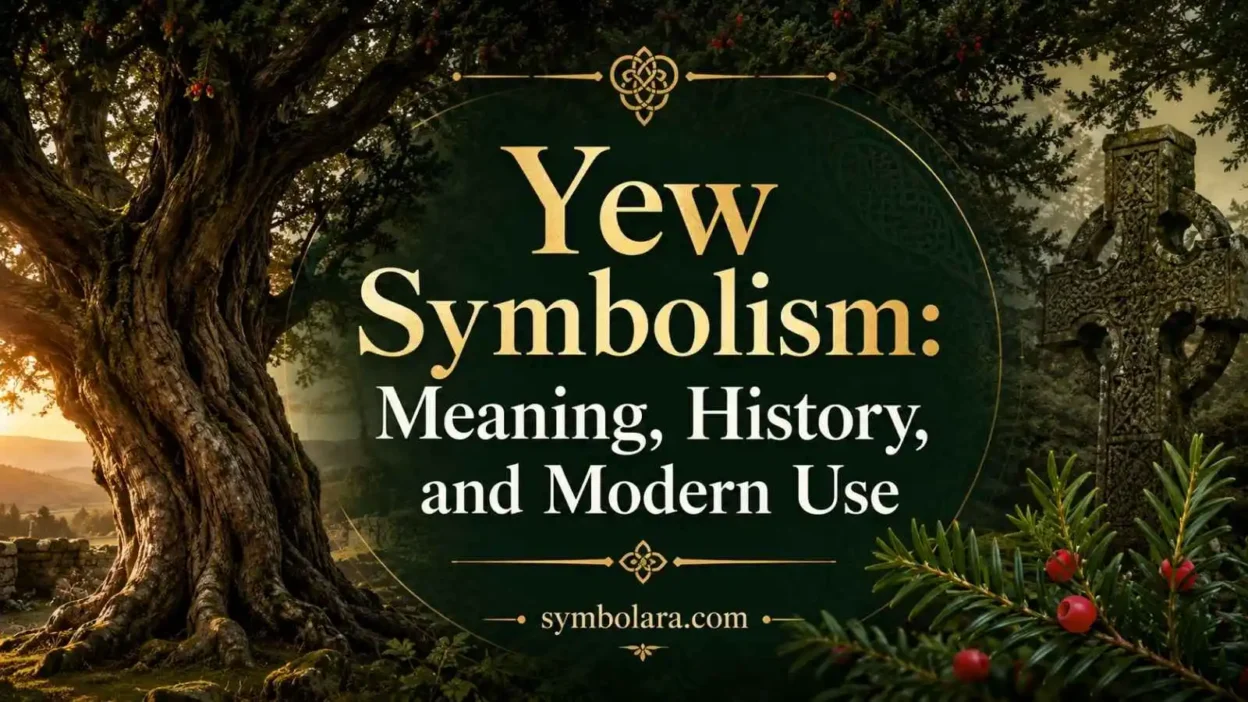
Yew Symbolism centers on one of the most unusual trees in cultural memory: an evergreen that can live for centuries, grow in shadow, produce bright red arils, and remain poisonous in nearly every part. Because of that mix of endurance, danger, and winter-green life, the yew has become a symbol people associate with death, protection, renewal, ancestry, and survival.
For many Americans, the yew is not first encountered in ancient myth but in yards, cemeteries, formal gardens, old church imagery, fantasy stories, tattoos, or discussions of Celtic and European folklore. It may appear as a dark hedge near a house, a solemn tree beside graves, or a personal emblem of resilience after loss.
The yew remains symbolically powerful because it carries meanings that cannot be reduced to a single idea. Although it is connected with mourning and burial traditions, its evergreen nature also represents endurance and continued life. Its toxicity suggests danger, yet its role in medicine connects it with healing and survival. Found near places of remembrance, the yew also represents continuity, showing how life and memory can extend beyond a single generation.
Quick Answer
Yew Symbolism commonly symbolizes mortality, endurance, and renewal in modern American culture, especially in tattoos, memorial imagery, gardens, and nature-based spirituality. Historically, the yew has also been associated with churchyards, ancestors, protection, poison, long life, and the cycle between death and new growth.
TL;DR
- The yew often represents death and renewal.
- Its evergreen nature suggests endurance through hardship.
- Churchyards shaped much of its funerary meaning.
- Americans often read it as solemn, ancient, and protective.
- Modern tattoos use it for resilience and transformation.
- Its toxicity adds warning, boundary, and respect.
What the Yew Looks Like and Where People Encounter It
The yew is usually recognized by its dark green needles, dense branching, reddish-brown bark, and small red berry-like cups called arils. Unlike many cone-bearing trees, yews do not have the familiar woody cones people associate with pines or spruces. Their red arils stand out sharply against the dark foliage, which is one reason the tree has long attracted symbolic attention.
In the United States, many people encounter yews as shrubs or hedges rather than as ancient trees. They are common in residential landscaping, foundation plantings, formal borders, privacy screens, and older institutional grounds. Their ability to tolerate shade and repeated pruning makes them useful around homes, churches, campuses, and public buildings.
The symbolic impression depends heavily on setting. A clipped yew hedge outside a suburban home can feel orderly and traditional. A twisted old yew in a cemetery feels solemn. A yew branch in art or tattoo design can suggest survival, ancestral memory, or a private relationship with grief.
What the Yew Commonly Means in the United States
In modern American interpretation, the yew most often means endurance in the presence of loss. It is not usually seen as cheerful or decorative in the symbolic sense, even though it is widely used as an ornamental plant. Its emotional tone is quieter: memory, grief, protection, winter survival, and the ability to keep living after damage.
Americans who look up the meaning of the yew often arrive through several pathways. Some encounter it in Celtic-inspired symbolism, some through cemetery or churchyard history, some through tattoo ideas, and others through gardening or plant folklore. Across these uses, the same themes tend to return: death, long life, renewal, caution, and continuity.
The yew is also a symbol of boundaries. Because it is poisonous, it has long carried a sense of warning. Because it is evergreen, it suggests that not everything ends when visible life seems to fade. This combination gives the tree a more serious emotional meaning than many flowering plants.
Yew Tree Spiritual Meaning and Symbolism
The yew tree carries a deep spiritual meaning because it represents the connection between endings and beginnings. Unlike symbols that focus only on growth or happiness, the yew reflects the full cycle of life. It reminds people that change, loss, and renewal can exist together.
Many people interpret the yew as a symbol of spiritual endurance. Its ability to remain green through harsh seasons connects it with inner strength, patience, and survival. For those experiencing grief or major life changes, the yew can represent the idea that life continues even after difficult periods.
The yew also symbolizes a connection with ancestors and memory. Because ancient yews often stand near burial places, people associate them with remembrance and the lasting influence of previous generations. In modern spiritual interpretations, the tree may represent honoring the past while continuing to grow.
However, yew symbolism is not only peaceful or protective. Its poisonous nature gives it a reminder of respect, boundaries, and awareness. Spiritually, the yew can represent wisdom gained through understanding both the beautiful and dangerous parts of life.
Why the Yew Became a Symbol of Death
The yew’s connection with death has several practical roots. First, many yews are toxic. Their needles, seeds, and bark contain dangerous compounds, and the plant has long been known as hazardous to livestock and people when eaten. A tree that could kill naturally became associated with danger, caution, and the border between life and death.
Second, yews became closely linked with burial grounds, especially in Britain and parts of Europe. Their presence in churchyards made them familiar companions to funerals, graves, mourning rituals, and family memory. Over time, the setting and the tree reinforced each other: the graveyard made the yew seem funerary, and the yew made the graveyard feel older and more solemn.
Third, the yew’s appearance supports that meaning. Its dark foliage, slow growth, and dense shade can feel grave and watchful. Unlike a spring blossom that suggests a brief emotional lift, the yew suggests long memory. It does not brighten a mourning place so much as stand guard over it.
Immortality, Continuity, and Regeneration
The yew is not only a death symbol. Its strongest meaning comes from the tension between death and ongoing life. Old yews can survive extraordinary damage, and some continue growing even when their centers hollow out. Branches may root where they touch the ground, creating the impression of a tree renewing itself from its own aging body.
This habit helped shape the yew’s symbolism of immortality and regeneration. People did not need abstract theology to see the pattern. A tree that looked ancient, damaged, and still alive naturally suggested continuity. It seemed to embody the idea that life can change form rather than simply disappear.
In modern American terms, this is why the yew appeals to people processing grief, trauma, illness, or major life transitions. It does not promise that pain vanishes. Instead, it suggests that survival may look gnarled, altered, and still alive. That makes it a fitting symbol for mature resilience rather than simple optimism.
Ancient European Roots and Celtic Associations
Much of the yew’s symbolic reputation comes from Europe, especially the British Isles and Celtic-influenced traditions. In these contexts, the tree is often associated with ancestors, sacred groves, burial places, and the threshold between the living and the dead.
Celtic interpretations commonly connect the yew with transformation, old age, and rebirth. The tree’s long life and regenerative growth made it a natural emblem of continuity across generations. In later tree alphabets and folklore systems, the yew is often treated as a tree of endings that lead into new beginnings.
It is important to be careful with claims about ancient Celtic practice. Modern books and online discussions sometimes present uncertain folklore as if it were a fully documented ancient system. A cautious view is better: the yew clearly became important in Celtic and British folklore, but not every modern spiritual meaning can be traced directly to ancient ritual.
Christian Churchyards and Funeral Traditions
The yew’s Christian symbolism developed through its long association with churchyards. In Britain and parts of Europe, yews were often planted near churches, and some became older than the buildings beside them. Whether every old churchyard yew predates Christianity is debated, but the visual connection between yew trees and sacred burial spaces is undeniable.
In Christian settings, the evergreen quality of the yew could suggest resurrection, eternal life, and hope beyond the grave. Its presence at funerals and in churchyards gave it a role as a witness tree, standing over generations of baptisms, weddings, burials, and community gatherings.
The yew’s meaning in this context is not simply gloomy. It is solemn, but it also carries a promise of continuity. In a cemetery, a yew can symbolize that the dead are remembered, that the community continues, and that faith offers an answer to mortality.
The Yew in American Culture and Public Life
The United States does not have the same ancient churchyard-yew tradition as Britain, but Americans inherited much of the symbolism through literature, Christianity, landscaping, genealogy, fantasy media, and Celtic revival culture. As a result, the yew often feels “old world” in American imagination.
In American cemeteries, evergreens in general carry associations with remembrance and ongoing life. The yew fits easily into that visual language. Even when people do not know its European folklore, they often read it as dignified, quiet, and formal.
American culture often interprets the yew differently depending on where and how the symbol appears. In a garden setting, the tree may represent structure, stability, and permanence. A yew tattoo can express themes of survival, resilience, or moving forward after loss. When found near a church or cemetery, it may symbolize mourning, remembrance, and connection with the past. In fantasy or folklore-inspired artwork, the yew often takes on an ancient, mysterious, magical, or ancestral quality.
| Context | Meaning in the USA | Common Associations | Notes |
| Cemeteries | Remembrance and mortality | Graves, mourning, ancestors | Often tied to European tradition |
| Gardens | Structure and permanence | Hedges, privacy, formality | More decorative than spiritual |
| Tattoos | Resilience and transformation | Loss, survival, rebirth | Usually personal rather than public |
| Christian imagery | Eternal life and resurrection | Churchyards, funerals, hope | Meaning depends on denomination and context |
| Folklore spaces | Thresholds and old wisdom | Celtic themes, ancestors, nature spirituality | Some claims are modern reconstructions |
Meanings in Gardens, Decor, and Design
In American landscaping, yews often symbolize stability without people consciously naming that symbolism. Their dense evergreen form makes them feel reliable, architectural, and established. A mature yew hedge can make a house look older, more formal, and more rooted in place.
Because yews tolerate pruning, they are also connected with control and order. In formal gardens, they may be clipped into hedges, columns, screens, or topiary. This design use gives the yew a different meaning from its wild or churchyard associations. Here it suggests discipline, privacy, tradition, and careful maintenance.
In interior decor or seasonal design, yew-like evergreens may be used to create a winter atmosphere, although people should be cautious with actual yew around children and pets. Symbolically, evergreen decor often suggests life in winter, but the yew adds a darker note of caution and respect.
Tattoos, Jewelry, and Personal Style
Yew tattoos are usually chosen by people who want a symbol of endurance, grief, transformation, or ancestral connection. A yew branch, needle cluster, red aril, or old twisted tree can communicate a private story without being as common as roses, oaks, or willows.
The meaning changes with the design. A bare or dark yew may emphasize mourning. A yew with red arils may suggest life and danger together. A yew paired with a skull can represent mortality, while a yew paired with roots may point to ancestry, family, or survival across generations.
In jewelry and personal style, the yew is often featured in nature-inspired, gothic, Celtic, and memorial designs. Its symbolism appeals to people who prefer meanings that feel thoughtful and understated rather than overly sentimental. Instead of suggesting that life is always perfect, the yew represents a deeper message: loss is part of existence, yet growth, endurance, and continuation remain possible.
Yew Tree Symbolism in Tattoos and Art
Yew tree tattoos often represent strength that develops through hardship. People who choose this design may connect with themes of survival, personal transformation, remembrance, or a strong relationship with nature.
A yew tree with deep roots can symbolize family connections, ancestry, and lasting foundations. A twisted ancient yew may represent endurance after difficult experiences. Some designs include skulls, moons, ravens, or cemetery imagery to highlight the tree’s connection with mortality and mystery.
Other tattoo styles focus on the yew’s evergreen nature. In these designs, the tree may represent healing, renewal, and the ability to continue growing despite challenges.
Unlike more common nature tattoos, yew designs usually carry a quieter and more reflective meaning. They often appeal to people who want a symbol connected with memory, resilience, and the balance between life and death.
Emotional and Psychological Meaning
Emotionally, the yew is a symbol of serious endurance. It speaks to people who have lived through grief, illness, family change, aging, or long periods of uncertainty. Its meaning is not about escaping hardship but about remaining present through it.
Psychologically, the yew can represent acceptance of mortality. Many symbols try to soften death or turn it into something pretty. The yew does not do that. Its poison, cemetery associations, and dark foliage keep death visible. At the same time, its evergreen life prevents the symbol from becoming hopeless.
This is why the yew often appeals to people with a reflective or private temperament. It is not loud, romantic, or flashy. It communicates boundaries, memory, patience, and the kind of strength that develops slowly.
Yew Tree Meaning in Dreams and Personal Interpretation
Seeing a yew tree in a dream is often interpreted as a symbol connected with endurance, memory, transformation, or major life transitions. Because the yew has long associations with both death and renewal, its meaning depends on the emotions and details within the dream.
A healthy green yew may represent strength, stability, and the ability to survive difficult circumstances. An old or damaged yew may suggest reflection on the past, family history, or personal experiences that shaped someone’s identity.
A yew near a grave or dark landscape may represent thoughts about loss, change, or accepting the natural cycles of life. However, this does not automatically make the dream negative. Many symbolic interpretations view the yew as a reminder that endings can create space for new growth.
Dream meanings are personal rather than universal. A person’s memories, beliefs, and experiences influence what the yew represents to them.
Cross-Cultural and Religious Meanings
Across many traditions, the yew has collected symbolic meanings connected with death, protection, endurance, and longevity. European folklore often presents it as a tree associated with graveyards, ancestors, and spiritual thresholds. Within Christian contexts, the yew can symbolize resurrection, eternity, and the promise of life beyond death. Celtic-influenced interpretations frequently connect the tree with renewal, rebirth, and transitions between different states of existence.
Some discussions also connect yew wood with bows, especially in medieval Europe, where yew was valued for longbows. This gives the tree another layer of meaning: defense, force, and protection. A plant already associated with poison and boundary becomes connected with weaponry as well.
There are also North American yew species, including Canada or American yew. Indigenous communities in some regions had practical plant knowledge involving local yew species, but modern readers should avoid flattening many Indigenous traditions into one symbolic meaning. In a U.S. article, it is more respectful to say that native yews belong to North American ecology and have specific local histories rather than claiming a single universal Indigenous interpretation.
Medicine, Poison, and the Modern American Imagination
One of the most striking modern meanings of the yew comes from medicine. Compounds associated with yew species played a major role in the development of paclitaxel, a cancer drug originally connected with the Pacific yew. This history changed the modern image of the tree in an unexpected way.
The same plant family long associated with poison and death became connected with treatment and survival. Symbolically, that is a remarkable reversal. The yew came to represent not only mortality, but also the possibility that dangerous natural compounds, carefully studied, can be transformed into healing tools.
This does not mean the yew is safe as an herbal remedy. It is not. The symbolic lesson is not “poison heals.” It is that nature can contain both risk and remedy, and human knowledge determines whether that risk becomes harm or help.
Protection, Boundaries, and Watchfulness
The yew often carries a protective symbolism because of its environment and natural qualities. In churchyards, these trees can appear as silent guardians watching over sacred spaces. When used in hedges, they create privacy and define boundaries between areas. Folklore has also connected the yew’s toxicity with ideas of defense and protection. Together, these associations make the yew a powerful boundary symbol, representing the space between home and wilderness, the sacred and the ordinary, and life and death.
In American homes, yew hedges may not be planted for symbolic reasons, but they still create a psychological effect. They make space feel enclosed, private, and established. A dense evergreen border says, visually, “this place is held.”
This protective meaning is different from warmth or welcome. The yew does not symbolize open hospitality in the way a flowering arch might. It suggests guardedness, dignity, and a controlled threshold.
The Yew in Folklore, Fantasy, and Digital Culture
Modern Americans often meet the yew through fantasy novels, games, witchy aesthetics, Celtic-inspired content, and online symbolism pages. In these spaces, the tree is usually framed as ancient, shadowy, magical, or connected to death and rebirth.
This digital version of the yew is not always historically precise, but it shows how the symbol functions now. People use the yew to create an atmosphere of old forests, ancestral memory, graveyards, and nature-based mystery. It fits especially well in gothic, dark academia, pagan-inspired, and folklore-themed visual culture.
The risk is oversimplification. Online culture sometimes turns the yew into a vague “tree of transformation” without explaining its material reasons: poison, longevity, churchyards, evergreen growth, and regenerative habit. The symbol becomes stronger when those concrete roots are remembered.
Yew Tree Symbolism in Literature and Popular Culture
The yew tree appears in literature and popular culture because its symbolism naturally fits stories about mystery, transformation, and the passage of time. Writers often use ancient trees to represent forgotten knowledge, old civilizations, family history, or hidden power.
Because the yew connects life and death, it works especially well in fantasy and gothic storytelling. A yew forest or ancient yew tree can create an atmosphere of age, mystery, and connection with the past.
Modern creators often use yew imagery to suggest themes such as survival, darkness, rebirth, and the relationship between humans and nature. Although fictional uses may exaggerate the tree’s symbolism, they continue many older associations with endurance and transformation.
Common Misunderstandings and Misuse
One common misunderstanding is that every old yew in a churchyard must be pre-Christian. Some may be extremely old, and some may predate church buildings, but broad claims should be treated carefully. The relationship between yews, pagan sites, and Christian churchyards is complex.
Another misunderstanding is that the yew is simply a “positive” symbol of immortality. Its meaning is more balanced than that. It carries death, poison, grief, and caution alongside endurance and renewal. Removing the darker side makes the symbol less accurate.
A more serious misuse involves treating yew as a safe folk medicine. The plant is toxic, and casual internal use can be dangerous. Symbolically, the yew may represent healing through modern science, but that is very different from using the plant at home.
There is also occasional confusion around Norse world-tree imagery. Yggdrasil is most often described as an ash tree in the major Norse sources, though later speculation and alternative interpretations sometimes bring yew into the discussion. It is better not to claim that the yew is definitively Yggdrasil.
How the Meaning Has Changed Over Time
The yew’s meaning has shifted from sacred tree and practical material to cemetery emblem, landscape plant, medicine-linked botanical, and personal symbol. In ancient and medieval contexts, people knew it through place, ritual, danger, and use. It was part of churchyards, bows, boundaries, and folk memory.
In modern American life, the yew is more often interpreted through aesthetics and personal meaning. A person may choose it for a tattoo after a loss. A homeowner may plant it for structure without thinking of death at all. A reader may encounter it in mythology and connect it with ancestors or transformation.
The core has remained surprisingly steady: the yew still sits at the meeting point of life and death. What has changed is the setting. Today, its meaning is less communal and more personal, less tied to one churchyard and more tied to individual memory, identity, and design.
Is the Yew a Positive or Negative Symbol?
The yew is both positive and negative, depending on context. Its negative meanings include death, poison, danger, grief, and endings. Its positive meanings include endurance, protection, renewal, long life, and remembrance.
This balance is exactly why the symbol has lasted. A purely happy tree could not carry the emotional weight of mourning. A purely fearful tree could not represent renewal. The yew matters because it holds both truths at once.
For modern Americans, the yew is best understood as a mature symbol rather than a lucky or unlucky one. It does not promise ease. It represents the kind of continuity that remains after time, loss, and change have done their work.
Is the Yew Tree a Good or Bad Symbol?
The yew tree is neither completely good nor completely bad as a symbol. Its meaning depends on the cultural setting and personal interpretation. It represents both difficult realities and hopeful ideas.
Negative meanings connected with the yew include death, poison, endings, and danger. These associations developed because of the tree’s toxicity and its historical connection with burial grounds.
Positive meanings include endurance, protection, renewal, memory, and long life. Its evergreen leaves and ability to survive for centuries created associations with strength and continuity.
For modern readers, the yew is best viewed as a balanced symbol. It represents the ability to face difficult experiences while continuing forward.
FAQs
What does the yew tree symbolize?
The yew tree symbolizes death, endurance, renewal, protection, and long memory. Its meaning comes from its toxicity, evergreen foliage, long lifespan, and strong association with churchyards and burial grounds.
What does a yew tattoo mean?
A yew tattoo often means resilience after loss, acceptance of mortality, or personal transformation. It can also represent ancestry, protection, or the belief that life continues in changed form after hardship.
Is the yew tree a symbol of death?
Yes, the yew is one of the trees most closely associated with death in European and English-speaking symbolism. That meaning comes from its poisonous nature and its long presence in churchyards, cemeteries, and funeral customs.
Why are yew trees planted in churchyards?
Yews have been planted in churchyards for several reasons, including tradition, evergreen symbolism, protection of sacred space, and practical concerns such as discouraging grazing animals. Over time, their presence made them symbols of burial, resurrection, and communal memory.
Is the yew tree connected to Celtic symbolism?
Yes, the yew is strongly connected with Celtic-influenced folklore, especially themes of rebirth, ancestors, and the passage between life and death. Some modern claims go beyond what can be firmly proven, so it is best to treat the Celtic connection as meaningful but not always fully documented.
Is yew symbolism positive?
The yew has positive meanings when it represents endurance, protection, renewal, and remembrance. It also has darker meanings tied to poison, grief, and mortality, so its symbolism is balanced rather than simply good or bad.
What does the yew mean in modern American culture?
In modern American culture, the yew often suggests solemn beauty, privacy, resilience, and old-world tradition. People may encounter it in landscaping, cemetery imagery, tattoos, fantasy art, or nature-based spirituality.
Why is the yew tree associated with immortality?
The yew became associated with immortality because some trees survive for centuries, regenerate after damage, and remain green throughout the year. These qualities made people connect it with continuity and long life.
Conclusion
The yew is a tree whose symbolism is shaped by powerful contrasts. Although it remains evergreen and represents endurance, it is also strongly associated with graves and remembrance. Its poisonous nature has given it a connection with danger, yet its historical use in medicine links it with healing. The yew can represent endings and mortality while also symbolizing renewal, resilience, and the ability to survive through time.
Yew Symbolism is best understood as the symbolism of life held beside mortality. In the United States today, that meaning appears in gardens, tattoos, memorial spaces, folklore, and personal design choices. The tree reminds people that endurance is not always bright or easy; sometimes it is quiet, shadowed, and rooted in memory.
That is what gives the yew its lasting place in symbolic language: it does not deny death, but it does not let death have the final word.