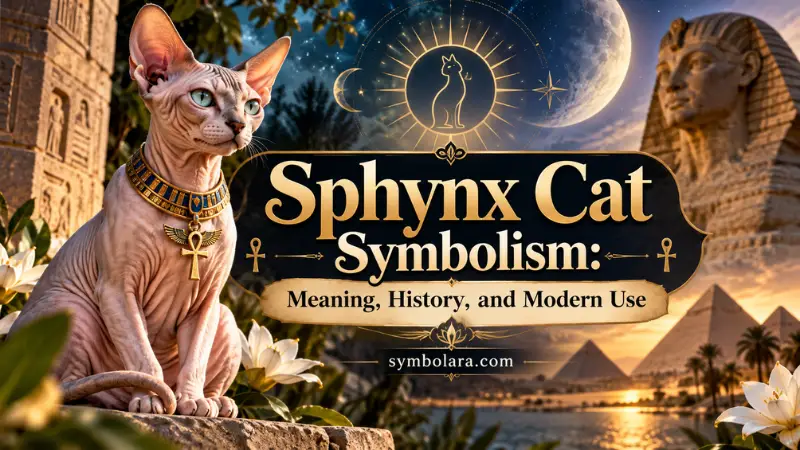
A cat with almost no fur, oversized ears, wrinkled skin, and bright, watchful eyes is difficult to overlook. The Sphynx looks different from most household cats, yet its personality is often playful, friendly, and affectionate.
That contrast is central to sphynx cat symbolism. People associate this unusual breed with individuality, confidence, acceptance, vulnerability, and beauty that does not follow ordinary expectations.
Although its name suggests ancient Egypt, the modern Sphynx developed in Canada during the twentieth century. Its symbolic meanings are much newer than many people assume.
Today, Americans encounter Sphynx cats in homes, tattoos, photography, movies, and social media. Each setting adds something to how people understand this distinctive animal.
Quick Answer
Sphynx cat symbolism commonly represents individuality, confidence, unconventional beauty, vulnerability, and affectionate companionship. These meanings come mainly from the breed’s unusual appearance and friendly nature, while its Egyptian-inspired name adds a historical association with the famous Sphinx monument.
TL;DR
- Individuality: The Sphynx represents confidence in being different.
- Beauty: Its unusual appearance challenges traditional standards of attractiveness.
- Affection: Its friendly personality suggests companionship and emotional warmth.
- Origins: The modern breed developed in Canada during the 1960s.
- History: Its name references Egypt, not an Egyptian breed origin.
- Modern culture: Tattoos, photography, and social media celebrate its distinctive appearance.
What Makes the Sphynx Cat Look So Different?
The Sphynx is recognizable because its skin is visible rather than covered by a thick coat of fur. Its large ears, defined cheekbones, almond-shaped eyes, and muscular body give it an almost sculpted appearance.
Despite being described as hairless, most Sphynx cats have a thin covering of soft down. Their skin can feel similar to warm suede.
They also come in different colors and patterns. Cream, gray, black, pink-toned, and patterned skin can make individual cats look surprisingly different.
Several physical features influence their symbolic appeal.
Visible skin and wrinkles
These features can suggest openness, natural beauty, and acceptance of imperfections. Unlike a long-haired cat, a Sphynx displays much of its physical form without a covering of fur.
Large ears and alert eyes
The breed’s facial features can create an impression of curiosity and careful observation. Artists sometimes emphasize these details to suggest intelligence or awareness.
Muscular body and confident posture
A Sphynx standing upright often looks composed and self-assured. This appearance helps explain why it can represent confidence in visual artwork.
Its unusual shape also makes it suitable for recognizable silhouettes in illustrations and tattoos.
However, physical appearance does not determine an animal’s character. The meanings people attach to these features are interpretations rather than established traits of every individual cat.
The Seven Meanings Most Often Associated With Sphynx Cats
There is no universal set of meanings assigned to the Sphynx. In modern American culture, interpretations are usually personal and depend on appearance, behavior, and the owner’s experiences.
Seven associations are especially useful for understanding why people choose this breed as a personal symbol.
- Individuality: Its distinctive appearance represents standing apart from the crowd.
- Confidence: Its exposed skin can suggest comfort with one’s natural appearance.
- Acceptance: The breed encourages some people to reconsider their ideas about beauty.
- Vulnerability: Its lack of a protective fur coat can represent sensitivity and openness.
- Affection: Its social behavior can symbolize closeness, love, and companionship.
- Curiosity: Its attentive expression and playful behavior suggest exploration and learning.
- Resilience: Some people interpret its special care needs as a reminder that living with differences can require adaptation.
These meanings are not equally established traditions. They are modern associations that people develop through personal experience, art, and cultural discussion.
For example, someone who has felt judged for their appearance might see a Sphynx as a symbol of self-acceptance. A devoted cat owner might associate the same animal with friendship and emotional comfort.
This flexibility is one reason the breed attracts interest beyond ordinary pet ownership.
How the Modern Sphynx Breed Began in Canada
Despite its Egyptian-inspired name, the Sphynx is a relatively modern breed.
An important event occurred in Toronto, Canada, in 1966. A domestic cat gave birth to a naturally hairless male kitten named Prune.
Prune’s appearance resulted from a genetic mutation affecting hair growth. Early breeders attempted to develop a recognizable hairless breed, although those initial efforts did not produce a stable breeding population on their own.
During the 1970s, other naturally hairless kittens appeared in North America. Cats associated with breeding programs in Toronto and Minnesota helped establish the foundation of the modern Sphynx.
Breeders also used Devon Rex cats to expand breeding lines. Over time, selective breeding helped establish the physical characteristics associated with the Sphynx today.
The Cat Fanciers’ Association granted the breed championship status in 2002, an important milestone in its recognition.
This history matters because the breed’s symbolic identity did not emerge from an established ancient religious tradition.
Instead, modern interpretations developed around an unusual natural mutation, human breeding choices, and growing familiarity with the cats.
The breed’s story can therefore suggest unexpected beauty and the way something unusual can become appreciated over time.
It is an interpretation of that history, not a traditional meaning assigned when the breed first appeared.
Why the Sphynx Name Creates an Egyptian Connection
The name Sphynx refers to the Sphinx, the famous figure associated with ancient Egyptian art and architecture.
The Great Sphinx of Giza has the body of a lion and the head of a human. It is generally associated with royal authority and, in its broader historical setting, religious beliefs connected to kingship and the sun.
The modern cat breed received its name because its appearance reminded people of Egyptian sphinx imagery.
That resemblance created a lasting cultural association.
A Sphynx cat photographed beside an Egyptian-style statue might suggest elegance, watchfulness, or historical grandeur. These impressions come from combining two different images.
The cat itself, however, is not descended from the Great Sphinx or from a documented breed kept by Egyptian rulers.
There is also an important distinction between Egyptian and Greek sphinx traditions.
Greek mythology includes a sphinx known for challenging travelers with a riddle. Egyptian sphinx figures generally served different artistic, royal, and religious purposes.
Modern illustrations sometimes mix these traditions, giving hairless cats imagined roles as guardians or keepers of secrets.
Such artwork is creative interpretation rather than evidence of an inherited religious meaning.
Recognizing the difference allows people to appreciate Egyptian influences without presenting a Canadian cat breed as an ancient Egyptian sacred animal.
How Affection and Curiosity Shape the Cat’s Meaning
Appearance may attract attention first, but behavior often changes people’s opinions about Sphynx cats.
The breed is widely described as sociable, playful, and interested in human interaction. Many enjoy spending time near their owners, exploring rooms, and participating in household activities.
Some even follow family members from room to room.
This behavior creates a contrast between appearance and personality.
A person unfamiliar with the breed might initially find its wrinkled face intimidating. After meeting a friendly Sphynx, that impression can change completely.
For owners, this experience sometimes becomes a reminder that appearances do not reveal everything about someone’s personality.
Their interest in people can also support interpretations involving companionship.
A Sphynx resting beside its owner on a couch may represent comfort and closeness. A playful cat investigating a shopping bag might instead suggest curiosity and enthusiasm.
These associations make the breed suitable for artwork about friendship, home life, and emotional attachment.
Still, not every Sphynx behaves identically. Early social experiences, environment, and individual temperament all influence how a cat interacts with people.
The symbolism comes from commonly observed characteristics, not a guarantee about every cat.
Why Hairless Skin Can Represent Vulnerability and Acceptance
One of the most personal interpretations of the Sphynx involves vulnerability.
Most cats have fur that provides insulation and some protection from their surroundings. A Sphynx lacks much of that covering.
This visible difference can make the animal appear more exposed.
People sometimes connect that appearance with emotional openness, sensitivity, or the courage to be seen without hiding perceived flaws.
Wrinkles also play a role.
In advertising and beauty culture, smooth skin is frequently presented as desirable. The Sphynx offers a different visual example: wrinkles are an expected and admired part of the breed’s appearance.
That contrast can inspire ideas about accepting natural differences.
For someone who has experienced insecurity about appearance, a portrait of a Sphynx might serve as a personal reminder that attractiveness does not depend on meeting one standard.
The interpretation is especially meaningful when the cat is shown in a relaxed position rather than an intimidating pose.
A sleeping Sphynx wrapped in a soft blanket may communicate tenderness and trust.
Its exposed skin also reminds owners of practical responsibilities. These cats need protection from excessive sunlight and cold temperatures.
In that setting, vulnerability becomes connected to care rather than weakness.
The animal’s needs encourage a relationship based on attention, responsibility, and understanding.
What Owning a Sphynx Can Communicate in American Life
In the United States, choosing a Sphynx can be an expression of personal taste.
Some owners admire unusual animals. Others appreciate the breed’s affectionate behavior or enjoy caring for a cat whose needs differ from those of a typical shorthaired pet.
The choice does not automatically reveal someone’s personality.
However, people may interpret it as evidence of an interest in originality, unconventional beauty, or distinctive design.
This perception also appears in social settings.
A Sphynx visiting a veterinary clinic or appearing in a family photograph may attract questions from people who have never encountered the breed.
Its appearance naturally creates opportunities for conversation.
For some owners, these interactions become part of the pleasure of living with an unusual pet.
The interpretation changes depending on the setting.
| Context | Meaning in USA | Common Associations | Notes |
| Family portraits | Belonging and acceptance | Love, inclusion, attachment | The cat appears as a valued family member |
| Personal tattoos | Individual identity | Confidence, self-expression | Meaning depends on the wearer’s story |
| Fashion photography | Unconventional elegance | Originality, bold design | The cat creates a recognizable visual contrast |
| Social media portraits | Playful individuality | Humor, personality, affection | Captions can change the intended message |
| Home artwork | Appreciation for unusual beauty | Artistic taste, character | Minimalist portraits emphasize shape and texture |
There is no established American holiday centered on Sphynx cats.
They may appear in Halloween photographs, costume posts, and seasonal artwork because their appearance suits certain imaginative themes.
That use is a modern creative choice, not an inherited holiday tradition.
How Movies and Television Changed Public Perception
American entertainment helped introduce the Sphynx to audiences who might never have encountered one in person.
One memorable example is Mr. Bigglesworth in the 1997 comedy Austin Powers: International Man of Mystery.
The character is Dr. Evil’s cat, which becomes hairless after a fictional freezing accident.
A real Sphynx performed the hairless-cat role.
The joke relied on the animal’s unusual appearance, connecting it with exaggerated villain imagery.
Another example appeared in Friends in 1999.
Rachel purchases a Sphynx named Mrs. Whiskerson in the episode “The One with the Ball.” Much of the humor comes from other characters reacting negatively to the cat’s appearance.
These portrayals helped establish the breed as visually memorable in American entertainment.
They also reinforced certain stereotypes.
Viewers unfamiliar with Sphynx cats could associate them with strange creatures, villains, or unpleasant personalities.
Those impressions were created for comedy, not as accurate descriptions of the breed.
Pet photography and owner-created videos now offer a contrasting perspective.
A Sphynx playing with toys, sleeping beside a dog, or following its owner around the house presents a very different image.
The contrast between fictional portrayals and everyday behavior helps explain why the breed can symbolize both eccentricity and affection.
What a Sphynx Cat Tattoo May Symbolize
Sphynx cat tattoos often focus on the features that make the breed recognizable.
Large ears, folded skin, a narrow face, and prominent eyes provide tattoo artists with a distinctive subject.
The meaning depends largely on the person wearing the design.
Someone who owns a Sphynx may choose a tattoo to remember a beloved companion. Another person might select the image because it reflects a personal interest in unconventional beauty.
Design details can change the message.
Minimalist Sphynx tattoos
A simple outline emphasizes individuality and clean design. These tattoos often focus on the ears and face rather than detailed skin texture.
Realistic Sphynx portraits
A carefully shaded portrait may represent affection for a particular pet. Small features, such as wrinkles or eye shape, help preserve the animal’s identity.
Sphynx tattoos with flowers
Adding flowers can soften the visual appearance. Depending on the flowers chosen, the design may suggest tenderness, memory, or personal growth.
Sphynx tattoos with Egyptian-style elements
Some designs combine the cat with pyramids, decorative collars, or imagery inspired by Egyptian art.
These combinations are modern artistic choices. They should not be mistaken for documented ancient Egyptian tattoo traditions involving this breed.
A Sphynx tattoo does not have one fixed meaning.
Its significance usually comes from the wearer’s experiences and the way the final design combines different images.
Why Artists and Designers Favor the Sphynx Silhouette
A Sphynx offers something unusual to photographers and illustrators: a cat whose physical structure remains clearly visible.
Without a thick coat, the contours of its face, shoulders, and body become important visual features.
This creates opportunities for portraits that focus on shape, shadow, and texture.
A black-and-white photograph, for example, can emphasize folds around the forehead and neck. Side lighting may create a striking contrast between smooth skin and sharply defined ears.
Artists can use these characteristics without adding elaborate backgrounds.
The breed also works well in simplified illustrations.
A few lines showing tall ears, a narrow face, and a curved body may be enough for viewers to recognize it.
In fashion-related photography, a Sphynx can create a contrast with polished fabrics, jewelry, or carefully arranged interiors.
The animal may suggest unconventional elegance rather than traditional softness.
Online, humorous photographs offer another interpretation. Owners sometimes share pictures of their cats sleeping in strange positions or making exaggerated facial expressions.
Such images present the breed as playful and approachable.
Responsible creative work also respects the animal’s comfort. Clothing, props, lighting, and photo sessions should never compromise a cat’s health or cause unnecessary stress.
How Sphynx Symbolism Has Changed Since the 1960s
The modern history of the Sphynx provides a useful way to understand changes in public attitudes.
During the early breeding years of the 1960s and 1970s, hairlessness was an unusual physical trait that breeders were working to establish.
The breed was not widely familiar to American households.
As organized breeding and cat shows introduced more people to the Sphynx, its appearance became associated with rarity and distinctive pedigree cats.
By the late 1990s, movies and television were using its appearance for humor and surprise.
The breed had become recognizable enough to make an impression on general audiences, even when portrayals were unflattering.
In the 2000s and 2010s, online pet communities created additional opportunities for owners to share their experiences.
Photographs and videos showed everyday behavior that entertainment programs often ignored.
By 2025–2026, Sphynx imagery could carry several meanings at once.
Some viewers still see an unusual-looking animal. Others recognize an affectionate companion or appreciate the breed’s distinctive appearance as an artistic subject.
The change is not a complete replacement of older perceptions.
Instead, more ways of understanding the breed now exist side by side.
This is an important feature of modern symbolism: meanings can grow as people encounter an animal in different settings.
Common Misunderstandings and the Importance of Responsible Care
Several misconceptions affect how people interpret the Sphynx.
The first is that the breed comes from ancient Egypt.
Its name creates that impression, but the modern breed developed in North America.
Another misconception is that Sphynx cats are completely hairless. Most have fine down, and some possess small amounts of visible hair on certain body parts.
The belief that they are automatically suitable for people with cat allergies is also inaccurate.
Cat allergies often involve proteins found in saliva, skin secretions, and other sources. Removing a thick fur coat does not eliminate those allergens.
Another issue concerns the assumption that a Sphynx is effortless to maintain because it does not require brushing like a long-haired cat.
In reality, its skin, ears, and nails need appropriate attention. Bathing requirements vary, and excessive washing can irritate the skin.
The breed also has an important health concern: hypertrophic cardiomyopathy, a heart disease that can affect Sphynx cats.
Responsible breeding programs use veterinary heart screening, and owners should discuss ongoing care with their veterinarians.
These realities raise a broader question about the relationship between appearance and animal welfare.
Admiring a distinctive physical feature should not mean overlooking the needs of the living animal.
For people who associate the Sphynx with acceptance, that responsibility is particularly relevant.
True appreciation involves understanding the cat’s health, behavior, and care requirements rather than treating it as a decorative object.
An unusual appearance may inspire artwork, but the animal’s well-being must remain more important than the image it creates.
FAQs
A Sphynx is not traditionally classified as a good or bad omen. Modern interpretations are usually positive or neutral, although some fictional portrayals give the breed an unsettling appearance.
Some people personally associate Sphynx cats with awareness, intuition, or self-acceptance. There is no established historical evidence that the modern breed has a universal spiritual role or an inherited sacred status.
Bastet was an Egyptian goddess associated with feline imagery, but the modern Sphynx breed has no documented historical connection to her worship. Artwork combining Bastet and a Sphynx cat represents a modern creative interpretation.
There is no scientifically established meaning for dreaming about a Sphynx cat. Someone might connect the image with feeling exposed, encountering something unfamiliar, or remembering a pet, depending on the dream’s details and personal experiences.
There is no widely established tradition assigning separate meanings to Sphynx cats based on skin color. An artist might use darker coloring for a dramatic design or lighter coloring for a softer appearance, but those choices are not fixed rules.
No. The Donskoy and Peterbald are other recognized hairless or partially hairless cat breeds. They have different breed histories and should not automatically be treated as interchangeable with the Canadian Sphynx.
Yes, someone may personally use a Sphynx image to express independence or a willingness to stand apart from social expectations. However, the breed is often highly social, so independence is better understood as a human interpretation of its appearance than a defining behavioral trait.
Conclusion
Sphynx cat symbolism centers on individuality, unconventional beauty, confidence, vulnerability, curiosity, and companionship. These meanings arise mainly from the breed’s distinctive appearance, affectionate personality, and place in modern culture.
Its Canadian origins also separate historical fact from the Egyptian associations suggested by its name. Although its appearance may inspire imaginative interpretations, the modern Sphynx has no single inherited symbolic meaning.
For many people, the most meaningful image is also the simplest: an unusual-looking cat resting comfortably beside someone who cares for it. That ordinary moment expresses acceptance more clearly than any elaborate design.