A firefighter enters a burning building to rescue a stranger. A parent works an extra shift to support their children. A soldier risks their life to protect others. These actions share something important: someone accepts a personal cost for a purpose they consider greater than their own comfort.
Sacrifice symbolism represents selflessness, devotion, courage, responsibility, and the willingness to give up something valuable for another person or cause. Its meaning changes with the situation. Sometimes it honors an act of love. Other times, it remembers a painful loss or questions whether the cost was justified.
In American culture, sacrifice appears in military memorials, religious traditions, family stories, literature, and personal art. A folded flag, an empty chair, or a simple candle can remind people of what someone gave and why it mattered.
The idea also raises an important question: When does giving something up become an act of love, and when does it become an unfair burden?
Quick Answer
Sacrifice symbolism represents selflessness, love, devotion, courage, and the willingness to give up something valuable for a meaningful purpose. Its historical roots include religious offerings and rituals, while modern American interpretations often focus on personal commitment, service, remembrance, and protecting others.
TL;DR
- Core meaning: Giving up something valuable for someone or something important.
- Historical roots: Religious offerings expressed devotion, gratitude, duty, or reconciliation.
- Christian interpretation: Jesus’ crucifixion represents self-giving love and salvation.
- American culture: Memorials honor lives lost in military service.
- Personal meaning: Sacrifice can express loyalty, responsibility, and family commitment.
- Modern perspective: Meaningful sacrifice should not excuse exploitation or harm.
What Does Sacrifice Symbolize?
Sacrifice represents the choice to accept a loss, hardship, or personal cost because something else matters more.
That cost might involve time, money, comfort, opportunity, or even life itself. The meaning depends on what someone gives, why they give it, and whether they choose to do so freely.
Several important ideas are associated with sacrifice.
Selflessness and Compassion
Selflessness appears when someone considers another person’s needs without expecting an equal reward.
A volunteer spending weekends helping families after a hurricane offers a familiar example. The person gives up free time to help people facing hardship.
In this setting, sacrifice symbolizes kindness and concern for others.
Love and Devotion
Love sometimes requires giving up personal convenience.
A parent may delay a career opportunity to care for a child. Partners may adjust their plans to support each other during illness or financial trouble.
Such choices can represent lasting devotion. However, healthy relationships should not require one person to abandon their needs continually.
Courage and Responsibility
Sacrifice can also symbolize bravery.
Emergency workers, rescue volunteers, and others sometimes face danger while protecting people. Their actions connect personal risk with public responsibility.
The focus is not suffering itself. It is the decision to help despite a possible cost.
Hope and Renewal
People sometimes surrender something familiar to pursue a better future.
A student might leave home to attend college. A family might spend years saving for a new beginning.
These choices symbolize patience, commitment, and hope for change.
What Does Sacrifice Look Like as a Symbol?
Unlike a flower or animal, sacrifice has no single visual form.
Instead, people use recognizable objects and actions to represent giving, loss, remembrance, and devotion.
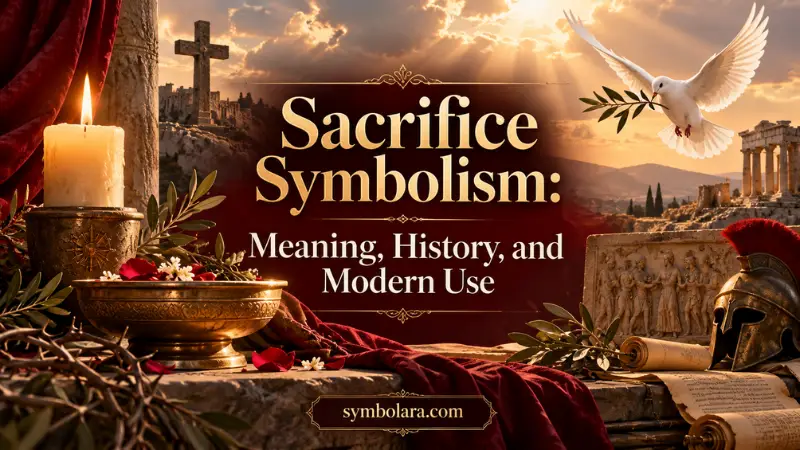
Common symbols associated with sacrifice include:
- The cross: Represents Jesus’ crucifixion, suffering, and salvation in Christianity.
- A candle: May honor someone who died or express remembrance during a vigil.
- An empty chair: Can represent an absent loved one and the cost of loss.
- A folded American flag: Often recalls military service, death, and national remembrance.
- A lamb: Has sacrificial associations in Jewish and Christian traditions.
- A broken chain: Can suggest the personal cost involved in gaining freedom.
- Open hands: May represent generosity, giving, or voluntary surrender.
These objects do not always mean sacrifice.
A candle used for decoration has a different purpose from one placed beside a photograph at a memorial. Similarly, a lamb in a children’s illustration may have no religious meaning.
Context determines the interpretation. The surrounding images, occasion, and cultural background tell viewers what the symbol is meant to express.
Historical Origins of Sacrifice and Its Meaning
The English word sacrifice comes through French from the Latin sacrificium, related to the ideas of making something sacred and performing a religious offering.
Long before the word entered English, communities in different parts of the world practiced offerings as part of religious life.
These practices did not share one universal origin or purpose.
Offerings in Early Religious Traditions
In parts of the ancient Mediterranean and Near East, religious offerings included grain, wine, incense, and animals.
People presented them during ceremonies connected with gratitude, purification, communal worship, or requests for divine favor.
Animal offerings were important in some traditions, but they were not the only form of sacrifice.
For example, the Hebrew Bible describes both animal sacrifices and grain offerings. Ancient Greek religious ceremonies also included offerings that could be shared during communal meals.
It would be inaccurate to describe every early sacrifice as a punishment or an attempt to pay for wrongdoing.
From Religious Ritual to Personal Commitment
Over time, the word acquired meanings beyond formal worship.
In English, people began using sacrifice to describe giving up personal advantages for family members, community responsibilities, or moral principles.
A person no longer needed to present an offering at an altar to describe an action as sacrificial.
Today, someone may speak of sacrificing sleep to finish a project or surrendering a personal opportunity to help another person.
This broader use connects the original idea of giving something valuable with ordinary human decisions.
Sacrifice Symbolism in Christianity
Christian interpretations of sacrifice center especially on the crucifixion of Jesus Christ.
The cross represents Jesus’ suffering and death, understood by Christians as central to God’s work of salvation.
The New Testament frequently connects Jesus’ death with love, forgiveness, and reconciliation.
Jesus as a Sacrificial Figure
In Christian teaching, Jesus willingly accepts suffering for the sake of others.
Different Christian traditions explain the theological meaning of his death in different ways. Many emphasize forgiveness and reconciliation, while others also stress victory over sin and death.
The cross therefore carries several connected meanings:
- Love expressed through personal cost
- Forgiveness and reconciliation
- Faithfulness during suffering
- Hope through the resurrection
For many Christians, sacrifice also involves service rather than physical suffering.
Helping neighbors, sharing resources, and caring for vulnerable people can be understood as ways of expressing faith.
Why the Cross Matters in American Culture
Crosses appear in American churches, religious artwork, jewelry, and memorial settings.
Some people wear a cross to express Christian identity. Others display one to remember a family member or a personal commitment to faith.
Because the cross has a specific religious history, its meaning should not be reduced to a general sign of hardship or bravery.
Christian interpretations are important, but they do not represent every American understanding of sacrifice.
Sacrifice in Judaism, Islam, and Other Traditions
Sacrifice carries different meanings across religious communities. These traditions should be understood on their own terms rather than treated as versions of one universal belief.
Judaism: Offerings, Gratitude, and Responsibility
The Torah describes several kinds of offerings associated with worship at the ancient Israelite sanctuary and, later, the Temple in Jerusalem.
Some were connected with thanksgiving, while others addressed ritual obligations or wrongdoing.
After the destruction of the Second Temple in 70 CE, Temple sacrifice ceased to be part of Jewish religious practice.
Jewish worship today emphasizes practices including prayer, study, repentance, and acts of kindness.
The story of Abraham’s willingness to offer Isaac, followed by the prevention of Isaac’s death, also raises questions about faith, obedience, and divine command.
Islam: Faith, Generosity, and Obedience
In Islam, Eid al-Adha remembers Prophet Ibrahim’s willingness to obey God in the account of a commanded sacrifice involving his son.
The Qur’an does not name the son in that passage, although Islamic tradition generally identifies him as Ismail.
Muslims who perform the festival sacrifice may distribute meat among family members and people in need.
The practice emphasizes devotion, gratitude, and generosity. The Qur’an also stresses that righteousness and devotion matter more than the physical offering itself.
Hindu Traditions: Offering and Renunciation
Hindu traditions include varied offerings made during worship, such as flowers, food, and clarified butter.
The idea of tyaga, or renunciation, can also involve giving up attachment to personal rewards or possessions.
These practices have different meanings depending on the tradition, text, and community.
Together, these examples show that sacrifice may represent devotion, gratitude, duty, generosity, or a commitment to spiritual discipline.
Sacrifice in American Culture and Public Remembrance
In the United States, sacrifice is closely associated with military service, emergency response, family responsibility, and civic duty.
Public memorials give these ideas a visible form.
Memorial Day and Military Sacrifice
Memorial Day honors U.S. military personnel who died while serving their country.
Its modern observance developed from grave-decoration traditions following the Civil War.
Families and volunteers place flowers and American flags at gravesites. Communities hold ceremonies, and visitors gather at monuments dedicated to fallen service members.
These actions symbolize gratitude and remembrance.
The sacrifice being honored is not simply participation in the military. Memorial Day specifically remembers those who died during service.
The Meaning of an Empty Place
The Vietnam Veterans Memorial in Washington, D.C., offers another example.
Its dark stone walls display the names of service members who died or remain missing as a result of the Vietnam War.
Visitors may leave photographs, letters, flowers, and personal objects.
Those items turn a public monument into a place for individual grief.
A name carved into stone reminds visitors that military losses involve real people, families, and unfinished lives.
Community Service and Everyday Responsibility
American communities also recognize sacrifice through local traditions.
Volunteer firefighters, emergency medical workers, and disaster relief volunteers may be honored for their service.
Yet sacrifice does not always involve public recognition.
Families caring for relatives with disabilities, neighbors organizing food deliveries, and people donating time to community projects also demonstrate commitment.
Their efforts represent the less visible side of service.
Why Sacrifice Symbolizes Love in Relationships
Love and sacrifice often appear together because meaningful relationships require consideration, patience, and compromise.
A parent wakes during the night to care for a sick child. A spouse changes plans to support a partner recovering from surgery.
These actions become symbols of love because someone willingly accepts inconvenience for another person’s well-being.
However, not every difficult choice is evidence of affection.
Healthy Giving Versus Harmful Self-Denial
A healthy sacrifice usually has a clear purpose and respects the people involved.
For example, two partners might agree to spend less money on vacations while saving for a home.
Both understand the decision, and both share responsibility.
An unhealthy pattern looks different.
If one person must constantly give up friendships, career opportunities, or personal safety to keep a relationship intact, the arrangement may reflect control rather than love.
Sacrifice can express devotion, but suffering alone does not prove that love exists.
This distinction matters when interpreting romantic stories, family expectations, or personal experiences.
The Emotional and Psychological Meaning of Sacrifice
Sacrifice can create mixed feelings.
A person may feel proud of helping someone while also experiencing sadness about what they lost.
These feelings can exist together without canceling each other.
Purpose and Personal Identity
People often connect their identity with responsibilities they consider important.
A caregiver may describe caring for an elderly parent as part of being a devoted family member.
A community volunteer may see years of service as an expression of personal values.
In these cases, sacrifice represents commitment to a chosen role.
Grief, Regret, and Unrecognized Effort
Not all sacrifices lead to satisfaction.
Someone who gave up an education or career opportunity may later wonder whether the decision was necessary.
Others may feel disappointed when their efforts go unnoticed.
These reactions reveal an important part of the symbolism: personal cost does not guarantee happiness, fairness, or recognition.
The meaning of a sacrifice depends partly on whether the person had a meaningful choice and whether the outcome served the intended purpose.
Sacrifice Symbolism in Literature and Storytelling
Writers frequently use sacrifice to reveal what characters value most.
A character’s willingness to lose something important can show loyalty, courage, guilt, or responsibility more clearly than a speech.
Three familiar works offer different examples.
A Tale of Two Cities
In Charles Dickens’ A Tale of Two Cities, Sydney Carton takes the place of Charles Darnay before an execution.
His choice allows another person to live and gives Carton’s life a new sense of purpose.
The act is often interpreted as redemption through self-giving love.
The Gift of the Magi
O. Henry’s short story The Gift of the Magi follows a young married couple with limited money.
Each sells a treasured possession to purchase a Christmas gift for the other.
Their presents become impractical because of the choices they have made.
The irony shows that affection can matter more than the financial value of a gift.
The Hunger Games
In Suzanne Collins’ The Hunger Games, Katniss Everdeen volunteers to take her younger sister’s place in a deadly competition.
Her choice represents protective love and courage.
However, the story also questions a society that demands suffering from its citizens for public entertainment.
This example shows how sacrifice can symbolize both personal heroism and resistance to injustice.
Common Symbols of Sacrifice and Their Meanings
The meaning of sacrifice changes depending on where an image appears and how people use it.
The following table highlights common American settings.
| Context | Meaning in USA | Common Associations | Notes |
| Memorial tattoo | Honoring someone lost | Names, dates, remembrance | Personal inscriptions explain the intended meaning. |
| Religious jewelry | Faith and commitment | Crosses, devotion, prayer | Interpretation depends on religious tradition. |
| Military remembrance | Recognition of lives lost | Flags, wreaths, grave markers | Often connected with formal remembrance ceremonies. |
| Wedding artwork | Shared commitment | Joined hands, rings, vows | Represents mutual responsibility rather than constant self-denial. |
| Charity campaigns | Willingness to help others | Open hands, hearts, giving | Emphasizes generosity and community support. |
| Film and literature | Personal cost for a greater goal | Farewells, difficult choices, loss | Can celebrate courage or question unfair expectations. |
How People Use Sacrifice Symbols in Tattoos and Personal Art
Sacrifice-themed tattoos often commemorate a person, belief, or major life experience.
They do not follow one universal design.
A military memorial tattoo might include a name, service dates, and a folded flag. A Christian design may feature a cross with a meaningful Bible verse.
Others choose less recognizable images.
Memorial Designs
A tattoo featuring a loved one’s handwriting, a favorite flower, or a meaningful date may represent personal loss.
The object itself might not traditionally symbolize sacrifice.
Its meaning comes from the story attached to it.
Religious Tattoos
Some Christian tattoos portray the crucifixion or include a cross.
These images may express gratitude, faith, or remembrance of Jesus’ suffering.
The design carries a specifically Christian meaning rather than a general message about endurance.
Minimalist Personal Symbols
People sometimes use a small candle, a pair of hands, or an empty chair in artwork about loss and devotion.
These designs work best when the wearer understands the connection.
A simple image can carry personal meaning without needing to explain an entire life experience to strangers.
Sacrifice in Movies, Music, and Modern Media
Modern American entertainment regularly uses sacrificial choices to create emotional turning points.
In superhero films, a character may risk death to protect other people. The scene invites viewers to judge the character by the cost they are willing to accept.
For example, Tony Stark’s final decision in Avengers: Endgame presents personal loss as the cost of stopping a threat to others.
The film links sacrifice with responsibility and protection rather than personal reward.
Popular music often approaches the subject differently.
Songs about parenting, family separation, and long-distance relationships may describe missed opportunities or years of effort as proof of commitment.
Online storytelling adds another perspective.
People share accounts of caregivers, emergency workers, and families facing financial hardship. Such stories may encourage gratitude, but they can also raise questions about whether individuals receive enough support.
In this setting, sacrifice is not always presented as something people should admire without question.
Audiences may honor someone’s generosity while criticizing the circumstances that made the sacrifice necessary.
When Sacrifice Becomes a Controversial Symbol
Sacrifice is often praised, but it can also be used to place unfair expectations on people.
The phrase “make a sacrifice” may sound admirable without explaining who bears the cost.
That distinction matters.
When Sacrifice Is Not Voluntary
A person forced to surrender money, safety, or opportunity has not necessarily made a free choice.
Calling such a loss noble can hide unequal treatment.
For example, employees may be praised for working unpaid hours while an organization avoids addressing excessive workloads.
Their effort may help others, but that does not automatically make the arrangement fair.
When Suffering Is Romanticized
Stories sometimes suggest that love becomes meaningful only when someone experiences pain.
This can create harmful expectations, especially in romantic relationships and caregiving roles.
Commitment may require effort, but constant suffering should not be treated as a measure of someone’s worth.
The Debate Around Heroism
Military and civilian memorials can also raise difficult questions.
Communities may honor people who died while disagreeing about the decisions or events that placed those people in danger.
Respecting individual loss does not require everyone to share the same political or moral opinion about a conflict.
This is one reason sacrifice remains a complex public symbol.
How the Meaning of Sacrifice Has Changed Over Time
Sacrifice has shifted from a term closely connected with religious offerings to a broader expression of personal and social responsibility.
The change did not happen all at once.
Religious and everyday meanings have existed alongside each other for centuries.
In nineteenth-century America, public memorial traditions increasingly emphasized the deaths of soldiers in national conflicts.
During the twentieth century, military memorials, war literature, and films continued to connect sacrifice with duty and national identity.
Family life also supplied familiar examples.
Parents were often praised for working difficult jobs or postponing personal ambitions to provide opportunities for their children.
In the twenty-first century, these interpretations remain common. However, discussions about emotional well-being, workplace expectations, and unequal caregiving have encouraged people to question whether every personal loss should be celebrated.
By 2025–2026, Americans could encounter sacrifice as a religious teaching, a patriotic ideal, a family value, or a subject of social criticism.
The newer questions do not erase earlier meanings.
Instead, they add attention to fairness, consent, and the consequences of giving something up.
FAQs
Sacrifice can be positive when someone freely accepts a reasonable personal cost to help others. It may carry a negative meaning when a person is pressured into suffering or when the loss serves an unfair purpose.
Red is often associated with sacrifice because it can suggest blood, suffering, love, and courage. White may communicate purity or religious devotion, while black is commonly associated with mourning. No color represents sacrifice universally.
Red poppies are associated with remembrance of military deaths, especially in traditions connected with World War I. In the United States, the red poppy is also used in veterans’ remembrance activities. Its primary message is remembrance, rather than a universal meaning of sacrifice.
The lamb is one of the best-known religious animals associated with sacrifice, particularly in Jewish and Christian contexts. However, its meaning varies: it can also represent innocence, vulnerability, or belonging to a flock.
Self-sacrifice may describe setting aside personal desires to serve a religious or moral purpose. The meaning depends on the belief system, and it does not necessarily require physical suffering or giving up essential personal needs.
Compromise usually involves two or more people adjusting their expectations to reach an agreement. Sacrifice places greater emphasis on the value of something one person gives up. A compromise can involve sacrifices, but the two ideas are not identical.
Yes. In personal storytelling, giving up an old habit, familiar role, or previous plan may represent making room for change. This interpretation focuses on the decision to leave something behind rather than on suffering for its own sake.
Conclusion
Sacrifice symbolism expresses love, commitment, courage, remembrance, and the personal cost of serving something important. Its meanings developed through religious traditions and expanded into family relationships, public memorials, literature, and everyday American life.
Yet sacrifice is not automatically admirable simply because someone suffers. The reason for the loss, the freedom to choose it, and the effect on others all help determine its meaning.
A folded flag presented to a grieving family, a parent making time for a struggling child, or a volunteer helping after a disaster can each represent a different kind of giving. What makes these actions meaningful is not the cost alone, but the people and values behind it.