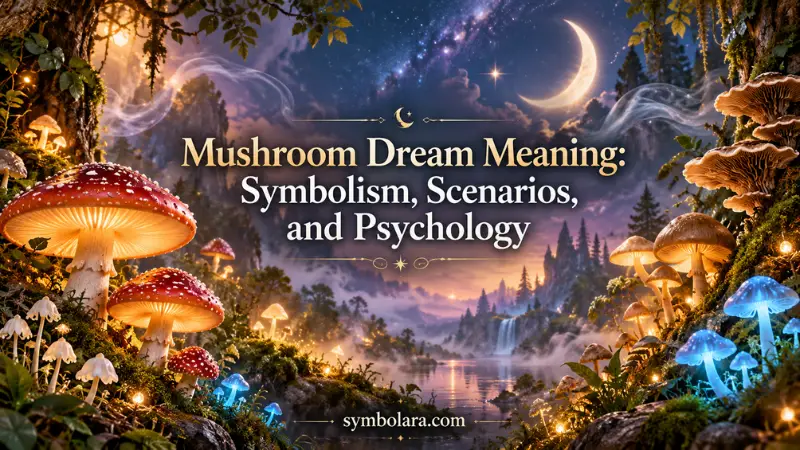
You walk through a quiet forest and notice mushrooms growing beneath the trees. Some look ordinary, while others glow in unusual colors. Perhaps you pick one, eat it, or watch dozens appear across the ground.
A dream like this can leave you feeling curious, peaceful, or strangely unsettled. Understanding mushroom dream meaning begins with the details of the experience and the feelings you remember after waking.
Mushrooms have connections to nature, hidden growth, food, decay, and fantasy. These associations can influence dream interpretations, but no scientific evidence shows that mushrooms have one fixed meaning in dreams.
Quick Answer
Mushroom dream meaning often involves possible themes of personal growth, unexpected change, hidden opportunities, or uncertainty. A pleasant mushroom dream may reflect curiosity and discovery, while a frightening one may connect with caution or unfamiliar situations.
However, these are symbolic possibilities rather than proven meanings. Your emotions, personal experiences, and the events within the dream offer the most useful context.
TL;DR
- Mushrooms may symbolize growth, transformation, uncertainty, or discovery.
- Healthy mushrooms can suggest hopeful feelings about change.
- Poisonous mushrooms may reflect caution or perceived risk.
- Recent memories and emotions can influence dream imagery.
- Mushroom folklore varies across cultures and traditions.
- Your personal associations matter more than fixed dream definitions.
What Mushroom Dreams Often Symbolize
Mushrooms grow in places that may seem dark, damp, or forgotten. Some appear quickly after rainfall, while others develop slowly through networks hidden beneath the soil. These natural features help explain why people connect mushrooms with change, discovery, and unseen development.
Growth and New Beginnings
One possible interpretation involves progress that has not yet become obvious.
For example, someone working toward a career goal might dream about mushrooms growing in a garden. They could personally connect the image with their efforts beginning to produce results.
This interpretation is symbolic, not a prediction of future success.
Hidden Opportunities
Mushrooms can remain unnoticed until someone looks closely. In dreams, discovering them beneath leaves or logs might represent finding something previously overlooked.
The opportunity could relate to a hobby, friendship, creative idea, or personal goal.
Uncertainty and Caution
Not every mushroom is safe to eat. Because edible and poisonous species can sometimes look similar, mushrooms may also suggest uncertainty.
A dream involving an unfamiliar mushroom might reflect hesitation about a decision, especially when the dreamer feels nervous.
These meanings depend on personal associations rather than any universal rule.
Why You Might Dream About Mushrooms
Sometimes the simplest explanation is the most useful.
You might dream about mushrooms after preparing dinner, visiting a farmers market, hiking through a forest, or watching a nature documentary. Images encountered during the day can reappear in dreams, often in altered forms.
Recent experiences are not the only possible influence.
A person beginning a new job might dream about unfamiliar mushrooms growing everywhere. Someone learning about mushroom identification might imagine poisonous species while sleeping.
Other possible influences include memories of childhood camping trips, fantasy movies, video games, or photographs of unusual fungi.
Emotions can also shape the dream’s atmosphere.
During a stressful week, a quiet forest might become threatening. On a relaxing vacation, the same setting could feel beautiful and welcoming.
Dreams often combine unrelated memories and feelings into unusual scenes. As a result, a mushroom dream does not necessarily indicate a major emotional issue.
Sometimes a mushroom is simply part of the brain’s imaginative activity during sleep.
Psychology Behind Mushroom Dreams
Psychology offers several ways to think about dream imagery, although none can prove what a specific mushroom represents.
Sigmund Freud viewed many dreams through the lens of unconscious wishes and conflicts. His approach encouraged people to consider whether dream images had personal associations beyond their obvious appearance.
Carl Jung placed greater importance on symbolic images and the connections people make between dreams, emotions, and life experiences.
A Jungian-style interpretation might consider whether mushrooms represent something developing outside the dreamer’s awareness.
However, neither Freud’s nor Jung’s theories establish a scientifically verified meaning for mushroom dreams.
Modern psychological approaches often place more emphasis on the connection between waking experiences and dream content.
Imagine someone who recently started a small business. They dream about discovering mushrooms growing beneath an old tree.
Rather than assigning a fixed meaning, they might explore whether the dream reminds them of patience, uncertainty, or the possibility of gradual progress.
This kind of reflection can be personally useful without proving that the dream contains a hidden message.
What Dream Science Can and Cannot Explain
Dreams involve images, emotions, thoughts, and experiences that occur during sleep.
Many vivid dreams happen during rapid eye movement (REM) sleep, a stage associated with increased brain activity and rapid eye movements.
However, dreaming also occurs during non-REM sleep.
Scientists continue to study how dreaming relates to memory, emotion, and learning. Some theories suggest dreams involve the reactivation or reorganization of waking experiences.
Researchers have also found connections between dream content and personally meaningful memories.
For instance, someone who spent the afternoon collecting photographs of mushrooms might later dream about an unfamiliar forest filled with enormous fungi.
The sleeping brain could combine recent images with older memories, emotions, and imaginative details.
This does not mean every dream has a particular purpose. Researchers have not reached a single explanation for why all dreams occur.
Most importantly, there is no established scientific meaning for seeing mushrooms in a dream.
Research can help explain why familiar objects appear in dreams. It cannot reliably determine whether a particular mushroom predicts success, danger, or a relationship change.
Common Mushroom Dream Scenarios and Their Possible Meanings
The events surrounding a mushroom often provide more useful clues than the mushroom itself.
Here are eight realistic dream situations and ways someone might understand them.
1. Dreaming About Mushrooms Growing in a Forest
Walking through a forest filled with mushrooms may create feelings of discovery, peace, or mystery.
If the surroundings feel welcoming, the dream might remind you of exploring new interests or finding opportunities in unfamiliar places.
A dark forest filled with frightening sounds may produce a different interpretation, perhaps relating to uncertainty.
Your experience with forests and outdoor activities matters greatly.
2. Dreaming About Picking Mushrooms
Collecting mushrooms may suggest careful selection, curiosity, or the satisfaction of finding something valuable.
Someone facing several career choices might associate this dream with deciding which opportunity deserves attention.
However, the meaning changes if picking mushrooms feels dangerous or difficult.
That version could reflect hesitation or concern about making the wrong choice.
3. Dreaming About Eating Mushrooms
Eating mushrooms in a dream may relate to nourishment, comfort, or trying something unfamiliar.
A delicious mushroom meal shared with family might simply reflect positive memories of food and connection.
If eating the mushrooms causes fear, the dream could instead involve uncertainty about consequences.
Consider whether the experience felt enjoyable, forced, or uncomfortable.
4. Dreaming About Poisonous Mushrooms
Poisonous mushrooms may symbolize caution in a personal interpretation.
Perhaps you recently encountered a situation that looked promising but made you suspicious.
A dream about avoiding a poisonous mushroom could reflect your attention to risk.
Still, it does not mean someone around you is dishonest or that danger is approaching.
The dream may simply borrow a familiar warning from real life.
5. Dreaming About Mushrooms Growing Rapidly
Watching mushrooms suddenly spread across the ground can feel exciting or overwhelming.
One possible association is a situation developing faster than expected.
For example, someone managing several new responsibilities might connect this image with their growing workload.
If the dream feels pleasant, rapid growth could instead suggest enthusiasm about recent progress.
The emotional tone changes the interpretation.
6. Dreaming About Giant Mushrooms
Enormous mushrooms may appear in fantasy-like dreams.
Their unusual size can create wonder, amusement, or fear.
A giant mushroom providing shelter might feel protective. One blocking your path could resemble an obstacle.
Dreams frequently exaggerate ordinary objects, so unusual size does not necessarily indicate a serious concern.
7. Dreaming About a Circle of Mushrooms
A ring of mushrooms may remind someone of fairy tales, woodland stories, or mysterious places.
In European folklore, mushroom circles have been associated with fairies and supernatural gatherings.
Someone familiar with these stories may experience the dream as magical or unsettling.
Others might simply recognize the image from a forest walk.
The folklore provides cultural context, not evidence of supernatural activity.
8. Dreaming About Colorful or Glowing Mushrooms
Brightly colored mushrooms can appear beautiful, strange, or intimidating.
Such imagery may draw on fantasy artwork, animated movies, or video games.
A person who loves fantasy adventures might experience glowing mushrooms as symbols of imagination and discovery.
Someone unfamiliar with them could feel nervous instead.
Color alone cannot determine a dream’s meaning.
Mushroom Dream Meaning at a Glance
| Dream Scenario | Possible Meaning | Emotional Association | Important Context |
| Picking mushrooms | Choosing between possibilities | Curiosity, confidence | Whether collecting felt safe |
| Eating mushrooms | Comfort or trying something new | Satisfaction, hesitation | Taste and consequences |
| Poisonous mushrooms | Awareness of possible risks | Fear, caution | Recent difficult decisions |
| Rapidly growing mushrooms | Unexpected developments | Excitement, pressure | Current responsibilities |
| Giant mushrooms | An exaggerated challenge or discovery | Wonder, anxiety | Whether they helped or blocked you |
| Mushroom circle | Mystery or familiar folklore | Curiosity, unease | Personal exposure to fairy tales |
These interpretations are possibilities for reflection, not established psychological findings.
Are Mushroom Dreams Positive or Negative?
Mushroom dreams are generally neutral until their emotional and personal context gives them significance.
A peaceful dream about collecting edible mushrooms might remind someone of abundance, family meals, or time spent outdoors.
Finding a beautiful mushroom in an unfamiliar forest could also create feelings of curiosity and independence.
Unpleasant dreams may involve different associations.
Mushrooms spreading uncontrollably through a home might represent disorder to someone who feels overwhelmed by responsibilities.
A frightening dream involving poisonous mushrooms may reflect concerns about safety or uncertainty.
However, positive imagery does not guarantee good fortune, and disturbing imagery does not predict misfortune.
A person who enjoys horror movies may even find frightening mushroom scenes entertaining rather than upsetting.
Instead of labeling the entire dream good or bad, consider how you reacted within it.
Feelings often reveal more about your personal experience than a simple positive-or-negative classification.
Mushrooms in Folklore and Spiritual Traditions
Mushrooms have symbolic roles in several cultural traditions. However, those associations should not automatically become rules for interpreting dreams.
European Fairy-Ring Folklore
In parts of European folklore, circles of mushrooms were associated with fairies or other supernatural beings.
Stories sometimes described these rings as gathering places where fairies danced.
Modern biology explains mushroom rings through fungal growth patterns rather than supernatural activity.
Still, someone who grew up hearing fairy stories may associate mushrooms with mystery, enchantment, or unfamiliar places.
Mushrooms in Chinese Symbolism
In traditional Chinese art, the lingzhi fungus has been associated with longevity, good fortune, and immortality.
Its image appears in decorative objects and artistic traditions connected with hopes for long life.
A person familiar with this symbolism might understand a lingzhi dream through associations with health or longevity.
That cultural connection does not establish a traditional dream interpretation for every mushroom species.
Contemporary Spiritual Interpretations
Some people who practice personal forms of spirituality associate mushrooms with transformation, renewal, or hidden knowledge.
These interpretations may draw on the life cycle of fungi and their relationship with decaying organic material.
However, contemporary spiritual interpretations are personal beliefs, not scientific conclusions.
It is also important not to claim that Christianity, Islam, or other major religions assign a single established meaning to every mushroom dream.
Religious discussions of dreams vary widely, and ordinary mushroom imagery does not automatically carry a sacred message.
Mushroom Dreams in American Life Today
In the United States during 2025–2026, people may encounter mushroom imagery in many different settings.
Cooking videos, hiking activities, gardening, nature photography, and mushroom-growing hobbies can all provide material for dreams.
Mushrooms also appear frequently in fantasy entertainment, video games, illustrations, and woodland-themed decorations.
Someone who enjoys this imagery might dream about glowing mushrooms or imaginary forests without connecting the experience to a personal problem.
Public interest in psychedelic mushrooms creates another possible association.
A dream involving psychedelic mushrooms might reflect curiosity, concern, a past experience, or something recently encountered in media.
Dreaming about a substance does not establish a desire to use it.
Online dream discussions may assign fixed meanings to particular mushroom colors or species.
However, these interpretations often reflect popular symbolism rather than controlled scientific research.
For American readers, the most useful approach is to compare a dream with familiar experiences instead of assuming that an online definition applies to everyone.
How Emotions and Personal History Change the Meaning
Two people can dream about the same mushroom and remember completely different experiences.
A professional chef might associate mushrooms with creativity, flavor, and preparing meals.
Someone who has studied poisonous fungi may connect the same image with safety and careful identification.
A person who loved exploring wooded areas as a child may feel nostalgic when mushrooms appear in a dream.
Another person might find damp forests uncomfortable and interpret the setting negatively.
Recent events can also change these associations.
For example, dreaming about mushrooms after a pleasant camping trip may reflect enjoyable memories. The same dream during a difficult week could feel tense because of unrelated emotional concerns.
Ask yourself which part of the experience remained most memorable.
Was it discovering the mushrooms, choosing one, feeling afraid, or enjoying the landscape?
Your response may reveal more useful personal associations than the appearance of the mushrooms alone.
Why You Keep Dreaming About Mushrooms
Recurring mushroom dreams can feel unusual, especially when similar scenes appear several times.
Repeated dreams sometimes contain themes connected with ongoing waking experiences or emotional concerns.
A person who regularly hikes, studies fungi, or works with mushrooms may simply have more mushroom-related memories available for dream imagery.
Someone experiencing repeated uncertainty might also notice themes of searching, choosing, or avoiding danger in different dreams.
However, the repeated appearance of mushrooms does not establish which explanation is correct.
Sleep patterns may affect how often dreams are remembered.
Waking during or shortly after a vivid dream can make its details easier to recall.
Keeping a record of recurring dreams may help identify repeated locations, emotions, and situations.
If mushroom dreams become frequent nightmares that disturb sleep or affect daily activities, speaking with a qualified healthcare professional may be helpful.
Recurring dreams alone are not evidence of a psychological disorder or an approaching event.
Common Misunderstandings About Mushroom Dreams
Several popular claims about mushroom dreams deserve careful attention.
Myth: Mushrooms always symbolize wealth.
Mushrooms may suggest abundance to some dreamers, but they do not reliably predict money or financial success.
Myth: Poisonous mushrooms predict betrayal.
A frightening mushroom might reflect suspicion or caution. It does not prove that someone intends to deceive you.
Myth: Giant mushrooms indicate a major life transformation.
Large dream objects can result from ordinary imagination and exaggerated imagery during sleep.
Myth: Every mushroom dream has a spiritual meaning.
Some individuals interpret mushrooms spiritually, but others associate them with food, hobbies, nature, or recent memories.
Myth: Dream interpretation can reveal a medical diagnosis.
A mushroom dream cannot establish whether someone has a physical or psychological condition.
Separating imaginative interpretations from reliable evidence helps keep dream reflection useful and realistic.
How to Make Sense of Your Own Mushroom Dream
Begin by recalling what happened before you woke up.
Rather than searching immediately for a fixed interpretation, try describing the experience in ordinary language.
For example, you might remember walking into a forest, finding several mushrooms, and feeling unsure which ones were safe to touch.
Next, consider your strongest emotion.
Were you excited, relaxed, nervous, surprised, or frightened?
Think about recent experiences that may relate to those feelings.
Perhaps you recently had to choose between unfamiliar options, watched a documentary about fungi, or visited a wooded area.
These connections are possibilities, not proof that the dream represents a particular concern.
A dream journal can make this process easier.
Write down the location, people, objects, actions, and emotional details soon after waking. If similar dreams return, compare what remains consistent and what changes.
Avoid forcing an interpretation when no meaningful connection appears.
Sometimes remembering an imaginative dream is interesting enough without needing to explain every detail.
FAQs
Seeing mushrooms may suggest growth, curiosity, hidden possibilities, or uncertainty in a personal symbolic interpretation. The meaning depends on the dream setting, your feelings, and your associations with mushrooms.
A pleasant mushroom dream may feel encouraging, especially when it involves discovery or enjoyable experiences. However, dreams do not scientifically establish whether future events will be positive or negative.
Eating mushrooms may remind you of nourishment, comfort, or trying something unfamiliar. Whether the food tasted good, caused concern, or appeared in a familiar setting can influence your interpretation.
Poisonous mushrooms might reflect caution, uncertainty, or an imagined threat. They do not prove that danger, betrayal, or illness will occur in waking life.
Some contemporary spiritual interpretations connect mushrooms with renewal, transformation, and hidden knowledge. These associations depend on personal and cultural beliefs rather than universally established religious teachings.
Repeated mushroom imagery may relate to familiar interests, memories, emotions, or ongoing experiences. Recording the details can help you notice patterns, but repetition alone does not establish a specific meaning.
There is no reliable scientific evidence that mushroom dreams predict future events. Their imagery may reflect memories, emotional associations, and creative activity during sleep.
Conclusion
Mushroom dream meaning can involve possible associations with growth, discovery, caution, transformation, or unfamiliar experiences. Yet no single interpretation applies to everyone, and a dream about mushrooms does not predict what will happen next.
Psychology and sleep research help explain how memories, emotions, and personal experiences can shape dreams. Cultural folklore offers additional symbolic perspectives, but these beliefs should remain separate from scientific findings.
When reflecting on a mushroom dream, pay attention to what happened, how you felt, and whether the imagery connects with your waking life. Those details provide a more grounded starting point than treating every mushroom as a symbol with one fixed meaning.