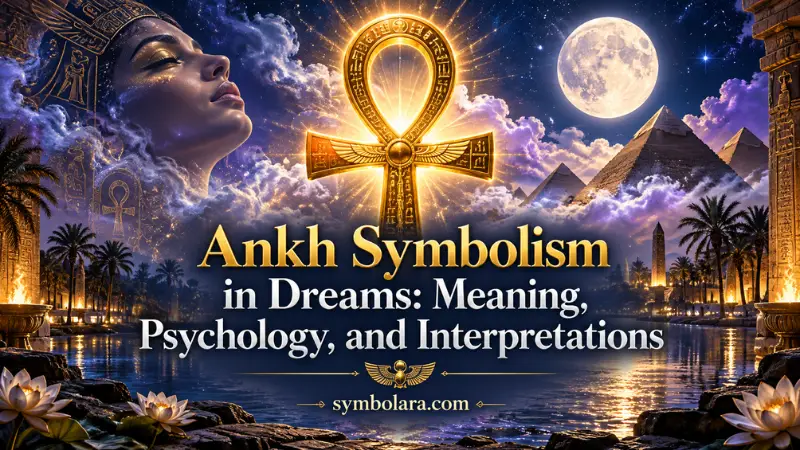
Imagine walking through an ancient Egyptian temple in a dream. You notice a golden cross with a loop at the top, glowing against a stone wall. Perhaps someone places it in your hand, or you wake up remembering its unusual shape. This experience may leave you curious about Ankh symbolism and what the image could represent.
The ankh is an ancient Egyptian symbol associated with life, vitality, and continued existence after death. Its long history gives it strong cultural meaning, but seeing it during sleep does not automatically carry a spiritual message.
Dreams can combine familiar images, recent memories, emotions, and unexpected details. For someone in the United States, an ankh might recall a museum visit, a piece of jewelry, a tattoo, or an interest in Egyptian history.
Understanding the dream begins with two questions: What does the ankh mean historically, and what did it mean to you when you saw it?
Quick Answer
Ankh symbolism in dreams is commonly interpreted as representing life, renewal, personal growth, or a desire for stability. A comforting dream might reflect hope during a life transition, while an unsettling one could relate to uncertainty, loss, or change. These are possible personal interpretations, not scientifically proven meanings, and the dreamer’s experiences and emotions matter most.
TL;DR
- Central meaning: The ankh traditionally represents life and continued existence.
- Emotional connection: Ankh dreams may accompany hope, uncertainty, or personal change.
- Psychology: Memories and recent experiences can influence dream imagery.
- Cultural history: Ancient Egyptians connected the ankh with life and divine protection.
- Dream scenarios: Receiving, losing, or wearing an ankh may feel different.
- Practical advice: Consider your emotions before accepting a symbolic interpretation.
What Does Dreaming About an Ankh Usually Mean?
The ankh’s historical association with life makes renewal one possible interpretation when it appears in dreams. Someone recovering from a difficult period might connect the image with beginning again or feeling more hopeful.
However, dream meanings are not fixed. A person who recently studied Egyptian artifacts may dream about an ankh simply because the symbol remains fresh in memory.
Several interpretations are worth considering.
Life and renewal: An ankh may remind someone of new opportunities, recovery, or the importance of living fully.
Continuity and remembrance: Because the symbol was connected with life beyond death in ancient Egyptian religion, some people associate it with remembering loved ones or reflecting on mortality.
Protection and reassurance: Someone familiar with Egyptian amulets might experience the ankh as a comforting image.
Knowledge and curiosity: A dream featuring an ankh inside a temple may reflect an interest in history, culture, or unfamiliar ideas.
Consider a person who recently changed careers. Dreaming about receiving an ankh could feel like a symbol of fresh possibilities. Someone grieving a relative might interpret the same image through memories and questions about life and death.
Neither interpretation can be confirmed by the symbol alone.
Why Might an Ankh Appear in Your Dreams?
Dreams often borrow images from waking life, including details that seemed unimportant when they first appeared.
You might have noticed an ankh in a movie, museum, textbook, or social media post. Even brief exposure can make an image familiar enough to appear later in a dream.
Other possible influences include:
- Watching a documentary about ancient Egypt.
- Seeing an ankh necklace or tattoo.
- Reading about Egyptian gods and religious practices.
- Thinking about personal changes or long-term goals.
- Remembering someone who wore Egyptian-inspired jewelry.
- Exploring spiritual beliefs or cultural history.
Emotional experiences may also influence the dream’s setting.
For example, someone worried about an aging parent might dream about symbols associated with life. The ankh could appear because of its familiar meaning, but the dream does not establish that a specific concern caused it.
Sometimes, the explanation is simpler. The sleeping mind combines unrelated details into unusual scenes without any clear symbolic purpose.
Psychological Interpretations of Ankh Dreams
Psychology offers several ways to think about meaningful dream images. These approaches differ in how much scientific support they have.
Jung’s Approach to Symbols
Psychologist Carl Jung viewed dreams as possible expressions of psychological themes. His theories often considered how cultural symbols and personal experiences could shape dream imagery.
From a Jungian perspective, an ankh might invite reflection on life, change, or the relationship between beginnings and endings.
This remains a theoretical interpretation. Jung’s ideas do not establish that everyone who dreams about an ankh shares the same psychological experience.
Freud’s Historical Perspective
Sigmund Freud believed dreams could express wishes and conflicts that people did not fully recognize while awake.
A Freudian interpretation would focus less on the ankh’s dictionary meaning and more on the dreamer’s personal associations.
For example, a necklace given by a former partner might connect the image with memories of that relationship.
Freud’s approach is historically important, but it cannot reliably identify a person’s feelings from one dream symbol.
Modern Psychological Thinking
Modern dream research often examines connections between dream content, memory, and waking experiences.
One relevant idea is the continuity hypothesis, which suggests that dreams often reflect parts of everyday life, including personal concerns and interests.
Under this view, the ankh may appear because it connects with something meaningful or memorable in the dreamer’s life.
The image does not need to represent an unconscious problem. It might simply reflect curiosity about Egyptian culture.
What Modern Dream Science Actually Suggests
Researchers have learned a great deal about when dreams happen, although their exact purposes remain debated.
Vivid, emotional dreams commonly occur during rapid eye movement sleep, known as REM sleep. However, dreaming can also happen during non-REM sleep.
During sleep, the brain remains active. Memories, emotions, and familiar images may contribute to dream experiences.
Memory and Dream Imagery
Sleep supports memory processing. Research has also found connections between waking experiences and dream content.
A person who spends an afternoon studying Egyptian artifacts might later dream about a temple or an ankh-shaped object.
That connection is plausible, but it does not mean the brain must be delivering a hidden message.
Emotion and Unusual Dream Scenes
Dreams can combine ordinary memories with unexpected situations.
Someone might dream of holding a golden ankh while standing in a childhood bedroom. The setting may reflect familiar memories, while the symbol comes from something recently seen.
Researchers continue to investigate how dreams relate to emotional processing. They have not established that individual symbols reveal specific emotional states.
There is no established scientific meaning for dreaming about an ankh. Its interpretation cannot be determined through the shape, color, or location of the symbol alone.
Common Ankh Dream Scenarios and Their Possible Meanings
The events surrounding an ankh often provide more useful context than the symbol by itself.
Dreaming About a Golden Ankh
You might see a bright golden ankh resting on a table or shining inside a temple.
Gold may suggest value, admiration, or importance because of its familiar cultural associations.
If the image feels beautiful or comforting, you might connect it with hope or something personally meaningful.
However, a glowing object can also be an ordinary feature of vivid dream imagery. Its appearance does not confirm a spiritual experience.
Dreaming About Wearing an Ankh Necklace
Wearing an ankh necklace may feel connected to identity, personal values, or cultural interests.
Someone who already wears similar jewelry might simply dream about a familiar possession.
For another person, the necklace could represent a wish to feel secure or connected to a meaningful tradition.
Notice whether wearing it felt natural, comforting, or uncomfortable.
Dreaming About Receiving an Ankh
Imagine someone placing an ankh in your hand.
A gift often brings attention to the relationship between the giver and receiver. If a loved one offers the symbol, the experience might evoke affection or support.
Receiving it from a stranger could feel mysterious, confusing, or exciting.
The person’s identity and your reaction are more informative than assuming the gift predicts good fortune.
Dreaming About an Ankh in an Egyptian Temple
An ankh appearing on a temple wall may connect with memories of Egyptian history, archaeology, or historical films.
A peaceful temple could reflect curiosity or admiration.
A dark, unfamiliar temple might create uncertainty, especially if you cannot find your way out.
The emotional effect of the setting matters more than the ancient appearance of the symbol.
Dreaming About a Broken Ankh
A damaged ankh might feel disturbing because the original symbol represents life.
Someone facing a major change could associate the broken object with uncertainty or losing something important.
Still, a broken ankh does not predict illness, death, or misfortune.
It might simply be part of a dream involving damaged objects or unexpected events.
Dreaming About Losing an Ankh
Searching for a missing ankh may feel frustrating, especially if the object belonged to someone important.
The dream could connect with worries about responsibility, memory, or losing a valued possession.
If you recently misplaced jewelry, the explanation may be straightforward.
The dream’s emotional pattern matters more than treating the lost symbol as a warning.
Dreaming About an Ankh Tattoo
An ankh tattoo may draw attention to identity, self-expression, or a personal commitment.
If you are considering a tattoo, the dream might reflect that decision.
Seeing the symbol on another person’s body could remind you of someone familiar or of a design you recently noticed.
A tattoo dream does not establish that you should make a permanent change.
Ankh Dream Meaning at a Glance
| Dream Scenario | Possible Meaning | Emotional Association | Important Context |
| Golden ankh | Something personally valuable | Wonder, happiness | Recent interests or achievements |
| Wearing ankh jewelry | Identity or belonging | Confidence, comfort | Personal values and possessions |
| Receiving an ankh | Support or connection | Gratitude, curiosity | Identity of the giver |
| Broken ankh | Concern about change | Sadness, uncertainty | Current worries or recent loss |
| Lost ankh | Fear of losing something valued | Frustration, worry | Memories and responsibilities |
| Ankh in a temple | Interest in history or belief | Curiosity, awe | Recent cultural exposure |
These possibilities are prompts for personal reflection, not established dream interpretations.
Positive, Negative, and Emotional Meanings
Ankh dreams can feel positive, negative, or neutral. Their emotional tone depends on the surrounding events and the dreamer’s response.
A peaceful dream about receiving an ankh may feel reassuring. Someone beginning a new job or relationship might connect that comfort with personal growth.
A frightening dream involving a broken ankh might bring up concerns about change or losing control.
Neither emotional response proves that the dream predicts a real event.
Personal associations can also reverse the expected meaning.
For someone who treasures Egyptian history, an ankh might bring happiness. Another person may associate Egyptian imagery with a frightening movie and experience discomfort.
Even the same person can respond differently at different points in life.
Rather than asking whether the ankh is automatically a good or bad sign, consider how the experience felt and why that feeling seems familiar.
Ancient Egyptian History and Cultural Symbolism
The ankh is one of the most recognizable symbols from ancient Egypt.
Its shape resembles a cross with a loop above the horizontal bar. In Egyptian hieroglyphic writing, it represented words connected with life and living.
Ancient Egyptian artwork frequently shows gods holding ankhs. In some temple scenes, a deity presents the symbol to a king, expressing the gift of life.
Artists sometimes positioned an ankh near a person’s nose, connecting the symbol with the breath of life.
The ankh also appeared in funerary settings and amulets. These uses reflected Egyptian religious beliefs about continued existence and well-being beyond death.
What Does the Shape Represent?
The exact origin of the ankh’s shape remains uncertain.
One historical explanation connects it with a sandal strap. Other interpretations have been proposed, but scholars have not established one definitive origin.
Modern explanations sometimes describe its loop and crossbar as representing male and female forces or the union of opposites.
These interpretations should not automatically be treated as documented original meanings.
Did Ancient Egyptians Interpret Ankh Dreams?
Ancient Egyptians did practice dream interpretation.
A surviving manuscript known as the Chester Beatty III Dream Book, dating to the New Kingdom, records interpretations of various dream experiences.
However, the existence of ancient Egyptian dream manuals does not establish a specific traditional meaning for seeing an ankh during sleep.
The symbol’s documented meaning in art and religion should not be confused with a historically verified dream interpretation.
Spiritual and Religious Interpretations
The ankh’s religious history explains why some people view dreams featuring it as spiritually meaningful.
In ancient Egyptian religion, the symbol represented life and was associated with divine power and continued existence after death.
A modern person who follows an Egyptian-inspired spiritual practice may interpret an ankh dream through those beliefs.
Someone else might see it as an expression of hope or respect for life’s importance without attaching any supernatural meaning.
The Ankh and Christianity
In Egyptian Christian history, the looped cross form was also adopted in some Coptic artistic contexts. It is often called the crux ansata, meaning a cross with a handle.
However, the ancient Egyptian ankh and the Christian cross belong to different religious traditions.
Their historical connections do not establish a standard Christian interpretation of an ankh dream.
Modern Spiritual Beliefs
Some contemporary spiritual interpretations associate the ankh with renewal, protection, or eternal life.
These associations often draw on its Egyptian background and later symbolic uses.
They may be meaningful to individuals, but they are not scientific evidence that a dream involves divine communication.
A person can appreciate the symbol’s spiritual significance while recognizing that a dream cannot prove supernatural contact.
How Americans Interpret Ankh Dreams Today
In the United States, people encounter the ankh through several cultural settings.
Museums, school history lessons, Egyptian-inspired movies, jewelry, artwork, and tattoos all introduce the symbol to different audiences.
Its meaning often changes depending on where someone first encountered it.
Jewelry, Tattoos, and Personal Identity
For some Americans, an ankh necklace represents an interest in ancient Egyptian culture. Others wear it because of its association with life or personal renewal.
The symbol also has a place in some Black American cultural and spiritual expressions, where Egyptian and broader African historical imagery can hold special significance.
These connections vary between individuals and communities. They should not be treated as one shared belief.
Someone who wears an ankh to express cultural identity may experience a dream involving it differently from someone who recognizes it only as a historical artifact.
Movies, Games, and Online Images
Egyptian symbols frequently appear in entertainment.
A film featuring ancient tombs or a game involving Egyptian mythology can make the ankh visually memorable.
Online discussions may assign meanings such as spiritual awakening or protection to ankh dreams.
Those explanations can reflect personal beliefs or modern symbolism, but they are not verified findings about how dreams work.
Everyday American Experiences
Consider a college student preparing a presentation on Egyptian history. A dream involving an ankh may reflect recent study.
Someone choosing an ankh tattoo might dream about the design before an appointment.
A person attending an Egyptian museum exhibition could remember an ankh-shaped amulet later that night.
These ordinary examples show why recent experiences deserve attention before applying a broad spiritual interpretation.
Why You Might Keep Dreaming About an Ankh
Recurring dreams sometimes share similar images, settings, or emotional situations.
If an ankh appears repeatedly, consider whether it connects with something you encounter often.
A recurring image might relate to an ongoing interest, a memorable experience, or a concern that remains important in daily life.
Sleep patterns may also affect dream recall. People who wake during or shortly after a vivid dream may remember it more clearly.
Repetition does not prove that the symbol carries an urgent warning.
Instead, compare the details across dreams.
Does the ankh always appear in the same location? Are you holding it, searching for it, or observing it from a distance?
Notice whether the feelings remain consistent or change over time.
If repeated dreams become frightening, interrupt sleep, or cause lasting distress, speaking with a qualified health professional may help. Treatments are available for persistent nightmares, including approaches that work with troubling dream imagery.
Common Misunderstandings About Ankh Dreams
Several popular assumptions can make dream interpretation unnecessarily confusing.
Misunderstanding 1: An ankh dream predicts eternal life or good fortune.
The symbol’s historical association with life does not make dreams predictive.
Misunderstanding 2: A broken ankh warns about death.
There is no scientific evidence supporting this interpretation. A damaged object in a dream should not be treated as a forecast.
Misunderstanding 3: Every ankh dream has a spiritual meaning.
The image may come from ordinary memories, recent entertainment, or personal interests.
Misunderstanding 4: Ancient Egyptians recorded a universal meaning for ankh dreams.
Although ancient Egyptian dream interpretation is documented, a universal interpretation of this particular dream image is not established.
Misunderstanding 5: Psychologists can diagnose problems from the symbol.
No recognized psychological diagnosis can be made simply because someone dreams about an ankh.
How to Understand Your Own Ankh Dream
A useful interpretation starts with remembering what actually happened rather than choosing a symbolic meaning immediately.
Try these practical steps:
- Record the main scene. Write down where the ankh appeared and what happened around it.
- Describe your feelings. Did you experience comfort, fear, curiosity, sadness, or excitement?
- Identify familiar details. Consider whether the place, people, or objects resemble recent experiences.
- Think about personal associations. What does the ankh mean to you outside the dream?
- Consider recent events. Have you been studying Egypt, shopping for jewelry, or thinking about a major life change?
- Look for recurring patterns. If the dream returns, compare its emotional tone and setting.
A dream journal can help preserve details that might otherwise fade after waking.
For example, you may initially remember only receiving an ankh. After writing down the scene, you might recall that the person giving it to you resembled a family member.
That relationship could provide a more meaningful point for reflection than the object’s historical meaning alone.
Still, journaling cannot prove that a specific symbol represents a particular emotion.
You do not need to interpret every detail. Sometimes, a memorable dream is simply an unusual combination of familiar images.
FAQs
An ankh may represent life, renewal, or personal significance because of its ancient Egyptian associations. The dream’s emotional meaning depends on your memories, beliefs, and the events surrounding the symbol.
Some people view the image positively because it traditionally represents life. However, dreams do not reliably predict good or bad events, and an uncomfortable ankh dream does not automatically indicate danger.
A golden ankh might remind you of something valuable, admired, or personally important. Its meaning could also reflect recent exposure to gold-colored Egyptian artifacts or jewelry.
Some contemporary spiritual interpretations connect the symbol with renewal or personal transformation. There is no scientific method for confirming spiritual awakening from dream imagery alone.
Repeated appearances may relate to familiar memories, ongoing interests, or emotional experiences. Recording each dream can help you notice patterns, although repetition does not establish one fixed meaning.
A broken ankh might bring up feelings about uncertainty, change, or losing something meaningful. It does not predict death, illness, or another negative event.
Yes. You might connect the image with history, art, cultural identity, or personal experiences without holding spiritual beliefs. Such interpretations can be meaningful as personal reflections even when they are not scientifically proven.
Conclusion
Ankh symbolism in dreams often invites reflection on life, renewal, continuity, and personal change. These possible meanings come partly from the symbol’s ancient Egyptian history and partly from the associations people develop through their own experiences.
Modern dream research suggests that memories, emotions, and everyday events can influence what people see during sleep. Historical religious meanings and modern spiritual interpretations offer different perspectives, but neither establishes a universal explanation for an individual dream.
The most useful place to begin is with what you remember: where the ankh appeared, how you felt, and whether the scene connects with something in your waking life.