
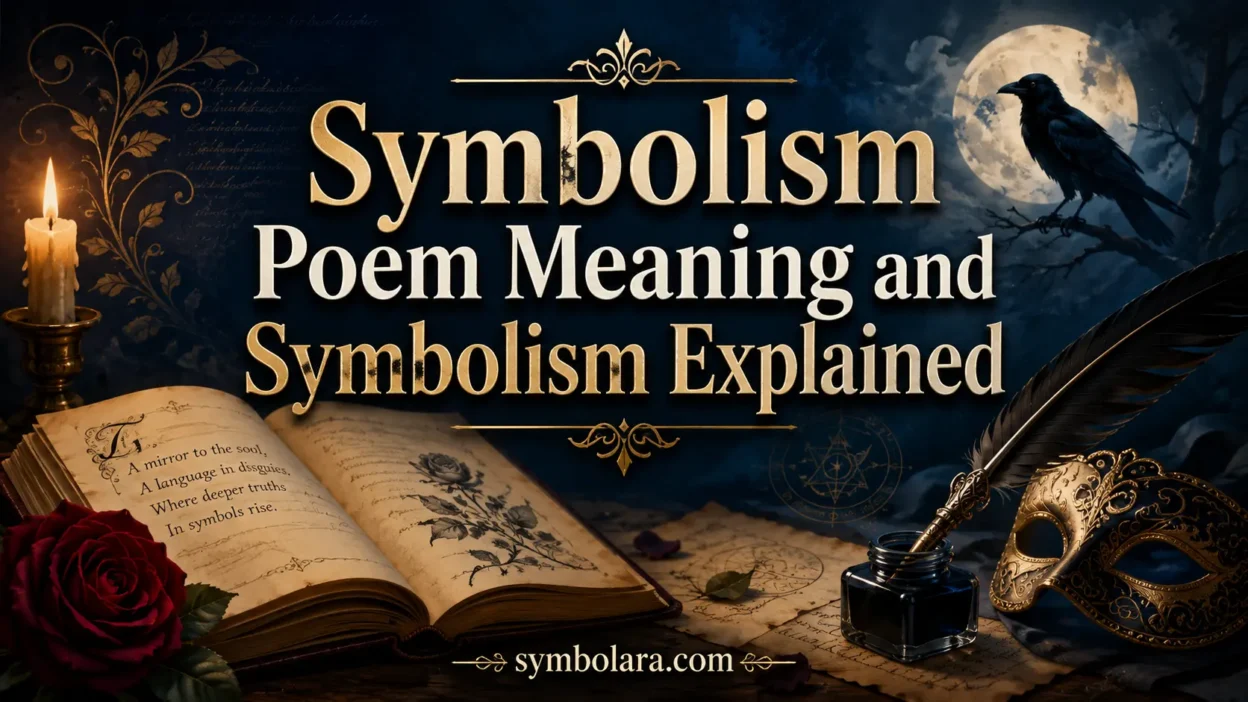
A Symbolism Poem is a poem that uses objects, images, colors, animals, seasons, places, or actions to suggest ideas beyond their literal meaning. Readers care about this kind of poem because it turns ordinary details into carriers of memory, grief, love, faith, identity, conflict, or hope.
In modern American culture, symbolic poetry shows up in classrooms, wedding readings, memorial services, social media captions, protest art, tattoos, song lyrics, and spoken-word performances. It gives people a way to say something emotionally precise without explaining every feeling directly.
Symbolic poems matter because they invite readers to participate. A rose may be a flower, but in a poem it can also carry romance, loss, beauty, fragility, secrecy, or remembrance depending on the context.
Quick Answer
A Symbolism Poem commonly symbolizes layered emotion, personal experience, or cultural meaning expressed through concrete images rather than direct explanation. Historically, symbolic poetry is tied to older religious, mythic, and literary traditions, as well as the late nineteenth-century Symbolist movement, which emphasized suggestion, atmosphere, and indirect meaning.
TL;DR
- Symbols make abstract emotions easier to picture.
- Meaning depends on context, culture, and tone.
- Symbolic poetry has ancient and modern roots.
- Americans often meet it in school and ceremonies.
- Modern use includes tattoos, captions, and public art.
- Overreading can distort a poem’s actual meaning.
What a Symbolic Poem Actually Is
A symbolic poem is built around images that work on two levels at once. On the surface, the poem may describe a bird, a road, a candle, a storm, or a house. Beneath that surface, the image points toward something less visible: freedom, choice, mortality, memory, safety, spiritual longing, or emotional change.
The important point is that a symbol is not just a decorative detail. It must matter to the poem’s larger meaning. A tree may simply be part of a landscape, but if the poem connects that tree to family roots, aging, endurance, or seasonal renewal, it begins to function symbolically.
Good symbolic poetry does not usually decode itself in a mechanical way. It leaves room for interpretation while still giving readers enough clues to make a thoughtful reading.
Why Symbols Matter in Poetry
Poetry often works by compression. A poem may have only a few lines, but a single image can carry more emotional weight than a long explanation. This is why symbols are so useful: they let poets place complex feelings inside visible things.
A cracked cup can suggest a damaged relationship. A locked door can suggest exclusion, secrecy, fear, or protection. A river can suggest time, movement, cleansing, danger, or passage from one stage of life to another.
Symbols also help readers feel meaning before they fully explain it. The reader may sense loneliness in an empty room or hope in a window filled with morning light. That emotional recognition is part of what makes poetry memorable.
What It Commonly Means in the United States
In the United States, a poem based on symbolism is most often understood as a poem that asks readers to look beneath the literal image. American students are commonly taught to notice repeated objects, colors, settings, and contrasts as clues to theme. That classroom habit has shaped how many Americans approach poetry throughout adulthood.
Outside school, symbolic poems are often associated with personal expression. People use them at funerals to speak about grief without naming every pain. They use them at weddings to suggest commitment, growth, and shared life. They share them online when a symbolic image says more than a plain statement would.
In everyday American reading, symbolic poetry usually means “this image stands for something more.”
How Symbolism Looks on the Page
Symbolism in poetry is often quiet. It may appear as a repeated image, a surprising object, a color pattern, or a setting that changes with the speaker’s mood. Unlike a direct statement, a symbol gathers meaning through placement and repetition.
For example, if a poem opens with a porch light, returns to that light in the middle, and ends with it burning out, readers may connect the light with welcome, family, memory, or fading connection. The poem does not need to announce that meaning.
Sound can strengthen symbolism too. Soft sounds may make an image feel tender or mournful. Harsh sounds may make the same image feel threatening. Line breaks, silence, and rhythm all influence how symbolic meaning lands.
Difference Between Symbolism and Metaphor in Poetry
Symbolism and metaphor are related poetry techniques, but they are not exactly the same. Symbolism uses an image, object, person, or action to represent a deeper idea throughout a poem. A metaphor directly compares one thing to another to create meaning.
For example, a poet may use a rose as a symbol of love, memory, beauty, or loss throughout an entire poem. A metaphor might say, “Her heart was a rose,” creating a direct comparison between the heart and the qualities associated with a rose.
The main difference is that symbolism often develops through context and repetition, while metaphor usually creates meaning through comparison. Many poems use both techniques together because they help writers express complex thoughts in a powerful way.
Ancient Roots of Symbolic Writing
Symbolic poetry is older than modern literary criticism. Ancient religious songs, myths, epics, and oral traditions often used natural images to express spiritual or social meaning. Light could suggest divine presence. Water could suggest cleansing, danger, birth, or renewal. Mountains could suggest distance from ordinary life or closeness to sacred power.
In many traditions, symbols helped people remember stories before widespread literacy. A repeated animal, color, plant, or celestial image could carry a shared meaning across generations.
This does not mean every symbol has one universal meaning. Ancient symbols were shaped by climate, religion, geography, politics, and daily life. A snake, for example, might suggest danger in one tradition, wisdom in another, and renewal in another because of its shedding skin.
The French Symbolist Movement and Modern Poetry
The term “Symbolist” is especially connected with late nineteenth-century French poetry. Writers associated with that movement favored suggestion, dreamlike imagery, musical language, and the emotional power of association over straightforward realism. Major figures included poets such as Charles Baudelaire, Stéphane Mallarmé, Arthur Rimbaud, and Paul Verlaine.
This movement mattered because it changed what many poets believed poetry could do. Instead of describing the world as plainly as possible, Symbolist poets treated the visible world as a doorway into states of mind, spiritual uncertainty, desire, decay, beauty, and alienation.
Their influence reached beyond France. Symbolist ideas helped shape later modernist poetry, where fragments, images, mythic echoes, and indirect meaning became central techniques.
American Poetry and the Language of Symbols
American poetry has its own symbolic habits. Walt Whitman turned grass, the body, roads, crowds, and democratic space into images of national identity and human connection. The Library of Congress notes that Whitman’s self-presentation in Leaves of Grass helped create an image of the American poet as a rough, ordinary, democratic figure.
Emily Dickinson often used small domestic or natural images—flies, birds, doors, rooms, light, and storms—to approach death, faith, doubt, and consciousness. Robert Frost’s roads, woods, walls, and winter landscapes are frequently read symbolically, though his poems often resist simple one-answer interpretations.
In the United States, this makes symbolic poetry feel both literary and familiar. It belongs to anthologies, but it also belongs to ordinary things: fences, fields, kitchens, highways, porches, and weather.
Common Symbols Readers Recognize
Some symbols appear so often that many American readers recognize them quickly. A rose often suggests love, beauty, or remembrance. A dove often suggests peace. A road often suggests choice, journey, or life direction. Darkness may suggest fear, confusion, grief, secrecy, or the unknown. Light may suggest knowledge, hope, revelation, safety, or spiritual presence.
Still, familiar symbols should not be read automatically. A rose in a love poem may suggest romance, but a wilted rose in a hospital room may suggest decline or mourning. A road may suggest freedom in one poem and exile in another.
The strongest interpretation always comes from the poem itself. Tone, setting, speaker, and surrounding images matter more than a general symbol dictionary.
Examples of Symbolism Poems and Their Meanings
Symbolism becomes easier to understand when readers see how poets use images to create meaning. Famous poems often use simple objects or scenes to represent larger human experiences.
Examples include:
- “The Road Not Taken” by Robert Frost: The road is commonly interpreted as a symbol of choices, decisions, and personal direction. However, the poem also questions whether people can truly understand the importance of their choices.
- “Because I Could Not Stop for Death” by Emily Dickinson: The carriage ride and journey imagery represent the movement from life toward death and the human attempt to understand mortality.
- “I Wandered Lonely as a Cloud” by William Wordsworth: Daffodils become symbols of memory, beauty, and emotional renewal.
These examples show that symbols rarely have only one meaning. A road is not always about choices, and flowers are not always about beauty. Poets create meaning by connecting images with emotion, setting, and the speaker’s experience.
Meaning in Different Contexts
| Context | Meaning in the USA | Common Associations | Notes |
| Classroom poetry | Hidden or layered meaning | Theme, imagery, interpretation | Often taught through close reading |
| Memorial poems | Grief and remembrance | Flowers, candles, seasons, birds | Symbols soften direct expressions of loss |
| Wedding poems | Commitment and shared future | Rings, trees, gardens, light | Meaning depends on tone and tradition |
| Protest poetry | Identity and resistance | Flags, streets, bodies, fire | Symbols can become public and political |
| Social media captions | Personal mood or transformation | Moons, storms, butterflies, roads | Often brief, visual, and emotionally coded |
How Symbols Carry Emotion
Symbols are emotionally useful because they give feeling a shape. Grief can be hard to describe, but an empty chair, a silent phone, or a winter field can make absence visible. Hope can sound abstract, but a seed, sunrise, open window, or returning bird gives it a form.
This is why symbolic poems often feel intimate. They do not tell readers exactly what to feel. Instead, they create an emotional environment where readers recognize something from their own lives.
Psychologically, symbols also allow distance. A person may not be ready to say “I am afraid of change,” but they may write about a bridge, a storm, or a door that will not open. The symbol carries what direct speech cannot yet handle.
Types of Symbolism Used in Poetry
Symbolism in poetry appears in many forms because poets use different parts of life to represent deeper ideas. Some symbols come from nature, while others come from human experiences, objects, or cultural traditions.
Common types of symbolism in poetry include:
- Nature symbolism: Trees, flowers, oceans, storms, and seasons often represent growth, change, emotions, or cycles of life.
- Animal symbolism: Birds, wolves, butterflies, and other animals may represent freedom, strength, transformation, loyalty, or instinct.
- Color symbolism: Colors such as white, black, red, and blue often create emotional associations related to purity, mystery, passion, sadness, or calm.
- Object symbolism: Everyday items like keys, mirrors, clocks, doors, and candles can represent ideas such as opportunity, identity, time, change, or hope.
- Religious and cultural symbolism: Images connected to faith, traditions, and historical events may carry meanings shaped by communities.
A single symbol can belong to more than one category. A candle, for example, may represent remembrance at a memorial, celebration at a birthday, or spiritual meaning in a religious setting. The poem’s context determines which meaning becomes strongest.
Symbolic Poems in Classrooms and Public Culture
Many Americans first learn symbolic poetry in school. Teachers often ask students to identify images, explain what they may represent, and connect those meanings to the poem’s theme. This can be helpful when it teaches careful reading, but it can become limiting if students think every object has one fixed answer.
Poetry also has a public life in the United States. National Poetry Month, launched in 1996, is observed each April by schools, libraries, publishers, booksellers, poets, and cultural organizations. In 2026, it marked its thirtieth year.
Public poetry projects show how symbolism still matters outside textbooks. Poems installed in parks, displayed in transit systems, or read at civic events often use landscape, weather, animals, and everyday objects to connect private feeling with shared public space.
Tattoos, Jewelry, Decor, and Social Media
Symbolic poems often move beyond the page. A short line from a poem may become a tattoo because it connects with survival, grief, love, identity, or transformation. People may choose images from poems—birds, moons, flowers, waves, trees, hands, stars—because those images feel personal without being too literal.
Jewelry and home decor use similar symbolic language. A framed poem about roots may hang in a family home. A moon charm may suggest change or intuition. A pressed flower beside a poem may suggest memory, tenderness, or a specific relationship.
On social media, symbolic poetry is often condensed into short posts. Images of storms, oceans, candles, and roads appear with poetic lines because they allow users to communicate mood quickly and visually.
Cross-Cultural and Religious Meanings
Symbolic poems often draw from religious and cultural traditions, but meanings vary widely. Water may suggest baptism, purification, birth, danger, or grief depending on the cultural setting. Fire may suggest divine presence, destruction, passion, punishment, or renewal. Birds may suggest the soul, freedom, prophecy, migration, or fragility.
In Christian contexts familiar to many Americans, light often suggests divine truth, guidance, or hope. In broader spiritual or secular poetry, light may suggest clarity, recovery, or understanding. In Indigenous, African American, Jewish, Buddhist, Hindu, Islamic, and other traditions, symbols carry meanings shaped by specific histories and practices.
Cultural respect matters. A symbol borrowed from a living tradition should not be treated as a vague aesthetic object. Its original context may be central to its meaning.
Common Misunderstandings and Misuse
The most common misunderstanding is assuming that symbols work like code. A poem is not usually a puzzle where “bird equals freedom” every time. Birds can suggest freedom, but they can also suggest hunger, migration, surveillance, fragility, death, song, or spiritual presence.
Another mistake is forcing symbolism onto every detail. Some details create setting, rhythm, realism, or mood without carrying a major symbolic burden. Good interpretation notices patterns rather than grabbing one object and assigning it a meaning too quickly.
Misuse can also happen when symbols are stripped from their cultural or historical setting. Religious symbols, Indigenous imagery, mourning symbols, and protest symbols can be distorted when used only for decoration or shock value.
How Meaning Has Changed Over Time
In older poetry, symbols were often tied to shared religious, mythic, or social systems. Readers could recognize a lamb, crown, garden, serpent, or pilgrimage through widely taught traditions. Meaning was not always simple, but many symbols had strong communal associations.
Modern poetry often treats symbols more personally. A poet may turn a refrigerator magnet, bus stop, hoodie, cracked phone screen, or fast-food sign into a symbol of class, memory, loneliness, or belonging. The symbolic world has expanded with modern life.
Digital culture has changed symbolic reading too. Emojis, memes, profile images, and visual captions have trained people to read small images as emotional signals. That habit makes symbolic poetry feel surprisingly current, even when its roots are ancient.
How to Read a Symbol Without Overreading It
A careful reader starts with the literal image. What is actually in the poem? A road? A room? A crow? A cup? Then the reader asks how the poem treats that image. Is it repeated? Does it appear at a turning point? Does the speaker fear it, desire it, ignore it, or remember it?
Next, look at context. A candle at a birthday party is not the same as a candle beside a coffin. A river in a childhood memory is not the same as a river at the edge of a battlefield.
The best symbolic reading is specific. Instead of saying “the storm means sadness,” a stronger reading might say, “the storm suggests emotional pressure because it arrives when the speaker avoids speaking honestly.”
How to Identify Symbolism in Any Poem
Readers can identify symbolism by paying attention to the images and patterns that seem especially important in a poem. A symbol is usually connected to the poem’s larger message rather than appearing as a random detail.
Use these steps:
- Notice repeated images: If an object, color, or idea appears several times, it may carry symbolic meaning.
- Look at emotional connections: Ask what feelings the image creates for the speaker or reader.
- Study the context: A symbol’s meaning changes depending on the situation around it.
- Connect it to the theme: Consider how the image supports the poem’s main idea.
- Avoid fixed definitions: Do not assume every symbol has one universal meaning.
The strongest interpretations come from combining the symbol itself with the poet’s language, tone, and overall message.
Why Symbolic Poetry Still Feels Modern
Symbolic poetry remains relevant because people still need indirect ways to express complicated experiences. Americans live in a culture filled with images: logos, flags, icons, emojis, memorial ribbons, protest signs, tattoos, and profile pictures. People already read symbols every day.
Poetry slows that process down. It asks readers to notice how an image gathers meaning through sound, memory, placement, and emotion. In a fast visual culture, a symbolic poem can make a simple object feel newly important.
That is why symbolic poems continue to work in 2025–2026. They fit a culture that communicates visually, but they also resist the quickness of modern communication by asking for attention.
FAQs
What does a symbolic poem usually mean?
A symbolic poem usually means that the poem uses concrete images to express abstract ideas, emotions, or themes. Its meaning depends on how the symbol appears in the poem, not just on a general definition.
Is symbolism in poetry always hidden?
No. Some symbols are subtle, but others are fairly clear because the poem repeats or emphasizes them. The goal is not secrecy; it is layered meaning.
What is a common example of symbolism in American poetry?
A road is one common example because it often suggests choice, direction, memory, or the story people tell about their lives. Robert Frost’s “The Road Not Taken” is famous partly because readers continue to debate how straightforward or ironic that road symbol really is.
Can a poem have more than one symbol?
Yes. Many poems use several symbols that work together. A poem might connect winter, silence, and an empty house to create a larger emotional picture of grief or isolation.
What does a symbolic poem tattoo mean?
A symbolic poem tattoo usually represents a personal connection to a line, image, or life experience. The meaning may come from the poem itself, but it may also come from the wearer’s memory, grief, recovery, love, or identity.
Are religious symbols in poems always meant religiously?
Not always. A poem may use religious imagery literally, critically, culturally, historically, or metaphorically. The poem’s speaker, tone, and context help determine whether the symbol is devotional, skeptical, personal, or artistic.
How can you tell if something is really a symbol in a poem?
Look for emphasis, repetition, placement, contrast, and emotional weight. If an image helps reveal the poem’s larger meaning rather than simply filling the scene, it is probably functioning symbolically.
Are symbols in poetry always intentional?
Not always. Some symbols are deliberately created by poets, while others develop through reader interpretation. Strong interpretations are supported by patterns, language, and the overall meaning of the poem.
Conclusion
A symbolic poem turns visible details into emotional and cultural meaning. Its images may come from nature, religion, personal memory, public life, or ordinary American experience, but their purpose is the same: to let readers feel and understand something that direct explanation might flatten.
The meaning of Symbolism Poem is best understood as the art of saying more through carefully chosen images. A bird, road, candle, room, or storm becomes meaningful because the poem teaches readers how to see it.
At its best, symbolic poetry does not hide meaning from readers. It invites them to look longer, listen more carefully, and recognize how much human experience can live inside a single image.
[…] endures because it gives readers a symbolic vocabulary for experiences that are hard to explain plainly. The wardrobe names the hope of discovery. Winter names spiritual and emotional deadness. […]