
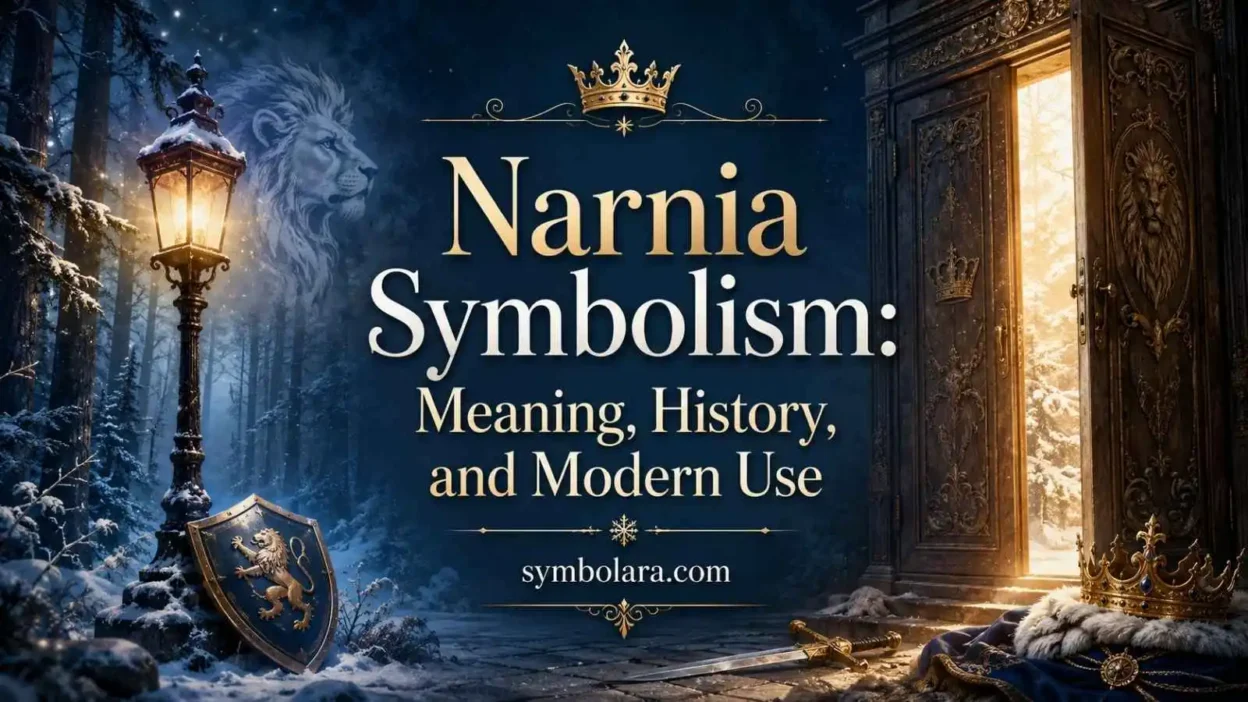
Narnia Symbolism refers to the layered meanings behind C. S. Lewis’s fictional world: the wardrobe, the lion Aslan, the White Witch, the long winter, the lamppost, the sea, the stone table, and the children’s journey from ordinary life into moral adventure. For many American readers, Narnia is not only a fantasy setting. It is a language for talking about childhood, faith, courage, temptation, sacrifice, imagination, and the hope that ordinary doors can open into larger realities.
The Chronicles of Narnia began as a seven-book children’s fantasy series published from 1950 to 1956 by British writer C. S. Lewis. The books are now classics of children’s literature and fantasy, known for their talking animals, mythical creatures, royal quests, and repeated movement between the everyday world and a hidden land of moral testing.
In the United States, Narnia carries several meanings at once. Some readers meet it through Christian education, some through school libraries, some through movies, and some through family reading. That wide audience is why its symbolism still matters: the same image can feel like childhood nostalgia, religious allegory, fairy-tale adventure, or a debate about older cultural assumptions.
Quick Answer
Narnia Symbolism commonly represents the passage from ordinary childhood into moral imagination, where courage, faith, betrayal, forgiveness, and sacrifice become visible through fantasy. Historically, the world of Narnia also draws on Christian theology, medieval imagery, classical mythology, British fairy tale, and postwar ideas about hope after darkness.
TL;DR
- Narnia often symbolizes moral awakening through imagination.
- Aslan represents divine authority, sacrifice, and restoration.
- Winter signals tyranny, fear, and emotional numbness.
- The wardrobe marks passage into hidden truth.
- American readers often connect Narnia with faith and childhood.
- Modern debate focuses on gender, race, and religious meaning.
What Narnia Physically Looks Like as a Symbol
Narnia is not a single object. It is a symbolic world made of recurring images: snowy woods, castles, talking animals, hidden doors, sea voyages, underground realms, ruined kingdoms, and a lion whose presence changes the moral weather of the story.
The most recognizable image is the wardrobe in The Lion, the Witch and the Wardrobe. It begins as ordinary furniture, something domestic and familiar. Then it becomes a threshold. A child pushes past coats and finds trees, snow, and lamplight. That physical movement gives the whole series one of its central meanings: the sacred, dangerous, or meaningful can appear through the ordinary.
Other images work the same way. The lamppost stands in a snowy forest as a strange meeting point between worlds. The stone table looks ancient and ceremonial. The sea in The Voyage of the Dawn Treader becomes a symbol of longing, purification, and movement toward the edge of known life. Narnia’s physical details are memorable because they make abstract ideas feel touchable.
Why Is Narnia Considered a Portal Fantasy Symbol?
Narnia is one of the most influential examples of portal fantasy, a genre where ordinary characters enter another world through a doorway, object, or hidden passage. The wardrobe creates this transition by turning an everyday household item into an entrance to adventure.
The portal itself symbolizes possibility. It suggests that reality may contain more than people notice at first. A child walking through a wardrobe experiences a change in perspective, not just a change in location.
Portal fantasies often use another world to help readers examine their own. Narnia follows this pattern by allowing children to face courage, betrayal, leadership, and sacrifice away from ordinary surroundings.
For American readers, this idea connects strongly with childhood imagination and the belief that books, stories, and creativity can open new ways of understanding life.
What Narnia Commonly Means in the United States
In modern American culture, Narnia most often symbolizes childhood wonder joined to moral seriousness. It is not merely “escape.” It is the kind of fantasy where children are asked to become braver, humbler, more honest, and more responsible than they are at home.
For Christian readers in the U.S., Narnia often symbolizes a story-shaped approach to faith. Aslan’s death and return, the thawing of winter, and the promise of Aslan’s country are commonly read through Christian themes of sacrifice, resurrection, judgment, and renewal. Lewis himself preferred describing the Christian dimension as a “supposal” rather than a simple one-to-one allegory: imagining what Christ might be like in a world of talking beasts.
For nonreligious readers, Narnia can still work as a moral fantasy. Aslan may be read as goodness that cannot be controlled, the White Witch as tyranny, Edmund’s betrayal as the cost of selfishness, and Lucy’s faith as the courage to trust what others dismiss. That flexibility is part of why the stories remain culturally durable.
The Wardrobe as a Doorway Into Moral Imagination
The wardrobe is one of the clearest symbols in the series because it turns a child’s private curiosity into a life-changing passage. It suggests that discovery begins with attention: Lucy notices what others ignore, enters where others do not, and tells the truth even when she is not believed.
In American readings, the wardrobe often represents the child’s imagination, but it is more than make-believe. It is a door into a world where choices matter. Edmund’s greed, Lucy’s honesty, Peter’s courage, and Susan’s caution all become visible in sharper form once they cross over.
The wardrobe also speaks to a common experience of childhood reading itself. A book is an ordinary object until it opens. Then it becomes a passageway. Narnia’s most famous door symbolizes why fantasy can feel emotionally true even when its setting is impossible.
What Does the Lamp Post Symbolize in Narnia?
The lamppost in Narnia symbolizes guidance, connection between worlds, and the unexpected appearance of meaning in ordinary places. It is one of the strangest images in the series because it combines a familiar human object with an enchanted forest.
For many readers, the lamppost represents a sign that the ordinary and extraordinary can exist together. Lucy does not enter a completely separate universe with no connection to her own world. Instead, a simple object from human life appears inside a magical landscape.
The lamppost also represents direction and hope. It stands in the snowy darkness of the White Witch’s winter, creating a small point of light in an uncertain environment. This makes it a visual reminder that guidance can appear even during difficult periods.
In modern American interpretations, the lamppost is often associated with curiosity, discovery, and the idea that familiar places may contain hidden meaning.
Aslan and the Symbolism of the Lion
Aslan is the symbolic center of Narnia. He is a lion, a king, a creator, a judge, a comforter, and a figure whose goodness is never sentimental. He is not tame, but he is good. That distinction matters because Aslan represents moral authority that cannot be reduced to politeness or safety.
The Christian meaning is strong. Many readers connect Aslan with Christ because he gives his life for Edmund, breaks the power of death, and returns in triumph. Britannica notes the biblical echoes in Aslan’s death in Edmund’s place, Narnia’s creation, and the final vision of a renewed Narnia.
As a lion, Aslan also carries older symbolic associations: kingship, courage, danger, nobility, and protection. Lewis chose a lion partly because the lion traditionally functions as the “king of beasts” and because Christian language includes the image of the Lion of Judah.
Winter, the White Witch, and the Meaning of Frozen Time
The White Witch’s Narnia is trapped in winter without Christmas. That image works because winter is not just weather in the story. It is emotional and political control. Joy is postponed. Growth is stopped. Warmth is forbidden. The land is alive, but it cannot flourish.
For American readers, this image often feels immediately understandable. “Always winter and never Christmas” suggests depression, fear, dictatorship, spiritual coldness, and a world where celebration has been outlawed. It is a child-friendly way of imagining tyranny: not only soldiers and commands, but the removal of delight.
When Aslan returns, the thaw begins before the final victory. Snow melts, rivers move, and Father Christmas reappears. The symbolism is direct but effective: goodness does not merely defeat evil at the end; it starts restoring life as soon as it enters the world.
Edmund’s Betrayal and the Symbolism of Temptation
Edmund’s Turkish Delight is one of the series’ most memorable images of temptation. It is sweet, private, and immediately satisfying. It also isolates him from his siblings and makes him vulnerable to the Witch’s manipulation.
The point is not that pleasure itself is evil. The deeper meaning is that desire becomes dangerous when it is joined to resentment, secrecy, and the wish to be more important than others. Edmund wants sweets, but he also wants status. He wants to be treated as special. The Witch uses that weakness.
His redemption gives Narnia one of its strongest emotional meanings. The betrayer is not discarded. He is confronted, rescued, and changed. In American religious and psychological readings, Edmund often symbolizes guilt, moral failure, and the possibility of being restored without pretending the harm never happened.
The Stone Table and Sacrificial Meaning
The stone table is where Narnia’s symbolism becomes most explicitly sacrificial. It is ancient, legal, and solemn. When Aslan dies there in Edmund’s place, the story connects justice with mercy: wrongdoing has consequences, but love willingly bears the cost.
The breaking of the table after Aslan’s return changes the symbol. What looked like a place of death becomes evidence that death has been defeated. In Christian readings, this echoes resurrection theology. In broader literary terms, it shows the collapse of an old order built on fear, punishment, and the Witch’s claim to ownership over the guilty.
The stone table matters because it avoids a shallow view of forgiveness. Edmund is not excused because betrayal was harmless. He is saved because someone stronger and better intervenes. That is why the scene has remained central to how many readers interpret the whole series.
Narnia as a Christian “Supposal,” Not a Simple Code
Many people call Narnia an allegory, and in everyday conversation that is understandable. Still, Lewis’s own explanation was more precise. He did not imagine Aslan as a flat symbol where “lion equals Jesus” in a mechanical code. He described the Christian dimension as a supposal: what might happen if divine incarnation, sacrifice, and redemption appeared in a world of talking animals?
That distinction helps explain why the stories still work for readers who do not share Lewis’s faith. The books do not pause to decode every object. They operate as stories first. A child can care about Lucy, Edmund, Reepicheep, Eustace, and Aslan before understanding any theological pattern.
This is also why Narnia’s symbolism can feel personal. It does not only tell readers what to believe. It asks what kind of person they become when they meet fear, beauty, betrayal, courage, temptation, and grace.
What Does Narnia Symbolize in Literature?
Narnia symbolizes the way literature can transform difficult human experiences into memorable images. Instead of explaining ideas directly, C. S. Lewis uses fantasy elements to explore questions about morality, identity, loss, hope, and personal growth.
As a literary symbol, Narnia represents a world where internal struggles become visible. A character’s fear, pride, loyalty, or selfishness is not hidden inside the mind; it appears through battles, journeys, creatures, and choices. This allows readers to understand emotional and moral conflicts through story.
The series also represents the power of imagination in literature. The wardrobe does not simply transport children to another location. It changes how they understand reality. The impossible becomes a way to examine possible truths about human behavior.
For many American readers, this is why Narnia remains valuable in classrooms and family reading. The books show that fantasy can explore serious topics while still offering adventure, humor, and wonder.
Mythology, Folklore, and the Older Roots of Narnia
Narnia’s symbolic world is not only Christian. It borrows freely from classical mythology, medieval romance, British fairy tale, talking-animal fables, and adventure literature. Fauns, dryads, centaurs, dwarfs, giants, river gods, and enchanted objects all belong to a much older imaginative tradition.
This mixture sometimes surprises readers who expect Narnia to be purely biblical. Lewis was a scholar of medieval and Renaissance literature, and his imagination was shaped by older stories in which the natural world is morally alive. Trees can dance, animals can speak, stars can be personal, and landscapes can reveal spiritual meaning.
For American readers, this blending often makes Narnia feel like a bridge between Sunday school, fairy tales, mythology, and fantasy fandom. It helped make the series accessible across different communities: religious families, fantasy readers, homeschool circles, classrooms, and general pop culture audiences.
How Americans Use Narnia as a Cultural Reference
In the United States, “Narnia” has become shorthand for a hidden world. People jokingly use it for a closet, basement, back room, or unexpected space that seems larger or stranger than expected. That casual use shows how deeply the wardrobe image has entered everyday language.
Narnia also appears in church curricula, children’s literature discussions, fantasy reading lists, movie nostalgia, memes, tattoos, art prints, and social media references to wonder or escape. The 2005–2010 film adaptations helped make the imagery visually familiar to a generation that may have encountered the story first on screen rather than on the page.
The symbolism is gaining renewed attention because new screen adaptations remain part of public discussion. Greta Gerwig’s Narnia: The Magician’s Nephew has been announced for a 2027 theatrical release followed by Netflix streaming, with the story expected to focus on Narnia’s creation by Aslan.
Common Narnia Symbols and Their Meanings
| Symbol or Image | Meaning in the USA | Common Associations | Notes |
| The wardrobe | Discovery and passage | Childhood, imagination, hidden truth | The most common popular symbol |
| Aslan | Goodness, sacrifice, divine authority | Christ, courage, kingship | Read religiously and morally |
| The White Witch | Tyranny and temptation | Winter, fear, control | Often linked to frozen emotional life |
| Turkish Delight | Manipulated desire | Greed, secrecy, betrayal | Edmund’s temptation makes it memorable |
| The lamppost | Meeting of worlds | Guidance, strangeness, threshold | A domestic object in a wild place |
| The sea | Longing and transformation | Pilgrimage, adventure, spiritual desire | Strongest in Dawn Treader |
Emotional and Psychological Meaning
Psychologically, Narnia speaks to the wish that childhood perception might be true: that the world is not flat, that courage matters, and that hidden meaning exists behind ordinary surfaces. This is one reason adults often return to the books with nostalgia. They are not only remembering a plot; they are remembering a way of seeing.
Lucy represents trust and openness. Edmund represents shame and repair. Peter represents responsibility. Susan often represents caution, maturity, and, in later debates, the tension between growing up and losing imaginative faith. Eustace represents selfishness transformed through discomfort and grace.
The emotional pattern is consistent: Narnia reveals character. People do not enter the world as finished heroes. They enter with fear, pride, vanity, loyalty, doubt, and longing. The adventure brings those traits into the open.
Tattoos, Jewelry, Decor, and Personal Style
Narnia-inspired tattoos often feature Aslan, the lamppost, the wardrobe door, a quote about courage or homecoming, a ship from The Voyage of the Dawn Treader, or a small winter forest scene. These designs usually symbolize faith, childhood wonder, moral courage, or the belief that ordinary life can open into something larger.
Jewelry and decor tend to use subtler images: lion pendants, wardrobe keys, lamppost art, bookish prints, or winter-and-lantern designs. In American homes, Narnia-themed decor often overlaps with reading culture, Christian symbolism, and cozy fantasy aesthetics.
The key difference between Narnia style and generic fantasy style is moral atmosphere. A dragon tattoo may simply mean strength or danger. A Narnia tattoo often points to a story of rescue, loyalty, sacrifice, or spiritual longing.
Controversies and Modern Reassessment
Narnia’s symbolism is loved, but it is not free from criticism. Modern readers often discuss three major concerns: the strongly Christian framework, the treatment of Susan, and the depiction of Calormen.
Some critics see the Christian symbolism as too didactic, especially when Narnia is presented to children as neutral fantasy rather than religiously shaped literature. Others argue that the religious dimension is precisely what gives the books coherence and emotional force. This disagreement has been part of Narnia’s public reception for decades.
The “Problem of Susan” centers on Susan Pevensie’s absence from the final heavenly vision in The Last Battle and the way other characters describe her interest in nylons, lipstick, and invitations. Critics have read this as a troubling dismissal of female adolescence or sexuality, while defenders argue that the issue is not womanhood but vanity, performance, and the loss of deeper loyalty.
The portrayal of Calormen has also drawn criticism for Orientalist imagery and racialized cultural contrasts. Scholars and readers have noted that Calormen is often marked through “Eastern” stereotypes and set against Narnia as a morally inferior civilization. A careful modern reading can acknowledge the books’ imaginative achievement while also recognizing that some depictions reflect dated assumptions.
How Narnia’s Meaning Has Changed Over Time
When the books first appeared in the 1950s, many readers approached them as children’s fantasy shaped by fairy tale, wartime memory, and Christian imagination. The early emotional power came from adventure, moral clarity, and the relief of seeing winter give way to spring.
By the late 20th and early 21st centuries, Narnia had become both beloved classic and cultural argument. Christian readers emphasized Aslan, redemption, and moral formation. Fantasy readers placed Narnia in conversation with Tolkien, Rowling, Pullman, and modern portal fantasy. Critics examined gender, empire, race, and religious instruction.
In 2025–2026, Narnia is read with both affection and scrutiny. Many Americans still cherish it as a childhood gateway into fantasy and faith. At the same time, contemporary readers are more likely to ask whose imagination is centered, whose culture is simplified, and how older stories should be taught without ignoring their limits.
What Do the Seven Chronicles of Narnia Represent?
The seven Chronicles of Narnia represent different stages of moral growth, discovery, and transformation. Although each book has its own story, together they create a larger symbolic journey from creation to restoration.
The books can be viewed through these broad themes:
- The Magician’s Nephew: Represents creation, beginnings, temptation, and the responsibility that comes with power.
- The Lion, the Witch and the Wardrobe: Represents sacrifice, redemption, courage, and the defeat of tyranny.
- The Horse and His Boy: Represents identity, freedom, and discovering personal purpose.
- Prince Caspian: Represents restoration, memory, and returning to forgotten truths.
- The Voyage of the Dawn Treader: Represents spiritual growth, exploration, and personal change.
- The Silver Chair: Represents perseverance, truth, and resisting deception.
- The Last Battle: Represents judgment, renewal, and the end of an old world.
Rather than following one simple message, the complete series explores how people change when they face fear, temptation, responsibility, and hope.
Why Narnia Still Matters in Modern Culture
Narnia endures because it gives readers a symbolic vocabulary for experiences that are hard to explain plainly. The wardrobe names the hope of discovery. Winter names spiritual and emotional deadness. Aslan names goodness that is comforting but not controllable. Edmund names the shame of betrayal and the relief of forgiveness.
Its symbols also work because they are concrete. A child understands snow, sweets, fear, a lion, a door, and a broken table before understanding theology or literary theory. The deeper meanings arrive through the senses first.
That may be the most important reason Narnia remains culturally alive in the United States. It lets families, teachers, churches, artists, and readers talk about moral life without beginning in abstraction. The story does not merely say that courage matters. It sends children through a wardrobe and makes courage necessary.
FAQs
What does Narnia symbolize overall?
Narnia most often symbolizes a hidden moral world where ordinary people are tested, changed, and called into courage. It represents imagination as a serious way of seeing truth, not simply a form of escape.
Is Narnia Christian symbolism?
Yes, many of Narnia’s central images have Christian meaning, especially Aslan’s sacrifice, return, authority, and role in creation. Lewis did not treat the books as a strict code, though; he imagined how Christian truth might appear inside a different world.
What does Aslan symbolize?
Aslan symbolizes divine goodness, kingship, sacrifice, judgment, and restoration. For Christian readers, he is strongly associated with Christ, while broader readers may understand him as the story’s image of moral authority and redemptive love.
What does the wardrobe symbolize?
The wardrobe symbolizes passage from ordinary life into hidden meaning. It also represents childhood openness: Lucy finds Narnia because she is willing to explore, notice, and tell the truth about what she has seen.
Why is winter important in Narnia?
Winter symbolizes fear, tyranny, lifelessness, and the suppression of joy. The thaw that comes with Aslan’s return shows restoration beginning in the land before the final defeat of the White Witch.
Is Narnia symbolism good for tattoos?
Yes, especially for readers who connect the story with faith, courage, imagination, recovery, or childhood memory. Common tattoo symbols include Aslan, the lamppost, the wardrobe, a ship, a crown, or a snowy forest.
Why do some modern readers criticize Narnia?
Some readers criticize Narnia for its treatment of Susan, its portrayal of Calormen, and its overt Christian worldview. These critiques do not erase the books’ meaning, but they do shape how many Americans discuss and teach them today.
Conclusion
Narnia is meaningful because it turns moral and spiritual questions into images readers can remember: a door in a wardrobe, a lion on the move, a winter that begins to melt, a table that breaks, and children learning that their choices matter.
The heart of Narnia Symbolism is the belief that imagination can reveal responsibility. The stories ask whether wonder can make people braver, whether failure can be forgiven, and whether a hidden country might teach ordinary people how to live more truthfully in their own world.
That is why Narnia still feels alive: it gives readers a fantasy landscape, but it leaves them thinking about courage, loyalty, temptation, grief, joy, and the kind of goodness that cannot be tamed.
[…] everyday American reading, symbolic poetry usually means “this image stands for something […]