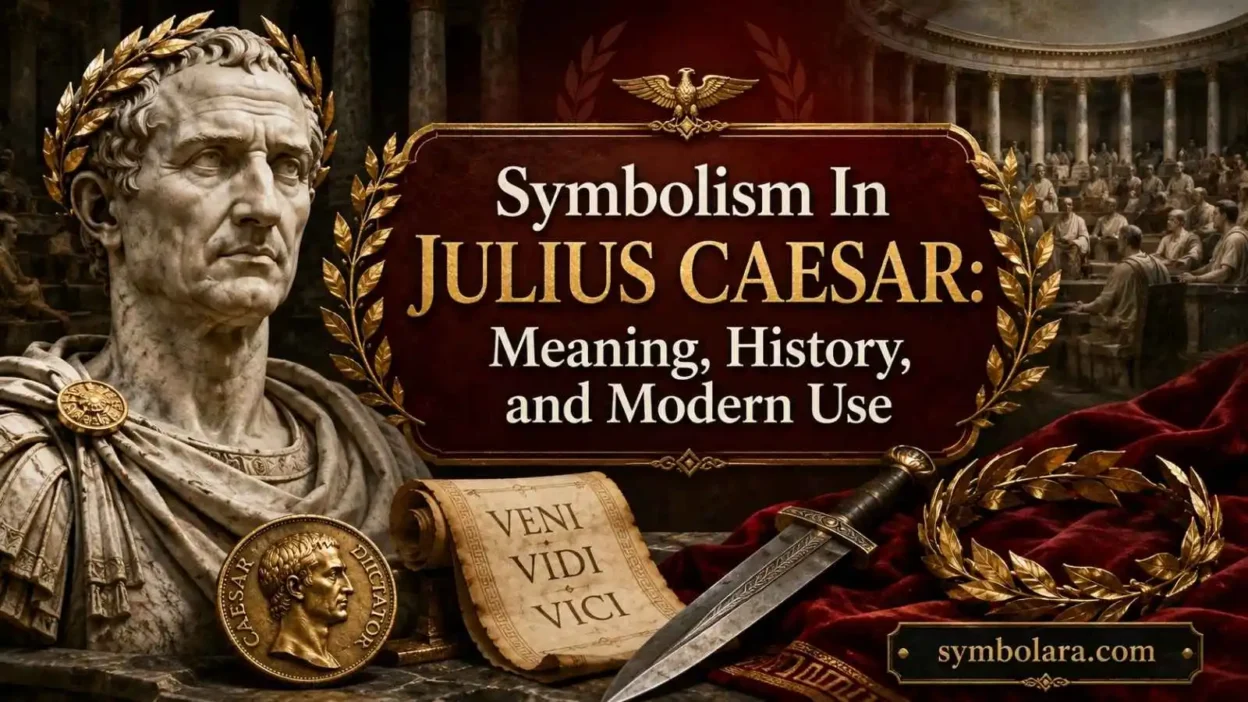
Symbolism In Julius Caesar helps readers understand Shakespeare’s play as more than a political murder story. The play uses blood, storms, omens, public speeches, ghosts, crowns, and wounds to show how power can unsettle a society from the inside.
For American readers, the play often feels familiar because its symbols connect with civic questions that still matter: What makes a leader dangerous? When does public loyalty become manipulation? Can violence ever protect a republic, or does it usually damage the very thing it claims to save?
Shakespeare’s symbols work because they are simple on the surface but complicated in meaning. A crown is not only a crown. A storm is not only weather. A bleeding body is not only evidence of murder. Each image becomes a way to think about ambition, fear, persuasion, patriotism, and political collapse.
Quick Answer
Symbolism In Julius Caesar commonly symbolizes the danger of political ambition, the fragility of republican government, and the way public opinion can be shaped by language. Historically, Shakespeare drew on Roman history, Renaissance ideas about fate and order, and the politics of leadership to turn familiar images like blood, omens, and crowns into warnings about power.
TL;DR
- Blood represents guilt, sacrifice, and political violence.
- The crown symbolizes ambition and fear of tyranny.
- Storms reflect disorder in Rome’s political world.
- Omens show anxiety about fate and leadership.
- Public speeches symbolize persuasion and mass opinion.
- Caesar’s ghost represents unresolved guilt and consequence.
What the Play’s Symbols Are Really Doing
In Julius Caesar, symbols are not decorative details added to make the play sound poetic. They are part of how the drama thinks. Shakespeare uses recurring images to show what characters cannot fully admit, especially when politics forces them to speak carefully.
The conspirators talk about honor, liberty, and Rome, but the symbols around them often reveal fear, envy, and confusion. Brutus imagines himself acting for the public good, yet the blood on his hands suggests that noble motives cannot erase violence. Antony calls the assassins “honorable,” but Caesar’s wounds become a visual argument against that claim.
The play’s symbolism is especially effective because it turns private emotion into public meaning. A bad dream becomes a political warning. A storm becomes a sign of civic breakdown. A corpse becomes a stage prop in a struggle over truth. Shakespeare shows that symbols matter most when people compete to define them.
The Crown as a Symbol of Ambition and Tyranny
The crown is one of the central symbols in the play because it represents the question everyone is afraid to ask directly: Does Caesar want to become king?
Rome’s republican identity depended on rejecting monarchy. To many Romans, a crown would not simply mean personal success. It would suggest the return of one-man rule, the loss of civic freedom, and the weakening of the Senate’s authority. That is why Caesar’s refusal of the crown at the public festival does not settle the issue. The gesture itself becomes ambiguous.
To Caesar’s supporters, refusing the crown may look like humility. To his enemies, it looks like theater. They suspect he wants the crowd to beg him to accept power. Shakespeare never gives a simple answer, and that uncertainty is the point. The crown symbolizes both Caesar’s possible ambition and the conspirators’ fear that ambition is already becoming unavoidable.
In modern American terms, the crown often reads as a warning about executive power. The United States has no monarchy, but the image still carries meaning because Americans often discuss leadership through fears of authoritarianism, personality cults, and weakened institutions. In the play, the crown is less an object than a political test: how much power should one person be allowed to hold?
Blood as a Symbol of Guilt, Sacrifice, and Political Violence
Blood is the most visible and disturbing symbol in Julius Caesar. It appears as physical evidence of murder, but it also carries emotional and political meanings.
After Caesar is stabbed, the conspirators bathe their hands in his blood. They imagine this act as a public sign of liberation. In their minds, the blood proves that they have sacrificed one man to save Rome. But the image is unsettling because it also makes them look like ritual killers. The symbol refuses to stay under their control.
Blood in the play means sacrifice, but it also means guilt. Brutus wants the assassination to seem clean, almost surgical, but blood makes that impossible. The body is opened. The violence is visible. The murder cannot be separated from the mess it creates.
Antony understands this better than the conspirators do. During his funeral speech, Caesar’s wounds become “mouths” that speak against the assassins. Blood shifts from a symbol of republican rescue to a symbol of betrayal. Shakespeare shows that political violence depends not only on what happens, but on who gets to explain it afterward.
Storms and Strange Weather as Signs of Disorder
The storm before Caesar’s assassination is more than a dramatic backdrop. It symbolizes disorder in Rome and uncertainty in the moral world of the play.
Casca describes frightening events: fire in the streets, unnatural behavior in animals, and people terrified by signs they cannot explain. In Shakespeare’s world, unusual weather often suggested that something was wrong in the political or moral order. When rulers became unstable, nature itself seemed unsettled.
The storm also reveals character. Casca sees the signs as terrifying. Cassius interprets them as proof that Caesar’s rise is unnatural. Cicero, more cautious, warns that people often interpret events according to their own fears. That range of reactions matters. The storm does not deliver one simple message. It exposes how easily people turn uncertainty into political evidence.
For modern readers, the storm can symbolize public panic. When institutions feel fragile, ordinary events begin to look ominous. Rumors spread. People search for patterns. The weather outside Rome mirrors the atmosphere inside the city: charged, anxious, and ready to break.
Omens, Dreams, and the Fear of Fate
Omens and dreams appear throughout the play because the characters live in a world where public action and supernatural warning seem connected. Calpurnia’s dream of Caesar’s statue bleeding is one of the most important examples.
Her dream suggests that Caesar’s death will affect all of Rome, not only Caesar himself. The image of Romans bathing in his blood is disturbing because it predicts both murder and public involvement. Caesar’s body will become a political symbol, and citizens will gather around it, interpret it, and use it.
The soothsayer’s warning, “Beware the Ides of March,” also symbolizes ignored wisdom. It is famous because it is direct, simple, and still dismissed. Caesar hears the warning but treats it as beneath him. His mistake is not merely that he fails to understand fate. It is that he believes his status places him beyond ordinary danger.
In American classrooms and popular culture, the Ides of March often symbolizes a turning point that people should have seen coming. It has become shorthand for betrayal, political danger, and the cost of ignoring warnings.
The Role of Fate vs Free Will in Julius Caesar’s Symbolism
Fate and free will are two opposing forces that shape the symbolism of Julius Caesar. The omens, dreams, and warnings suggest that danger surrounds Caesar, but the characters still make choices that lead to tragedy.
The soothsayer’s warning and Calpurnia’s dream create the feeling that Caesar’s future may already be predicted. However, Shakespeare does not show fate as the only force controlling events. Caesar chooses to ignore warnings, and the conspirators choose assassination.
This balance creates one of the play’s biggest questions: Are people trapped by destiny, or do their decisions create their own downfall?
The symbols of the play suggest that both ideas exist together. Warnings appear, but characters must decide how they respond. Caesar’s pride, Brutus’s idealism, and Cassius’s manipulation all contribute to the final outcome.
For modern audiences, this symbolism remains powerful because it reflects a common human experience: people often receive warnings but must still choose their actions.
Caesar’s Body as a Public Symbol
After the assassination, Caesar’s body becomes the most important political object in Rome. While he is alive, characters argue about what he might become. Once he is dead, they argue over what his death means.
Brutus sees the body as proof of patriotic sacrifice. Antony sees it as proof of treachery. The crowd first accepts Brutus’s interpretation, then changes its mind after Antony speaks. This shift shows how unstable public meaning can be.
The body also symbolizes the transformation of a person into a political cause. Caesar is no longer only a leader with flaws and ambitions. He becomes a symbol that others use to claim authority. Antony’s grief may be sincere, but he also understands the power of displaying wounds before a crowd.
This is one reason the play still feels modern. Public life often turns people into symbols after death. Their image, words, and suffering can be used by different groups to support different causes. Shakespeare understood that memory is political.
What Does Caesar’s Death Symbolize in Julius Caesar?
Caesar’s death symbolizes the collapse of political stability and the dangerous consequences of using violence to solve political problems. The assassination begins as an attempt to protect Rome from possible tyranny, but it creates a larger crisis filled with revenge, conflict, and civil war.
The murder also represents the failure of the conspirators’ belief that removing one person can restore a broken system. Brutus and the other assassins focus on Caesar as the problem, but Shakespeare shows that deeper issues remain: ambition, distrust, rivalry, and the struggle for influence.
Caesar’s death changes him from a living leader into a powerful symbol. Before his murder, people debate what Caesar might become. After his death, different groups use his memory to support their own political goals.
For modern readers, Caesar’s death often symbolizes a warning about political violence. It raises questions about whether force can truly defend freedom or whether it creates new problems that are harder to control.
Public Speeches as Symbols of Persuasion
The funeral speeches are not just plot devices. They symbolize the power of rhetoric to shape public reality.
Brutus speaks first and appeals to reason. He explains that he loved Caesar but loved Rome more. His style is orderly, balanced, and direct. For a moment, it works. The crowd accepts his logic because he gives them a clear moral structure: Caesar’s death was necessary for freedom.
Antony’s speech works differently. He uses repetition, irony, pauses, emotional timing, and Caesar’s wounded body. He does not openly command the crowd to rebel at first. Instead, he lets them feel that they have reached the conclusion themselves.
The contrast between the speeches is one of the play’s clearest warnings. Public opinion can be moved by argument, but it can also be moved by grief, performance, and carefully controlled outrage. In the United States, where political speeches, media clips, campaign messaging, and viral moments influence public feeling, this symbolism remains especially recognizable.
The Ghost as a Symbol of Consequence
Caesar’s ghost appears to Brutus after the assassination and before the final defeat. The ghost symbolizes consequence, guilt, and the return of unresolved violence.
It does not matter whether readers interpret the ghost as supernatural reality or as Brutus’s troubled conscience. Either way, Caesar’s presence has not disappeared. The assassination was supposed to solve Rome’s political crisis, but the ghost shows that murder has created a deeper one.
For Brutus, the ghost also represents the failure of moral certainty. He believed he could separate honorable intention from violent action. Caesar’s ghost suggests that history will not let him make that separation so easily.
In emotional terms, the ghost is the symbol of what follows people after a choice they cannot undo. It gives the play a tragic shape: the past does not stay buried, especially when it has been buried through bloodshed.
The Dagger and the Act of Stabbing
The dagger symbolizes decisive action, conspiracy, and the crossing of a moral line. Before the assassination, the plot is still an idea. Once the daggers strike Caesar, thought becomes irreversible action.
The repeated stabbing matters. Caesar is not killed by one person in a private act. He is killed by a group, which makes the murder political and collective. Each conspirator’s blade becomes a sign of shared responsibility.
Brutus’s participation carries special symbolic weight because Caesar trusted him. When Caesar recognizes Brutus among the attackers, the assassination becomes more than political removal. It becomes personal betrayal. The dagger in Brutus’s hand symbolizes the collapse of friendship under the pressure of ideology.
Modern readers often connect this image with the phrase “stabbed in the back,” but Shakespeare’s scene is more complex. The betrayal is not only emotional. It is civic. Rome’s leaders destroy trust in the name of saving the state.
The Symbolism of Loyalty and Betrayal in Julius Caesar
Loyalty and betrayal are among the strongest emotional symbols in Julius Caesar. The relationship between Caesar and Brutus shows how personal trust can become damaged when political beliefs take control.
Brutus is not Caesar’s enemy in the traditional sense. He is a friend who believes he must choose Rome over personal loyalty. This conflict makes his betrayal more painful because Caesar expects protection from someone close to him.
The famous phrase “Et tu, Brute?” represents the shock of betrayal from someone trusted. The moment is powerful because Caesar does not only face physical violence. He faces the emotional collapse of friendship.
The symbolism shows that betrayal often hurts most when it comes from within a trusted circle. Shakespeare uses Brutus and Caesar’s relationship to explore how loyalty can conflict with duty, ideology, and personal ambition.
Today, the symbol remains familiar because people continue to struggle with conflicts between relationships, beliefs, and responsibilities.
Rome as a Symbol of the Republic
Rome itself is symbolic in the play. It stands for civic identity, public duty, law, tradition, and political inheritance. Characters constantly claim to act for Rome, but they do not agree on what Rome means.
For Brutus, Rome means republican liberty and resistance to tyranny. For Cassius, Rome is also a place where personal status matters; Caesar’s rise feels like a humiliation to other elites. For Antony, Rome becomes a public stage where loyalty to Caesar can be turned into political momentum.
This conflict is important because symbols of country are rarely neutral. Flags, monuments, founding stories, and public ceremonies can unite people, but they can also become contested. Different groups may claim the same national symbol while arguing for very different futures.
In the play, “Rome” is the word everyone uses to justify action. Shakespeare invites the audience to ask whether love of country can become dangerous when it refuses self-examination.
How Americans Commonly Read the Play’s Symbols
In the United States, Julius Caesar is often read through the lens of democracy, public speech, ambition, and political violence. Because American civic culture is strongly shaped by ideas of republican government, checks and balances, and suspicion of monarchy, the play’s symbols can feel close to home.
The crown becomes a sign of concentrated power. The assassination becomes a troubling example of anti-tyrannical violence that produces chaos rather than stability. The funeral speeches become a study of persuasion in public life. The mob becomes a warning about how quickly civic judgment can turn into rage.
American readers do not need to see the play as a direct political allegory for any single moment. Its symbols last because they apply to repeated patterns: fear of ambitious leaders, distrust among elites, emotional manipulation of crowds, and the difficulty of protecting institutions without corrupting them.
| Symbol or Image | Meaning in the USA | Common Associations | Notes |
| Crown | Fear of one-person rule | Tyranny, ambition, monarchy | Connects strongly with republican values |
| Blood | Cost of political violence | Guilt, sacrifice, betrayal | Changes meaning after Antony’s speech |
| Storm | Civic instability | Panic, disorder, warning | Reflects Rome’s tense atmosphere |
| Funeral speech | Public persuasion | Media, rhetoric, crowd emotion | Shows language shaping political reality |
| Ghost | Consequence after violence | Guilt, memory, unfinished conflict | Haunts Brutus morally and politically |
Julius Caesar Symbolism in Modern Politics and Media
The symbolism of Julius Caesar continues to appear in modern politics, journalism, and popular culture because the play explores timeless questions about leadership and influence.
The crown still represents fears about concentrated power. Public speeches still represent the ability of language to shape beliefs. Caesar’s wounds still symbolize how images of suffering can influence public opinion.
Modern audiences often recognize Antony’s funeral speech as an example of emotional persuasion. His ability to change the crowd’s opinion shows how powerful storytelling and presentation can become in public life.
The play does not belong only to ancient Rome. Its symbols continue to appear whenever societies debate leadership, authority, loyalty, and the responsibility of citizens.
For American readers, Julius Caesar remains relevant because democratic systems depend not only on laws but also on how people interpret information, respond to emotions, and judge those seeking power.
Cross-Cultural and Historical Layers Behind the Symbols
The play’s symbols come from several overlapping traditions. Shakespeare drew from Roman history, but he wrote for an English audience shaped by Christian moral ideas, Renaissance humanism, monarchy, succession anxiety, and classical education.
Roman culture gave the play its public rituals, honor codes, republican language, and fear of kingship. The Renaissance added renewed interest in ancient political examples. Shakespeare’s England added another layer because questions about rulers, legitimacy, rebellion, and succession were highly sensitive.
Some symbols also carry broader cultural meanings. Blood has long been associated with kinship, sacrifice, violence, and guilt. Storms often symbolize disorder across many literary traditions. Ghosts frequently represent unfinished moral business, especially when a death has not been properly resolved.
The play works because it does not depend on one culture alone. It uses Roman material, English theatrical tradition, and widely recognizable human fears about power and betrayal.
Emotional and Psychological Meaning
The emotional symbolism of Julius Caesar centers on anxiety. Nearly every major symbol reflects fear of what might happen next.
The crown represents fear of domination. The storm represents fear that the world is becoming unreadable. The omens represent fear that danger has already announced itself but will not be stopped. Blood represents fear that moral action may still leave permanent guilt.
Brutus is the key psychological figure because he wants to see himself as honorable. His tragedy comes from the gap between self-image and consequence. He believes his motives can purify the assassination, but the symbols around him suggest otherwise.
The play also explores group psychology. Crowds in Julius Caesar are emotionally responsive, easily redirected, and hungry for certainty. That does not mean ordinary citizens are foolish by nature. It means public emotion becomes dangerous when grief, anger, and political performance combine faster than careful judgment can respond.
Modern Use in Classrooms, Theater, and Pop Culture
Today, the play’s symbols appear most often in education, theater, political commentary, and popular references. Students encounter the crown, blood, omens, and speeches as tools for understanding theme and character. Theater productions often emphasize different symbols depending on the era in which they are staged.
A production focused on authoritarianism may make the crown and public ceremonies feel threatening. A production focused on media and persuasion may highlight Antony’s speech and the crowd’s reaction. A production focused on trauma may emphasize blood, ghosts, and Brutus’s inner conflict.
Outside the stage, phrases and images from the play continue to circulate. The Ides of March is used as a warning date. “Et tu, Brute?” is widely understood as a phrase of betrayal, even by people who have not read the full play. Caesar’s assassination remains one of the most recognizable images of political murder in Western literature.
The symbols endure because they are portable. They can move from a Roman Senate scene to a classroom discussion, a political cartoon, a film reference, or a social media caption without losing their basic meaning.
Common Misunderstandings About the Symbolism
One common misunderstanding is that the play simply praises the assassination of a tyrant. Shakespeare makes that reading difficult. Caesar may be proud and ambitious, but the murder does not restore peace. It produces civil war.
Another misunderstanding is that Brutus is either purely noble or purely foolish. The symbols around him suggest something more tragic. He is principled, but he is also politically naïve. He understands honor better than public emotion.
Readers also sometimes assume that omens in the play have only supernatural meaning. They do matter as signs of fate, but they also show how people interpret uncertainty. The same strange event can become a warning, a political argument, or an excuse, depending on who explains it.
The play’s symbols should not be treated as one-to-one codes. A symbol may carry several meanings at once. Blood can mean liberation to the conspirators, betrayal to Antony, grief to the crowd, and guilt to Brutus.
Controversies and Distorted Uses
Because Julius Caesar is about political assassination, its symbolism can become controversial when staged or discussed in modern political contexts. Productions that dress Caesar like a current public figure often draw attention because audiences may disagree about whether the play is warning against tyranny, condemning political violence, or both.
The safest reading is also the most accurate: Shakespeare does not present assassination as a clean solution. The killing of Caesar unleashes disorder, revenge, and war. Even when the conspirators claim patriotic motives, the symbols of blood and haunting undercut the fantasy of simple political cleansing.
The play can also be misused when people quote it to glorify betrayal or violence without considering the tragic consequences. Shakespeare’s imagery does not celebrate chaos. It shows how quickly noble language can become attached to destructive action.
Separating historical meaning from modern misuse is important. The play examines political violence; it does not offer a simple endorsement of it.
How the Meaning Has Changed Over Time
The meaning of the play’s symbols has shifted as audiences have changed. Early audiences would have seen the Roman story through concerns about monarchy, rebellion, divine order, and succession. Later readers often emphasized republican politics, tragic heroism, and moral conflict.
In the United States, the play has gained particular force because Rome’s republic has often been compared with modern democratic systems. The symbols of crowns, civic virtue, public speech, and political breakdown fit naturally into American conversations about leadership and institutions.
In recent decades, audiences have also become more aware of mass communication and image-making. Antony’s funeral speech can now feel strikingly modern because it shows how emotional framing, repeated phrases, and visual evidence can transform public opinion.
The symbols have not lost their original meanings. Instead, they have gathered new associations. The crown still suggests ambition. Blood still suggests guilt and violence. But today those images also speak to media politics, public trust, and the fragility of shared truth.
Why These Symbols Still Matter
The symbols in Julius Caesar still matter because they ask readers to think beyond personalities. The play is not only about Caesar, Brutus, Cassius, or Antony. It is about what happens when a society loses confidence in its political rules.
A crown can become terrifying before it is ever worn. A speech can change the meaning of a murder. A crowd can become a political force before it understands what it wants. A ghost can show that consequences outlive intentions.
That is why the play remains useful in American culture. It gives readers a language for discussing ambition, loyalty, fear, persuasion, and the moral cost of public action. Its symbols do not tell people what to think about one leader or one crisis. They teach people to notice how power presents itself, how fear spreads, and how meaning is fought over in public.
FAQs
What is the main symbol in Julius Caesar?
The most important symbol is Caesar’s blood because it gathers the play’s central ideas: sacrifice, guilt, betrayal, and political violence. The conspirators try to make the blood mean freedom, but Antony turns it into evidence of murder and disloyalty.
What does the crown symbolize in Julius Caesar?
The crown symbolizes ambition and the fear that Caesar may become a king. Since Rome defines itself against monarchy, the crown represents a possible threat to republican freedom and shared political authority.
What do the omens symbolize in the play?
The omens symbolize warning, uncertainty, and the feeling that Rome’s political order is breaking down. They also show how people interpret signs according to their hopes, fears, and ambitions.
Why is Caesar’s ghost important symbolically?
Caesar’s ghost symbolizes consequence and unresolved guilt. Whether seen as a real spirit or Brutus’s conscience, it shows that the assassination has not ended Caesar’s influence or Rome’s crisis.
Is the symbolism in Julius Caesar mostly political?
Much of it is political, but it is also emotional and psychological. The symbols explore fear, loyalty, pride, grief, guilt, and the human need to justify difficult choices.
How do Americans usually interpret Julius Caesar today?
American readers often connect the play with democracy, leadership, public persuasion, and the danger of political violence. The symbols feel familiar because they raise questions about power, institutions, and how crowds respond to emotional appeals.
Does Shakespeare support Brutus through the play’s symbolism?
Shakespeare presents Brutus sympathetically but not simply. Symbols like blood, ghosts, and public disorder suggest that honorable motives do not protect him from responsibility for the violence he helps unleash.
What does the Ides of March symbolize today?
The Ides of March symbolizes unexpected danger, betrayal, and ignored warnings. Modern culture often uses the phrase as a reminder that threats can appear even when people feel secure.
Conclusion
The central symbolism of Julius Caesar turns Roman history into a study of ambition, fear, persuasion, and consequence. Crowns, blood, storms, omens, speeches, and ghosts all show how political meaning is created, challenged, and changed.
Symbolism In Julius Caesar remains important because it does not offer easy answers. It asks whether violence can ever defend liberty without damaging it, whether public language can be trusted, and whether good intentions are enough when the results are destructive.
The play’s symbols still speak clearly because they are rooted in public life as people actually experience it: uncertain, emotional, persuasive, and always vulnerable to the struggle for power.