
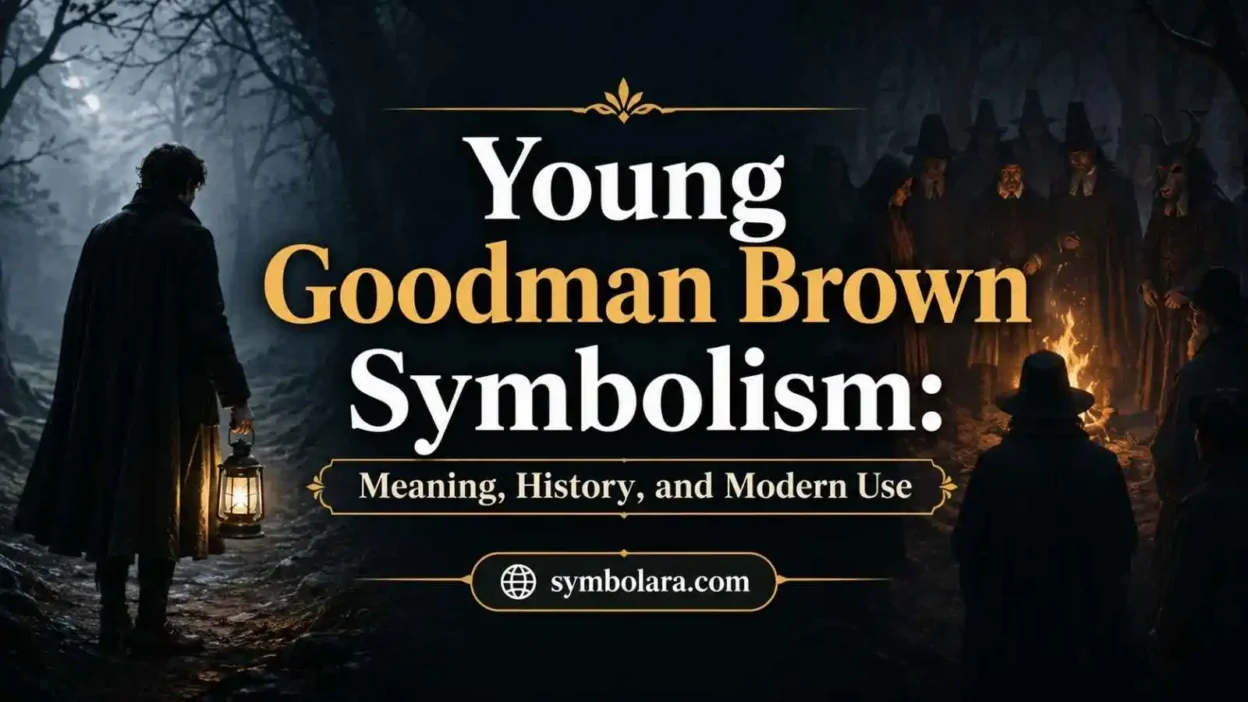
Nathaniel Hawthorne’s “Young Goodman Brown” is one of the most discussed short stories in American literature because nearly every detail carries symbolic weight. Young Goodman Brown Symbolism centers on a young Puritan man’s nighttime journey into the forest, where his trust in his wife, his community, his religion, and human goodness begins to collapse.
The story matters because it turns a simple plot into a moral and psychological test. A man leaves home at sunset, meets a sinister traveler, sees respected people connected with evil, and returns changed. Whether the night was real or a dream remains uncertain, but the damage to his inner life is permanent.
For modern American readers, the story is often less about witchcraft than about suspicion, hypocrisy, moral fear, and the danger of seeing people only as sinners. Hawthorne uses Puritan New England to examine a problem that still feels familiar: what happens when a person loses the ability to trust anyone?
Quick Answer
Young Goodman Brown Symbolism commonly symbolizes the loss of faith, especially the moment when innocence gives way to suspicion and moral doubt. Historically, the story also reflects Puritan ideas about sin, temptation, the Devil, and the fear that evil may exist beneath respectable public life.
TL;DR
- Goodman Brown represents damaged faith and moral suspicion.
- Faith symbolizes both his wife and religious belief.
- The forest represents temptation, secrecy, and inner fear.
- Pink ribbons suggest innocence, affection, and fragile trust.
- Hawthorne critiques rigid Puritan moral thinking.
- Modern readers see a warning against cynicism.
What “Young Goodman Brown” Symbolizes at Its Core
At its center, “Young Goodman Brown” symbolizes a spiritual and emotional crisis. Goodman Brown begins the story believing that goodness is visible, stable, and attached to the people he already trusts. By the end, he can no longer separate appearance from corruption. The tragedy is not simply that he discovers evil; it is that he lets the possibility of evil destroy his capacity for love.
The story’s central symbol is Brown’s journey from confidence to suspicion. He leaves behind his wife, Faith, and enters the forest at dusk. That movement is both literal and symbolic. He steps away from home, marriage, daylight, community, and religious certainty. He enters a place associated with secrecy, temptation, and fear.
Hawthorne does not give readers a simple moral lesson. Brown may have witnessed an actual satanic gathering, or he may have dreamed it. Either way, his reaction matters more than the event itself. He chooses to live as though the worst possible interpretation of others is the only truth.
That is why the story still works for American readers today. It is about the emotional cost of distrust. Brown’s final loneliness shows how a person can become morally alert but spiritually barren.
The Story as an Allegory of Faith
“Young Goodman Brown” is often read as an allegory, meaning its characters and events represent larger ideas. The clearest example is Faith, Brown’s wife. Her name makes her symbolic from the moment she appears. When Brown leaves Faith behind, he is also leaving behind his religious faith, his trust in marriage, and his confidence in goodness.
This symbolism is direct, but it is not shallow. Faith is not only an abstract idea. She is also a young wife who fears being left alone at night. Hawthorne makes her human before making her symbolic. That matters because Brown’s tragedy involves both theology and personal relationship. He does not merely lose a doctrine; he loses tenderness toward another person.
When Brown later believes Faith may be part of the dark ceremony, the shock is devastating. If Faith can fall, then in Brown’s mind no one is safe from corruption. His problem is not that he recognizes moral weakness. His problem is that he cannot accept imperfection without turning bitter.
The allegory works because it shows faith as something relational. Brown’s belief in God, his belief in his wife, and his belief in his community are tied together. Once one breaks, the others collapse.
Why the Forest Matters
The forest is one of the story’s strongest symbols. In Puritan New England, the village represented order, church life, law, family, and watchful community. The forest represented the unknown. It was outside the settled world, outside social supervision, and outside the comforting structures of daily religion.
For Brown, the forest becomes the place where hidden truths appear. He meets a traveler who resembles him, carries a serpent-like staff, and speaks with unsettling familiarity about Brown’s family. As Brown moves deeper among the trees, the ordinary rules of the village seem to dissolve.
The forest also symbolizes Brown’s own mind. Its darkness, twisting path, and unseen presences resemble fear itself. Brown worries about who may be hidden behind the trees, but the story gradually suggests that the most dangerous darkness is internal. He brings fear, pride, curiosity, and self-righteousness with him.
In modern terms, the forest can be read as the psychological space where a person confronts what polite society hides. It is where Brown encounters temptation, but also where he confronts his own desire to judge.
Faith and the Pink Ribbons
Faith’s pink ribbons are small, but they carry major symbolic importance. They suggest youth, softness, domestic affection, and ordinary human innocence. In a story filled with darkness, fire, and stern religious anxiety, the ribbons feel almost childlike.
Their color matters. Pink is not the severe black or gray often associated with Puritan restraint. It introduces warmth and vulnerability. Faith’s ribbons make her seem alive, loving, and personal rather than merely symbolic.
When one of the ribbons appears in the forest, Brown interprets it as proof that Faith has been lost to evil. His cry of despair marks a turning point. The ribbon becomes evidence in his emotional trial of the world.
But Hawthorne keeps the symbol uncertain. A ribbon in the forest may mean Faith is truly present at the ceremony. It may also be part of a dream, a hallucination, or a temptation designed to break Brown’s trust. The ambiguity matters because Brown reacts as though doubt itself is certainty.
The ribbon shows how fragile trust can be. One small sign is enough for Brown to condemn the person he loves most.
What Does Faith Symbolize in Young Goodman Brown?
Faith is the most important symbolic character in “Young Goodman Brown.” Her name immediately connects her with religious belief, trust, hope, and emotional security. When Brown leaves Faith behind, he symbolically leaves behind the values that once gave his life meaning.
However, Faith represents more than religion. She also symbolizes human connection. She is Brown’s wife, someone who loves him and welcomes him home. This makes Brown’s loss more personal because he does not only lose spiritual confidence; he loses the ability to trust another person.
The uncertainty surrounding Faith creates one of Hawthorne’s most powerful symbols. Brown never receives complete proof that Faith has joined the dark gathering. Instead, he reacts to suspicion as if it were undeniable truth.
This reflects a larger message in the story. Faith is fragile when a person allows fear to replace understanding. Brown’s mistake is not simply discovering possible corruption. His mistake is refusing to accept that people can be imperfect while still deserving love.
For modern readers, Faith symbolizes the challenge of maintaining trust in a world where disappointment and uncertainty are unavoidable.
Goodman Brown as Everyman and Self-Righteous Believer
The name “Goodman Brown” carries symbolic irony. “Goodman” was a form of address in early New England, but to modern ears it also sounds like “good man.” Hawthorne uses that double meaning carefully. Brown wants to see himself as morally sound, respectable, and spiritually safe.
His surname, Brown, feels plain and ordinary. He is not a king, prophet, saint, or heroic rebel. He is an average man, which makes him easier to read as a representative figure. His experience is not only about one Puritan husband. It is about the ordinary human temptation to divide the world into the pure and the corrupt.
Brown’s weakness is not open wickedness. It is pride disguised as moral concern. He believes he can step into danger for one night and then return safely to a life of goodness. He assumes his future repentance will cancel his present choice.
That assumption is important. Brown thinks sin can be managed on his own terms. By the end, he discovers that even the suspicion of sin can master him. His name becomes tragic because the “good man” cannot live with the knowledge that goodness in real people is mixed, flawed, and incomplete.
Goodman Brown Character Symbolism: What Does Young Goodman Brown Represent?
Young Goodman Brown represents the ordinary person facing a crisis of belief. Hawthorne does not create him as a hero or villain. Instead, Brown symbolizes a person who wants a simple division between good and evil but struggles when reality becomes more complicated.
His journey represents the loss of certainty. At the beginning of the story, Brown believes that his family, religion, and community provide a clear path toward goodness. He assumes that respected people must also be morally pure. However, his experience in the forest challenges that belief.
Brown also symbolizes the danger of moral pride. He believes he can observe evil without being affected by it. He enters the forest thinking he is different from those around him, but Hawthorne slowly reveals that Brown shares many human weaknesses, including curiosity, fear, and the desire to judge others.
Modern readers often see Goodman Brown as a symbol of people who lose trust after discovering disappointment or hypocrisy. His tragedy is not only that he sees darkness. His tragedy is that he allows darkness to control how he views everyone else.
Through Brown, Hawthorne explores an important question: Can people recognize human flaws while still keeping compassion and hope? The story suggests that wisdom requires more than discovering imperfection. It also requires understanding, forgiveness, and humility.
The Devil Figure and the Serpent Staff
The traveler Brown meets in the forest is usually interpreted as a Devil figure. He is calm, familiar, and disturbingly respectable. He does not appear as a monster. He looks enough like Brown to suggest kinship, inheritance, or a darker version of Brown himself.
His staff evokes the serpent from the biblical story of Eden. That connection brings in themes of temptation, knowledge, disobedience, and moral awakening. Like the serpent, the traveler offers Brown a new way of seeing. He suggests that evil is not rare, not distant, and not limited to obvious sinners.
The staff also symbolizes movement into corruption. It helps guide the journey, but it also marks the path as spiritually dangerous. When the staff is associated with Goody Cloyse, Brown’s former religious teacher, the shock is sharp: a woman linked to his childhood instruction appears connected to the same dark power.
The Devil figure’s most unsettling trait is his knowledge of Brown’s family and town. He implies that evil has been present in the community for generations. The symbol therefore reaches beyond one man’s temptation. It points toward inherited violence, hidden guilt, and the gap between public virtue and private history.
Salem, Puritanism, and Historical Memory
The story draws much of its force from its Puritan New England setting. Salem is not just a backdrop. It carries the historical memory of religious strictness, witchcraft fear, public judgment, and communal suspicion. Hawthorne wrote long after the seventeenth century, but he returned to that world because it gave him a language for exploring guilt and moral anxiety.
Puritan belief emphasized sin, salvation, discipline, and the seriousness of spiritual life. Hawthorne understood the moral intensity of that tradition, but he also questioned the damage caused by fear-based religion. In “Young Goodman Brown,” the problem is not faith itself. The problem is a system of thought in which human imperfection can become terrifying, and suspicion can look like holiness.
The story also alludes to darker parts of colonial history, including violence against Indigenous people, persecution of religious dissenters, and the witch-trial atmosphere. These references complicate the village’s image of righteousness. Hawthorne suggests that a community may tell itself a story of purity while carrying a history of cruelty.
For American readers, this historical layer is important. The story is part of a larger national habit of revisiting early New England to ask how moral ideals and moral failures can exist in the same society.
Public Goodness and Private Sin
One of the story’s major symbolic tensions is the difference between public reputation and private reality. Brown sees or imagines religious leaders, respected elders, and moral instructors gathering in the forest. The shock comes from contrast. These are the very people who define goodness in the village.
Hawthorne is not simply saying that all religious people are hypocrites. The story is more subtle than that. It shows what happens when Brown discovers that public virtue may not tell the whole truth about a person. Instead of responding with humility, he responds with disgust.
This is where the story becomes psychologically sharp. Brown cannot tolerate mixed humanity. If someone is not purely good, he treats that person as wholly corrupt. His moral imagination has no room for weakness, repentance, contradiction, or grace.
The symbol of the secret gathering therefore works in two directions. It exposes the fear of hidden sin, but it also exposes Brown’s inability to live with moral complexity. By the end, he becomes less loving than the flawed people he condemns.
The Meaning of Good and Evil in Young Goodman Brown
The conflict between good and evil is one of the central ideas in “Young Goodman Brown.” However, Hawthorne presents this conflict in a complex way. The story does not suggest that some people are completely good while others are completely evil.
Instead, Hawthorne explores the mixture of morality within ordinary human life. Brown begins with a simple belief that good people and bad people can be easily separated. His experience forces him to question that belief.
The dark ceremony in the forest represents the fear that evil exists beneath respectable appearances. Religious leaders, family members, and community figures appear connected to corruption, creating a disturbing contrast between public image and private behavior.
Yet Brown’s response creates another moral problem. He becomes so focused on the possibility of evil that he loses kindness and forgiveness. Hawthorne suggests that obsession with judging others can damage a person’s own character.
The story’s deeper message is that recognizing human weakness should lead to humility, not hatred. True moral understanding requires balance between awareness and compassion.
Dream, Reality, and Ambiguity
One reason “Young Goodman Brown” remains so widely read is that Hawthorne never fully explains what happened in the forest. The narrator asks whether the experience was a dream, but does not settle the question. That uncertainty is not a trick. It is central to the symbolism.
If the forest meeting was real, then Brown has witnessed a horrifying truth about his community. If it was a dream, then the horror came from his own mind. In either case, the result is the same: Brown becomes suspicious, cold, and isolated.
This ambiguity makes the story feel modern. It recognizes that perception can shape a life as strongly as fact. Brown’s tragedy is not only what he saw; it is how completely he trusts his darkest interpretation.
The dreamlike quality also connects the story to nightmare logic. People appear suddenly. Voices emerge from darkness. Objects take on exaggerated meaning. The setting shifts from realistic forest path to ritual clearing. Hawthorne uses this unstable atmosphere to show a mind under pressure.
The unresolved ending leaves readers with a hard question: is Brown ruined by truth, illusion, or his own inability to forgive?
Key Symbols and Their Meanings
| Symbol | Meaning in the Story | Common American Reading | Notes |
| Faith | Wife, belief, trust | Loss of religious and personal confidence | Her name creates the central allegory |
| Pink ribbons | Innocence, affection, fragility | A small sign that changes Brown’s worldview | Their meaning depends on uncertainty |
| Forest | Temptation, secrecy, fear | A place outside social order | Also reflects Brown’s inner darkness |
| Devil traveler | Evil, inheritance, temptation | The voice that normalizes corruption | His resemblance to Brown is important |
| Night journey | Moral testing | A crisis of identity and belief | Begins with choice, ends in alienation |
| Secret gathering | Hidden sin, hypocrisy | Fear that respectable society conceals evil | May be real, dreamed, or symbolic |
Emotional and Psychological Meaning
Emotionally, the story is about the collapse of trust. Brown experiences fear, shock, grief, anger, and disgust in rapid succession. He enters the forest anxious but still hopeful that his moral world will remain intact. He leaves unable to feel secure with anyone.
Psychologically, Brown becomes a case study in suspicion. Once he believes he has seen hidden evil, he cannot stop seeing it everywhere. A blessing sounds false. A prayer feels empty. A loving greeting from Faith becomes unbearable.
This emotional shift is what makes the ending so bleak. Brown does not become wiser in a balanced way. He becomes hardened. He may know more about human weakness, but he understands less about mercy, love, and shared imperfection.
Modern readers often recognize this pattern. A person can become so focused on exposing hypocrisy that they lose the ability to recognize sincerity. Brown’s fate warns that distrust can become an identity.
The Story’s Meaning in the United States Today
In the United States, “Young Goodman Brown” is commonly taught as a story about Puritanism, allegory, temptation, and moral hypocrisy. But its modern relevance goes beyond the classroom. It speaks to American concerns about public image, private wrongdoing, religious authority, and social trust.
Americans often live in a culture that exposes hidden failures quickly. Public figures, institutions, churches, families, and communities can appear stable until scandal or contradiction emerges. Hawthorne’s story fits that experience because it asks what happens after disillusionment.
The American reading is not simply “everyone is evil.” A stronger reading is that moral certainty can become dangerous when it turns into contempt. Brown cannot accept that people may be guilty, weak, loving, sincere, and broken at the same time.
That makes the story especially useful in discussions of cancel culture, religious trauma, political distrust, and institutional disappointment. It does not give easy answers, but it shows how destructive total cynicism can be.
Christian and Religious Symbolism
The story uses Christian imagery throughout: faith, the Devil, temptation, sin, prayer, heaven, baptism-like initiation, and the struggle between salvation and damnation. These symbols reflect the religious language of the Puritan world.
Faith’s name is the most obvious religious symbol, but Brown’s entire journey has the shape of a spiritual trial. He leaves the safety of home, walks into darkness, meets a tempter, witnesses a corrupt ritual, calls on heaven, and returns changed.
However, Hawthorne’s religious symbolism should not be reduced to a simple sermon. The story does not merely warn readers to avoid evil. It also questions a form of religion that trains people to fear hidden corruption everywhere. Brown’s final state is not presented as holy. It is miserable.
The story therefore separates faith from suspicion. True faith, Hawthorne implies, may require humility and compassion. Brown’s version of faith is brittle. Once tested, it breaks into judgment.
Cross-Cultural Symbolism: Forests, Night, and the Tempter
Although the story is rooted in American Puritan history, several of its symbols have wider cultural meanings. Forests often represent the unknown in folklore and myth. They are places where travelers meet danger, transformation, spirits, witches, or hidden truths.
Night also has broad symbolic meaning. It suggests uncertainty, secrecy, fear, and the temporary suspension of ordinary rules. Brown’s journey begins at sunset, a threshold between the known day and the unknown dark.
The tempter figure appears in many religious and literary traditions. Such figures often do not force a hero to fall; they invite, persuade, flatter, or reveal. Hawthorne’s traveler works this way. He does not simply attack Brown. He leads him toward a vision of the world that Brown is already partly willing to believe.
These broader patterns help explain why the story remains readable outside its specific historical setting. Its Puritan details are local, but its symbols of fear, temptation, and disillusionment are widely recognizable.
Young Goodman Brown Symbolism in American Gothic Literature
“Young Goodman Brown” is an important example of American Gothic literature because it uses fear, darkness, uncertainty, and psychological conflict to explore deeper human concerns.
The Gothic elements in the story are not only supernatural. The greatest fear comes from Brown’s own thoughts and doubts. The forest, the mysterious traveler, and the nighttime ceremony create a frightening atmosphere, but the emotional horror comes from Brown’s inability to trust anyone afterward.
Hawthorne uses Gothic symbolism to explore hidden fears within society. The forest represents the unknown, while the mysterious gathering represents the possibility that respectable communities may contain secrets.
Unlike traditional horror stories that focus only on external threats, Hawthorne makes the human mind the center of the conflict. The real danger is not only the Devil figure or the dark forest. It is Brown’s transformation into someone who cannot experience love, faith, or connection.
This psychological approach helped shape American Gothic writing and continues to influence modern stories about fear, suspicion, and moral uncertainty.
Modern Use in Classrooms, Pop Culture, and Digital Discussion
Today, “Young Goodman Brown” is most often encountered in literature classes, anthologies, online study guides, and discussions of American Gothic fiction. Its symbols are especially teachable because they are clear enough for students to identify but complex enough to debate.
The story also fits modern interest in dark academia, Gothic imagery, witch-trial history, and morally ambiguous fiction. Its forest setting, satanic suggestions, and Salem background make it easy to connect with American Halloween aesthetics, though the story itself is more psychological than decorative.
In digital culture, readers often discuss Brown as an example of religious paranoia, fragile masculinity, moral absolutism, or the loss of innocence. These interpretations are modern, but they are not disconnected from the story. Brown’s reaction to Faith, his need for certainty, and his final bitterness invite those conversations.
The story’s symbols are also used in essays, classroom debates, and literary analysis videos because they reward close reading. A ribbon, a path, a name, or a staff can open an entire discussion about trust and fear.
Common Misunderstandings About the Story
A common misunderstanding is that the story simply says all people are secretly evil. That reading misses Hawthorne’s irony. Brown may have glimpsed human sin, but his response is also morally flawed. He becomes cold, proud, and incapable of grace.
Another misunderstanding is that Faith is definitely guilty. The text does not prove this. Brown sees signs and hears voices, but the dreamlike structure keeps the truth uncertain. The point is not only whether Faith fell. The point is that Brown treats uncertainty as enough reason to condemn her emotionally.
Some readers also assume the story attacks Christianity as a whole. A more careful reading shows that Hawthorne is criticizing fear, hypocrisy, and rigid moral judgment within a specific religious culture. The story uses Christian symbolism, but it does not present Brown’s final despair as spiritual maturity.
Finally, the story is sometimes flattened into a simple “loss of innocence” narrative. That is partly true, but incomplete. Brown loses innocence, but he also loses charity. The second loss is the more tragic one.
How the Meaning Has Evolved
When Hawthorne wrote the story in the nineteenth century, he was looking back at Puritan New England from a later American moment. That distance allowed him to examine inherited guilt, religious severity, and the moral contradictions of early colonial history.
Over time, readers have expanded the story’s meaning. Earlier interpretations often emphasized sin, allegory, and Puritan theology. Later readers have paid more attention to psychology, repression, gender, trauma, social distrust, and the ambiguity of perception.
In the 2025–2026 context, the story feels especially relevant because Americans are surrounded by public revelations of private failure. Institutions lose trust. Leaders disappoint. Online spaces reward suspicion. Brown’s mistake is painfully recognizable: he discovers that people are flawed and concludes that love itself is foolish.
The story’s meaning has evolved from a Puritan allegory into a broader American warning about cynicism. It asks whether moral awareness can survive without becoming contempt.
Why the Ending Feels So Bleak
The ending is bleak because Brown lives a long life after the forest, but not a full one. He returns to the village physically, yet emotionally he remains trapped in the darkness. He cannot listen to hymns, prayers, family voices, or Faith’s affection without suspicion.
His final years show the cost of refusing complexity. Brown cannot unknow what he believes he has seen, but he also cannot transform that knowledge into compassion. He becomes a man who sees sin everywhere and grace nowhere.
That is why the story’s final mood is not triumph but waste. Brown’s life becomes narrow. His relationships wither. Even his death lacks comfort because he has rejected the hopeful meanings that once sustained him.
The ending leaves readers with a practical moral insight: seeing human weakness clearly is not enough. Without mercy, truth can make a person cruel.
FAQs
What does “Young Goodman Brown” mainly symbolize?
The story mainly symbolizes the loss of faith and the emotional damage caused by suspicion. Goodman Brown’s journey shows how quickly trust can collapse when a person believes hidden evil is everywhere.
What does Faith symbolize in “Young Goodman Brown”?
Faith symbolizes Brown’s wife, his religious belief, and his trust in goodness. Her name makes the allegory clear, but she also matters as a human character whose love Brown fails to trust.
What do the pink ribbons symbolize?
The pink ribbons symbolize innocence, tenderness, and the fragile nature of Brown’s trust. When a ribbon appears in the forest, Brown treats it as proof that Faith is corrupted, even though the story keeps the evidence uncertain.
Is the forest real or a dream?
The story never gives a final answer. The forest may be a real place of temptation, a nightmare, or a symbolic version of Brown’s own fearful mind.
Is “Young Goodman Brown” anti-religious?
The story is better understood as a critique of fear-based moral judgment than an attack on religion itself. Hawthorne questions the kind of belief that turns human imperfection into a reason for permanent distrust.
Why is Goodman Brown changed at the end?
He is changed because he can no longer see others as genuinely good or loving. Whether his vision was real or dreamed, he accepts suspicion as truth and spends the rest of his life emotionally separated from his community.
Why is the story still important today?
The story remains important because it speaks to modern distrust, public hypocrisy, and the difficulty of keeping faith after disappointment. It warns that exposing flaws in others does not automatically make a person wise.
What is the main lesson of Young Goodman Brown?
The story suggests that discovering human flaws should not lead to complete distrust. Hawthorne warns that judgment without compassion can destroy relationships and personal happiness.
Conclusion
“Young Goodman Brown” endures because its symbols are simple on the surface but unsettling in their implications. A forest, a ribbon, a traveler, a name, and a nighttime walk become a study of faith, fear, temptation, and the human need to trust.
The central meaning of Young Goodman Brown Symbolism is not merely that evil exists. It is that a person can be ruined by responding to imperfection with total suspicion. Brown’s tragedy is that he sees darkness and loses the ability to recognize light.
Hawthorne’s story leaves readers with a grounded warning: moral seriousness without compassion can become its own kind of darkness.
[…] Modern audiences often recognize this symbolic contrast because it appears widely in literature, film, and storytelling. Light frequently represents safety and hope, while darkness represents challenges or unknown dangers. […]
[…] See also Young Goodman Brown Symbolism: Meaning, History, and Modern Use […]