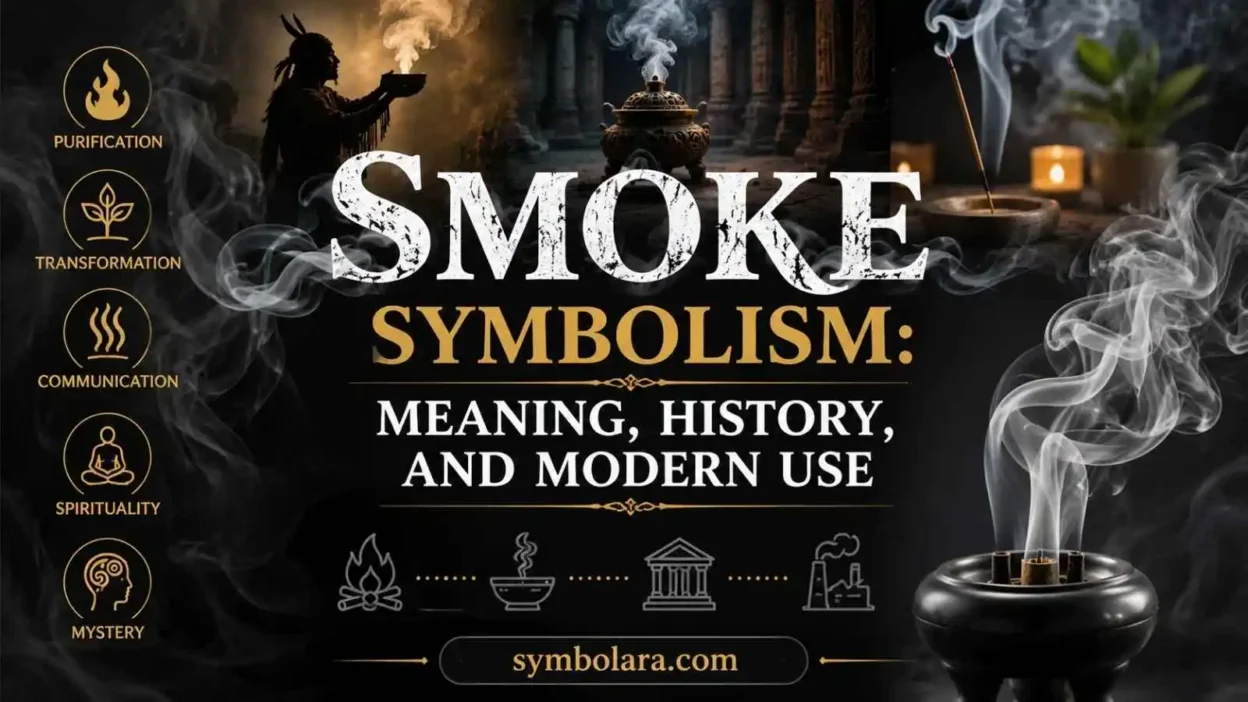
Smoke is one of the most flexible symbols in American culture because it can mean danger, mystery, prayer, memory, or change depending on where it appears. Smoke Symbolism matters because smoke is both physical and emotional: we see it when something burns, but we also use it to describe suspicion, grief, secrecy, cleansing, and transformation.
Unlike a fixed emblem such as a flag or a ring, smoke never holds one shape for long. It rises, spreads, hides, fades, and leaves a scent behind. That behavior is exactly why people attach so many meanings to it.
In the United States today, smoke appears in wildfire alerts, church incense, tattoos, film noir scenes, barbecue culture, protest imagery, wellness rituals, stage effects, and everyday expressions like “where there’s smoke, there’s fire.” Its meaning depends on whether it is sacred, dangerous, comforting, theatrical, or out of control.
Quick Answer
Smoke Symbolism commonly represents uncertainty, danger, transformation, and something hidden becoming noticeable in modern American culture. Historically, smoke has also symbolized prayer, purification, communication, mourning, and the connection between the visible world and unseen forces.
TL;DR
- Smoke often means danger, mystery, or change.
- Rising smoke can symbolize prayer or release.
- In America, smoke also signals warning and evidence.
- Sacred smoke requires cultural respect and context.
- Modern smoke imagery appears in tattoos, art, and film.
- Wildfire smoke has changed its emotional meaning.
What Smoke Physically Represents
Smoke is the visible result of burning. It appears when fire changes wood, herbs, paper, tobacco, incense, oil, or other materials into heat, ash, gases, and airborne particles. Because it is visible but hard to grasp, smoke naturally became a symbol of things that are present yet unstable.
Its movement shapes its meaning. Smoke rises, so many traditions connect it with ascent, prayer, spirit, or release. Smoke also obscures vision, which makes it useful as a symbol of confusion, secrecy, illusion, or danger. When it lingers after a fire, it can represent memory, loss, or the trace of something that has already changed.
Americans encounter smoke in many ordinary settings: campfires, fireplaces, Fourth of July fireworks, barbecue pits, candles, incense, cigarettes, vape clouds, industrial stacks, house fires, stage fog, and wildfire reports. Each setting changes the emotional message.
What Smoke Commonly Means in the United States
In modern U.S. culture, smoke most often symbolizes warning, uncertainty, hidden truth, atmosphere, or transformation. A column of smoke may mean fire or emergency. A smoky room may suggest secrecy. A curl of incense may suggest quiet reflection. A smoky visual effect in a movie or concert may create suspense or drama.
Smoke is also tied to evidence. The phrase “where there’s smoke, there’s fire” reflects the idea that visible signs often point to a hidden cause. Merriam-Webster defines the expression as implying that accusations or rumors usually have some reason behind them, even if the full truth is not yet visible.
| Context | Meaning in the USA | Common Associations | Notes |
| Wildfire or house fire | Danger and urgency | Evacuation, loss, public alerts | Often read as a warning sign |
| Incense or herbs | Prayer, cleansing, atmosphere | Churches, meditation, ritual | Meaning depends on tradition |
| Film and photography | Mystery or tension | Noir, concerts, portraits | Creates mood more than doctrine |
| Idioms | Suspicion or deception | “Smoke and mirrors,” “smoking gun” | Common in politics and media |
| Tattoos | Change, grief, freedom, survival | Skulls, flames, clouds, candles | Meaning depends on design |
Why Smoke Suggests Change and Transition
Smoke appears when one form becomes another. Wood becomes ash. Herbs become scent. Paper becomes residue. This visible transformation is why smoke often symbolizes endings, transition, release, and the passage from one state to another.
That does not always make smoke sad. In a candlelit room, smoke can mean peace after the flame is blown out. Around a campfire, it may suggest warmth, storytelling, and shared time outdoors. In a disaster scene, it may mean destruction. The same physical process can carry very different emotional meanings.
This is one reason smoke works so well in symbolism: it marks the moment between presence and disappearance. It is not the object itself, but the sign that something has changed.
Sacred Smoke in Prayer and Ritual
One of the oldest symbolic meanings of smoke is prayer rising upward. Incense has been used in many religious settings because its scent fills a space while its smoke moves toward the sky. Britannica notes that incense was used in ancient religious practice to counter odors, drive away harmful forces, honor deities, and accompany prayer or divination.
In Catholic and Orthodox Christian worship, incense smoke is commonly interpreted as a visual sign of prayer rising to God. Catholic sources often connect this meaning with biblical imagery in Psalms and Revelation, where incense is associated with prayer and heavenly worship.
In Buddhist and Hindu settings, incense can mark sacred space, focus attention, and remind practitioners of impermanence. The meaning is not identical across traditions, but smoke often creates a boundary between ordinary time and ritual time.
Indigenous Traditions and Respectful Interpretation
In many Indigenous cultures of North America, smoke can be part of prayer, purification, healing, and relationship with the sacred. It is important to avoid treating all Native traditions as the same. Different Nations have different protocols, plants, ceremonies, and teachings.
The National Museum of the American Indian explains that, among many tribes, pipe ceremonies are among the most sacred ways to pray, and the pipe may be cleansed in sage smoke before use. Britannica also describes the Sacred Pipe as a holy object in which ascending smoke symbolizes communication between humans and sacred beings.
Modern Americans sometimes use words like “smudging” casually for burning sage or other plants at home. That can be controversial when sacred Indigenous practices are removed from their cultural context, sold as lifestyle products, or performed without understanding. A respectful interpretation separates broad smoke symbolism from specific ceremonies that belong to living Indigenous communities.
Smoke as Communication and Warning
Smoke can carry a message before words arrive. In practical terms, smoke signals that something is burning. In symbolic terms, it means “pay attention.”
Popular American imagination often associates smoke signals with Native American communication, though the historical reality is more complex than movie stereotypes suggest. The Smithsonian’s National Museum of the American Indian has educational material addressing the question of whether American Indians used smoke signals, reflecting how common and simplified that image has become in U.S. culture.
Smoke still functions as public communication today. Wildfire smoke alerts, air quality warnings, controlled-burn notices, and evacuation updates all use smoke as a sign that private danger has become public information.
Smoke in American Language and Public Life
American English is full of smoke-based expressions. “Smoke and mirrors” means distraction or deception, especially when someone hides an unpleasant truth behind spectacle. Merriam-Webster defines it as something intended to disguise or draw attention away from an embarrassing or unpleasant issue.
“Smoke-filled room” is another important American phrase. It refers to secretive political deal-making by insiders, especially party bosses or power brokers. The phrase became strongly associated with U.S. politics after the 1920 Republican National Convention and the nomination of Warren G. Harding.
These expressions show how smoke moved from physical experience into moral language. When Americans say something is smoky, hazy, or covered in smoke, they often mean the truth is being hidden.
White Smoke, Black Smoke, and Public Decision-Making
One of the clearest modern examples of smoke as a public symbol is the Vatican conclave. White smoke from the Sistine Chapel signals that a new pope has been chosen, while black smoke means the cardinals have not reached a decision. This tradition became globally visible again on May 8, 2025, when Vatican News reported white smoke signaling the election of Pope Leo XIV.
For Americans, even those outside Catholicism, white smoke has become shorthand for resolution after suspense. News headlines often use “white smoke” metaphorically when a board, committee, or political group finally reaches a decision.
Black smoke, by contrast, suggests delay, uncertainty, or failure to agree. The symbolism is simple but effective: one color announces clarity; the other preserves suspense.
Different Smoke Colors and Their Symbolic Meanings
The color of smoke often changes its symbolic meaning. While context remains the most important factor, different smoke colors commonly create different emotional associations.
| Smoke Color | Common Symbolic Meaning | Modern Associations |
|---|---|---|
| White Smoke | Peace, clarity, announcement, resolution | Religious ceremonies, decisions, new beginnings |
| Black Smoke | Danger, uncertainty, destruction | Fires, pollution, warnings |
| Gray Smoke | Confusion, transition, balance | Change, unclear situations |
| Blue Smoke | Calmness, creativity, mystery | Art, atmosphere, personal expression |
White smoke often feels positive because it suggests completion, communication, or a successful outcome. Black smoke usually creates concern because people connect it with fire, damage, or danger.
Gray smoke represents the space between two conditions. It can symbolize uncertainty, adjustment, or a period when answers are not fully visible yet.
Blue smoke is less common in everyday life but often appears in artistic or creative settings. It can create feelings of calmness, imagination, and mystery.
Smoke as Memory, Grief, and the Trace of What Remains
Smoke often appears after something has ended. A burned letter, a blown-out candle, a ruined building, or the last curl from a campfire all leave smoke behind. Because of that, smoke can symbolize memory, grief, and the emotional residue of loss.
In mourning contexts, smoke may suggest the soul’s departure, the fading of a life, or the persistence of memory after physical presence is gone. This meaning appears in religious ritual, funeral imagery, poetry, and visual art. It is not always tied to one doctrine. Sometimes smoke simply gives shape to the feeling that something is gone but not fully absent.
This is why smoke can feel melancholy even when it is beautiful. It marks disappearance without making it invisible.
Smoke in Art, Film, Literature, and Music
Artists often use smoke because it can transform the emotional tone of a scene almost instantly. In film noir, cigarette smoke combined with dim lighting creates an atmosphere of suspicion, secrecy, and moral uncertainty. Horror stories frequently use smoke or fog to make ordinary places feel unfamiliar, threatening, or unsettling. Meanwhile, smoke machines in music videos and stage performances add drama, depth, and a sense of theatrical scale.
Within literature, smoke commonly represents unclear intentions, fading memories, destruction, or the effects of past conflicts. A landscape covered in smoke can create a feeling of uncertainty and instability. When a character appears surrounded by smoke, the image may suggest mystery, danger, glamour, emotional pain, or distance from others.
American pop culture has also changed how people read cigarette smoke. In older movies, it often suggested sophistication, rebellion, or cool detachment. Today, because smoking is widely understood as a health risk, the same image can also suggest addiction, self-destruction, nostalgia, or dated glamour.
Smoke Symbolism in Literature: Meaning Behind Smoke Imagery
Writers often use smoke as a symbol because it can express ideas that are difficult to describe directly. Smoke can represent confusion, secrets, destruction, memory, or emotional change.
In mystery and crime stories, smoke often creates an atmosphere of uncertainty. A character surrounded by smoke may appear hidden, suspicious, or emotionally distant. In dramatic writing, smoke after a fire may represent the aftermath of conflict or the remains of something that has ended.
Smoke can also symbolize fading memories. Because it disappears slowly, writers use it to show how experiences remain meaningful even after they have passed.
Unlike simple symbols with one meaning, smoke allows readers to interpret scenes differently. Its meaning depends on the characters, setting, and message of the story.
Smoke in Tattoos, Fashion, and Personal Style
Smoke tattoos are popular because smoke can wrap around other symbols without overpowering them. It is often paired with skulls, candles, roses, snakes, clocks, daggers, incense, portraits, or flames. The smoke may soften the design, connect separate images, or suggest that the meaning is still shifting.
A smoke tattoo can represent many personal themes, including survival after hardship, grief, freedom, mystery, spiritual change, or personal transformation. When smoke rises from a candle, it may symbolize remembrance, reflection, or the memory of someone important. If it surrounds a skull, the image may highlight mortality, impermanence, or the passage of time. When combined with flames, smoke can suggest destruction, intense emotion, renewal, or the possibility of rebirth.
In fashion and personal branding, smoky colors such as charcoal, ash gray, and smoky black often suggest restraint, edge, maturity, or urban cool. The symbolism is less literal, but the emotional effect is similar: smoke adds ambiguity and atmosphere.
Smoke in Home Decor, Wellness, and Everyday Atmosphere
In American homes, smoke is often connected with mood. Candles, incense, fireplaces, and outdoor fire pits create atmosphere through scent, light, and movement. A small amount of controlled smoke can feel cozy, reflective, or ceremonial.
Wellness culture has increased the popularity of incense, sage bundles, palo santo, and other smoke-based practices. Some people use them for scent, meditation, or personal ritual. Others attach spiritual meanings such as cleansing, grounding, or intention-setting.
The important distinction is context. Lighting incense for relaxation is not the same as borrowing a sacred ceremony. Smoke can be personally meaningful without claiming ownership of traditions that require cultural knowledge, permission, or community connection.
The Negative Side: Danger, Pollution, and Loss of Control
Smoke is not only symbolic. It is also physically dangerous in many situations. In the United States, wildfire smoke has become a stronger part of public life, especially in the West but increasingly across other regions when smoke travels long distances.
The American Lung Association warns that wildfire smoke can affect people nearby and many miles downwind. The EPA states that short-term exposure to fine particles in smoke can cause effects ranging from eye and respiratory irritation to more serious outcomes, especially for people with asthma, heart disease, or other vulnerabilities.
This modern reality has changed the emotional meaning of smoke for many Americans. Smoke no longer only suggests campfires, incense, or atmosphere. It can also mean evacuation, climate anxiety, property loss, poor air quality, and the need to stay indoors.
Common Misunderstandings and Cultural Misuse
A common misunderstanding is that smoke always means purification. It can, but not automatically. In some contexts, smoke purifies; in others, it poisons, hides, damages, or warns.
Another misunderstanding is that all “sacred smoke” traditions are interchangeable. They are not. Catholic incense, Buddhist incense, Hindu incense, Indigenous smudging, ceremonial pipe traditions, and modern home rituals each come from different histories and communities.
There is also a tendency to romanticize smoke while ignoring harm. Cigarette smoke, wildfire smoke, industrial smoke, and house-fire smoke carry real risks. A balanced interpretation recognizes both the symbolic appeal and the physical consequences.
How the Meaning Has Changed Over Time
Smoke’s earliest meanings grew from direct human experience: fire, warmth, cooking, prayer, protection, danger, and communication. Over time, those meanings expanded into religion, politics, art, language, and personal identity.
Across history, smoke has carried different meanings depending on cultural and social context. In older ritual traditions, it was often viewed as a connection between human life and the sacred. During industrial America, smoke became linked with progress, labor, manufacturing, pollution, and expanding cities. Twentieth-century films later used cigarette smoke to create images of glamour, mystery, rebellion, and secrecy. Today, wildfire smoke and public health concerns have given the symbol a stronger connection with environmental awareness and collective safety.
The meaning has not replaced itself; it has layered. Smoke can still symbolize prayer, mystery, and transformation, but Americans now also read it through climate, health, media, and cultural respect.
Is Smoke a Positive or Negative Symbol?
Smoke is both positive and negative. Its meaning depends on whether it is controlled or uncontrolled, sacred or harmful, clarifying or concealing.
Positive smoke is usually intentional: incense, candles, fireplaces, barbecue, ceremonial smoke, or theatrical effects. Negative smoke is usually unwanted: wildfire smoke, pollution, burning buildings, secrecy, or deception.
That contrast is the heart of smoke’s symbolism. It can make a moment feel holy, warm, or intimate, but it can also signal that something dangerous is spreading.
Why Smoke Feels Mysterious
Smoke feels mysterious because it hides and reveals at the same time. It makes light visible, softens hard edges, and turns empty air into something moving. Yet it also blocks vision and makes the source harder to see.
Psychologically, smoke often matches emotions that are difficult to name: suspicion, longing, grief, confusion, attraction, or uncertainty. It is visible but unstable, present but temporary.
That is why smoke appears so often in scenes of transition. It gives form to the in-between: before clarity, after loss, during change, or at the edge of danger.
Smoke Symbolism in Psychology: Why Humans Connect Smoke With Mystery
From a psychological perspective, smoke attracts attention because it combines visibility with uncertainty. People can see smoke clearly, but they cannot always see where it comes from or what it hides.
This creates a natural connection between smoke and unknown situations. A person may associate smoke with secrets, unclear emotions, hidden problems, or major life changes.
Smoke also represents temporary experiences. Unlike solid objects, smoke changes shape constantly and disappears quickly. Because of this, artists and storytellers often use smoke to represent memories, passing time, emotional shifts, or moments that cannot be captured forever.
The human response to smoke also comes from survival instincts. Throughout history, smoke often meant fire, danger, or a need to react. Even today, smoke can trigger feelings of caution while also creating feelings of warmth when connected to fireplaces, candles, or campfires.
Smoke Symbolism in Dreams: Common Meanings and Interpretations
Dreams about smoke often connect with uncertainty, emotions, change, or situations that feel unclear. Because smoke can hide what is behind it, many people associate it with unanswered questions, confusion, or something that needs attention.
The meaning of smoke in a dream depends on the situation. Seeing gentle smoke from a candle or fireplace may represent comfort, memories, reflection, or a peaceful transition. Thick dark smoke, however, may suggest stress, fear, conflict, or a warning that something feels out of control.
Smoke rising upward can symbolize letting go of old emotions or moving through a personal transformation. Smoke covering a place or person may represent confusion, hidden information, or difficulty seeing the truth.
Dream symbolism is personal rather than universal. A person’s experiences, emotions, and memories usually influence what smoke represents in their own dreams.
FAQs
What does smoke symbolize spiritually?
Spiritually, smoke often symbolizes prayer, purification, release, or communication with the sacred. The exact meaning depends on the tradition, so it should not be treated as one universal belief.
Is smoke a good or bad symbol?
Smoke can be either good or bad. Controlled smoke may suggest warmth, ritual, memory, or atmosphere, while uncontrolled smoke often means danger, damage, secrecy, or pollution.
What does a smoke tattoo mean?
A smoke tattoo usually represents change, mystery, survival, grief, or release. Its meaning depends heavily on the other images in the design, such as candles, skulls, flames, roses, or clocks.
What does smoke mean in dreams?
In dream interpretation, smoke is often read as confusion, hidden information, emotional uncertainty, or a warning that something needs attention. It may also suggest that a situation is changing but not yet clear.
Why is smoke used in religious rituals?
Smoke is used in many rituals because it rises, spreads scent, changes the atmosphere, and creates a visible sign of offering or transition. In several traditions, incense smoke is connected with prayer, reverence, purification, or sacred presence.
What does black smoke symbolize?
Black smoke often symbolizes danger, destruction, pollution, or an unresolved decision. In the Vatican conclave tradition, black smoke specifically means that a new pope has not yet been elected.
What does white smoke symbolize?
White smoke often symbolizes resolution, announcement, cleansing, or spiritual clarity. In Catholic conclave imagery, it signals that a new pope has been chosen.
What does smoke symbolize in tattoos?
Smoke tattoos commonly symbolize transformation, survival, mystery, grief, freedom, or personal change. The meaning depends on the symbols combined with the smoke design.
Conclusion
Smoke is a symbol of change made visible. It shows that something is burning, ending, transforming, or trying to be noticed. In American culture, it can mean danger, mystery, prayer, evidence, grief, atmosphere, or release.
The most useful way to understand Smoke Symbolism is to look at context. Sacred incense, wildfire smoke, a tattoo design, a political idiom, and a candle after a memorial all carry different meanings.
Smoke reminds people that some signs are temporary but still important. It rises, spreads, and disappears, yet it often tells us exactly where to look.