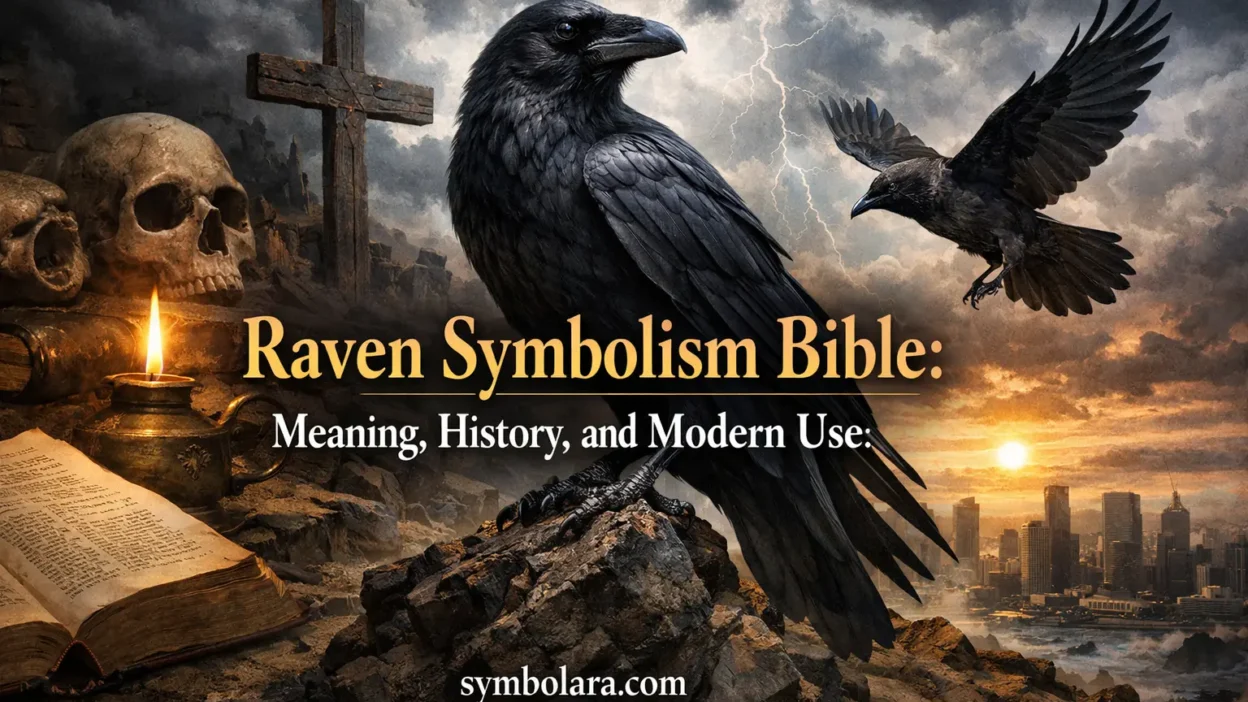
Raven Symbolism Bible is usually searched by readers who want to know whether the raven in Scripture stands for evil, judgment, wisdom, provision, or something more complicated. In American Christian reading, the strongest biblical meaning is not “pure darkness” but a tension between wilderness and God’s care: the raven is an unclean bird in biblical law, yet it is also a creature God watches over and even uses in key moments.
That tension is exactly why the raven still matters. Americans often inherit a pop-culture image of the raven as spooky, ominous, and death-adjacent, but the Bible gives the bird a broader role. It appears in flood imagery, prophetic survival, and teachings about trust, which makes it symbolically sharper and more human than a simple bad-omen cliché.
Quick Answer
Raven Symbolism Bible commonly points to survival, divine provision, and life at the edge of human control in modern American Christian reading. Historically, the raven also carries associations with ritual uncleanness, flood aftermath, and wilderness, which is why its biblical meaning is more mixed and more interesting than a simple symbol of evil.
TL;DR
- In Scripture, ravens symbolize both hardship and provision.
- Biblical law treats ravens as unclean birds.
- Noah’s raven suggests flood aftermath and endurance.
- Elijah’s ravens make provision the key biblical image.
- In the U.S., Poe helped darken the raven’s public image.
- Modern use mixes faith, grief, grit, and independence.
What The Bird Looks Like And Why People Notice It
A raven is a large black bird in the crow family, known for its size, intelligence, heavy bill, and commanding presence. People notice ravens because they do not blend into the background. Their dark plumage, scavenging habits, and bold behavior make them easy to connect with themes like aftermath, survival, watchfulness, and unease.
In the United States, many readers approach the raven with two images already in mind: the Bible and Edgar Allan Poe. That combination matters. One source teaches that God feeds ravens and can use them; the other fixed the raven in American imagination as a bird of grief and relentless memory.
What It Commonly Means In The Bible
Biblically, the raven most often symbolizes a harsh world under God’s rule. That includes hunger, exposed landscapes, waiting after disaster, and the reality that God’s care is not limited to pretty or socially approved creatures. The raven is not the Bible’s symbol of innocence. It is a symbol of life in rough conditions.
That is why the bird feels so memorable in Scripture. It carries contradiction. It is legally unclean, but it is not outside divine attention. It is associated with carrion and bleak spaces, but it becomes an instrument of sustenance in Elijah’s story and an example in Jesus’ teaching about anxiety.
Biblical Raven Verses and Their Exact Meanings
The Bible mentions ravens several times, and each reference adds another layer to the bird’s symbolism. Instead of presenting the raven as only negative, Scripture uses it to explore themes of survival, dependence, and God’s relationship with creation.
In Genesis 8:7, Noah sends out a raven after the flood. The bird flies back and forth while the waters slowly disappear. This moment represents a world that has not fully recovered yet. The raven reflects uncertainty, transition, and the search for signs of renewed life.
In 1 Kings 17:4–6, ravens bring food to the prophet Elijah during a drought. This passage creates one of the strongest positive meanings connected to ravens. The bird becomes a symbol of unexpected provision, showing that help can come from unlikely sources.
In Job 38:41, God asks who provides food for ravens when their young cry out. The passage highlights divine awareness of even the creatures humans may overlook.
In Luke 12:24, Jesus tells his followers to consider the ravens because God provides for them. Here, the raven becomes a lesson about trust rather than fear.
Together, these verses create a balanced biblical picture. The raven represents hardship, wilderness, dependence, and God’s ability to provide even in difficult circumstances.
Why Biblical Raven Symbolism Is Not One-Note
Many readers assume the raven must mean evil because it is black, loud, and linked in later folklore to death. That assumption says more about later Western symbolism than about the Bible itself. Scripture does not flatten the bird into a villain. It uses the raven in scenes where the world is raw, but God is still active.
This is an important distinction for a U.S. audience, because modern American symbolism often collapses black birds into horror imagery. Biblical interpretation is subtler. The raven can signify exposure, need, divine oversight, and improbable help all at once.
Noah’s Raven And The Meaning Of Aftermath
In Genesis, Noah first sends out a raven after the flood. The bird goes back and forth while the waters recede. That detail is brief, but symbolically it matters: the raven belongs to the unsettled interval between destruction and a stable new beginning. It is the bird of aftermath, not yet peace.
American readers often contrast the raven with the dove and olive branch, and that contrast is understandable. The dove later became the cleaner public symbol of peace and reassurance, while the raven stayed closer to ambiguity. In biblical terms, though, the raven’s role is not failure. It marks a world still in transition.
Elijah’s Ravens And The Meaning Of Provision
The clearest positive biblical image appears in 1 Kings 17, where ravens bring bread and meat to Elijah during drought. This is one of the reasons Christian readers have long seen the raven as a sign that God can provide through unexpected means. The bird is not sentimental here. It is practical. Food arrives in a hard season.
That scene carries real emotional force in American devotional culture. When believers place a raven on a journal cover, art print, or tattoo, they are often not saying “I love dark omens.” They are saying, “I survived a lean season,” or “help came from a place I did not expect.”
God’s Care For Ravens In Wisdom And Gospel Texts
The Bible also uses ravens to teach about divine attention. Job asks who provides prey for the raven when its young cry out, and Psalm 147 says God gives food to the young ravens. In Luke, Jesus tells his listeners to consider the ravens: they do not store up harvests, yet God feeds them.
This changes the symbolic picture. The raven becomes evidence that God’s care extends beyond what humans call attractive, useful, or pure. In modern American spirituality, that often translates into a message about trust, especially for people who feel overlooked, rough around the edges, or outside neat religious categories.
Raven Symbolism in Christianity: Faith, Trials, and Divine Provision
Christian interpretations of the raven often focus on endurance during difficult seasons. The bird does not represent an easy or comfortable path. Instead, it appears in situations involving drought, uncertainty, and survival.
For many Christians, the raven represents the idea that God can provide in unexpected ways. Elijah did not receive help from a powerful person or a traditional source of comfort. Instead, God used ravens, a bird many people considered ordinary or even undesirable.
This symbolism connects with a broader Christian message: difficult circumstances do not mean abandonment. The raven reminds believers that support can appear in surprising forms and that hardship does not remove divine care.
Some Christians also view the raven as a symbol of spiritual honesty. The bird does not represent pretending that life is always peaceful. Instead, it acknowledges struggle while still pointing toward hope, trust, and perseverance.
Because of this, raven imagery appears in some Christian artwork, journals, and personal designs as a reminder of faith during wilderness seasons.
Why The Bird Is Also Associated With Uncleanness
Leviticus and Deuteronomy list every raven after its kind among unclean birds. In ancient Israel, that classification belonged to the ritual logic of holiness and separation. It did not mean the raven was demonic. It meant the bird belonged on the wrong side of Israel’s food boundaries.
That matters because modern readers often import moral judgment into ritual categories. Biblically, “unclean” is not the same thing as “evil.” The raven’s symbolism gets stronger precisely because the Bible holds two truths together: the bird sits outside ritual purity rules, and it still sits inside God’s created order and care.
What It Commonly Means In The United States
In the United States, biblical raven symbolism is filtered through American literature, especially Poe’s “The Raven,” first published in 1845. That poem attached the bird to grief, unending remembrance, dread, and the feeling of being mentally cornered by loss. For many Americans, that literary image is stronger than any Bible passage they can quote.
At the same time, U.S. Christian readers often recover a different emphasis: the raven as proof that God can feed, guide, or sustain in wilderness seasons. So in American culture, the bird usually carries a double charge. Outside church settings it may suggest darkness, death, or gothic taste; inside faith language it may suggest resilience, provision, and survival without prettiness.
Even public life reflects that complexity. Baltimore chose “Ravens” for its NFL team in explicit homage to Poe, and the name has since been absorbed into local pride, toughness, and city identity rather than only gloom.
Cross-Cultural Meanings Beyond The Bible
Outside the Bible, ravens carry many meanings. In Norse tradition, Odin is associated with ravens, which link the bird to thought, memory, war, and message-bearing. In parts of the Pacific Northwest, Raven appears in Indigenous traditions as a culture figure, creator, transformer, or trickster, though those traditions vary by nation and should not be collapsed into one generic “Native meaning.”
These broader traditions help explain why the raven so often symbolizes intelligence and mediation between worlds in modern design and storytelling. But the biblical use remains distinct. Scripture is less interested in the raven as a cosmic magician than in the raven as a creature embedded in hunger, land, law, and divine care.
Raven Symbolism vs Crow Symbolism: Are They the Same?
Ravens and crows are closely related birds, so people often confuse their symbolism. However, they do not always carry the same meanings in cultural and religious traditions.
In biblical contexts, the raven receives specific attention because of its appearance in stories about Noah, Elijah, Job, and Jesus’ teachings. The crow does not hold the same symbolic role in Scripture.
Modern symbolism often gives ravens a larger and more mysterious image because of their size, intelligence, and connection with literature. Crows are frequently associated with adaptability, community, and cleverness, while ravens are more commonly linked with mystery, transformation, and deeper reflection.
Both birds can represent intelligence and observation, but the raven’s biblical connections make it especially significant for discussions about faith, survival, and divine provision.
Emotional And Psychological Meaning
Psychologically, the raven often communicates seriousness. It can signal a person who has lived through loss, values realism over cheerfulness, and does not want their spiritual life reduced to sweetness. That is why the raven appeals to people who see faith as something that survives drought, grief, exile, or personal rebuilding.
It also speaks to watchfulness. Ravens are observant birds, and humans project that quality onto them. In symbolic use, that becomes discernment, caution, and the ability to notice what others ignore. When joined to biblical themes, that watchfulness often turns into endurance with open eyes rather than naïve optimism.
What Does a Raven Symbolize Spiritually Today?
Today, many people view the raven as a symbol of awareness, transformation, and personal strength. While spiritual interpretations vary between cultures and individuals, the bird often represents the ability to face difficult experiences with wisdom and patience.
For some people, seeing a raven represents a reminder to pay attention to hidden lessons or changes happening in life. Others connect the bird with resilience because ravens survive in challenging environments and adapt to changing conditions.
In a biblical-inspired spiritual context, the raven may represent trust during uncertain times. Its connection with Elijah encourages the idea that support can arrive in unexpected ways.
However, symbolic meanings depend heavily on personal beliefs and cultural background. A raven does not have one universal meaning. Its significance comes from the stories, traditions, and experiences people connect with it.
Why It Appears In Tattoos, Jewelry, Decor, And Online Identity
In tattoos, ravens often mean survival after grief, trust during isolation, intelligence, or refusal to hide darker chapters of life. When the design includes a Bible verse, a branch, desert imagery, or bread, the symbolism usually leans toward Elijah, divine care, and wilderness provision rather than horror.
In home decor and fashion, raven imagery often appears in autumn styling, gothic interiors, literary merchandise, and faith-adjacent art. Social media uses it similarly: some people use raven imagery to signal bookish gloom, others to signal spiritual resilience, and others simply because the bird looks striking and self-possessed.
Raven Symbolism in Dreams: Common Interpretations
Dream interpretations involving ravens vary widely, but the bird often appears as a symbol connected with awareness, change, memory, or difficult emotions.
A raven in a dream may represent a period of transition or a situation that requires careful attention. Because ravens are intelligent and observant animals, some people interpret them as reminders to look deeper before making decisions.
In spiritual or biblical interpretations, a raven dream may connect with themes of endurance and unexpected support. The story of Elijah gives the bird an association with receiving help during challenging periods.
However, dreams are personal experiences. A raven dream does not automatically predict a future event or carry a fixed message. The meaning usually depends on the dreamer’s emotions, circumstances, and personal beliefs.
Quick Comparison Table
| Context | Meaning in the USA | Common Associations | Notes |
| Bible reading | Provision in hardship | Elijah, drought, wilderness | Often surprisingly positive |
| Old Testament law | Ritual uncleanness | Food laws, separation | Not the same as evil |
| Noah story | Aftermath and waiting | Flood, transition, uncertainty | Pre-peace stage |
| American literature | Grief and haunting memory | Poe, loss, “Nevermore” | Strong public influence |
| Personal symbolism | Resilience and realism | Tattoos, mourning, endurance | Popular in recovery narratives |
Common Misunderstandings About The Symbol
The biggest misunderstanding is that the Bible treats the raven as a straightforward emblem of evil. It does not. The text gives the bird mixed roles and uses that complexity to make theological points about scarcity, dependence, and God’s reach.
Another mistake is blending biblical symbolism with every later raven tradition as if they say the same thing. Norse, literary, and Indigenous meanings can enrich modern understanding, but they are not interchangeable with Scripture. A careful reading keeps those layers separate.
How The Meaning Changed Over Time
In the biblical world, the raven was tied to real ecology: scavenging habits, dietary law, drought, exposed landscapes, and survival. Over time, especially in European and American culture, the bird became increasingly linked with doom, battlefields, haunted settings, and then literary melancholy.
Modern U.S. meaning now combines those layers. Many Americans still read the raven as dark, but others reclaim it as a symbol of grit, intelligence, spiritual honesty, and provision in difficult terrain. That evolution explains why the raven can appear in both a gothic poem and a Christian testimony without feeling out of place.
FAQs
Is a raven a bad symbol in the Bible?
Not simply. The raven is associated with ritual uncleanness, but the Bible also presents it as a creature God feeds and even uses to sustain Elijah.
What does a raven symbolize for Christians today?
For many Christians in the United States, it symbolizes provision in hardship, trust during uncertainty, and survival through wilderness seasons. It can also represent realism about grief rather than denial of it.
Why did Noah send out a raven first?
Genesis presents the raven as the first bird sent into a world still marked by floodwaters. Symbolically, that makes it a bird of testing, exposure, and transition before the calmer reassurance associated with the dove.
What does a raven tattoo usually mean?
A raven tattoo often signals endurance, intelligence, grief, or personal transformation through a hard season. In explicitly Christian designs, it often points to Elijah and unexpected provision rather than to occult ideas.
Is biblical “unclean” the same as evil?
No. In biblical law, “unclean” is a ritual category tied to holiness boundaries and food practices. It does not automatically mean a creature is morally bad or opposed to God.
Why do Americans often connect ravens with death?
The strongest reason is cultural rather than strictly biblical: Poe’s “The Raven” helped cement the bird as a symbol of grief, dread, and memory in American imagination. That literary layer often overrides the more complex biblical picture.
Does seeing a raven have a biblical meaning?
Some people connect seeing a raven with biblical themes like endurance, trust, and divine provision. However, the Bible does not teach that every raven sighting carries a specific message or prediction. Meaning usually depends on personal faith and interpretation.
Conclusion
Raven Symbolism Bible is best understood as a symbol of life in hard conditions under God’s eye. Scripture does not turn the raven into a neat emblem of either purity or evil. Instead, it uses the bird to hold together wilderness, provision, ritual distance, and divine care.
That is why the raven still speaks so clearly in modern American culture. It fits people who want symbols honest enough for grief, strong enough for endurance, and grounded enough to admit that help does not always arrive in beautiful forms.