
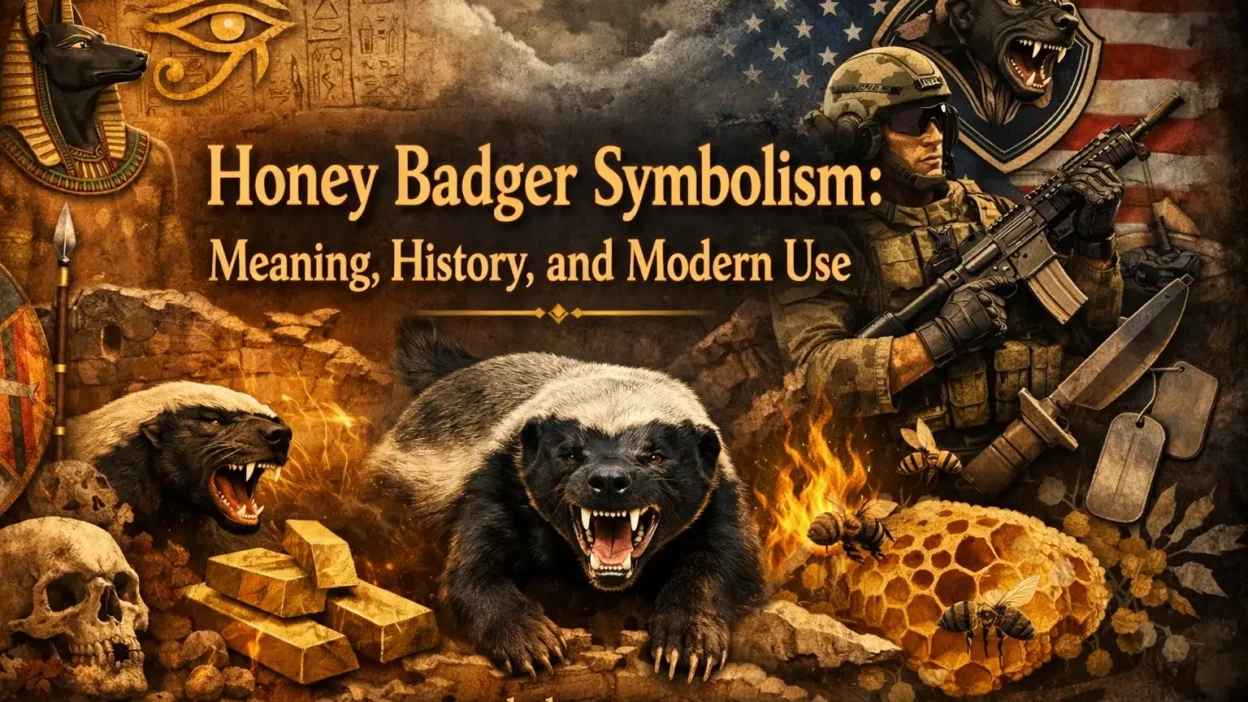
Honey badgers are not traditional symbols in the way lions, doves, or ravens are, but Honey Badger Symbolism has become surprisingly recognizable in modern American culture. People usually turn to it when they want an image of toughness without polish, courage without ceremony, or persistence that feels more stubborn than noble.
That appeal comes from the animal itself. The honey badger is small compared with many of the predators it faces, yet it has a reputation for defending itself fiercely, raiding beehives, digging relentlessly, and surviving in difficult environments. Those traits make it easy for people to read human qualities into the animal.
In the United States, the honey badger is now less a sacred symbol than a personality symbol. It tends to represent someone who is hard to intimidate, unusually self-directed, and willing to endure discomfort to get what matters.
Quick Answer
Honey Badger Symbolism most commonly represents fearlessness, grit, and stubborn independence in modern American culture, especially when people want to signal that they do not back down easily. Historically, its meaning comes less from formal myth than from the animal’s real behavior, along with African folklore, colonial-era animal lore, and more recent pop-culture portrayals that turned it into an emblem of defiance.
TL;DR
- In the U.S., it usually means grit and defiance.
- Its symbolism comes from behavior more than religion.
- People read it as stubborn, bold, and self-protective.
- Internet culture amplified its “don’t care” reputation.
- Tattoos often use it for resilience and survival.
- The symbol can be exaggerated into reckless aggression.
What the Honey Badger Looks Like and Why People Notice It
The honey badger, also called the ratel, has a compact body, short legs, powerful claws, and a striking coat that looks almost divided into two bold bands: pale gray or white across the back and darker black below. It is not elegant in the way a leopard is elegant, and it is not majestic in the way Americans often describe wolves or eagles. Its visual impact comes from toughness.
That matters symbolically. People tend to attach meaning to animals whose bodies appear to match their behavior. The honey badger looks built for hard use. Its thick skin, digging claws, low center of gravity, and blunt shape all suggest durability. Even people who know almost nothing about the species often read it immediately as a creature that can take punishment and keep moving.
The Core Meaning Today
In present-day U.S. usage, the honey badger most often symbolizes three linked traits: fearlessness, refusal to submit, and survival through tenacity. It does not usually symbolize grace, wisdom, or harmony. It points instead to endurance under pressure.
That makes it appealing in situations where people want a symbol of personal toughness but do not want something overly grand or ceremonial. A lion can suggest rank, dominance, or kingship. A honey badger suggests something rougher and more personal: “I may not be the biggest person in the room, but I am not easy to overpower.”
There is also a fourth meaning that often tags along with the first three: indifference to outside opinion. In American slang and online humor, the honey badger became shorthand for someone who ignores ridicule, obstacles, or social pressure.
Where the Meaning Comes From
Unlike animals with long, highly developed symbolic roles in major religious systems, the honey badger’s meaning comes mostly from observed behavior. People watched what it did and built meaning from that.
Honey badgers are known for digging, raiding, defending themselves aggressively, and taking risks that look disproportionate to their size. Whether every dramatic story about them is fully accurate is beside the point symbolically. What matters is the reputation the animal earned. Symbols often grow from public perception as much as from strict biological fact.
That reputation gave the honey badger a specific emotional profile. It came to stand for the kind of courage that is not polished, strategic, or diplomatic. It is the courage of confrontation, grit, irritation, and refusal.
Early Lore and Regional Folklore
The honey badger does not hold the same broad mythic status as animals like the serpent, eagle, or bear, but it does appear in regional storytelling across parts of Africa and Asia where the animal lives. In those settings, it has often been treated as a bold, difficult, disruptive creature that survives by nerve and cunning.
In some East and southern African accounts, the honey badger appears in stories as a troublemaker, raider, or relentless survivor. That is important because it shows that the animal’s symbolic reputation did not begin on the internet. Long before viral video culture, people were already reading the animal as unusually daring and hard to control.
At the same time, it is worth being careful here. The honey badger is not one of the best-documented sacred animals in world religion, and its folklore is more local and practical than ceremonial. Its symbolism developed from lived encounters, oral storytelling, and reputation rather than from a major formal symbolic system.
Honey Badger Symbolism in Native and African Animal Traditions
The honey badger has a stronger connection to local animal traditions than to major global symbolic systems. In regions where the species naturally lives, people have long recognized its unusual behavior, including its intelligence, persistence, and willingness to defend itself.
Across parts of Africa, the animal has often appeared in stories and everyday observations as a creature that is difficult to control and surprisingly resourceful. These qualities shaped its reputation as a symbol of determination and survival.
Unlike animals such as the eagle, lion, or serpent, the honey badger does not have one universal symbolic meaning shared across many cultures. Instead, its meaning developed through direct encounters with the animal and the stories people created around its behavior.
This makes honey badger symbolism practical rather than ceremonial. It reflects qualities people notice in real life: persistence, adaptability, courage, and the ability to survive challenging conditions.
Why the Animal Became a Symbol of Fearlessness
Fearlessness is the trait most people attach to the honey badger first, but the symbolism is slightly more specific than that. The animal is not read as fearless because it seeks danger for glory. It is read as fearless because it appears willing to keep acting despite danger.
That difference matters. In symbolic terms, the honey badger represents nerve under pressure, not noble heroism. It signals a willingness to endure pain, irritation, and threat in order to keep going. That is why it resonates with people who have survived difficult work, conflict, illness, poverty, training, or social rejection. The message is not “I am invincible.” The message is “I keep moving.”
In American motivational language, that often translates into resilience. In more casual language, it becomes stubbornness. Both ideas are close to the symbol.
What It Commonly Means in the United States
In the United States, the honey badger is primarily a modern cultural symbol rather than an inherited traditional one. Americans usually interpret it through three familiar frames: internet culture, sports culture, and personal identity.
Internet culture popularized the honey badger as the animal that “doesn’t care,” meaning it ignores fear, consequence, and approval. Sports culture picked up that same energy and used the image or nickname to praise players who were undersized, relentless, and disruptive. Personal identity culture turned it into a symbol for people who see themselves as hard to discourage.
This American reading is noticeably individualistic. It is less about the animal’s place in nature and more about attitude. The honey badger becomes a mascot for emotional toughness, anti-fragility, and the refusal to be easily managed.
How Pop Culture Changed the Meaning
Modern honey badger symbolism in the U.S. cannot be separated from viral media. A generation of Americans learned the animal through comedic narration and meme culture rather than through wildlife books. That shift changed the symbol.
Before internet fame, the honey badger might have been known mainly as an unusual African and Asian carnivore with a fierce reputation. After its viral breakout, it became something else: a comic emblem of extreme indifference, reckless confidence, and abrasive self-belief.
That pop-culture version made the symbol more accessible, but it also flattened it. The honey badger became a joke, a slogan, and a personality type. People now use it to describe coworkers, athletes, children, internet posters, political figures, and anyone else who seems impossible to embarrass or control. The symbol got louder, funnier, and less tied to the real animal.
Emotional and Psychological Symbolism
Psychologically, the honey badger often communicates a defensive form of strength. It does not suggest softness or emotional openness. It suggests a person who has learned to survive by refusing intimidation.
That makes the symbol especially attractive to people who identify with being underestimated. Someone small, overlooked, or outnumbered may see the honey badger as a better self-symbol than a lion or eagle because it represents survival without prestige. It speaks to people who have had to become difficult in order to remain safe or effective.
It can also symbolize boundary enforcement. A honey badger is not usually read as friendly. It signals, “Do not mistake my size or appearance for weakness.” In that sense, the symbol carries a warning as well as an affirmation.
Honey Badger Symbolism in Dreams: What Does It Mean?
Dreams about honey badgers often connect with themes of confidence, protection, and dealing with challenges. Because the animal is strongly associated with toughness and persistence, seeing one in a dream may reflect a situation where you feel the need to defend yourself, stay determined, or push through difficulty.
A calm honey badger in a dream may symbolize inner confidence and the ability to handle pressure without panic. It can represent a reminder that you already have the strength needed to face an obstacle.
A defensive or aggressive honey badger may point toward personal boundaries. The dream could reflect feelings that someone is testing your limits or that you need to protect your time, energy, or beliefs.
A honey badger fighting a larger animal may represent an underdog situation. It can symbolize courage when facing challenges that appear bigger than you.
However, dream symbolism is personal. The meaning depends on the dreamer’s emotions, experiences, and the situation surrounding the dream. For some people, the honey badger represents bravery; for others, it may represent stubbornness or the need to approach conflict carefully.
Why It Appears in Tattoos, Clothing, and Personal Style
In tattoos, the honey badger usually means resilience, defiance, or a lived history of surviving hard conditions. People choose it when they want a less predictable toughness symbol than a wolf, tiger, or skull. Its appeal lies partly in its roughness. It does not feel decorative. It feels earned.
In fashion and graphic design, the animal works well because its silhouette is recognizable and its attitude is instantly legible. A honey badger image on a shirt, patch, gym logo, or sticker usually says some version of “unbothered,” “hard to break,” or “not backing down.”
In personal style, the symbol often attracts people who dislike polished self-branding. The honey badger projects toughness with a hint of dark humor. It says grit without pretending to be noble.
Honey Badger Symbolism in Business, Branding, and Leadership
In branding and leadership, the honey badger often represents a company or individual that values determination over appearance. Businesses and organizations may use the animal to communicate toughness, innovation, competitiveness, and the ability to operate under pressure.
The symbol works especially well for brands that want to appear unconventional. Unlike traditional symbols of authority, the honey badger suggests a different type of strength: persistence without needing approval.
In leadership contexts, the honey badger can represent a person who stays focused during difficult situations, challenges expectations, and continues working toward a goal despite obstacles.
However, effective leadership requires more than stubbornness. The strongest interpretation of the symbol combines determination with adaptability. A true honey badger mindset is not simply refusing to change; it is finding a way forward when conditions become difficult.
A Quick Comparison of Common Meanings
| Context | Meaning in the USA | Common Associations | Notes |
| Tattoos | Resilience and survival | Endurance, scars, comeback stories | Often chosen over more glamorous animals |
| Sports | Relentless competitor | Hustle, toughness, disruption | Common for undersized but aggressive players |
| Internet culture | Defiant indifference | “Doesn’t care,” chaos, attitude | Often exaggerated for humor |
| Personal identity | Boundary-setting strength | Self-protection, grit, independence | Appeals to people who feel underestimated |
| Decor or gifts | Bold personality | Humor, toughness, nonconformity | Less spiritual than many animal symbols |
Cross-Cultural Meaning Beyond the United States
Outside the U.S., the honey badger is not universally loaded with one stable meaning. In some places within its range, it has been viewed with respect because of its toughness and resourcefulness. In others, it has been seen as a nuisance, raider, or dangerous opportunist.
That mixed reputation matters. Some animals symbolize purely admired traits, but the honey badger rarely does. It often blends admiration with irritation. People may respect its nerve while also seeing it as destructive, unpredictable, or difficult to live around.
This makes the symbol more realistic than idealized. It does not stand for innocence or virtue. It stands for effectiveness under harsh conditions, even when that effectiveness is inconvenient to others.
Honey Badger Symbolism vs Other Animal Symbols
Honey badger symbolism stands apart from many traditional animal symbols because it focuses less on status and more on survival.
| Animal Symbol | Common Meaning | Difference From Honey Badger |
|---|---|---|
| Lion | Leadership, power, authority | Represents dominance rather than persistence |
| Wolf | Loyalty, instinct, independence | Often focuses on community and connection |
| Bear | Strength, protection, confidence | Carries more traditional wilderness symbolism |
| Eagle | Vision, freedom, achievement | Represents elevation and perspective |
| Honey Badger | Grit, defiance, resilience | Represents survival through determination |
The honey badger appeals to people who identify with overcoming challenges rather than leading from a position of power. Its message is less “I rule” and more “I endure.”
That difference explains why many people choose it as a personal symbol. It represents strength that comes from experience, struggle, and persistence.
Religious Meaning and Spiritual Limits
The honey badger has no major role in mainstream American religious symbolism. It is not a standard Christian symbol, and it does not occupy the broad ritual or doctrinal space held by animals like lambs, serpents, doves, or lions.
That said, some people use it in a loosely spiritual way, especially in animal-symbol or “spirit animal” style language. When they do, they usually mean lessons of courage, self-protection, grit, and persistence. But this is modern personal symbolism, not a long-established religious tradition.
It is better understood as a contemporary identity symbol than as a sacred one. That distinction keeps the interpretation honest.
What Does a Honey Badger Spirit Animal Mean?
When people use honey badger as a spirit animal symbol, they usually connect it with courage, independence, and personal boundaries. The animal represents the ability to remain strong when facing pressure or opposition.
A honey badger spirit animal interpretation may encourage someone to:
- Stand firm during difficult situations
- Protect personal boundaries
- Trust personal abilities
- Continue working toward important goals
- Avoid being controlled by outside opinions
Modern spirit animal discussions are personal interpretations rather than universal religious rules. Different cultures and individuals may understand animal symbols in different ways.
For many people today, the honey badger represents a mindset of resilience: facing challenges directly while refusing to give up.
Misunderstandings, Distortions, and Misuse
One common mistake is treating the honey badger as a symbol of pure aggression. That is too simple. Its symbolism is stronger when understood as defensive boldness, persistence, and refusal to retreat under pressure. Aggression may be part of its reputation, but it is not the whole meaning.
Another distortion comes from meme culture, which can make the animal seem cartoonishly invincible. Real honey badgers are impressive, but the symbolic version often turns them into exaggerated avatars of chaos. That can produce a shallow reading in which the symbol becomes an excuse for recklessness, antisocial behavior, or pride in being impossible to deal with.
There is also a cultural caution worth noting. Because the honey badger is native to regions outside the United States, American use of the symbol can sometimes detach it from its ecological and cultural context. When people use it only as a punchline or attitude badge, they flatten a real animal into a caricature.
How the Meaning Has Evolved
The honey badger’s meaning has shifted from reputation to meme to identity symbol. Earlier views centered on the animal as a fierce and difficult creature known through direct encounter, local storytelling, hunting culture, and natural history writing. Modern views, especially in the U.S., are shaped by mass media and self-branding.
That evolution moved the symbol from local ecology into global personality language. Today, someone can use a honey badger as a self-description without knowing much about the species at all. The meaning now lives in slogans, sports nicknames, tattoos, reaction memes, and attitude-heavy branding.
Still, the core has remained surprisingly stable. Across different settings, the honey badger keeps pointing to the same cluster of traits: boldness, stubbornness, survival, and refusal to yield.
Why People Keep Returning to This Symbol
People return to the honey badger because it offers a version of strength that feels accessible. It is not royal, beautiful, or idealized. It is strong in a more recognizable way. It looks like something that has been through rough conditions and learned how to persist anyway.
That gives the symbol unusual emotional credibility. For many people, especially in modern American culture, the honey badger feels closer to real life than grander animals do. It represents grit without glamour, confidence without polish, and survival without sentimentality.
FAQ
What does a honey badger symbolize spiritually?
Spiritually, a honey badger usually symbolizes courage, self-protection, and the will to keep going when life becomes hostile. In modern personal symbolism, it often represents learning how to stand your ground without waiting for approval.
Is the honey badger a positive or negative symbol?
It is mostly positive when it stands for resilience, boldness, and independence. It turns negative when people use it to glorify needless aggression, hostility, or an inability to cooperate with others.
What does a honey badger tattoo mean?
A honey badger tattoo usually means toughness shaped by experience rather than image. Many people choose it to represent survival, personal boundaries, or the refusal to be intimidated after hardship.
Does the honey badger have religious meaning?
It does not have a major established role in mainstream American religious symbolism. When people use it spiritually today, they are usually drawing on personal interpretation rather than a formal religious tradition.
Why do Americans associate honey badgers with not caring?
That idea comes largely from viral pop culture, which exaggerated the animal’s fierce reputation into a comic attitude of total indifference. In American usage, “doesn’t care” usually means hard to shame, hard to scare, and unwilling to back down.
Is honey badger symbolism the same as badger symbolism in general?
Not exactly. General badger symbolism often leans toward persistence, protection, and groundedness, but the honey badger version is sharper and more confrontational. It usually carries more edge, more defiance, and more pop-culture influence.
Does the symbol mean bravery or stubbornness?
Usually both. The most accurate reading is bravery expressed through stubborn persistence, especially when someone keeps pushing through pressure instead of stepping aside.
What does a honey badger represent in a tattoo?
A honey badger tattoo often represents survival, independence, toughness, and overcoming difficult experiences. Many people choose it as a reminder that they can handle pressure and continue moving forward.
Is honey badger symbolism positive or negative?
Honey badger symbolism is usually positive when it represents courage, resilience, and self-confidence. It becomes negative when people interpret it as an excuse for unnecessary aggression or refusing to cooperate.
Conclusion
Honey badgers are not among the oldest or most formal animal symbols, but they have become one of the clearest modern images of grit without glamour. Their symbolism rests on a recognizable pattern: a small, durable, difficult animal that seems unwilling to surrender simply because something larger is in its way.
In American culture, Honey Badger Symbolism now points most strongly to resilience, defiant independence, and hard-earned self-protection. That is why the image keeps showing up in tattoos, sports language, humor, and identity-driven design.



[…] are common in marine education, wildlife rescue, beach communities, tattoos, and decor, so their symbolism now blends traditional meanings with environmental […]
[…] does not mean the symbol was inevitable. Early seal proposals included many other images, and the final design emerged after […]
[…] symbolic meanings come from human reactions rather than scientific […]
[…] curiosity, and the desire to follow something bright even when it may come with risk. That layered meaning makes the moth one of the most expressive symbols in nature-inspired art and […]