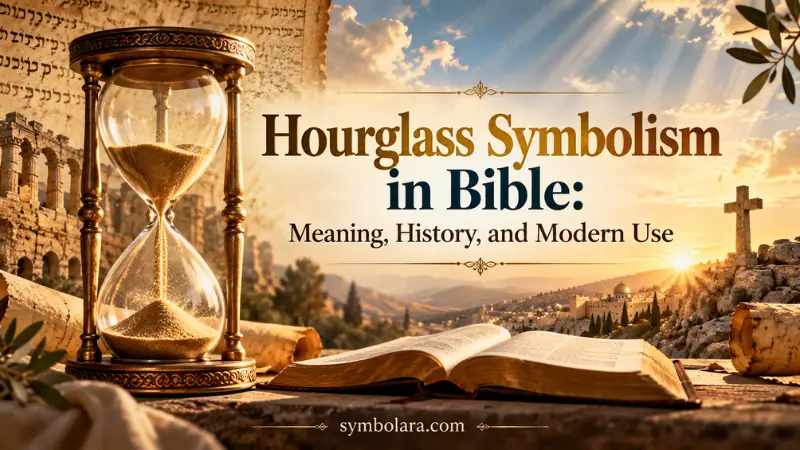
An hourglass has two glass chambers connected by a narrow opening. As sand moves from the top chamber to the bottom, it shows time passing. Once the upper chamber empties, that measured period is over.
This simple design helps explain why people connect hourglasses with life, death, patience, and the importance of each day.
People searching for hourglass symbolism in Bible often want to know whether the image has a biblical meaning or represents a Christian teaching. The distinction matters because the Bible discusses time and human mortality without describing an hourglass as a religious symbol.
In American culture, hourglasses still appear in memorial artwork, tattoos, jewelry, and Christian-inspired designs. Their meaning depends on the setting, but the central message remains familiar: time passes, life changes, and our choices matter.
Quick Answer
Hourglass symbolism in Bible is commonly understood as a reminder that human life is limited, time should be used wisely, and each day has value. Although the Bible never identifies the hourglass as a sacred symbol, its meaning connects with passages such as Psalm 90:12 and Ecclesiastes 3:1. The association developed through later European Christian art and traditions about mortality.
TL;DR
- The hourglass represents passing time, mortality, patience, and personal responsibility.
- The Bible does not directly mention hourglasses.
- Psalm 90:12 encourages people to recognize life’s limited length.
- European Christian artwork connected hourglasses with death and reflection.
- Early American gravestones sometimes featured winged hourglasses.
- Modern Americans use the symbol in tattoos, memorials, and personal artwork.
Why Two Glass Bulbs Make Time Visible
An hourglass contains two connected glass chambers, usually enclosed within a protective frame. Fine sand or another flowing material passes through a narrow opening at a measured rate.
Unlike a clock with moving hands, an hourglass shows time through something gradually disappearing from one place and collecting in another.
That visible movement gives the object much of its symbolic meaning.
The upper chamber can suggest time that remains. The lower chamber represents time that has already passed. The narrow opening draws attention to the present moment, when one part becomes the other.
These interpretations are modern ways of reading the design, not meanings assigned to its parts in Scripture.
Another important feature is that the hourglass can be turned over.
When the sand finishes falling, someone can reverse the device and begin another measured period. This action allows the hourglass to represent a fresh start, renewed effort, or another opportunity.
However, human life does not work exactly like a reversible timer.
That difference explains why traditional Christian artwork generally used the object to emphasize life’s limits rather than promise that time could be restored.
An hourglass may also appear with wings, a skull, a candle, or a cross. Each additional object changes how viewers understand the image.
Does the Bible Ever Mention an Hourglass?
No. The Bible does not directly mention an hourglass or describe one as a religious symbol.
This is the most important distinction when discussing its biblical meaning.
Biblical writers used several images to describe the passing of time, including shadows, grass, flowers, breath, and changing seasons.
For example, Psalm 39:4–5 presents human life as brief when compared with God’s existence. The writer asks to understand how limited his days are.
James 4:14 uses mist as a comparison for life’s uncertain length.
These descriptions communicate ideas similar to those represented by an hourglass, but they come from different images.
The Bible also describes shadows moving in the account of King Hezekiah in 2 Kings 20:9–11. That passage concerns a sign involving a shadow on steps, not sand passing through glass.
This difference is worth remembering when viewing religious illustrations.
A modern Bible study graphic might show an hourglass beside a verse about mortality. The design can help explain the passage, but it does not mean the original biblical writer had that object in mind.
The hourglass is a later visual interpretation of biblical themes, not a symbol specifically established by Scripture.
Psalm 90:12 and the Call to Number Our Days
Psalm 90:12 is one of the clearest biblical connections to hourglass imagery.
The verse asks God to teach people to recognize the number of their days so they may gain wisdom.
Its focus is not on calculating the exact length of someone’s life. Instead, it encourages an awareness that human existence has limits.
An hourglass expresses a similar idea visually.
Someone watching sand fall can see that a measured period is passing. The experience may encourage reflection about how that time is being spent.
Consider a person who keeps an hourglass on a desk beside a Bible.
The object might serve as a reminder to make room for family, prayer, service, or thoughtful decisions instead of giving every spare moment to distractions.
However, the biblical message is not simply that people should remain busy.
Psalm 90 connects awareness of mortality with wisdom. A person may spend time resting, caring for another person, or enjoying an ordinary afternoon without wasting it.
The concern is whether someone recognizes the value of life.
For many Christian readers, this makes the hourglass a suitable illustration of gratitude and responsibility.
It is not a warning that every quiet moment represents a failure.
Ecclesiastes 3 and the Right Time for Each Season
Ecclesiastes 3:1 introduces another important biblical idea: different activities and experiences have their appropriate times.
The passage describes contrasting parts of life, including birth and death, planting and gathering, mourning and dancing.
Its message is more complex than the idea that time is running out.
Life includes periods that people cannot fully control. Some moments call for action, while others require waiting, acceptance, or change.
An hourglass can represent this movement between life’s stages.
The sand continues falling whether someone feels prepared for the next season or not. Likewise, childhood gives way to adulthood, relationships develop, and circumstances change.
This interpretation is especially meaningful during personal transitions.
A graduating student might view the hourglass as a reminder that one stage has ended and another is beginning. Someone entering retirement may see it as a symbol of adjustment rather than decline.
For religious readers, Ecclesiastes also raises questions about human understanding and God’s relationship to time.
The hourglass cannot answer those questions.
It can, however, provide a familiar picture of the passage’s main concern: people experience life within changing seasons and cannot control every event.
James 4:14 and the Uncertainty of Tomorrow
James 4:14 compares human life to mist that appears briefly and then disappears.
The passage addresses people who make confident plans about future business and financial success without acknowledging uncertainty.
Its message is not that planning is wrong.
Instead, it challenges the assumption that tomorrow is guaranteed.
An hourglass provides a different picture of a similar concern. The falling sand shows that time moves forward even when a person is occupied with other matters.
Yet there is an important limitation to the comparison.
An hourglass contains a visible amount of sand. People do not know exactly how much time remains in their lives.
That uncertainty is central to the passage in James.
A Christian interpretation may therefore emphasize humility rather than fear.
Someone can make plans, pursue education, build a career, or save for the future while recognizing that circumstances may change.
For readers facing major decisions, the image can encourage attention to responsibilities that should not be postponed indefinitely.
A needed apology, a difficult conversation, or an act of kindness may matter more than an imaginary perfect moment in the future.
Using Time Well in Ephesians 5:15–16
Ephesians 5:15–16 encourages Christians to live carefully and make good use of their opportunities.
The passage is sometimes associated with the expression redeeming the time.
That wording does not mean people can purchase additional hours or recover every past mistake.
It concerns wise conduct and recognizing opportunities for meaningful action.
An hourglass may help communicate this teaching, but its message depends on how someone uses it.
For example, a person might place a small sand timer near a prayer journal to create a regular period for quiet reflection.
Another might use one while reading Scripture to avoid checking a phone every few minutes.
In both examples, the hourglass has a practical purpose as well as a personal meaning.
It creates a short period in which attention is directed toward one activity.
Still, biblical wisdom should not be confused with constant productivity.
Christian teachings also recognize the importance of rest, compassion, and relationships.
A timer cannot determine which action is most valuable.
The biblical connection is therefore about making thoughtful choices, not measuring personal worth by the number of tasks completed.
This allows the hourglass to carry an encouraging message. Even a short period can provide an opportunity to help someone, repair a relationship, or develop a worthwhile habit.
How the Hourglass Entered European Art
The exact invention date of the hourglass remains uncertain.
Reliable evidence of the device appears in Europe during the 14th century. One notable example is a 1338 painting by the Italian artist Ambrogio Lorenzetti.
In his Allegory of Good Government fresco in Siena, the figure representing Temperance holds an hourglass.
Temperance refers to moderation and self-control.
This early example is significant because the hourglass was not presented simply as a symbol of death. It was associated with measured behavior and responsible judgment.
During the following centuries, hourglasses became familiar objects in European daily life.
They were useful aboard ships and in situations where people needed to measure a set period.
As the objects became more recognizable, artists could use them to communicate ideas without much explanation.
A painted hourglass could remind viewers that time passes and opportunities have limits.
By the Renaissance, artists increasingly placed hourglasses beside human figures, books, and other objects representing learning or worldly success.
The symbol gradually moved beyond practical timekeeping.
It became a way to ask what people should value during their lives.
This development occurred long after the biblical texts were written. The Christian associations came from later interpretations and artistic traditions rather than a specific biblical command.
The Christian Message in Skulls, Candles, and Sand
In European Christian-influenced artwork, hourglasses often appeared with objects connected to human mortality.
One important tradition was known as memento mori, a Latin expression meaning a reminder that a person must die.
During the 16th and 17th centuries, artists used skulls, extinguished candles, fading flowers, and hourglasses to express this idea.
The objects worked together.
A skull represented the certainty of death. An extinguished candle could suggest a life that had ended. An hourglass reminded viewers that time continued moving toward that point.
Dutch painters developed a related tradition called vanitas painting.
These works often combined expensive objects, books, musical instruments, or signs of achievement with reminders of mortality.
The contrast suggested that wealth, reputation, and possessions could not prevent death.
Christian viewers could connect these images with teachings about humility and the limits of earthly life.
However, not every artist or viewer understood the objects in exactly the same way.
Some paintings also explored learning, artistic achievement, or the desire to leave something meaningful behind.
The hourglass therefore had more than one possible interpretation.
For some, it encouraged preparation for death. For others, it urged thoughtful living.
These ideas still influence religious memorial designs and artwork in the United States.
What Colonial American Gravestones Reveal
The hourglass became part of American visual culture well before modern tattoos and decorative wall art.
In colonial New England, gravestone carvers sometimes included hourglasses beside skulls, coffins, and other images of mortality.
Some designs featured a winged hourglass.
The wings suggested that time was passing quickly, while the sandglass represented the limited span of human life.
These carvings were especially associated with the solemn burial traditions of the 17th and 18th centuries.
Boston’s historic burial grounds preserve examples of this visual language.
The headstone of Richard Kettell, who died in 1680, includes a winged hourglass along with other mortality symbols.
On Elizabeth Pain’s gravestone, dating to the early 1700s, an hourglass appears with a death’s head and floral decoration.
These details offer a useful reminder about religious history.
Not every image found in a Christian community was considered a sacred biblical emblem.
Many early New England Puritans avoided certain religious figures and decorative images. Yet gravestone carvings could still communicate lessons about death and human limits.
The hourglass was useful because it made those concerns visible without portraying God or a biblical scene.
Today, visitors to historic cemeteries may see these carvings as examples of early American art.
They also reveal how earlier generations expressed ideas about life, death, and remembrance through ordinary objects.
How Americans Use the Hourglass Today
In the United States during 2025–2026, hourglass imagery appears in both religious and secular settings.
Some people connect it with biblical teachings about limited time. Others use it to represent patience, personal change, or a significant life event.
Unlike older funeral artwork, modern designs do not always emphasize death.
A decorative hourglass in a living room might suggest calm reflection. A digital hourglass symbol can represent a waiting period or approaching deadline.
The meaning depends on context.
| Context | Meaning in USA | Common Associations | Notes |
| Christian-themed artwork | Wise use of limited time | Faith, reflection, responsibility | Often paired with biblical verses |
| Memorial jewelry | Remembering someone who died | Love, memory, loss | May include names or dates |
| Graduation gifts | Transition into a new stage | Growth, opportunity, change | Emphasizes the future |
| Wedding or anniversary art | Shared years and commitment | Partnership, memories, devotion | Usually a personal interpretation |
| Workplace or digital graphics | Limited time for an activity | Deadlines, waiting, urgency | Usually unrelated to religion |
The table shows how the same object can communicate different ideas without changing its basic appearance.
For Christians who use the hourglass in personal artwork, the religious meaning often comes from an accompanying verse.
For example, an illustration featuring Psalm 90:12 gives the object a different emphasis from an image showing a countdown.
One encourages reflection about wisdom. The other may simply express urgency.
Neither interpretation can be determined from the hourglass alone.
Hourglass Tattoos and Personal Memorials
Hourglass tattoos are one modern way people express their relationship with time.
Some designs include a cross, while others feature flowers, birds, skulls, or meaningful dates.
The surrounding details often explain why someone chose the image.
An hourglass with a cross may express Christian faith and a desire to use life responsibly.
A design containing a loved one’s name or birth and death dates can serve as a memorial.
For someone who has experienced loss, the image may acknowledge that a relationship mattered even though the time shared was limited.
Other people choose an hourglass after recovering from a difficult period or changing an important part of their lives.
The symbol can represent a decision to approach the future differently.
There is also an emotional distinction between an empty and a partially filled hourglass.
An empty upper chamber might suggest completion or an ending. Sand still falling can suggest that opportunities remain.
These are personal design interpretations rather than fixed religious rules.
A tattoo does not automatically reveal someone’s faith, experiences, or beliefs.
When an hourglass appears in memorial jewelry or artwork, it can also communicate something hopeful: appreciation for the time that was shared.
The symbol acknowledges life’s limits without requiring a person to view every ending only through sadness.
Common Mistakes
Several misunderstandings arise when people treat later Christian artwork as though it came directly from Scripture.
The first is the claim that the hourglass is an official biblical symbol.
It is not.
No biblical passage instructs believers to display an hourglass, and the object has no universally established religious meaning.
A second misunderstanding connects the falling sand with an exact countdown to death.
Although the device measures a fixed period, biblical passages about mortality do not provide a method for predicting someone’s final day.
James 4:14 actually emphasizes uncertainty about the future.
Another common interpretation connects the hourglass to the end times or biblical prophecy.
Images of countdowns may appear in religious videos, sermons, or illustrations, but the Bible does not identify an hourglass as a prophetic instrument.
The Book of Revelation contains references to time and judgment. Those passages should be understood through their own language and context rather than an hourglass added by a modern artist.
There is also a mistaken assumption that the object must represent something negative.
Historically, it often appeared in serious artwork about death. Yet modern viewers may associate it with patience, gratitude, and new opportunities.
Finally, the hourglass is not exclusively Christian.
Its history includes practical timekeeping, civic ideas about moderation, and nonreligious artwork.
A person can appreciate its symbolism without adopting any particular religious belief.
Recognizing these differences makes it easier to respect both the historical evidence and the personal meanings people give the image.
FAQs
Is the hourglass a symbol of God?
The hourglass is not an established biblical symbol of God. Some Christians use it to illustrate the difference between limited human time and beliefs about God’s eternal nature, but that comparison is a later interpretation.
Does an hourglass represent heaven or eternal life?
An hourglass does not have a fixed historical meaning of heaven. In artwork featuring a cross or other Christian imagery, it may contribute to a larger message about earthly life and hope beyond death, depending on the artist’s intention.
What does an hourglass with wings mean?
A winged hourglass traditionally represents the rapid passage of time. The design appeared in European mortality imagery and early American gravestone carving, where the wings helped communicate that life passes quickly.
Is the hourglass considered a good or bad spiritual symbol?
The object itself is not inherently good or bad. Its meaning depends on how it is presented, and Christian traditions do not share a universal rule assigning it a fixed spiritual status.
What does an upside-down hourglass symbolize?
An inverted hourglass may simply indicate that someone has turned the timer over to begin another period. In personal artwork, it can suggest renewal or a second chance, but there is no specific biblical teaching about an inverted hourglass.
Does the sand in an hourglass represent human souls?
There is no biblical teaching that the individual grains of sand inside an hourglass represent human souls. An artist may use that comparison creatively, but it should not be presented as a doctrine or an established historical interpretation.
Can Christians use an hourglass during prayer or Bible study?
An hourglass can serve as an ordinary timer during quiet reading or reflection. It has no special religious ability, and using one does not make a prayer more effective or give the object sacred status.
Conclusion
Hourglass symbolism in Bible is best understood as a later visual connection to biblical teachings about time, wisdom, mortality, and responsible living. Scripture does not present the hourglass as a sacred object, but passages such as Psalm 90:12, Ecclesiastes 3, and James 4:14 help explain why Christians have found the image meaningful.
Its history also extends beyond religion. European artists connected it with moderation and mortality, while early Americans placed it on gravestones. Today, it appears in personal memorials, tattoos, decorative artwork, and everyday designs.
The hourglass remains recognizable because its message is visible in its movement. Sand passes through a narrow opening, one grain after another, offering a simple reminder that time continues whether we notice it or not.